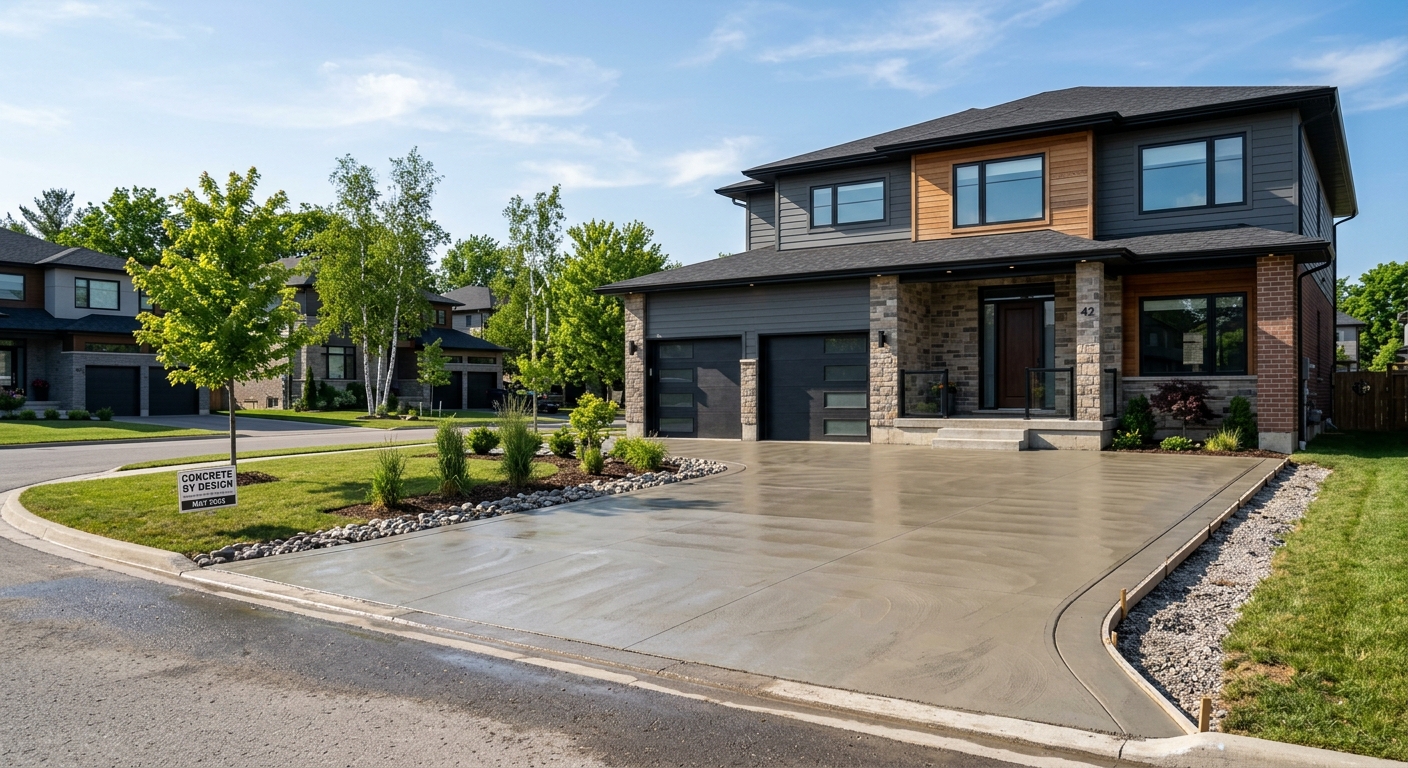
Concrete work options and costs in Tofield
Concrete work is a big part of everyday property maintenance in Tofield, and costs can swing noticeably depending on the mix design, excavation depth, and how the job is scheduled around our freeze–thaw cycles. In a town where single-detached homes make up 76.5% of dwellings, most driveway, patio, and walkway work is tied to curb appeal and practical access—especially in older neighbourhoods built over time as homeowners upgrade entryways. With 48.8% of homes built before 1981 (Statistics Canada, 2021 Census), you also see more replacement of settled aprons, cracked walk paths, and foundation-adjacent flatwork that needs proper base and drainage corrections. The Camrose–Drumheller economic region’s cold continental winters and a frost depth around 1.2 m / 4 ft shape the pricing right from the start: structural work must be excavated below frost to reduce frost heave, and exterior flatwork needs granular base preparation plus air-entrained concrete to resist scaling and spalling. Because the pour season is shorter—roughly late spring through early fall—labour demand concentrates in a tight window, so winter add-ons can require heated enclosures, insulated blankets, and slower, more controlled finishing. In Tofield, trades often get especially busy around residential areas like the downtown core and newer expansion edges where driveways and walkways are frequently upgraded as lots get developed. The result is that two projects that “look the same” on a sketch can price differently based on access, base thickness, reinforcement, and finish level. Use the table below to anchor realistic expectations before you compare quotes.
| Application |
Typical Size |
Key Spec |
Finish Option |
Price Range |
| Concrete driveway (standard broom finish) |
20 ft × 10 ft (200 sq ft) |
Air-entrained mix, compacted granular base, control joints |
Broom finish |
$2,800 – $4,400 |
| Exposed aggregate driveway |
20 ft × 10 ft (200 sq ft) |
Air-entrained mix, correct base drainage, embedded aggregate texture |
Exposed aggregate |
$3,200 – $5,000 |
| Stamped concrete driveway or patio |
20 ft × 12 ft (240 sq ft) |
Air-entrained mix, proper curing and release, joints maintained |
Stamped pattern (e.g., stone/brick look) |
$4,500 – $8,400 |
| Plain concrete patio or walkway |
12 ft × 10 ft (120 sq ft) |
Granular base, air-entrained exterior mix, joints where needed |
Float and broom or light broom |
$1,400 – $2,400 |
| Garage floor (interior slab) |
22 ft × 20 ft (440 sq ft) |
Vapour barrier, reinforcement as specified, slab thickness per use |
Plain trowel finish |
$6,200 – $10,500 |
| Foundation footings (structural, below frost) |
Varies by plan (allowance per linear ft) |
Excavation below frost, structural concrete and rebar, forms |
Structural finish (not decorative) |
$180 – $260 |
Prices are estimates only and vary by project scope, site access and material selection.
What affects the price of concrete work in Tofield
In Tofield and the wider Camrose–Drumheller area, it’s common to see quotes for the “same” driveway or patio differ by 30% to 50%. The main reason isn’t just the concrete—it’s the depth of excavation, base thickness, reinforcement, and how contractors handle cold-weather scheduling and curing. In Alberta, the frost line depth drives engineering decisions: footings must extend below design frost to prevent frost heave, and that typically means deeper excavation and higher forming costs than you’d see in milder regions. Exterior slabs also need air-entrained concrete to survive freeze–thaw cycles without scaling and spalling; without it, you can get surface failure even if the slab “looks fine” at first. Labour costs rise when the pour season is tight: late spring to early fall is when crews can work at normal pace, but if a project slips into colder shoulder periods, you often pay for heating, insulating blankets, and slower placement/finishing to protect the slab. De-icing salt accelerates surface breakdown, so sealing is more than cosmetic—it’s a durability step that adds labour and materials.
Here are two practical Tofield examples of what moves the number: (1) If your site needs extra grading and thicker granular base due to soft spots or drainage issues near older foundations, you’re paying for more excavation and compacted aggregate; that can push a standard driveway from the $14–$22 per sq ft band toward the higher end. (2) Upgrading from broom-finish to stamped or exposed aggregate usually makes sense when you want better longevity plus curb appeal—stamped concrete is typically priced from the $20–$35 per sq ft range, so homeowners with lots of freeze–thaw exposure often choose it to get a more robust surface texture and better joint attention.
Local housing stock also matters. With nearly half of homes built before 1981 (Statistics Canada, 2021 Census), replacements often include removing older settled slabs and correcting drainage, not just pouring new concrete over old problems. That’s why two “200 sq ft” driveway projects can land far apart even with the same finish name.
| Price Factor |
Why It Matters |
Cost Impact |
| Frost line depth — determines footing depth and form height |
Footings must be placed below frost to reduce frost heave and movement |
Higher excavation and forming; can noticeably raise structural work pricing |
| Site preparation — excavation, grading, compacted granular base |
Proper base drainage and compaction prevent settlement and reduce freeze–thaw damage |
Thicker/granular base and haul-away can add labour and material costs |
| Reinforcement — rebar or wire mesh requirement |
Reinforcement helps control cracking and improves performance under loads |
Additional steel, placement time, and labour-driven cost increases |
| Mix design — air-entrainment and compressive strength spec |
Exterior air-entrainment resists scaling and spalling during freeze–thaw cycles |
Proper mix can cost more but significantly improves durability |
| Finish type — broom vs. stamped vs. exposed aggregate |
Complex finishes require more labour and tighter curing/finishing controls |
Stamped and exposed work typically pushes pricing toward the upper flatwork band |
| Pour size and concrete truck access to site |
Long carries, limited access, and multiple loads slow production and add handling |
May require additional trucks/crews and more prep time |
| Cold-weather curing precautions — heating and blankets |
Lower temps slow strength gain and increase risk if surfaces freeze early |
Heating/blanket rentals and slower schedules can add significant cost |
| Control joint pattern and sealing cost |
Joints manage cracking; sealing helps protect from salt and moisture ingress |
More layout and materials; improves long-term appearance and surface durability |
Permits & regulations in Alberta
In Alberta, structural concrete work usually means you’re dealing with a permit process and, for many projects, engineered drawings reviewed by the municipality. That typically includes footings and foundation components such as foundation walls, grade beams, and structural rebar/anchorage tied into the building design. For concrete flatwork—driveways, patios, and walkways—permits are often not required if the work is limited to replacing or adding surface concrete and it doesn’t meaningfully change lot grading, drainage, or impervious surface coverage rules, and it doesn’t interfere with municipal right-of-way requirements. Because details vary by lot and scope, the safest approach for a homeowner in Tofield is to confirm with the local authority before breaking ground, especially if you’re changing slopes, adding catch basins, or altering drainage near a foundation.
To verify a contractor properly in Alberta, start by checking the builder’s registration/licensing information through the relevant provincial online sources. Then ask for a certificate of insurance that lists you as the certificate holder where possible, and verify liability coverage is active for the dates of the job. For workers, confirm coverage through WSIB/WCB documentation (and ask for clearance letters or current proof of coverage). Finally, request references from similar-scale projects—ideally exterior flatwork completed in cold-weather conditions—so you can see how they handle air-entrainment, curing protection, and jointing.
Getting concrete right in Tofield's freeze-thaw climate
Concrete fails in Tofield when moisture and movement get a chance to reach the slab edge, the base, or the surface. In our freeze–thaw climate, the most common problem I see is surface spalling and scaling caused by inadequate air-entrainment or poor curing—especially when a slab is finished too aggressively or protected too little in colder conditions. To spec the job correctly, start with base preparation: the granular sub-base must be compacted to the right depth for your soil conditions and drainage, because trapped water under a slab expands during freeze events and creates voids or heave. Next is mix design—exterior flatwork should use air-entrained concrete with about 5% to 7% target air content, and contractors should specify minimum strength around 32 MPa for typical exterior use.
Then plan control joints. Joints are what give the concrete a “path” to crack—so you don’t get random cracking. Spacing is usually based on slab geometry and ACI-type guidance; your contractor should propose a joint layout that matches your driveway or patio dimensions rather than “winging it” on site. Curing is equally important: plan for at least 7 days of protected curing, and if temperatures are dropping, curing protection matters more than ever. Finally, sealing: a penetrating sealer is typically applied 28 days after the pour (once cured) to help repel de-icing salts and reduce water uptake at the surface.
To make the cost trade-off clear: if you’re comparing a plain broom-finish walkway in the $12–$20 per sq ft range to stamped concrete (often $20–$35 per sq ft), the price difference can be justified when the contractor also nails base prep, air content, and joint layout. In contrast, paying for a decorative finish without the right durability specs is a fast way to end up with patchy surface scaling a couple winters later.
| Spec | Why It Matters in Tofield | What to Ask For | Impact if Skipped |
| Compacted granular base (depth?) |
Prevents settlement and reduces moisture movement under slabs in freeze–thaw |
Ask for base thickness by design and confirmation of compaction testing method |
More cracking, lifting, and edge breakdown after multiple winters |
| Air-entrained concrete mix (target air %?) |
Air bubbles provide room for freezing water expansion |
Ask for air-entrainment target (commonly 5%–7%) and mix spec sheet |
Higher risk of scaling and spalling, especially with salt exposure |
| Compressive strength (MPa rating) |
Strength gain affects durability and resistance during early winter conditions |
Ask for minimum strength (commonly 32 MPa for typical exterior slabs) and curing plan |
Surface damage and premature deterioration if strength gain is delayed |
| Control joints (spacing per ACI guidelines) |
Limits random cracking caused by temperature swings |
Ask for joint layout before pour and confirmation of saw-cut timing |
Uncontrolled cracks and uneven appearance |
| Minimum 7-day curing period |
Cold conditions slow strength gain and increase vulnerability if surfaces freeze early |
Ask how they will protect the slab (curing blankets/temperature monitoring when needed) |
Reduced strength, dusting, and surface scaling in early seasons |
| Penetrating sealer (when applied after cure) |
Helps repel moisture and salt intrusion into surface pores |
Ask for sealer type and confirm it’s applied about 28 days after pour |
Faster deterioration of the surface and more frequent repairs |
How to choose a concrete work contractor in Tofield
Choosing a contractor in Tofield is mostly about protecting yourself from the two big risks in our climate: shortcuts on base/drainage and shortcuts on mix design, curing, and jointing. Start with Alberta verification. Ask for the contractor’s business registration/licence details (available through provincial online sources), then request a certificate of liability insurance with active dates and adequate limits for your project. For labour coverage, confirm WSIB/WCB is in place—ask for proof or clearance documentation before work starts.
Next, don’t accept a single lump-sum number with vague wording. Get 2–3 itemised written quotes that separate labour and materials, including excavation and disposal, granular base preparation, reinforcement (if required), concrete supply, forming, finishing, curing protection, and sealing (if included). Read exclusions carefully: is permit paperwork included (if required), is concrete cutting and saw-cut timing included, is site protection included, and who hauls away old concrete? Then check warranty terms. A workmanship warranty should be specific about duration and what it covers (often focusing on settlement/cracking related to construction errors). Also ask whether any product/manufacturer warranty is transferable and what maintenance is required to keep it valid.
For payment, never pay more than about 10% to 15% upfront. Hold back a meaningful portion until forms are removed, joints are finished, and the surface curing protection steps and sealing (if chosen) are complete. Finally, insist on a written timeline: start date, pour date, curing protection period expectations, and completion estimate—because winter scheduling in Alberta can shift fast if temperatures drop.
- Confirm their experience with exterior cold-weather flatwork (not just interior slabs).
- Ask what air-entrained mix they use and require the mix spec details in writing.
- Request their proposed joint layout before the pour.
- Check whether they include granular base preparation and compaction details.
- Make sure they list excavation and concrete removal/disposal costs separately.
- Verify they have liability insurance and WSIB/WCB coverage before work starts.
- Require a written schedule including curing protection steps.
- Confirm finishing method (broom vs. light broom vs. stamped texture) and when joints are saw-cut.
- Ask if reinforcement is included where needed (and where it’s placed).
- Check whether sealing is included, or if it’s offered as an add-on with timing (about 28 days).
- Review warranty length and ask what “excluded conditions” means for your situation.
- Avoid cash-only arrangements and insist on a signed contract with scope and exclusions.
Red flags in Tofield include contractors who won’t discuss air content or curing protection, who suggest pouring over unsuitable or unknown base conditions, who provide a price without jointing or drainage details, who ask for large upfront payments (over 15%), or who avoid putting timeline and exclusions in writing.
Frequently asked questions — concrete work in Tofield
When is the best time to pour concrete in Tofield?
In Tofield, the best results usually come from late spring through early fall, when crews can place and finish without major temperature stress. That timing matters because Camrose–Drumheller’s freeze–thaw cycles and a frost depth around 1.2 m / 4 ft make early freezing risky for new slabs. Contractors also need a reliable curing window; low temperatures slow strength gain and can reduce durability. If you must pour later in the season, ask what cold-weather precautions they’ll use (heated enclosures, insulated blankets, and temperature monitoring). It’s common for winter work to cost more due to added protection and slower schedules, so getting the pour in the main window can keep you closer to typical flatwork pricing—like plain patios/walkways often landing in the $12–$20 per sq ft range.
How long does concrete take to cure?
Concrete develops strength over time, but homeowners can think in stages. For many exterior flatwork projects in Alberta, you should expect at least a 7-day period of protected curing before normal use, with higher-strength development continuing beyond that. The exact “ready to handle” timeline depends on temperature, wind, and whether the contractor used curing blankets or heat when it’s cold. In Tofield’s climate, the danger isn’t just cracking right away—it’s reduced durability from early freeze exposure. If sealing is part of the scope, ask about timing: a penetrating sealer is typically applied about 28 days after the pour so the surface has cured enough to accept the product. If a contractor rushes curing or removes protection too early, it can shorten the slab’s lifespan even when the finish looks good.
Do I need a permit for concrete work in Alberta?
In most cases, concrete flatwork like driveways, patios, and walkways does not require a building permit in Alberta unless it affects lot grading, drainage, impervious surface limits, or anything tied to municipal right-of-way concerns. Structural concrete—footings, foundation walls, and grade beams—typically needs a building permit and often engineered drawings. In Tofield, if your concrete work changes slopes, directs water toward or away from your foundation, or includes new drainage/catch basins, treat it as a potential permit trigger and confirm with the local authority before work starts. A good contractor will help you understand what applies to your scope and will be comfortable showing what’s included (and what isn’t) on the quote. Always verify the contractor’s liability insurance and WSIB/WCB coverage regardless of permitting.
Concrete vs pavers for a patio in Tofield?
For patios in Tofield, both options can work, but concrete typically wins on cost and longevity when it’s built correctly for freeze–thaw. A properly built concrete patio relies on compacted granular base, air-entrained concrete, and well-planned control joints to manage cracking. Pavers can look great, and they offer flexibility for future repairs, but the sub-base and bedding still need strong compaction and drainage—otherwise freeze–thaw can shift units and create weed lines. Price-wise, plain concrete patios and walkways often sit in the $12–$20 per sq ft range, while stamped/decorative options can move toward $20–$35 per sq ft. If you want a decorative look similar to pavers, stamped concrete may be a better value—provided the contractor keeps durability specs tight and doesn’t skip air-entrainment or curing protection.
How long does a concrete driveway last?
A concrete driveway lifespan depends on how it was built for Alberta conditions—especially base prep, air-entrained mix, jointing, and curing. In a freeze–thaw climate like Tofield’s, a well-built driveway commonly lasts decades, while shortcuts can lead to scaling, spalling, and uncontrolled cracking much sooner. Proper drainage and granular base preparation are essential because trapped moisture under the slab expands during freeze cycles. Control joints help reduce random cracking. Sealing can also matter for de-icing salt resistance; in practice, a penetrating sealer applied after full cure (often around 28 days) helps slow surface deterioration. If your contractor proposes a low-price driveway but won’t clearly explain the base depth, air content, or curing steps, treat it as a major risk—even if the initial price seems attractive.
What is air-entrained concrete and why does it matter here?
Air-entrained concrete includes tiny, evenly distributed air bubbles in the mix. In Tofield, these bubbles give freezing water room to expand, which reduces internal pressure that leads to scaling and spalling. That’s why exterior concrete—driveways, patios, and walkways—should be air-entrained in our region’s freeze–thaw cycles. Many contractors target roughly 5% to 7% air for exterior flatwork, alongside a strength spec around 32 MPa for typical applications. When air-entrainment is missing or incorrect, you may see surface flaking and deterioration after repeated winters, even if the slab doesn’t crack immediately. This is also why cold-weather curing protection is part of “getting the spec right”: slow strength gain plus early freezing can worsen durability, especially on exposed, salted surfaces.