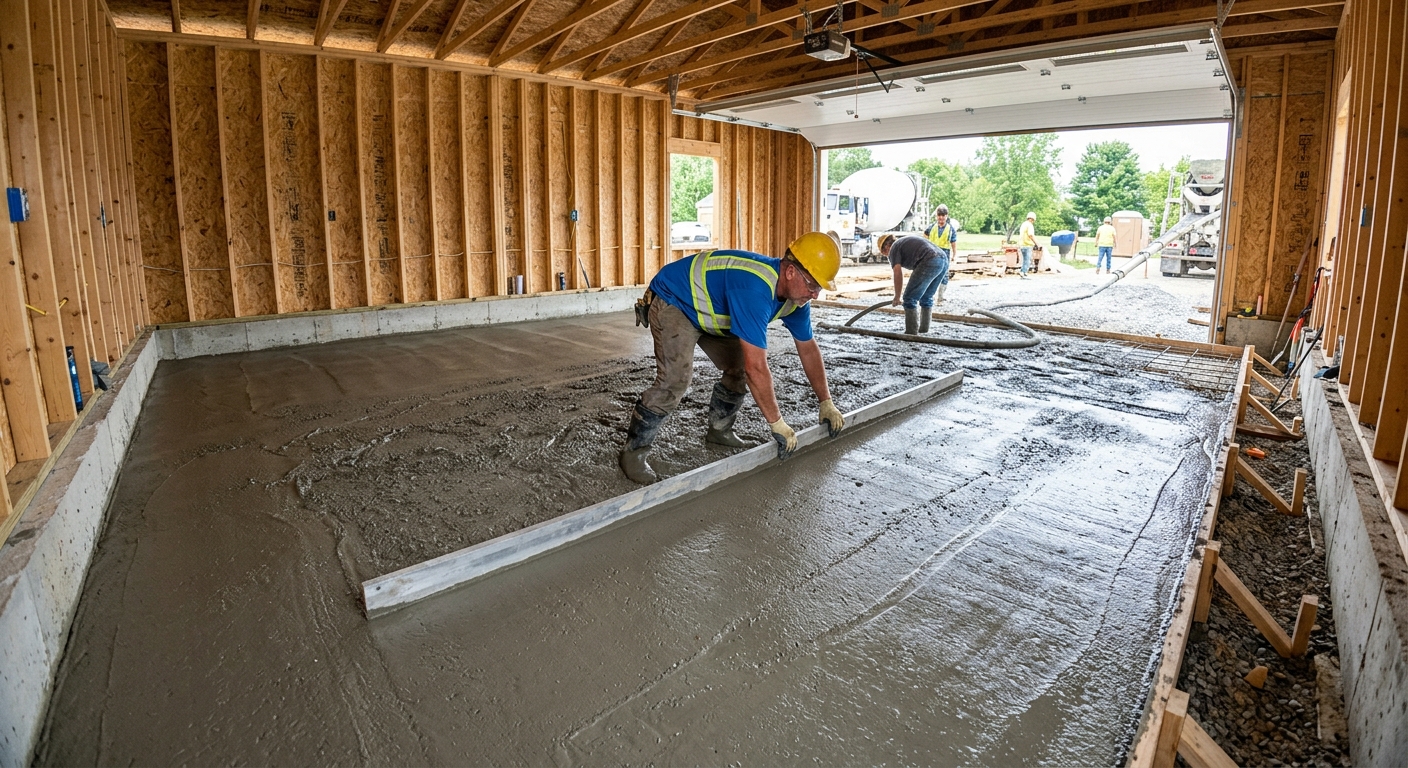
Concrete work options and costs in Blue Quill
Blue Quill, Alberta is a great place for concrete flatwork—until you factor in the climate. With a population of 4,552 (Statistics Canada, 2021 Census), the neighbourhood is busy enough that homeowners often compete for the same contractor schedules when winter sets in. Most driveways, patios and walkways in Blue Quill also serve older and newer single-detached homes, so you’ll see demand for standard broom-finish slabs as well as upgrades like exposed aggregate and stamped concrete where aesthetics matter.
In the Calgary region, pricing reflects cold continental weather engineered into every pour. Freeze–thaw cycles mean exterior concrete needs air-entrained mixes, careful base prep, and control joints spaced to manage cracking. Calgary also has a design frost depth around 1.2 m (roughly 4 ft), so footings for houses, garages, decks and retaining structures must bear below undisturbed soil at that depth. That typically translates into more excavation and higher foundation volumes, which is why foundation/footings budgets usually run well above simple slab numbers.
Labour availability also changes seasonally: the practical exterior pour season is shorter, so late-year work often costs more due to cold-weather placement precautions (insulating blankets and, at times, temporary heat) needed for proper curing. In Blue Quill, demand is especially strong for driveways and rear patio work in the busier residential pockets near transit corridors and established cul-de-sacs, where access and staging are more predictable.
Use the table below as a realistic starting point for planning your project in Blue Quill.
| Application |
Typical Size |
Key Spec |
Finish Option |
Price Range |
| Concrete driveway (standard broom finish) |
12 m x 3 m (about 36 m²) |
Air-entrained exterior mix; rebar or fibre reinforcement; control joints |
Broom finish, sealed (optional) |
$12,000–$18,000 |
| Exposed aggregate driveway |
12 m x 3 m (about 36 m²) |
Air-entrained exterior mix; proper base and drainage |
Exposed aggregate (surface wash) |
$14,500–$21,500 |
| Stamped concrete driveway or patio |
10 m x 3 m (about 30 m²) for driveway, or 20 m² patio |
Air-entrained exterior mix; integral colour (typical) |
Stamped pattern with release and colour |
$15,000–$26,000 |
| Plain concrete patio or walkway |
6 m x 3 m (about 18 m²) or 12 m x 1.2 m (about 14 m²) |
Slab engineered for local soil; air-entrained exterior mix |
Broom or smooth trowel with light broom texture |
$5,000–$9,000 |
| Garage floor (interior slab) |
6 m x 7 m (about 42 m²) |
Interior mix; vapour barrier (common); thicker edges/footings as needed |
Float finish, optional broom or densifier |
$9,500–$15,500 |
| Foundation footings (structural, below frost) |
Typical house perimeter + piers |
Engineered rebar; excavation to frost depth; formwork and waterproofing coordination |
Structural concrete only (not decorative) |
$28,000–$45,000 |
Prices are estimates only and vary by project scope, site access and material selection.
What affects the price of concrete work in Blue Quill
In Blue Quill and the wider Calgary region, two quotes for the same concrete scope can easily differ by 30–50%. The biggest drivers are how contractors engineer for frost and freeze–thaw, how much excavation and grading your site needs, and what finishing system they include (broom vs. stamped vs. exposed aggregate). Because contractors also price risk for shorter pour windows and cold-weather curing, you’ll see more variability during shoulder seasons when temperatures can swing quickly.
Frost line depth is non-negotiable. Local engineering practice uses a design frost depth around 1.2 m (roughly 4 ft), which means exterior foundations and structural footings must extend below undisturbed soil at that depth to reduce frost heave and seasonal movement. Exterior slabs—driveways, patios and walkways—also require air-entrained concrete mixes to survive repeated freeze–thaw cycles. When the weather is colder, the pour season tightens and contractors may add winter-grade mix schedules, insulated blankets, and sometimes temporary heat to achieve proper curing. That curing window is where the “hidden” cost comes from: rushing it increases risk of surface scaling and longer-term spalling.
Salt matters too. De-icing salts used on Calgary roads and driveways can accelerate surface deterioration, so sealing is often recommended. In practice, this is why an upgrade like sealing or adding proper reinforcement can be a smart value even when the initial finish option looks like it should be cheaper. For example, moving from a plain patio budget in the $5,000–$9,000 band to a stamped patio budget in the $15,000–$26,000 band is usually justified when you’re also getting better layout planning, integral colour, and a surface system designed for durability—not just “sprinkle-on aesthetics.”
Local site conditions in Blue Quill can also swing costs: stiffer soils and uneven grades increase excavation and granular base depth; limited truck access increases labour time; and older home footprints can require more demo and disposal. Even with similar slab sizes, those factors can move your final total by thousands of dollars.
| Price Factor |
Why It Matters |
Cost Impact |
| Frost line depth — determines footing depth and form height |
Footings must sit below design frost to prevent heave |
Higher excavation/formwork can add significant cost; drives foundation/footings budgets toward the upper band |
| Site preparation — excavation, grading, compacted granular base |
Concrete performance depends on drainage and compaction |
Unforeseen soil removal or thicker base can add thousands |
| Reinforcement — rebar or wire mesh requirement |
Controls cracking and improves load capacity |
Often a moderate increase, but essential for driveways and structural areas |
| Mix design — air-entrainment and compressive strength spec |
Freeze–thaw durability relies on air content and proper strength |
Winter/cold-weather mixes can increase material cost |
| Finish type — broom vs. stamped vs. exposed aggregate |
Higher finish labour and colour/release processes |
Broom stays in lower bands; decorative finishes push totals upward |
| Pour size and concrete truck access to site |
Small pours may need more trips; access affects pumping and labour |
Limited access can increase crew hours and equipment time |
| Cold-weather curing precautions — heating and blankets |
Proper curing prevents scaling and weak surface development |
Can add meaningful line items during late fall/early spring |
| Control joint pattern and sealing cost |
Joints reduce random cracking; sealing protects against de-icing salt |
Joint sawing/sealing adds cost, but reduces callbacks |
Permits & regulations in Alberta
In Alberta, many homeowners assume “concrete is concrete,” but the permitting path depends on what you’re building. Structural concrete work—such as foundation footings, foundation walls, grade beams, and any engineered structural elements—typically requires a building permit, and engineered drawings are often reviewed through the municipal process. Concrete flatwork (driveways, patios, sidewalks, and walkways) usually does not require a permit unless it impacts lot grading, changes how stormwater drains, affects impervious surface limits, or encroaches into municipal right-of-way areas.
For a Blue Quill project, your best approach is to verify the scope before demo. Step one: ask the contractor to clearly state whether they are pulling permits (and what trades are included). Step two: confirm the contractor carries liability insurance and has workers covered under WSIB/WCB for their crew. Step three: check contractor documentation—before you sign.
To verify credentials, you can: (1) search the relevant Alberta online contractor registration/registry for licensing status (if applicable to the scope), (2) request a current Certificate of Insurance and confirm coverage limits match the job size, and (3) ask for WSIB/WCB clearance and employer coverage documentation. Then, ask for references from similar-scale concrete jobs in the Calgary area so you can see finished examples—especially exterior work designed for frost and freeze–thaw.
Getting concrete right in Blue Quill's freeze-thaw climate
Concrete failures in Blue Quill are usually predictable: inadequate base prep, poor mix design (especially air-entrainment), incorrect jointing, or shortcuts in curing. In a cold continental climate with frequent freeze–thaw cycles, the concrete surface can scale and eventually spall when water infiltrates and repeatedly freezes. The way you spec the job—before the first truck arrives—is what protects your investment.
Start with base preparation: the slab needs a compacted granular sub-base to the right depth for your soil and drainage, engineered for Calgary’s frost demands. Next, require an air-entrained exterior mix; a common target for exterior flatwork is 5–7% air, with minimum compressive strength of 32 MPa (or the engineer’s requirement for structural work). Third, control joints: spacing needs to limit random cracking from shrinkage and temperature movement. Fourth, curing: you typically need at least 7 days of curing under proper conditions, and in cold weather you may need insulated blankets or heat to keep the concrete developing strength. Finally, sealing: a penetrating sealer applied after the cure period (often at about 28 days) helps repel de-icing salts and moisture that can drive surface deterioration.
Ask the right technical questions to avoid the classic “cheap job” problem in Alberta: spalling caused by inadequate air-entrainment and inconsistent finishing timing. For example, if you’re choosing between a broom-finished patio and a stamped patio, the decorative option can land in the higher band (around $15,000–$26,000), but the durability specs should be the same baseline—engineered base, correct air content, and proper curing. If a quote cuts corners on mix design to “pay for stamps,” you’ll likely pay later with repairs.
| Spec |
Why It Matters in Blue Quill |
What to Ask For |
Impact if Skipped |
| Compacted granular base (depth?) |
Proper drainage and support reduce frost-related movement |
Confirm engineered base thickness and compaction testing method |
Settlement, cracking, and premature edge spalling |
| Air-entrained concrete mix (target air %?) |
Freeze–thaw resistance depends on correct air content |
Ask for exterior mix design with 5–7% air target |
Scaling and spalling, especially after salty winters |
| Compressive strength (MPa rating) |
Strength development supports load and long-term durability |
Require minimum 32 MPa (or higher per engineer for structural) |
Surface wear, increased cracking, and lower lifespan |
| Control joints (spacing per ACI guidelines) |
Controls where cracks form under shrinkage and temperature shifts |
Ask for proposed joint layout and saw-cut timing |
Random cracking and uneven slab movement |
| Minimum 7-day curing period |
Proper curing is critical in cold snaps to reach strength |
Confirm curing plan; ask about blankets/heating if cold |
Weak early strength and increased long-term deterioration |
| Penetrating sealer (when applied after cure) |
Helps block moisture and de-icing salt penetration |
Confirm sealer type and that it’s applied after cure (commonly ~28 days) |
Faster surface breakdown and staining |
How to choose a concrete work contractor in Blue Quill
Choosing the right concrete contractor in Blue Quill is mostly about verifying coverage and being specific in your paperwork. First, licensing and registration: depending on the scope, Alberta may require contractor registration or specific trade authorizations—so ask the contractor what applies to your job and check their current standing through the appropriate Alberta online registry. Second, liability insurance: request a current Certificate of Insurance and ensure it lists you as the certificate holder if your agreement requires it. Third, WSIB/WCB coverage: ask for clearance documentation showing the contractor’s workers are covered (and confirm that subcontractors are also covered).
Next, get 2–3 itemised written quotes. You want labour and materials broken out—demo, excavation, granular base, reinforcement, formwork, concrete supply/mix design, finishing, joints, sealing, and disposal. Avoid lump-sum quotes that don’t explain what’s included. Read the scope carefully: what’s excluded (topsoil reinstatement, sidewalk/drive approach work, permit fees, coring/saw-cutting timing, load-out and disposal)? Is permit pulling included for structural work? Clarify staging and truck access if your lot has tight drive paths.
For warranty, ask for two parts: a workmanship warranty period and any product/manufacturer warranty on admixtures/sealers (and whether it’s transferable to a new owner). For payment, never pay more than 10–15% upfront; use a holdback until the job is complete and the final finish and joints are done. Also demand a written timeline: start date, curing/seasonal constraints, and a completion estimate.
- Verify Alberta registration/licence status for the scope before signing.
- Request a current Certificate of Insurance with adequate limits.
- Confirm WSIB/WCB clearance for the contractor and any subcontractors.
- Use itemised quotes (labour + materials), not only a single total.
- Ask for mix design details: exterior air-entrainment and target strength.
- Confirm reinforcement plan (rebar/wire mesh/fibres) for your application.
- Confirm base preparation depth and compaction method.
- Ask when control joints will be cut (timing matters) and planned spacing.
- Clarify cold-weather curing plan: blankets/heating if temperatures are near freezing.
- Ask whether sealing is included and when sealer is applied after cure (commonly around 28 days).
- Confirm disposal included for concrete demo and any unsuitable material removed.
- Agree on payment schedule: 10–15% max upfront and holdback until final acceptance.
Concrete red flags we see around Blue Quill: contractors who won’t discuss air-entrainment or provide mix specs; quotes that omit base thickness/compaction details; late changes to joint layout without revising the estimate; charging full payment upfront; and crews that pour exterior concrete in cold weather with no documented curing plan (blankets/heating).
Frequently asked questions — concrete work in Blue Quill
How long does a concrete project take in Blue Quill?
In Blue Quill, timelines depend on weather and curing, not just the pour day. A typical concrete patio or walkway often takes 1–3 days on-site for demo (if needed), base prep, forming, pour, and finishing—then it’s left to cure properly. Even after the surface looks “set,” exterior slabs still need curing time; the minimum is generally at least 7 days under good conditions, and winter pours may require additional heating/blankets to maintain temperatures. Driveways are longer mainly because of excavation, reinforcement, and jointing layout, often landing around 3–6 days total scheduling. If decorative work is included (stamping or exposed aggregate), finishing steps add time. Plan for limited access while the crew works and keep vehicles off until the contractor confirms strength has been reached.
What is a concrete overlay and is it suited to Blue Quill?
A concrete overlay is a new topping placed over existing concrete after proper surface preparation and repairs (crack and spall remediation, cleaning, and sometimes bonding/primer systems). In Alberta’s freeze–thaw climate, overlays can be suitable when the existing slab is structurally sound—meaning no major base failure or widespread settlement. The key is prep quality: if the original slab is already moving, moisture pumping, or failing due to poor base or inadequate drainage, an overlay just adds another layer on top of the problem. Overlays also need correct product selection to resist salt exposure. Cost can still be meaningful, and for many homeowners it may be comparable to replacing a slab in bad shape. If your current driveway/patio is mostly stable, an overlay may fit, but confirm with a contractor who will inspect base movement and discuss durability specs. For planning, homeowners often compare against standard patio ranges of $5,000–$9,000 and driveway bands of $12,000–$18,000.
How do I seal concrete to protect it in Blue Quill?
Sealing helps protect concrete surfaces from moisture and de-icing salt, which is important in Blue Quill where winters are harsh and freeze–thaw cycles are frequent. The biggest rule is timing: most sealers perform best after the concrete has cured fully—commonly around 28 days—so the concrete can stop releasing excess moisture. Use a penetrating sealer (rather than a thick film) for exterior slabs because it repels water while still allowing the concrete to breathe. Before sealing, the surface needs to be clean, dry, and free of laitance, dust, and grease; pressure washing is often part of prep. Ask your contractor what exact product they plan to apply and whether it’s rated for freeze–thaw and salt exposure. Also plan for traction: some sealers can darken the surface. If you’re choosing between finishes, sealing is typically a durability add-on regardless of broom finish versus decorative work, and it can be the difference between a driveway that stays good-looking for years and one that starts scaling early.
What is the difference between concrete and cement?
In Alberta, homeowners often use “cement” and “concrete” interchangeably, but they’re not the same. Cement is an ingredient—usually Portland cement—that’s included in the concrete mix. Concrete is the full engineered material: cement plus water plus aggregates (sand and gravel), with admixtures such as air-entrainment for freeze–thaw durability. When your contractor quotes exterior concrete in Blue Quill, what matters is the concrete mix design (including air-entrainment), the target compressive strength, and how it’s cured. “Cement” content alone doesn’t tell you the freeze–thaw performance; air-entrainment and curing conditions do. That’s why you should ask for the exterior mix specs and curing plan rather than focusing only on brand names. Also remember that structural items like footings are engineered concrete—so the cementitious system and reinforcement requirements are tied to design, not just general “mix strength.”
How much does concrete work cost in Blue Quill?
Concrete costs in Blue Quill typically follow Calgary-area pricing because the climate engineering is similar: frost depth around 1.2 m (roughly 4 ft), air-entrained exterior mixes, and careful curing. For budgeting, homeowners commonly see driveway/slab projects in the $12,000–$18,000 range depending on size, reinforcement, base prep, and access. Patios and walkways often land around $5,000–$9,000 for simpler plain finishes, while stamped and decorative concrete can move up to $15,000–$26,000 based on colour, pattern, and labour. Foundation footings are usually the most expensive line item, often in the $28,000–$45,000 band because excavation and structural engineering drive the scope below frost. The same sized slab can still vary by 30–50% if soil conditions, winter curing precautions, or finish complexity changes. Always ask for an itemised quote that explains what’s included.
How deep must footings be for Blue Quill's frost line?
For Blue Quill and the Calgary region, footing depth is designed around the local design frost depth, which is about 1.2 m (roughly 4 ft). The practical takeaway for homeowners is that exterior structural elements like house footings, garage footings, deck footings, and retaining structures must bear below the design frost depth on undisturbed soil to reduce frost heave and seasonal movement. Depth alone isn’t the whole story—engineered requirements also consider soil type, drainage, and foundation design details like reinforcement and formwork. Because design and permit requirements can vary by the specific build and municipal review, confirm the exact footing elevation and bearing requirements from the engineer/approved drawings used for your project. If a contractor suggests shallow footings “to save money” in Alberta’s freeze–thaw climate, that’s a serious concern.