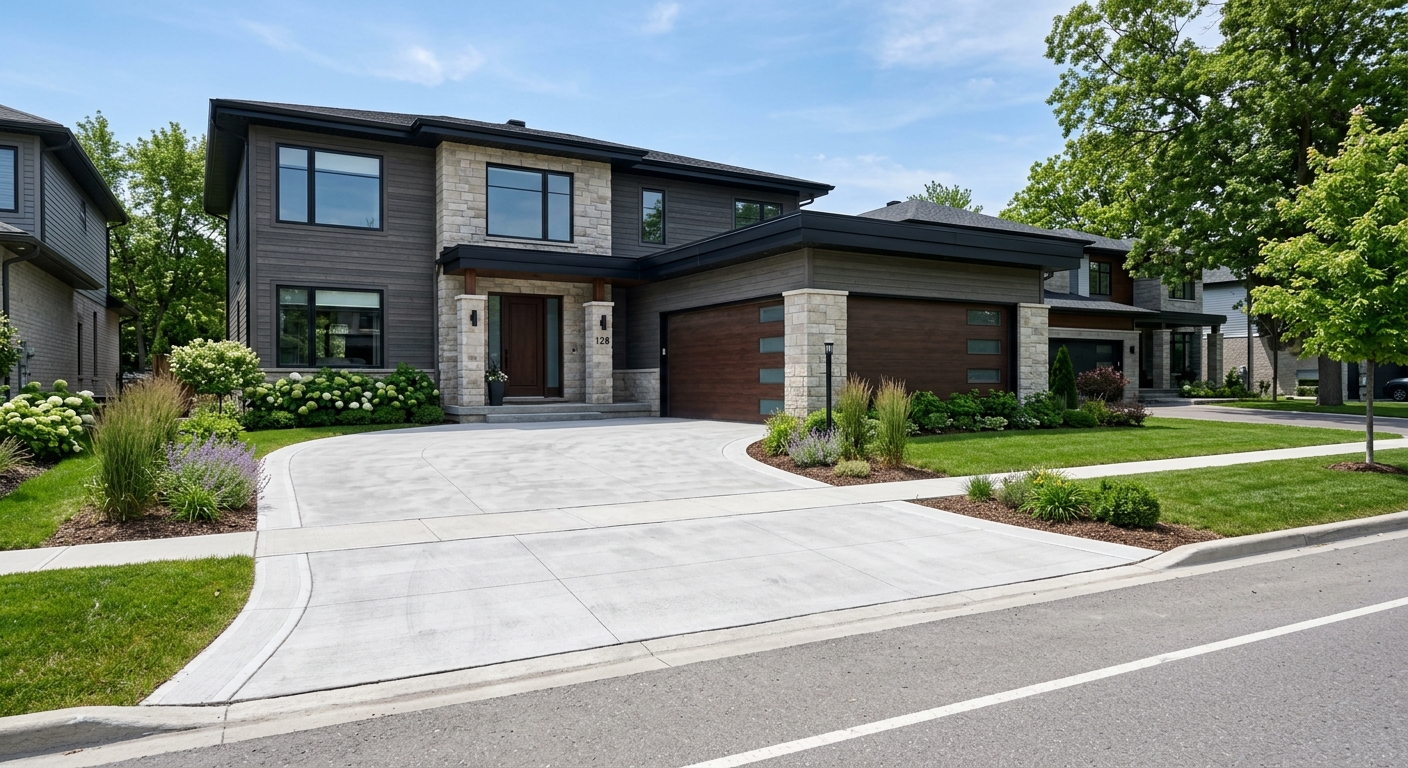
Concrete work options and costs in Wabasca-Desmarais
In Wabasca-Desmarais, homeowners typically choose concrete because it handles heavy snow loads and winter wear better than many alternatives. With a small population of 1,594 (Statistics Canada, 2021 Census), the local market is tight, so the best pricing usually comes from booking concrete crews in advance—especially for exterior work that has to fit a shorter placement season. Most flatwork demand centres around single-detached housing, which is where driveways, patios, and walkway slabs get added or replaced when houses are renovated or garages are upgraded. In many neighbourhoods around the townsite, contractor demand is especially high when new builds and accessory structures go up because crews can combine truck arrivals and equipment mobilization.
Calgary’s cold continental climate drives the cost structure in Wabasca-Desmarais: frost depth engineering and freeze–thaw durability requirements raise foundation and slab costs versus milder parts of Alberta. Local practice targets a design frost depth of about 1.2 m (roughly 4 ft), meaning exterior foundations, footing trenches, and structural support must bear below the frost line. For driveways and patios, air-entrained concrete, granular base prep, and control joints are engineered for repeated freeze–thaw cycles to reduce cracking and spalling. In late fall or early spring, cold-weather curing precautions (insulated blankets and sometimes temporary heat) can add labour and materials—because rushing curing increases the risk of surface scaling that can show up later. That’s why a “simple” slab is often quoted differently than a decorative option like stamped or exposed aggregate, even when the thickness looks similar.
Below is a practical cost comparison to help you line up quotes before you talk specs with your contractor.
| Application |
Typical Size |
Key Spec |
Finish Option |
Price Range |
| Concrete driveway (standard broom finish) |
400 sq. ft. (about 20 ft x 20 ft) |
4 in. thickness, air-entrained mix, control joints |
Broom finish |
$12,000–$18,000 |
| Exposed aggregate driveway |
400 sq. ft. (about 20 ft x 20 ft) |
4 in. thickness, air-entrained mix, aggregate exposure prep |
Exposed aggregate |
$16,000–$22,500 |
| Stamped concrete driveway or patio |
300 sq. ft. (about 15 ft x 20 ft) |
4 in. thickness, base prep + release agent + sealer system |
Stamped (pattern + colour) |
$15,000–$26,000 |
| Plain concrete patio or walkway |
200 sq. ft. (about 10 ft x 20 ft) |
4 in. thickness, air-entrained mix, edged forms |
Float + broom/light broom |
$5,000–$9,000 |
| Garage floor (interior slab) |
400 sq. ft. (about 20 ft x 20 ft) |
4 in. slab, vapour barrier (if specified), jointing |
Steel trowel or broom finish |
$9,500–$15,500 |
| Foundation footings (structural, below frost) |
Per house/engineered layout (commonly 1,500–3,000 lineal ft in trenches total) |
Excavation + rebar, engineered concrete to frost depth |
Structural concrete |
$28,000–$45,000 |
Prices are estimates only and vary by project scope, site access and material selection.
What affects the price of concrete work in Wabasca-Desmarais
In Wabasca-Desmarais and the broader Calgary economic region, it’s common to see quotes for the same concrete job swing by 30–50%. The main reason isn’t “random pricing”—it’s that contractors can’t treat a driveway or patio like a one-size commodity in a freeze–thaw climate. Concrete is engineered for durability, and the engineering shows up in the excavation depth, base thickness, mix design, reinforcement choices, and curing method. When those items change, the cost changes too, even if the slab thickness looks identical on paper.
First, the frost line depth is the cost driver. Local engineering practice uses a design frost depth of about 1.2 m (roughly 4 ft) in this region, which means exterior foundation support and structural footings must extend below this depth to avoid frost heave and seasonal movement. Second, freeze–thaw cycles dictate air-entrained concrete for exterior slabs—typically in the 5–7% air range—plus well-spaced control joints. Third, cold-weather placement reduces the working window. When crews pour in colder conditions, they often need winter-grade mix components, insulated blankets, and sometimes temporary heat to achieve proper curing. That curing window is critical; rushing it increases the risk of scaling that can lead to costly repairs later.
Two local examples that often change the final number: (1) if your site needs deeper excavation to reach competent subgrade and allow proper compaction, the base prep can push costs toward the higher end of the $12,000–$18,000 driveway band; (2) if you want stamped concrete, the added finishing steps and materials (release system, multiple tools, and an appropriate sealer schedule) justify pricing that can climb toward the $15,000–$26,000 stamped band. Finally, older housing stock that’s being renovated can have buried utilities, uneven grades, and heavier sawcut/rebuild requirements—those labour items often add thousands even before concrete arrives.
| Price Factor |
Why It Matters |
Cost Impact |
| Frost line depth — determines footing depth and form height |
Footings must bear below frost to prevent heave and movement |
Higher excavation and concrete volumes (major cost driver) |
| Site preparation — excavation, grading, compacted granular base |
Improper sub-base leads to settlement and cracking |
Added labour and granular supply/compaction time |
| Reinforcement — rebar or wire mesh requirement |
Controls cracking and supports structural load paths |
Material and placement labour increase |
| Mix design — air-entrainment and compressive strength spec |
Air-entrainment helps survive freeze–thaw; strength supports loads |
Specialty mix and QA testing can raise material costs |
| Finish type — broom vs. stamped vs. exposed aggregate |
Decorative finishes require more process steps and sealer systems |
More labour time and higher materials/consumables |
| Pour size and concrete truck access to site |
Access affects crane/placing methods, and pour efficiency |
Extra labour, pumping/hoses, and waiting time charges |
| Cold-weather curing precautions — heating and blankets |
Proper curing prevents scaling and early surface failure |
Winter products and added crew time/gear |
| Control joint pattern and sealing cost |
Joints control where cracks happen; sealing reduces salt-driven spalling |
Additional sawcut/finishing time plus sealer material |
Permits & regulations in Alberta
In Alberta, you’ll almost always need a building permit for structural concrete work such as foundation footings, foundation walls, and grade beams—because these elements directly affect building stability and must match engineered requirements. In practice, municipalities may request engineered drawings for the foundation scope before they approve excavation and placement. By contrast, concrete flatwork like patios, walkways, and driveways typically does not require a separate permit unless the work changes lot grading, impacts drainage plans, affects impervious surface coverage limits, or involves work within a municipal right-of-way.
For your Wabasca-Desmarais project, the best step is simple: confirm with your local authority before breaking ground, especially if you’re changing slopes, adding swales, or tying into existing drainage. Also verify your contractor is properly insured. Ask for proof of liability insurance and WSIB/WCB coverage (or a clear exemption/coverage documentation, if applicable), and get references from recent jobs with similar scope.
To verify contractor credentials in Alberta:
- Check the contractor’s business details and status through the appropriate online registry search used for licensing/registration in Alberta.
- Request a certificate of insurance and confirm it’s current and matches the work type (general liability coverage typically, plus any endorsements the contractor uses).
- Ask for WSIB/WCB clearance or coverage documentation and confirm names match the contracting company.
- Review prior projects: look for cold-climate concrete flatwork that shows good jointing and finish consistency.
Getting concrete right in Wabasca-Desmarais's freeze-thaw climate
Concrete failure in Wabasca-Desmarais usually comes down to the same chain: weak base preparation, inadequate air-entrainment, poor jointing, and rushed curing. With Calgary’s freeze–thaw cycles, small surface problems can worsen quickly when water gets into pores and expands during freezing. The specs you choose should reflect that reality. Start with base preparation: excavate to the correct depth for your local soil and frost considerations, then compact a granular sub-base so the slab has stable support. Next, demand the right mix design—exterior flatwork should use air-entrained concrete (commonly targeting 5–7% air content) and a minimum 32 MPa compressive strength. Air bubbles are what help the concrete resist scaling and spalling when it repeatedly freezes and thaws.
Control joints are also non-negotiable. They give concrete a planned crack path so random cracking doesn’t start at edges or around utilities. For curing, plan for at least 7 days under proper conditions. In cold weather, that may require blankets or temporary heat so the slab can build strength and develop a durable surface. Finally, sealing matters here because de-icing salt can accelerate surface scaling. Use a penetrating sealer applied 28 days after the pour (once curing is complete) to repel moisture and reduce salt penetration.
If you’re comparing options, it helps to understand where the money is justified: for example, moving from a basic broom-finished driveway to stamped concrete can add significant cost (often aligning with the $15,000–$26,000 stamped band), but you’re paying for extra finishing steps and an appropriate sealer approach—not just a “prettier top.” If a contractor tries to cut corners on air-entrainment or curing to keep prices near the lower $12,000–$18,000 driveway band, you’re more likely to see premature wear later, especially in winter traffic and salt exposure.
| Spec |
Why It Matters in Wabasca-Desmarais |
What to Ask For |
Impact if Skipped |
| Compacted granular base (depth?) |
Stable support reduces settlement and freeze-related movement |
Base depth and material type (e.g., compacted granular sub-base), plus compaction proof |
Cracks, dips, and uneven slabs after freeze–thaw cycles |
| Air-entrained concrete mix (target air %?) |
Air pores reduce freeze–thaw damage and surface scaling |
Specified air content (commonly 5–7% for exterior flatwork) |
Spalling and scaling accelerated by water and de-icing salts |
| Compressive strength (MPa rating) |
Strength supports loads from vehicles and thermal movement |
Minimum 32 MPa (and whether it’s specified for the placement) |
Premature surface failure and increased cracking risk |
| Control joints (spacing per ACI guidelines) |
Controls where cracking happens and reduces random shrinkage cracks |
Joint spacing plan and timing of sawcutting |
Uncontrolled cracking and wider repair costs later |
| Minimum 7-day curing period |
Proper hydration builds durable strength in cold conditions |
Confirm curing plan; blankets/heating if pouring near cold thresholds |
Weak surface, scaling, and reduced long-term durability |
| Penetrating sealer (when applied after cure) |
Helps block moisture and slows salt penetration |
Penetrating sealer applied after full cure (commonly 28 days post-pour) |
Faster deterioration and more frequent patching |
How to choose a concrete work contractor in Wabasca-Desmarais
Choosing the right contractor matters more in our cold freeze–thaw climate than many homeowners expect. Start with Alberta coverage verification: ask for proof of liability insurance and WSIB/WCB coverage (or the correct documentation for your situation). To check each item, request documents before work begins—don’t rely on verbal assurances. Confirm the certificate of insurance is current and clearly names the contracting company. For WSIB/WCB, ask for the clearance letter or coverage confirmation and ensure the company name matches the quote. If a contractor can’t provide these items promptly, that’s a strong warning sign.
Next, get 2–3 itemised written quotes. You want a breakdown that separates labour, concrete supply, excavation/site prep, base materials, reinforcement, finishing (broom vs. stamped vs. exposed aggregate), and any sealing. Avoid quotes that are only a single lump sum without explaining scope exclusions. Clarify disposal: is hauling away removed soil included, or is it an add-on? Confirm whether permits (when required) are included and who is responsible for submitting any forms.
Warranty should be clear and in writing. Ask about workmanship warranty length and whether product/manufacturer warranty applies to materials like sealer systems. Also check if the warranty is transferable if you sell your home. For payment, never pay more than about 10–15% upfront; hold back a portion until the job is complete and cleaned up. Finally, insist on a written start date and completion estimate, especially if winter curing blankets or heat are part of the plan.
- Provide proof of liability insurance (current certificate) before signing.
- Provide WSIB/WCB clearance or coverage documentation with your quote.
- Quote includes frost-relevant excavation and engineered footing depth (for foundations).
- Itemised costs: labour vs. concrete vs. base/granular supply vs. reinforcement.
- Written curing plan for cold days (blankets/heating if needed).
- Joint plan: where joints are placed and when sawcutting happens.
- Finish specification: broom, stamp pattern, aggregate exposure method, and sealer type.
- Confirm concrete thickness and whether it includes air-entrainment requirements.
- Access plan: how the crew handles short truck access or long hose runs.
- Clarify site protection: forms, edging, and protection of landscaping/fixtures.
- Disposal and clean-up: hauling included or billed separately.
- Warranty terms in plain language, including workmanship and materials.
Concrete contractor red flags in Wabasca-Desmarais: (1) no discussion of air-entrained mix or curing blankets when temps drop, (2) vague “we’ll do what we always do” jointing without spacing/timing, (3) quotes that don’t itemise excavation/base prep or specify thickness, (4) refusing to provide insurance/WSIB/WCB documentation, and (5) demanding a large upfront payment (well above 10–15%) before any prep starts.
Frequently asked questions — concrete work in Wabasca-Desmarais
How long does concrete take to cure?
In Wabasca-Desmarais, curing time depends on temperature, wind, and whether the crew uses blankets or heat. In general, concrete gains strength over time: it may be “walkable” after a day or two, but a proper cure for durability typically means at least 7 days before you treat it like a fully loaded surface. For cold snaps in the Calgary area, exterior flatwork may need insulated blankets or temporary heat so the concrete can hydrate and reach the target strength without surface scaling. If you’re sealing, plan for the sealer schedule: penetrating sealers are usually applied after the slab is fully cured—commonly around 28 days post-pour. If your contractor rushes curing for a late-season pour, that’s a common cause of early spalling.
Do I need a permit for concrete work in Alberta?
In Alberta, structural concrete work—like foundation footings, foundation walls, and grade beams—usually requires a building permit and often engineered drawings reviewed by the municipality. Concrete flatwork (driveways, patios, walkways) often does not require a permit unless it affects lot grading, drainage, impervious surface limits, or involves municipal right-of-way impacts. In Wabasca-Desmarais, the practical approach is to confirm with your local authority before excavation, especially if you’re changing slopes or adding drainage features. Also confirm whether the contractor includes permit handling when required. For any scope that could impact grading or drainage, insist on a clear plan in writing so you don’t end up redoing work that didn’t meet local requirements.
Concrete vs pavers for a patio in Wabasca-Desmarais?
Concrete and pavers both work for patios, but in Wabasca-Desmarais’s freeze–thaw climate, the details matter. Concrete patios are often a better fit when you want a uniform surface and less labour-intensive maintenance over time. A plain concrete patio typically falls around $5,000–$9,000 for many common backyard sizes, with cost rising if you add proper reinforcement, base depth, or decorative finishes. Pavers can be advantageous if you want easy localized repairs or more flexible design changes. However, pavers depend heavily on correct base preparation and edge restraints—otherwise they can heave or develop gaps. Ask each contractor how they handle base compaction, drainage, and jointing. In a cold region, the “best” choice is usually the one with the most rigorous freeze–thaw engineering and a solid joint/drainage plan.
How long does a concrete driveway last?
A well-built concrete driveway in the Calgary region often lasts decades, but performance depends on specs and salt exposure. The main early threats are freeze–thaw damage from inadequate air-entrainment, poor joint spacing, and curing issues. If your driveway is built correctly—with air-entrained concrete, a properly compacted granular base, and an intentional control joint plan—many homeowners see long service life. Costs reflect this engineering: standard broom-finished driveways commonly land in the $12,000–$18,000 range, while decorative options like stamped or exposed aggregate may cost more due to added finishing steps and a sealer system. After 28 days, sealing helps slow moisture and de-icing salt penetration. If you skip sealing or the contractor under-specifies air content, you can start seeing spalling or surface scaling sooner than expected.
What is air-entrained concrete and why does it matter here?
Air-entrained concrete is mixed with microscopic air bubbles that give freezing water somewhere to expand, reducing internal pressure that can break down the surface. In Alberta’s cold freeze–thaw environment, air-entrainment is one of the most important durability specs for exterior concrete like driveways, patios, and walkways. Without it, moisture trapped in the concrete can freeze and expand repeatedly, leading to scaling and spalling—especially where snow clearing and de-icing salts are used. That’s why reputable contractors build exterior slabs with an air-entrainment target (often in the 5–7% range) and pair it with granular base prep and control joints. When you see quotes, ask whether the mix is air-entrained and what specifications are being used—not just the finished look.
How do I prepare the base for a concrete slab?
Base preparation is the foundation of the foundation—especially in Wabasca-Desmarais where freeze–thaw cycles punish weak subgrade. Your contractor should excavate to the required depth for a stable, compacted granular base and then compact in lifts to reduce settlement. They should also confirm the granular material type and compaction approach, because a slab placed on loose or organic soils will crack regardless of how good the finish looks. For exterior slabs, make sure the scope includes grading for drainage and edge support, since standing water accelerates deterioration. Ask your contractor to explain the base depth and the compaction method. Then verify the mix and jointing plan: air-entrained concrete and control joints work together with the base to reduce cracking and spalling over time.