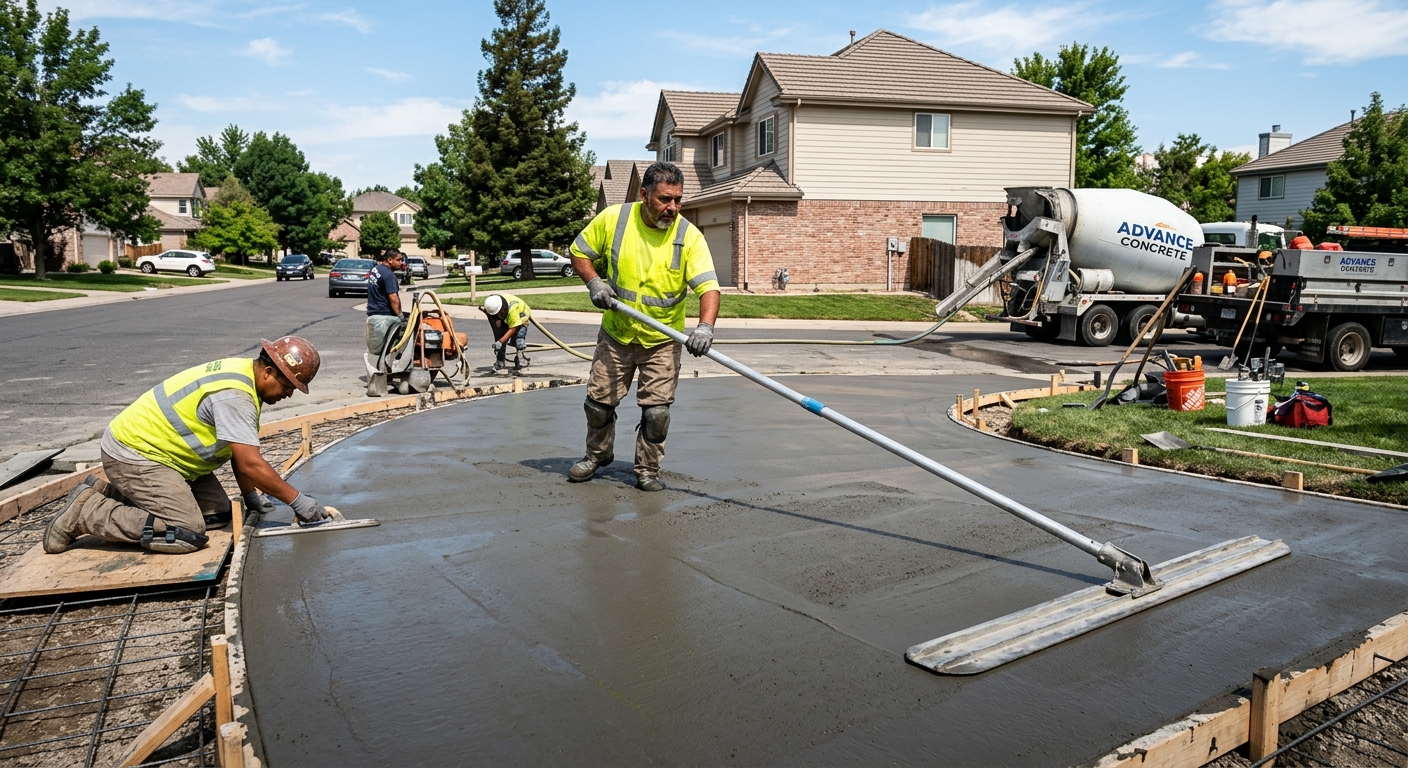
Concrete work options and costs in Donsdale
Donsdale, Alberta is a smaller community (population 1,250 as of the 2021 Census, Statistics Canada), and that shows up in the trades schedule: crews often coordinate around larger Calgary-area projects, so lead times can vary. Most concrete flatwork demand typically comes from single-detached neighbourhood builds and renovations along established residential pockets, where driveways, patios, and walkway upgrades are common. In this part of the Calgary region, the concrete market is shaped by a cold continental climate with frequent freeze–thaw cycles. That means contractors design the job around frost and curing—footings must bear on undisturbed soil below the local design frost depth (about 1.2 m, roughly 4 ft), and exterior slabs are typically made with air-entrained mixes plus more robust base prep.
Because frost depth is deeper than in warmer provinces, excavation and footing volumes are higher, which is a big reason foundation costs can land well above “warm climate” estimates. On top of that, Calgary’s pour season for exterior slabs is shorter, so winter-grade placement practices (insulated blankets, sometimes temporary heat, and strict curing control) can add cost if you’re scheduling late fall or early spring. Even when the work is straightforward, the labour intensity of proper excavation, compaction, and finishing is what drives consistent pricing—not just “more concrete.”
For homeowners in Donsdale, an especially busy area for flatwork upgrades is typically the established residential zones near local collector roads in and around the Donsdale area where access is easier for skid-steer/mini-excavators and where drainage grading matters. Use the options below as a practical starting point before you compare quotes.
| Application |
Typical Size |
Key Spec |
Finish Option |
Price Range |
| Concrete driveway (standard broom finish) |
400–550 sq. ft. |
Air-entrained mix; compacted granular base; control joints |
Broomed |
$12,000–$18,000 |
| Exposed aggregate driveway |
400–550 sq. ft. |
Air-entrained mix; specialty surface wash/retarder; sealed after cure |
Exposed aggregate |
$14,000–$22,000 |
| Stamped concrete driveway or patio |
350–500 sq. ft. |
Air-entrained mix; integral colour; stamped formwork |
Stamped (colour + texture) |
$15,000–$26,000 |
| Plain concrete patio or walkway |
200–350 sq. ft. |
Air-entrained mix; compacted base; edges and joints |
Plain (broom/float finish) |
$5,000–$9,000 |
| Garage floor (interior slab) |
400–600 sq. ft. |
Vapour barrier; thickened edges; joints as required |
Broom finish |
$6,000–$12,000 |
| Foundation footings (structural, below frost) |
Typical house: ~1,000–1,600 sq. ft. footing area |
Engineered rebar; excavation to design frost depth; consistent bearing |
Unformed/structural concrete |
$28,000–$45,000 |
Prices are estimates only and vary by project scope, site access and material selection.
What affects the price of concrete work in Donsdale
In the Calgary region—including Donsdale—two quotes for the “same” concrete project can differ by 30–50% once you look past the square footage. The driver is that freeze–thaw climate and deeper frost requirements influence everything from how deep you excavate to what mix design and curing precautions the contractor must use. Alberta’s cold season also tightens the workable schedule: a late pour can require insulated blankets and, in some cases, temporary heat to protect curing concrete, which pushes costs up.
To prevent frost heave, footings and structural elements must be engineered to extend below the design frost depth (about 1.2 m in this market). For exterior slabs, contractors typically use air-entrained concrete to improve durability through repeated freezing and thawing, and they plan a control-joint pattern to reduce random cracking. Calgary-area driveways and patios also face practical exposure to de-icing salts; without a proper sealing strategy, surface scaling and spalling risks increase over time, and that can force earlier repairs.
In Donsdale, costs rise when: you have clay-heavy soils that require extra base removal/replace, a tight site that limits truck access, or drainage grading that needs added granular build-up. Costs can lower when a site already has good bearing and accessible dig-out zones—labour and equipment time drop. As a practical example, a standard broom-finished driveway may fit the $12,000–$18,000 range, while stamped work can move into the $15,000–$26,000 range because of colour, stamping tools, labour time, and finishing care (not just “more concrete”).
| Price Factor |
Why It Matters |
Cost Impact |
| Frost line depth |
Determines footing depth and form height |
Excavation and concrete volume increase; often the biggest foundation cost driver |
| Site preparation |
Excavation, grading, compacted granular base |
Extra haul-off/replace can add thousands, especially on wetter or inconsistent soils |
| Reinforcement |
Rebar or wire mesh requirement |
Labour and steel cost rise for thicker slabs and engineered footing designs |
| Mix design |
Air-entrainment and compressive strength spec |
Cold-weather durability specs typically increase material cost and logistics |
| Finish type |
Broom vs. stamped vs. exposed aggregate |
Stamped/exposed work adds labour time, colour/stamp materials, and tighter finishing windows |
| Pour size and concrete truck access to site |
Long carries and limited access slow production |
Reduced efficiency can add labour hours and equipment use |
| Cold-weather curing precautions |
Heating and blankets |
Insulation/temporary heat can add line-items if temps drop during placement/curing |
| Control joint pattern and sealing cost |
Limits random cracking and protects from salts |
Correct joint layout and quality sealer can add cost now but reduce long-term maintenance |
Permits & regulations in Alberta
In Alberta, structural concrete work typically needs a building permit and often engineered drawings reviewed as part of the municipality’s process. That includes concrete that forms part of the structure—such as foundation footings, foundation walls, grade beams, and retaining structures. For homeowners in Donsdale, if the scope touches the foundation system or supports loads, plan on a permit. Concrete that is considered flatwork—driveways, patios, walkways, garage floors—usually does not require a permit by default, unless it affects lot grading, drainage, or municipal impervious surface and right-of-way considerations.
Step-by-step, here’s how to verify contractor coverage and legitimacy before you schedule the pour. First, confirm the contractor’s business information and credentials using the appropriate online business/contractor registry resources available in Alberta. Second, ask for a current certificate of insurance: you want to see liability coverage consistent with the project value and an address/insured parties that match the quote. Third, request proof of WSIB/WCB coverage (or the appropriate exemption documentation if applicable). Finally, ask for references on similar-scale jobs in the Calgary region and verify they can provide a work completion date window.
Always confirm permit requirements with the local authority before breaking ground—especially if you’re changing drainage, lowering/raising grade, or adding substantial impervious coverage.
Getting concrete right in Donsdale's freeze-thaw climate
Concrete fails in Donsdale most often when the job isn’t engineered for freeze–thaw durability and frost movement. The big culprits are poor base prep (settlement), weak or non-air-entrained mixes (surface scaling and spalling), inadequate curing protection (early damage), and a missing or incorrect control-joint layout (random cracking that lets water in). With Calgary’s design frost depth around 1.2 m (roughly 4 ft), exterior and structural work needs to be built on stable bearing, not just “good-looking excavation.”
To spec the job correctly, insist on five fundamentals. (1) Base prep: compacted granular sub-base to the right depth and profile for local soil conditions, with proper drainage grading. (2) Mix design: exterior concrete should include air-entrainment and meet a minimum 32 MPa compressive strength, typically alongside a target air content of about 5–7% for exterior flatwork in this climate. (3) Control joints: a regular spacing pattern to limit random cracking. (4) Curing: minimum 7 days of proper curing conditions, with extra protection when cold weather hits. (5) Sealing: a penetrating sealer applied after the concrete has cured (commonly around 28 days) to help repel de-icing salts.
Ask the right questions because spalling risk rises when contractors cut corners on air-entrainment. A dollar example: moving from a basic broom-finish approach into sealed, air-entrained, properly jointed exterior flatwork may keep you closer to the $12,000–$18,000 driveway band; trying to “save” by skipping sealer or cold-weather curing precautions can lead to repairs that exceed the initial difference—especially on high-salt surfaces where scaling shows up earlier.
| Spec |
Why It Matters in Donsdale |
What to Ask For |
Impact if Skipped |
| Compacted granular base (depth?) |
Prevents settlement and protects against frost-related movement |
Base depth and granular type; compaction standard; drainage grade plan |
Uneven slab, premature cracking, water pooling, faster deterioration |
| Air-entrained concrete mix (target air %?) |
Improves freeze–thaw durability and reduces scaling/spalling |
Specify target air content (often 5–7% for exterior flatwork) and mix design details |
Surface scaling and spalling within a few winters |
| Compressive strength (MPa rating) |
Provides structural and durability performance for load and weathering |
Minimum 32 MPa and strength test documentation if required |
Lower life expectancy; increased cracking and wear |
| Control joints (spacing per ACI guidelines) |
Controls where cracks form so water doesn’t infiltrate deep |
Joint layout plan and cutting schedule |
Random cracking, joint deterioration, moisture ingress and freeze damage |
| Minimum 7-day curing period |
Builds strength before the freeze cycle stresses early-age concrete |
How they protect curing (curing blankets/heat in cold weather) |
Weak surfaces, surface defects, compromised durability |
| Penetrating sealer (when applied after cure) |
Repels de-icing salts and helps reduce scaling in salted winters |
Sealer type and application timing (commonly ~28 days) |
Faster surface breakdown and higher maintenance/repairs |
How to choose a concrete work contractor in Donsdale
Choosing the right concrete contractor in Donsdale is mostly about verifying coverage, getting clear specs, and making sure their process matches the freeze–thaw realities of Calgary’s climate. Start by confirming Alberta business licensing status as applicable for the trade/service they’re providing, and verify liability insurance plus WSIB/WCB coverage. What to do: ask for a certificate of insurance (COI) before you sign anything, make sure the policy is active for the project dates, and confirm the wording/insured parties. For WSIB/WCB, request proof of coverage and, if they claim an exemption, ask for the documentation that supports it.
Next, get 2–3 itemised written quotes that break down labour and materials (concrete volume, base prep, reinforcement, finishing, joints, sealing, and any curing protection). Avoid “lump sum only” proposals because they often hide what happens if the soil is worse than expected. Read the scope carefully: what is excluded (haul-away, disposal, saw-cutting, excavation overage, permits), is sealing included, and is the schedule tied to temperature conditions?
Finally, protect yourself with payment and warranty terms. Don’t pay more than 10–15% upfront; hold back payment until substantial completion and cleanup. Ask for a workmanship warranty length and whether it covers typical Donsdale issues like scaling in salted winters. Payment and timeline should be in writing: a start date and realistic completion estimate.
- Confirm contractor insurance and WSIB/WCB coverage before scheduling the pour.
- Ask for at least two local references from Calgary-area projects with similar scope.
- Request an itemised quote showing excavation, base materials, reinforcement, concrete, and finishing.
- Confirm the mix is air-entrained for exterior work and specify target air content.
- Ask for minimum compressive strength (e.g., 32 MPa) in writing.
- Verify that control joints and a joint layout plan are included.
- Ask how they handle cold-weather curing (blankets/heat) if temps drop.
- Confirm whether disposal/haul-away is included or excluded.
- Check if sealing is included and the timeline for application (after cure).
- Ensure the quote includes site protection, finishing cleanup, and edge detailing.
- Use a written payment schedule with a holdback until job completion.
- Get start/completion dates in writing and confirm what weather clause applies.
Red flags to watch in Donsdale: no discussion of air-entrainment or curing protection; vague “we do whatever standard” specs; reluctance to provide proof of insurance and WSIB/WCB; lump-sum quotes with no excavation/base prep details; and offers to pour late fall/early spring without temperature plans or insulated blanket procedures.
Frequently asked questions — concrete work in Donsdale
What is the difference between concrete and cement?
Concrete is the finished building material you see—cement plus water, and combined with aggregates (sand and gravel/stone) and sometimes additives. Cement is only one ingredient inside concrete; it’s the binding component that reacts with water to form paste and “glues” the aggregates together. In Alberta’s freeze–thaw climate, the concrete you choose matters more than people expect: exterior flatwork should be air-entrained to resist scaling and spalling during winter cycles, and the mix must meet a minimum strength target for long-term durability. For Donsdale homeowners, that means asking your contractor to specify the mix design (including air entrainment) instead of only discussing “cement brand” or colour on decorative jobs.
How much does concrete work cost in Donsdale?
Pricing depends on scope, access, base prep, and finish level, but the Calgary-region bands hold well for Donsdale. For example, a typical concrete driveway (broom finish) often lands in the $12,000–$18,000 range depending on size and site conditions. A plain patio or walkway commonly fits around $5,000–$9,000 for moderate areas, while stamped concrete driveway or patio work can move into $15,000–$26,000 because of colour, stamping and labour time. If your project includes foundation footings (below frost), expect a much wider structural range—often $28,000–$45,000—driven largely by excavation depth to undisturbed soil and engineered reinforcement requirements.
How deep must footings be for Donsdale's frost line?
For Donsdale in the Calgary market, the practical design frost depth used for planning footings is about 1.2 m (roughly 4 ft). In plain terms, footings typically must extend below that frost depth to reduce the risk of frost heave and seasonal movement. Exact depths still depend on the engineered drawings for your specific lot conditions—soil type, bearing capacity, and house/foundation design. This is why quotes for “foundation footings” are rarely truly comparable unless both are engineered to the same frost and bearing requirements. If a contractor proposes shallower bearing without an engineered justification, that’s a durability red flag in Alberta’s freeze–thaw winters.
Why does concrete crack in Donsdale and how is it prevented?
Concrete can crack in Donsdale because temperature swings and freeze–thaw cycles create movement, and concrete also shrinks as it cures. The key is managing cracking locations and preventing water from infiltrating. Proper base prep and compaction reduce settlement-related cracking. For durability, exterior flatwork should include air-entrainment so the freeze–thaw cycles don’t cause surface scaling and spalling that accelerates failure. Control joints help guide cracking to predetermined lines; sealing and good drainage help keep water and de-icing salts from getting into joints. When contractors skip joint planning or cut corners on curing protection during cold weather, random cracking becomes more likely and repairs cost more later—often more than the difference between broom-finish and higher-spec options.
Stamped vs broom-finish concrete — cost difference?
Stamped concrete generally costs more than a broom-finish because it adds labour steps and materials: integral or colour, stamping formwork, careful finishing to ensure a consistent texture, and often extra curing/handling attention. In the Donsdale/Calgary region, it’s common to see broom-finished driveway work fall around $12,000–$18,000, while stamped driveway or patio projects often land closer to $15,000–$26,000. The price jump isn’t just “a different look”—it’s the extra time and precision required to get clean borders, consistent colour, and durable texture through Alberta winters. If you choose stamped work, still insist on the same freeze–thaw durability specs: air-entrainment, proper joints, and the right curing and sealing schedule.
When is the best time to pour concrete in Donsdale?
In Donsdale and the broader Calgary area, the best timing is typically during warmer stretches of the year when curing conditions are easier to manage—often late spring through summer into early fall. The challenge is that cold snaps compress the curing window: when temperatures drop, contractors must protect fresh concrete using insulated blankets and sometimes temporary heat to ensure proper strength gain. That’s why scheduling in late fall or early spring can increase costs compared with mid-season pours. If a contractor can’t explain their cold-weather curing plan (what they do, when they add blankets/heat, and how they protect the concrete until it reaches adequate strength), that’s a concern for durability in Alberta’s freeze–thaw climate. Ask for a temperature plan before you approve your start date.