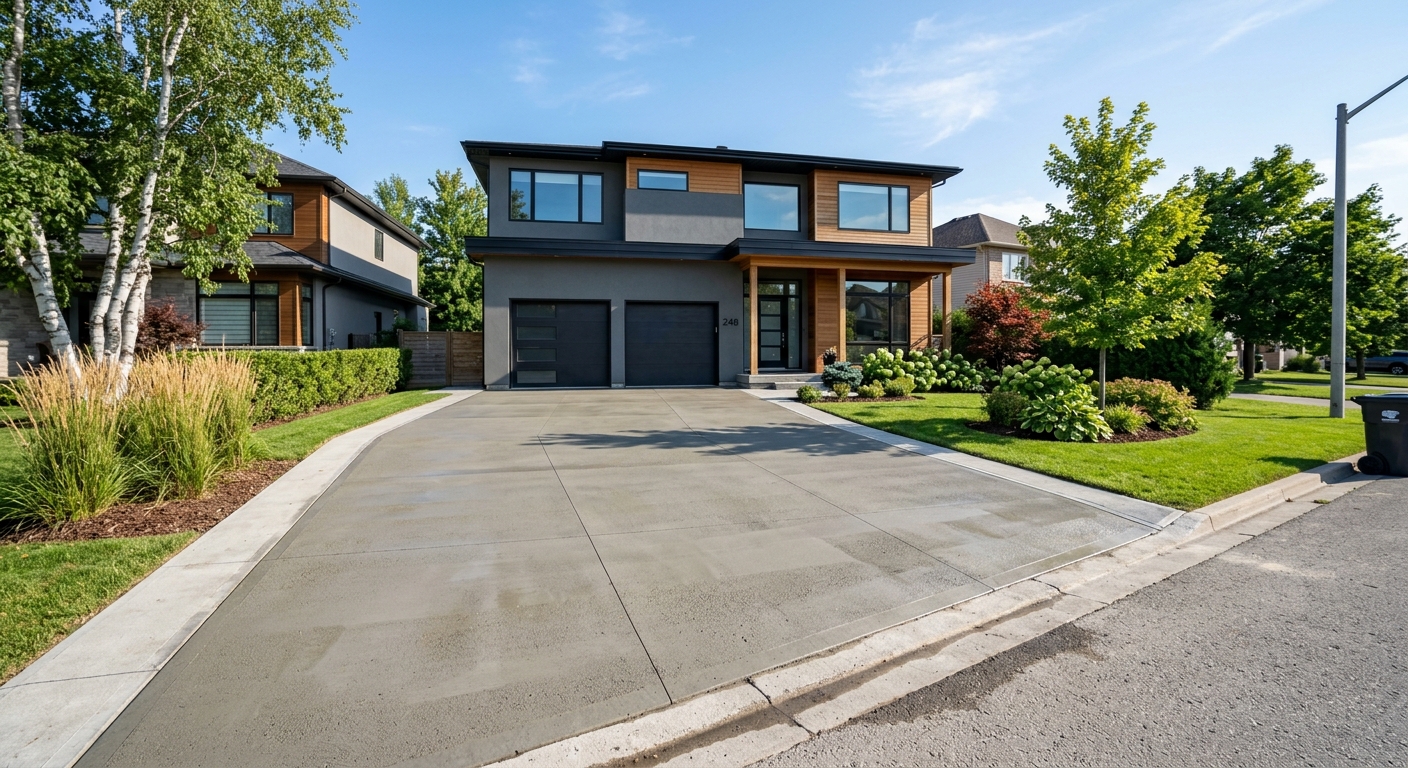
Concrete work options and costs in Northmount
Concrete work in Northmount is a major part of keeping driveways, patios and foundations performing through Alberta’s long winters. With a population of 2,902 (Statistics Canada, 2021 Census), Northmount’s housing market is primarily focused on practical, durable upgrades—especially where flatwork meets freeze–thaw conditions year after year. As more homeowners maintain existing sites and expand garages, the demand for dependable contractors is noticeable in established pockets like the Northmount–Calgary corridor, where access and seasonal scheduling can make or break timelines.
Calgary’s cold continental climate drives the way we design and price concrete. In this region, frost depth is engineered around approximately 1.2 m (about 4 ft) of design frost, so exterior foundations and below-grade elements require deeper excavation and higher concrete volumes than in milder areas. Frequent freeze–thaw cycles also mean air-entrained mixes, proper base prep, and a disciplined control-joint plan—otherwise you’ll see scaling and spalling earlier than you want. On top of that, the practical pour season is shorter, and cold-weather placement often requires winter-grade mix, insulated blankets, and sometimes temporary heat to keep curing on track.
Because of those factors, two quotes for the “same” driveway can differ substantially depending on footing depth (for structural work), excavation complexity, and finish package (broom vs. exposed aggregate vs. stamped). Below is a realistic comparison of common Northmount options—then we’ll break down what changes the final number.
| Application |
Typical Size |
Key Spec |
Finish Option |
Price Range |
| Concrete driveway (standard broom finish) |
24 ft x 20 ft (480 sq. ft.) |
Air-entrained exterior mix, proper granular base, control joints |
Broom finish |
$12,000–$18,000 |
| Exposed aggregate driveway |
24 ft x 20 ft (480 sq. ft.) |
Air-entrained mix, wash/surface retarder method, base & joints |
Exposed aggregate (light-to-medium stone) |
$15,000–$22,000 |
| Stamped concrete driveway or patio |
20 ft x 20 ft (400 sq. ft.) |
Air-entrained exterior mix, release agent, sealed finish system |
Stamped pattern (field + border options) |
$15,000–$26,000 |
| Plain concrete patio or walkway |
12 ft x 16 ft (192 sq. ft.) |
Air-entrained mix, compacted sub-base, edge forms & joints |
Smooth or light broom |
$5,000–$9,000 |
| Garage floor (interior slab) |
24 ft x 22 ft (528 sq. ft.) |
Vapour barrier (as required), steel reinforcement, slab thickness spec |
Float finish (optional broom) |
$12,000–$20,000 |
| Foundation footings (structural, below frost) |
Typical single-house footing package |
Engineered footing design, excavation below frost depth, rebar cages |
Structural concrete + finishing to grade |
$28,000–$45,000 |
Prices are estimates only and vary by project scope, site access and material selection.
What affects the price of concrete work in Northmount
In Northmount and the broader Calgary region, it’s common to see quotes for the “same” concrete job swing by 30–50%. The difference usually isn’t the concrete itself—it’s the engineered part around it: excavation depth, base prep, reinforcement scope, finishing package, and whether the contractor can schedule a proper curing window. For example, a driveway replacement can land in the $12,000–$18,000 band, but add complicated access, thicker slab design, upgraded base, or decorative elements and it can move toward higher-tier ranges fast. Similarly, foundation / footings are typically budgeted in the $28,000–$45,000 band, and the excavation reality below the frost line is what largely drives the final number.
In Calgary’s cold continental climate, frost depth is engineered around about 1.2 m (roughly 4 ft). That means footings for houses, garages and retaining elements must bear below design frost to prevent frost heave and seasonal movement. Freeze–thaw cycles also dictate exterior durability specs: all exterior slabs should use air-entrained concrete mixes, with the right spacing of control joints. Cold-weather placement further affects pricing because the pour season can be tighter, and contractors may need heating, insulated blankets, and winter-grade curing practices to avoid surface scaling and long-term performance issues. De-icing salt adds another pressure point—sealing (done correctly) becomes an important durability step, not an upsell.
Two practical Northmount cost examples: (1) if your driveway ties into an older approach with variable subgrade, base reconstruction can add labour and disposal; (2) if you want stamped concrete, the pattern materials and extra finishing time are real labour costs, but they’re not usually worth it if the base is underbuilt—because movement will crack any finish. The right spec protects your investment.
| Price Factor |
Why It Matters |
Cost Impact |
| Frost line depth — determines footing depth and form height |
Footings must bear below design frost to prevent heave |
Higher excavation volumes can push structural work toward the upper band |
| Site preparation — excavation, grading, compacted granular base |
Weak sub-base leads to settlement and early cracking |
Heavy site cuts, hauling, and compaction add labour and equipment time |
| Reinforcement — rebar or wire mesh requirement |
Controls cracking and improves slab durability |
More steel, chairs, and tied reinforcement raise material and labour costs |
| Mix design — air-entrainment and compressive strength spec |
Air-entrainment helps resist freeze–thaw scaling |
Proper specs cost more but reduce failures that are far more expensive later |
| Finish type — broom vs. stamped vs. exposed aggregate |
Finish complexity affects labour time and materials |
Decorative work often moves you from a standard band into a premium band |
| Pour size and concrete truck access to site |
Access constraints can require pumping or more labour staging |
Pumping, traffic control, and extra crew time increase the quote |
| Cold-weather curing precautions — heating and blankets |
Cold slows strength gain and increases scaling risk |
Winter protection can add meaningful cost, especially late fall/early spring |
| Control joint pattern and sealing cost |
Joints manage shrinkage cracking; sealing improves salt/durability |
Proper joint layout and sealant system typically add a line-item, but reduce long-term repairs |
Permits & regulations in Alberta
In Alberta, structural concrete work generally needs more oversight than flatwork. Footings, foundation walls, and grade beams are typically part of a building permit package and often rely on engineered drawings that are reviewed through municipal processes. In Northmount specifically, if your project changes loads or affects the structural system, treat it as permit-required work. Concrete flatwork such as patios, walkways, and driveways usually does not require a permit by itself—unless it affects lot grading, alters drainage patterns, or conflicts with impervious surface coverage limits or municipal right-of-way requirements. Always confirm with the local authority before breaking ground, especially if you’re changing elevation near sidewalks, swales, or existing drainage infrastructure.
Before hiring, verify the contractor carries liability insurance and has the correct coverage for workers (WSIB/WCB). In practice, I recommend you ask for three items before signing: (1) a certificate of insurance naming you as additional insured (where offered), (2) proof of worker coverage, and (3) reference projects similar in size and seasonality (winter curing matters in Calgary). To verify Alberta licence/standing, use the contractor registry tools online where applicable, then match the company name on the insurance certificates.
Step-by-step for homeowners: request their licence/registration number, request insurance documents, review the certificate validity dates, and ask for a clearance letter or account verification if the provider offers it. Then compare scopes and inclusions in writing so you’re pricing apples to apples.
Getting concrete right in Northmount's freeze-thaw climate
Northmount’s freeze–thaw cycle can be brutal on underbuilt concrete. The most common failures I see are surface scaling and spalling from insufficient air-entrainment, plus random cracking from poor base prep and an uncontrolled joint plan. To spec the job correctly for Calgary-area conditions, you want five fundamentals locked into the scope: (1) base preparation, (2) mix design, (3) control joints, (4) curing, and (5) sealing.
Base preparation means compacted granular sub-base to the right depth for the soil and frost strategy. In a region engineered around about 1.2 m design frost depth (roughly 4 ft), exterior work also needs a consistent, well-draining base so water doesn’t freeze under the slab. Mix design for exterior flatwork should use air-entrained concrete (commonly 5–7% air content for exterior exposure) and a minimum 32 MPa compressive strength spec. Control joints should be planned to limit random shrinkage cracking—spacing is a technical detail, but skipping or spacing too widely will cost you later. Curing matters, too: aim for at least 7 days under proper conditions, and in cold weather, winter curing precautions (insulated blankets and sometimes heat) are what prevent early surface damage. Finally, sealing should be a penetrating sealer applied after the concrete has cured—commonly around 28 days post-pour—to help repel de-icing salts.
One dollar example: an upgraded driveway finish might cost more, but the biggest value is proper base and air-entrainment. If you’re comparing a standard broom driveway in the $12,000–$18,000 range to decorative options that start higher, don’t assume the “look” is the driver—an underprepared base will crack whether it’s plain or stamped, and repairs usually erase the initial savings.
| Spec |
Why It Matters in Northmount |
What to Ask For |
Impact if Skipped |
| Compacted granular base (depth?) |
Prevents settlement and reduces frost-related movement |
Base depth for your soil type + compaction method and proof |
Uneven slabs, early cracking, water pooling |
| Air-entrained concrete mix (target air %?) |
Resists freeze–thaw scaling and spalling in Calgary-area winters |
Specify target air content (typically 5–7% for exterior flatwork) |
Surface deterioration and flaking, especially with de-icing salt |
| Compressive strength (MPa rating) |
Controls durability and long-term performance |
Minimum 32 MPa rating in the mix design |
Reduced strength gain, higher risk of cracking and scaling |
| Control joints (spacing per ACI guidelines) |
Manages shrinkage cracking during temperature swings |
Joint spacing plan and saw-cut timing |
Random cracks that are harder and costlier to repair |
| Minimum 7-day curing period |
Cold slows strength gain; poor curing increases early damage |
Guaranteed curing steps and weather protection plan |
Scaling, weak surface, reduced durability |
| Penetrating sealer (when applied after cure) |
Salt resistance improves when sealer is applied correctly |
Penetrating sealer after cure (commonly about 28 days post-pour) |
Faster deterioration from de-icing chemicals |
How to choose a concrete work contractor in Northmount
Choosing the right contractor in Northmount is mostly about verifying coverage and matching the quote to the technical spec—not just comparing the totals. In Alberta, confirm the contractor’s credentials, then check liability insurance by requesting a current certificate of insurance (and, if available, an additional insured endorsement). For worker coverage, ask for proof of WSIB/WCB status and make sure the documents are valid for the job period.
Next, get 2–3 itemised written quotes. You want a breakdown that separates labour and key materials (concrete volume, rebar/wire mesh, granular base, excavation, and disposal). A “lump sum” can hide whether they’re including proper base prep, saw-cut joints, curing blankets/heat, and sealing. Read exclusions carefully: is the permit pull included where required, is haul-away/disposal included, and who’s responsible for protecting lawns/structures during excavation?
Warranty matters. Ask for a workmanship warranty length and whether it covers cracking, joint performance, or spalling. Also ask about product/manufacturer warranties for the sealer or specialty mixes and whether warranties are transferable if you sell the home.
Payment schedule should be conservative: never pay more than 10–15% upfront. Hold back the remaining balance until the work is complete and you’ve reviewed surfaces, joints, elevation, and final cleanup.
- Request proof of Alberta registration/licence (and match it to the contract documents).
- Verify liability insurance certificate is current before work starts.
- Confirm WSIB/WCB coverage for the crew and subcontractors.
- Get 2–3 itemised quotes with labour and materials separated.
- Demand a written scope: base prep depth, reinforcement type, joint plan.
- Ask who supplies and installs control joints and when saw-cutting happens.
- Confirm curing plan for cold weather (blankets/heat if needed).
- Ask if sealing is included (and the sealer type: penetrating vs. film-forming).
- Clarify disposal: excavation haul-away included or extra?
- Verify truck access logistics (do they pump, and is pumping included?).
- Check timeline in writing: start date, curing timeframe, and completion estimate.
- Use a payment schedule with holdback until final inspection is done.
Concrete red flags I’d watch for in Northmount: contractors who won’t specify air-entrainment and joint spacing, who dismiss winter curing (no blankets/heat plan), who refuse to provide insurance/coverage proof, who quote using the same scope for every lot without a site visit, or who want large upfront payments before base prep begins.
Frequently asked questions — concrete work in Northmount
What is a concrete overlay and is it suited to Northmount?
An overlay is a new concrete layer placed over an existing slab, typically after surface prep like grinding/profiling and—if required—applying bonding systems. In Northmount and the wider Calgary area, overlays can work when the original slab is still structurally sound (no major settlement, deep heaving, or widespread base failure). The key risk in freeze–thaw climates is “trapping” moisture or bonding poorly, which can lead to debonding and spalling around joints. If your current slab has multiple crack patterns or drainage issues, the better move may be full removal and replacement, even if overlays look cheaper short-term. If you’re considering overlay, ask for a site assessment and a clear spec for prep, bonding, joint treatment, and curing—especially if you’re planning placement outside the summer window.
How do I seal concrete to protect it in Northmount?
For Northmount exterior concrete, sealing is mainly about helping the surface repel de-icing salt and moisture that fuels freeze–thaw damage. The most practical approach is a penetrating sealer applied after the concrete has cured—commonly around 28 days post-pour—so you’re not sealing in excess moisture. Before sealer goes on, the surface should be clean and dry; contractors usually power-wash and let it dry fully, then apply using the right method to avoid streaking or missed areas. If you have a broom finish driveway or patio in the winter, the sealer system matters because film-forming products can wear differently under traffic. When you get a quote, ask whether sealing is included, what type of sealer they use, and whether it includes a coverage guarantee.
What is the difference between concrete and cement?
In everyday conversation, people say “cement” when they mean “concrete,” but the difference matters for understanding your quote in Alberta. Cement is an ingredient—typically Portland cement—that provides the binder in the mix. Concrete is the full engineered product: cement plus water, sand, gravel/aggregate, and often admixtures (like air-entrainment for freeze–thaw durability). In Northmount, what really protects slabs through winter is the engineered mix design—especially air content for exterior exposure and the curing approach. So when contractors talk about performance, focus on the concrete spec: air-entrainment, minimum compressive strength (often 32 MPa for exterior work), and how they’ll manage curing in cold weather. If someone only discusses “cement” without referencing air-entrainment and curing, it’s a spec gap you should clarify.
How much does concrete work cost in Northmount?
Cost in Northmount depends on scope, access, thickness, and how much engineering is required to handle Calgary’s frost and freeze–thaw cycles. For typical exterior flatwork, driveway budgets often land in the $12,000–$18,000 range for a standard broom finish, while patios/walkways commonly fall in the $5,000–$9,000 range depending on size and prep. Decorative options like stamped concrete usually move higher and often land around $15,000–$26,000 for driveway or patio projects due to added labour and finishing complexity. Foundation / footings (structural work below frost depth) typically budget around $28,000–$45,000. If you’re seeing quotes wildly outside these bands, ask what’s different: base depth, reinforcement, air-entrained mix requirements, curing protection, disposal, or truck/pump logistics.
How deep must footings be for Northmount's frost line?
In the Calgary region around Northmount, design practice uses a frost depth of about 1.2 m (roughly 4 ft). That means exterior foundation footings generally need to bear on undisturbed soil below that design frost depth to reduce the risk of frost heave and seasonal movement. The exact footing depth on your property should still follow engineered drawings and your geotechnical/site conditions, because soil type, drainage, and local grade can influence excavation and foundation detail. Homeowners sometimes hear “one number” and then underestimate excavation volume; in reality, cold climate footings are often more intensive than in warmer provinces, and that’s reflected in structural pricing—typically in the $28,000–$45,000 band for footing packages. Your contractor should be able to explain how they’re achieving below-frost bearing and what they’re using to confirm soil readiness before pours.
Why does concrete crack in Northmount and how is it prevented?
Concrete can crack in Northmount because temperature swings and moisture changes cause shrinkage and movement, and freeze–thaw cycles punish poorly designed slabs. The most common avoidable causes are insufficient base preparation, inadequate air-entrainment for exterior exposure, and a control-joint plan that doesn’t manage shrinkage. In Calgary-area winters, inadequate air content is a common pathway to surface scaling and spalling, while missing or poorly spaced joints can lead to random cracking where you least want it. Prevention starts with a compacted granular base to the correct depth, an air-entrained mix, a minimum 7-day curing approach, and properly timed saw cuts/control joints. When you’re quoted for a driveway in the $12,000–$18,000 range, ask how they’ll handle joints, curing, and exterior air-entrainment—those are the details that reduce cracking risk over time.