Concrete work options and costs in West Meadowlark Park
In West Meadowlark Park, Alberta, homeowners typically consider concrete options in two main categories: exterior flatwork (driveways, patios, walkways) and structural concrete (garage slabs and foundation footings). With a population of 3,336 in the area profile (Statistics Canada, 2021 Census), the work is steady but not constant—so scheduling can matter, especially during spring ramp-up when many crews are booked. Most customers are addressing the same practical needs: durable surfaces for winter parking and entertaining, plus properly engineered foundations for Calgary’s deeper frost conditions.
Calgary’s cold continental climate drives concrete costs higher than in milder regions. Design frost depth is engineered around about 1.2 m (roughly 4 ft), which means footings and foundation-related excavation are more intensive. On top of that, frequent freeze–thaw cycling across the Calgary area pushes engineers toward air-entrained mixes, well-graded granular bases, and control joints to reduce cracking and spalling over time. When customers choose late-season work, the contractor must plan for cold-weather placement—often with insulated blankets, winter-grade mixes, and careful curing—so the concrete reaches strength without surface scaling.
Concrete demand is especially noticeable around family-heavy pockets near West Meadowlark Park’s residential streets, where driveways and back patio repairs come up repeatedly as homeowners replace aging slabs and upgrade drainage. If you’re comparing solutions now, the table below shows typical “apples-to-apples” cost ranges for the most common jobs we see in this neighbourhood, based on Calgary-area pricing and the engineering habits required for Alberta winters.
| Application |
Typical Size |
Key Spec |
Finish Option |
Price Range |
| Concrete driveway (standard broom finish) |
24 ft x 10 ft (240 sq. ft.) |
Air-entrained mix; compacted base; control joints |
Broom finish |
$12,000–$18,000 |
| Exposed aggregate driveway |
24 ft x 10 ft (240 sq. ft.) |
Air-entrained mix; proper curing for consistent texture |
Exposed aggregate |
$14,500–$21,500 |
| Stamped concrete driveway or patio |
20 ft x 12 ft (240 sq. ft.) |
Air-entrained mix; release agent; jointing plan |
Stamped pattern + sealer |
$15,000–$26,000 |
| Plain concrete patio or walkway |
12 ft x 14 ft (168 sq. ft.) |
Air-entrained mix; compacted granular base |
Float + light broom |
$5,000–$9,000 |
| Garage floor (interior slab) |
24 ft x 22 ft (528 sq. ft.) |
Vapour barrier (if specified); reinforcement as needed |
Standard broom finish |
$10,500–$16,500 |
| Foundation footings (structural, below frost) |
Per engineered plan (typical house) |
Excavate to undisturbed soil; rebar per design |
Structural concrete |
$28,000–$45,000 |
Prices are estimates only and vary by project scope, site access and material selection.
What affects the price of concrete work in West Meadowlark Park
In Calgary and the broader Alberta market, quotes for the “same” concrete job can swing by 30–50% because the scope hidden in the trench work and curing plan often differs. For example, one contractor may include proper excavation to the design frost depth and full granular base prep, while another price may assume you’ll handle grading and disposal. Labour availability also shifts seasonally—spring is busy, and late-fall scheduling can add costs for winter-grade mixes and curing protection.
Frost line depth and freeze–thaw cycles dictate every spec in this region. Footings must be engineered to extend below the design frost depth (about 1.2 m in this Calgary context) to reduce frost heave and seasonal movement. Exterior slabs and driveways also require air-entrained concrete to withstand repeated freezing and thawing; without it, surface scaling and spalling risks increase. Calgary’s colder placement window is shorter, and cold-weather curing precautions—heated enclosures or insulating blankets—can add real dollars, especially if pour conditions are marginal.
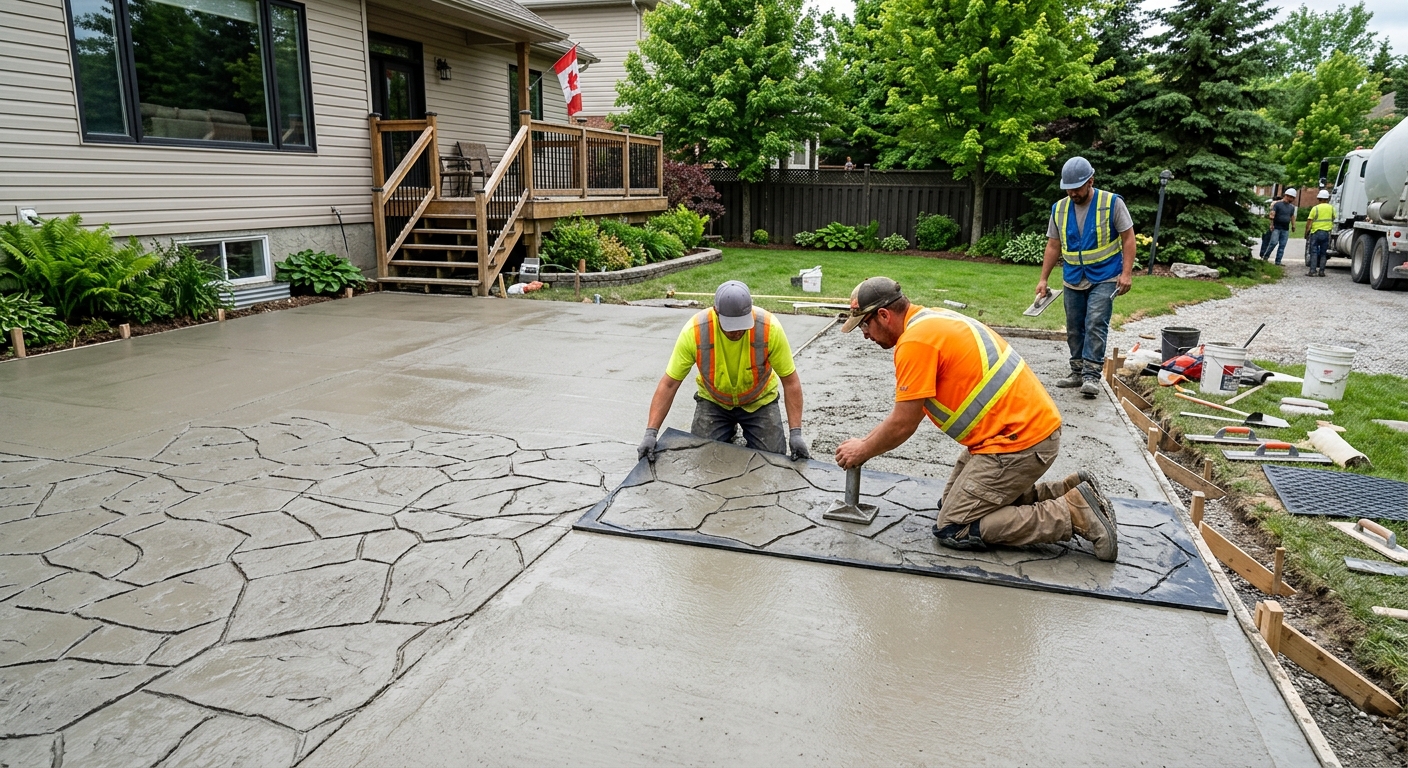
De-icing salt is another cost driver: sealed surfaces often perform better because the sealer reduces moisture ingress and helps slow deterioration. In West Meadowlark Park, we commonly see that price differences rise when: (1) the site needs extra haul for spoil and topsoil replacement, (2) reinforcement requirements change based on subgrade and load assumptions, or (3) you want premium finishes like stamped work instead of broom-finish concrete. A plain patio might land in the $5,000–$9,000 band, while a stamped option commonly moves toward the $15,000–$26,000 band once patterning, extra labour, and sealer are included.
| Price Factor |
Why It Matters | Why It Matters |
Cost Impact |
| Frost line depth |
Determines footing depth and form height |
Higher excavation and concrete volumes; more labour for structural jobs |
| Site preparation |
Excavation, grading, compacted granular base |
Under-prep causes settlement/cracking; full prep increases cost but improves longevity |
| Reinforcement |
Rebar or wire mesh requirement |
Material cost + labour; required for thicker slabs and structural elements |
| Mix design |
Air-entrainment and compressive strength spec |
Winter-grade and air-entrained mixes cost more but reduce freeze–thaw failure |
| Finish type |
Broom vs. stamped vs. exposed aggregate |
Stamped and exposed finishes add labour and material steps |
| Pour size and concrete truck access to site |
How far crews must place and finish |
Long carries/pumping or tight access can add fees and slow production |
| Cold-weather curing precautions |
Heating and blankets to reach proper strength |
Adds daily set-up time; prevents scaling and early surface failure |
| Control joint pattern and sealing cost |
Manages where cracks happen; protects against salt and moisture |
Good jointing + sealing reduces long-term repairs |
Permits & regulations in Alberta
In Alberta, structural concrete work—commonly including foundation footings, foundation walls, grade beams, and other elements that carry building loads—typically requires a building permit and often engineered drawings that must be reviewed through the municipal process. For concrete flatwork (driveways, patios, walkways), permits are usually not required unless the project affects lot grading, water drainage plans, impervious surface coverage limits, or any work that touches municipal right-of-way areas (for example, boulevard connections or curb-related drainage changes). Before breaking ground in West Meadowlark Park, confirm requirements with the local authority.
Regardless of permit requirements, a legitimate contractor should carry the right coverage. Start by verifying liability insurance and WSIB/WCB coverage (as applicable to the contractor’s workforce). Then, request recent references for similar concrete jobs in Calgary-area conditions—especially freeze–thaw exterior slabs. To check a contractor step-by-step, do this:
- Ask for their company information and a current insurance certificate (COI) showing liability coverage limits.
- Verify workers’ compensation coverage: check their WSIB/WCB clearance or registration proof.
- Confirm their Alberta licensing/registration where applicable for concrete-related trade activities (and make sure the person quoting is the same entity on the contract).
- Request a copy of the written quote/scope and confirm who obtains any required permits.
- Check references and photos from completed projects with similar scope (driveway/patio vs. structural footings).
If you’re unsure, it’s reasonable to pause and get clarification in writing before you commit.
Getting concrete right in West Meadowlark Park's freeze-thaw climate
Concrete failures in West Meadowlark Park’s climate usually start with one of three things: inadequate base preparation, incorrect mix design for freeze–thaw exposure, or poor curing and joint/sealer detailing. Calgary’s deep frost environment (about 1.2 m design frost depth) means exterior and foundation-adjacent work must be engineered so movement stays minimized. For slabs, the most common homeowner-visible problem is spalling—small flakes and surface pop-outs caused by water getting into the concrete and freezing, expanding, and breaking paste at the surface. That’s why the spec must include proper air entrainment and durable construction joints.
To spec the job correctly, build it from the ground up. First, require compacted granular sub-base to the correct depth for the slab and local soil conditions. Second, insist on air-entrained concrete suitable for exterior exposure—commonly aiming for 5–7% air content for exterior flatwork—plus a minimum compressive strength of 32 MPa for typical residential work. Third, ask for a control joint pattern that limits random cracking (rather than hoping cracks “don’t happen”). Fourth, require minimum curing: concrete needs time and temperature stability to gain strength; when cold nights arrive, winter curing measures (blankets/heating) may be necessary. Finally, sealing matters for salt protection: apply a penetrating sealer after the pour has cured—often around 28 days post-pour—so the surface repels de-icing moisture.
When choosing options, pay attention to where the extra dollars truly buy performance. For instance, a broom-finish driveway might fit the $12,000–$18,000 band, while stamped concrete moves toward the $15,000–$26,000 band; the price jump is justified when the contractor includes a jointing plan, proper release/bonding steps, and sealing that holds up to Calgary winters.
| Spec |
Why It Matters in West Meadowlark Park |
What to Ask For |
Impact if Skipped |
| Compacted granular base (depth?) |
Reduces settlement and helps keep the slab stable through freeze–thaw cycles |
State base thickness by slab type and confirm compaction testing/inspection |
Uneven settling, cracking, and early surface breakdown |
| Air-entrained concrete mix (target air %?) |
Prevents spalling by giving freeze–thaw protection inside the paste |
Ask for target air content (commonly 5–7% for exterior flatwork) and mix design details |
Spalling and scaling, especially where de-icing salts hit |
| Compressive strength (MPa rating) |
Ensures durability and load capacity in a cold freeze environment |
Confirm minimum 32 MPa (or higher if engineered) for the specified pour |
Lower strength leading to surface defects and faster wear |
| Control joints (spacing per ACI guidelines) |
Controls where shrinkage cracks form instead of letting them randomize |
Request joint spacing, saw-cut timing, and joint depth plan |
Wider, random cracks and moisture pathways |
| Minimum 7-day curing period |
Cold nights can slow hydration and weaken early-age concrete |
Require minimum 7 days curing under proper conditions (and winter measures if needed) |
Surface scaling and reduced long-term performance |
| Penetrating sealer (when applied after cure) |
Helps resist chloride/moisture from winter de-icing |
Ask for penetrating sealer applied after cure—commonly around 28 days post-pour |
Faster spalling and scaling around edges and high-salt areas |
How to choose a concrete work contractor in West Meadowlark Park
Choosing the right concrete contractor in West Meadowlark Park comes down to verifying coverage, getting clear itemized scope, and making sure they build to Alberta’s freeze–thaw reality. Start with Alberta verification: ask for their current certificate of liability insurance (COI) and proof of workers’ compensation coverage (WSIB/WCB clearance or registration proof). If a contractor can’t produce documents promptly, that’s a major warning sign. Next, confirm their Alberta licensing/registration for the trade activities involved and ensure the quoting entity matches the company doing the work.
Then, request 2–3 itemised written quotes—not just a single lump sum. You want a labour + materials breakdown that spells out what’s included: excavation, disposal, granular base, reinforcement, concrete mix type (air-entrained/winter grade if applicable), forms, finishing, saw cutting/control joints, and sealing. Ask whether permits are included or excluded, and if not, who pulls them. Confirm whether the quote includes site protection, protection of landscaping, and concrete saw-cut disposal.
Warranty should be in writing: workmanship warranty length (how long they stand behind cracking related to installation), plus whether any product/manufacturer warranty is included for sealer or specialty materials. Payment schedule matters too—never pay more than about 10–15% upfront; hold back a portion until the job is complete and final walk-through notes are addressed. Finally, get timeline details in writing, including a proposed start date, pour date, and estimated completion window—especially if cold-weather curing measures are anticipated.
- Ask for a current COI and confirm liability coverage limits.
- Request WSIB/WCB proof (clearance letter or registration confirmation).
- Verify Alberta licensing/registration relevant to their scope.
- Get itemized quotes: excavation, base, reinforcement, mix, labour, finishing, joints, sealing.
- Confirm whether disposal/haul is included for removed soil.
- Ask for the concrete mix spec: air-entrainment and minimum strength (e.g., 32 MPa).
- Confirm winter placement plan if weather turns—blankets/heating, curing protection.
- Ask about control joint spacing and when saw cuts happen.
- Clarify reinforcement: rebar/wire mesh placement and thickness assumptions.
- Confirm sealer type and when it’s applied (after cure, not immediately).
- Review warranty: workmanship duration and what defects are covered.
- Keep payment terms conservative: 10–15% max deposit; holdback until sign-off.
Red flags we see in the West Meadowlark Park market: contractors who won’t discuss air-entrainment or curing; quotes that omit excavation/base thickness and assume “existing grade is fine”; starting without written jointing/cut timing; refusing insurance/WSIB/WCB documentation; and pushing large upfront payments without a schedule, scope, and warranty in writing.
Frequently asked questions — concrete work in West Meadowlark Park
Can concrete be poured in cold weather in West Meadowlark Park?
Yes, concrete can be poured in West Meadowlark Park in colder weather, but it has to be engineered for it. Alberta freeze–thaw conditions mean the contractor must protect hydration and temperature—typically using winter-grade concrete mixes, insulated blankets, and sometimes heating, so the slab reaches strength without surface scaling. You’ll also want the contractor to plan the schedule around curing; rushing cure in late fall or early spring increases long-term problems like scaling and reduced durability. If you’re comparing pricing, cold-weather protection is one reason a driveway quote may move from the lower end of the $12,000–$18,000 band toward the upper end. Always ask what temperature thresholds trigger extra protection and how long curing protection will be maintained.
How do I maintain concrete in West Meadowlark Park's freeze-thaw climate?
Maintenance in Alberta’s freeze–thaw climate is mostly about moisture and salt control. Start with sealing: a penetrating sealer applied after the slab has cured (commonly around 28 days post-pour) helps repel de-icing moisture and slows deterioration. During winter, use de-icing products thoughtfully—avoid over-salting and promptly clear heavy salt build-up when safe. Keep edges and joints clean so drainage doesn’t trap water under the surface. If you notice small surface spalls or hairline cracks, address them early with appropriate repairs rather than waiting for water infiltration. For flatwork that’s already in place, regular inspection once or twice per season is a smart habit in West Meadowlark Park, because freeze–thaw cycles can expand small defects quickly.
What causes concrete to spall in West Meadowlark Park winters?
Spalling is usually caused by water getting into the concrete, then freezing and expanding—breaking down the paste at the surface. In Calgary-area winters, spalling risk rises when concrete isn’t air-entrained to the right spec, when finishing is rushed, or when curing protection isn’t sufficient in cold weather. It also happens when water can migrate through cracks or poorly sealed joints and reaches the surface during freeze–thaw cycles. De-icing salts worsen the problem because they increase chloride exposure. The right mix design (commonly targeting 5–7% air content for exterior flatwork) and proper curing are the best defenses. That’s also why a contractor should clearly state the mix and curing plan in their quote—spalling prevention isn’t optional.
What is rebar and when is it required in Alberta?
Rebar is steel reinforcement placed in concrete to help resist tension and control cracking, especially for thicker slabs, structural elements, and situations with higher loads. In Alberta, whether rebar is required depends on engineered design and slab thickness—not just on the homeowner’s preference. For example, foundation footings and many structural components are typically designed with reinforcement; those are the kinds of jobs that usually require engineered drawings and permits. For driveways and patios, some projects use wire mesh while others require rebar based on soil conditions, slab thickness, and vehicle/load assumptions. The key is to ask your contractor to explain the design basis in the quote: slab thickness, base prep, and reinforcement placement details. If they can’t specify what’s being used and why, that’s a concern in Calgary’s freeze–thaw environment.
How long does a concrete project take in West Meadowlark Park?
Timelines vary by scope, weather, and site access, but you can use Alberta freeze–thaw reality to set expectations. The actual pour day is often quick—hours rather than days—but preparation drives the schedule. For exterior flatwork like a patio or walkway, prep and forms can take 1–2 days, the pour may take a half day, and finishing/jointing is part of that same window. Curing is where time matters: you’ll typically need at least 7 days of proper curing conditions for strength development, and cold-weather protection can extend active protection time. If you’re doing a driveway, base prep and curing planning can add days depending on excavation and truck access. Structural footing timelines can be longer due to engineering, inspection steps, and deeper excavation to undisturbed soil below frost depth.
What is a concrete overlay and is it suited to West Meadowlark Park?
A concrete overlay is a new layer placed over an existing slab to improve appearance and extend service life, typically after surface preparation such as grinding or removal of weak edges. In West Meadowlark Park, overlays can be suited when the existing concrete is still structurally sound and properly bonded preparation is possible. However, overlays are not the best fix if the slab has major settlement, deep spalling from widespread freeze–thaw failure, or structural cracking that indicates movement. Also, drainage and joint conditions matter—if water is trapped and continues to freeze and expand, the overlay can fail as well. If you’re considering this option, ask for a clear assessment plan and bonding system details, and compare it to replacement pricing—driveways generally fall in the $12,000–$18,000 band for new work, while overlays can be lower upfront but may cost more over time if the base isn’t ready.