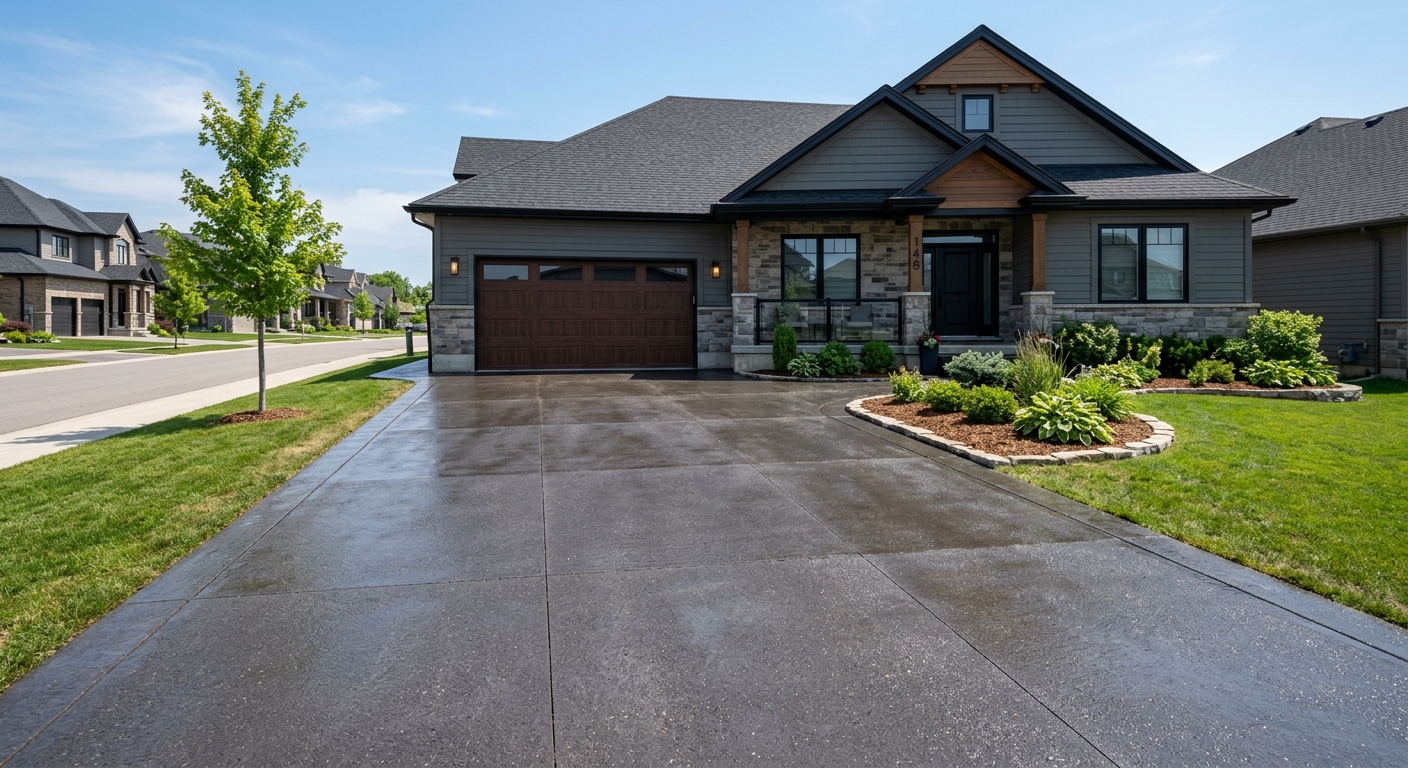
Concrete work options and costs in Spruce Grove
Spruce Grove homeowners typically choose concrete for driveways, patios, walkways and interior slabs because it holds up well against Edmonton-area freeze–thaw cycles when it’s detailed correctly. With 63.4% of dwellings being single-detached homes and about 10,890 homeowner households in the city area (Statistics Canada, 2021 Census), the demand is steady—especially for exterior flatwork that needs to manage both frost movement and winter de-icing.
Pricing in the Edmonton economic region is shaped by cold continental conditions. Frost depths commonly require footings set below the design frost line, and that means more excavation, more forming, and more engineered reinforcement than many mild-climate regions. For exterior slabs, Edmonton-area freeze–thaw cycles push contractors toward air-entrained mixes, well-compacted granular bases, and tighter control-joint layouts. Also, late-spring to early-fall is when many crews can pour flatwork without major cold-weather protection, so scheduling can affect labour pricing. In practical terms, that’s why a “simple” driveway can land anywhere within a wide band, while a foundation-only job can swing dramatically with excavation complexity and thickness.
In Spruce Grove, trades are especially busy around established residential pockets such as Brighton and Prairie Pointe, where lots are still being developed and homeowners frequently upgrade driveways, patios, and garage approaches. Below is a realistic comparison of common options so you can align scope with the kind of spec that performs in our climate—then you can use it to vet quotes.
| Application |
Typical Size |
Key Spec |
Finish Option |
Price Range |
| Concrete driveway (standard broom finish) |
18 ft x 24 ft (432 sq ft) |
Air-entrained exterior mix, compacted granular base, control joints |
Broom finish |
$9,000–$18,000 |
| Exposed aggregate driveway |
18 ft x 24 ft (432 sq ft) |
Air-entrained mix, uniform stone exposure, proper curing |
Exposed aggregate |
$12,000–$22,000 |
| Stamped concrete driveway or patio |
12 ft x 20 ft (240 sq ft) |
Air-entrained mix, integral colour, joint pattern planning |
Stamped + release + sealer |
$12,000–$26,000 |
| Plain concrete patio or walkway |
10 ft x 16 ft (160 sq ft) |
Air-entrained mix, compacted base, slope to drainage |
Float + broom edge |
$3,500–$9,000 |
| Garage floor (interior slab) |
22 ft x 20 ft (440 sq ft) |
Vapour barrier (if required), compacted base, wire mesh or rebar as specified |
Broom finish |
$6,500–$14,000 |
| Foundation footings (structural, below frost) |
Typical single-detached footing perimeter |
Below frost depth, forming, rebar, engineered details |
Structural concrete, not decorative |
$25,000–$60,000 |
Prices are estimates only and vary by project scope, site access and material selection.
What affects the price of concrete work in Spruce Grove
In Spruce Grove and the broader Edmonton region, two contractors can quote the “same” concrete job 30–50% apart because the details that control long-term performance are often what change—not just the concrete itself. The biggest drivers are frost-aware excavation and forming, the granular base quality, reinforcement decisions, mix design (especially air-entrainment), and how much cold-weather protection is required. If one quote includes those items and the other treats them as add-ons, the difference shows up quickly.
Across Alberta, frost line depth and freeze–thaw cycles dictate every spec. Exterior slabs and footings must be placed below the local design frost depth to prevent frost heave; in Alberta, that can push foundation excavation deeper than homeowners expect. Freeze–thaw also means exterior concrete should use air-entrained mixes so the slab can resist surface scaling and spalling over time. On top of that, the practical pour season for flatwork is shorter in winter shoulder conditions, so crews may need insulated blankets or heated curing enclosures to protect the concrete—adding both material and energy costs.
Local conditions can also raise costs in a way that looks “mysterious” on paper. For example, widening a driveway from 10 ft to 12 ft isn’t only extra area: it typically adds base thickness, reinforcement tie-ins, and drainage adjustments at the apron. Likewise, older homes or properties with services near the slab area can require extra hand excavation and waste disposal. Conversely, a straightforward, accessible patio with a clean grade and good drainage can land closer to the lower end of the $3,500–$9,000 patio/walkway band, while a decorative, stamped job can justify moving toward $12,000–$26,000 because of the colour system, stamping labour, and finishing time.
Finally, housing age matters: with 20.1% of homes built before 1981 (Statistics Canada, 2021 Census), you’ll sometimes see older fill, compacted inconsistencies, or drainage patterns that force more base correction before any slab is poured. That’s when a “quick patch” becomes a proper re-build to stop early cracking.
| Price Factor |
Why It Matters | Alberta |
Cost Impact |
| Frost line depth — determines footing depth and form height |
Below-frost placement protects against frost heave and differential movement |
Higher excavation and forming; can significantly increase foundation costs |
| Site preparation — excavation, grading, compacted granular base |
Cold-climate slabs rely on a stable, well-compacted base and proper drainage |
Extra labour and hauling; can swing the quote by thousands |
| Reinforcement — rebar or wire mesh requirement |
Helps control cracking where loads, span, or thickness require it |
Material and labour increase; essential for footings and many slabs |
| Mix design — air-entrainment and compressive strength spec |
Freeze–thaw survival depends on air-void system and proper strength |
Small material change, but required for performance in exterior flatwork |
| Finish type — broom vs. stamped vs. exposed aggregate |
Decorative finishes add steps, timing, and higher material handling |
Labour-intensive finishes push pricing toward the upper band |
| Pour size and concrete truck access to site |
Scheduling and placement efficiency affect labour and pumping/placement method |
Pump/placement logistics can add costs quickly on tight lots |
| Cold-weather curing precautions — heating and blankets |
Cold curing risks surface weakness and durability issues |
Added labour, equipment, and fuel; common in shoulder-season pours |
| Control joint pattern and sealing cost |
Joints and sealing reduce random cracking and salt-driven surface damage |
More cutting/layout time; sealing adds a separate but important line item |
Permits & regulations in Alberta
In Alberta, structural concrete work—such as foundation footings, foundation walls, and grade beams—typically requires a building permit, and engineered drawings are often reviewed as part of municipal plan review. For plain concrete flatwork like driveways, patios, and walkways, permits are usually not required, unless the work affects lot grading, impervious surface limits, or the municipal right-of-way. Because Spruce Grove projects can touch drainage and property line details, it’s smart to confirm with the local authority before breaking ground.
From a homeowner perspective, verification should be step-by-step:
- Contractor licence/eligibility: confirm the contractor’s business details and any trade authorizations listed by the province or applicable bodies (use the contractor’s official registration information from their documentation and any online registry they provide).
- Liability insurance certificate: ask for a current certificate of insurance naming you/your property as additional insured if required. Ensure coverage is active for the job duration.
- WSIB/WCB coverage: request proof of coverage (or the clearance letter) and confirm the policy is current.
- References: ask for similar-scale Alberta projects—ideally in cold climates where exterior slabs were detailed for freeze–thaw performance.
If the contractor can’t provide insurance/coverage documentation promptly—or tries to talk you out of itemising scope for permit-relevant items—treat that as a red flag before you sign.
Getting concrete right in Spruce Grove's freeze-thaw climate
Concrete fails in Spruce Grove most often when the job is built for “good weather,” not for freeze–thaw and salt. The big culprits are weak or unstable bases, inadequate air-entrainment (leading to spalling/scale), poor joint layout, and curing that’s too cold or too short. A properly specified exterior pour starts with a base designed to hold shape through frost movement: compacted granular sub-base to the correct depth, with drainage slopes so water doesn’t sit under the slab.
Next is mix design. For exterior flatwork, specify air-entrainment typically in the 5–7% air range and a minimum 32 MPa compressive strength (or as engineered for your structure). In our Edmonton market, this is non-negotiable; without an air-void system, freeze–thaw expands water and breaks down the surface mortar layer, causing spalling—especially where de-icing salt is used.
Control joints are also critical. They need to be cut or tooled early enough and laid out so shrinkage cracks happen in planned locations instead of randomly. For curing, aim for at least 7 days under proper conditions; when cold weather hits, contractors may need insulated blankets or heated enclosures to keep the concrete curing properly. Finally, sealing is a performance booster: apply a penetrating sealer after the slab has cured (commonly after 28 days) to help repel brine and reduce surface deterioration.
As a practical cost example: upgrading from a plain broom-finished patio to an exposed aggregate look might add labour and material, but if it’s built on a properly compacted base with the right air-entrained mix, you’re paying for durability and appearance—not just decoration. That’s the justification you should look for when quotes land anywhere within the $3,500–$9,000 patio/walkway band versus stepping up to more decorative systems.
| Spec |
Why It Matters in Spruce Grove |
What to Ask For |
Impact if Skipped |
| Compacted granular base (depth?) |
Sustains the slab during frost movement and controls settlement |
Base thickness plan, compaction method, and disposal of unsuitable material |
Uneven settling, cracking, and premature slab failure |
| Air-entrained concrete mix (target air %?) |
Freeze–thaw resistance reduces spalling and scaling in winter |
Air content target in the 5–7% range for exterior flatwork |
Surface scaling and spalling, especially after salt exposure |
| Compressive strength (MPa rating) |
Affects long-term durability and load capacity |
Minimum 32 MPa (or engineered spec) |
Higher risk of surface wear and cracking under traffic |
| Control joints (spacing per ACI guidelines) |
Manages shrinkage cracks during curing and temperature cycling |
Joint layout drawing and cutting plan (timing + spacing) |
Random cracking across visible areas |
| Minimum 7-day curing period |
Cold nights can slow strength gain and increase early damage |
Curing plan, protection details, and weather conditions handling |
Reduced strength and durability; more patchwork later |
| Penetrating sealer (when applied after cure) |
Helps repel de-icing salts and water ingress |
Apply after cure—commonly around 28 days—with product description |
Faster surface deterioration and more frequent repairs |
How to choose a concrete work contractor in Spruce Grove
Start by verifying the essentials for Alberta: ask for the contractor’s liability insurance certificate and confirm they carry current WSIB/WCB coverage for their workers. You should also request the related clearance letter if applicable. For itemised verification, don’t accept verbal answers—ask for the actual documents and check expiry dates. If a contractor can’t produce them promptly, it’s hard to trust the jobsite safety and coverage if something goes wrong.
Next, compare quotes in a way that protects you from surprises. Get 2–3 itemised written quotes that break out labour + materials (concrete volume, granular base, reinforcement, forming, cutting, sealing, and disposal). Make sure the scope clearly states what’s included: is the permit pull included where required, and is disposal included for excavation and old slab removal? Confirm whether they assume lift/haul costs, and how they handle drainage and tie-ins at edges and aprons.
Warranty should be in writing: ask for the workmanship warranty length, whether it’s transferable, and any product/manufacturer warranty terms. For payment schedule, don’t pay more than 10–15% upfront. Use a holdback until the work is complete and the finish/joint sealing plan is confirmed. Finally, insist on a start date and completion estimate in writing—Spruce Grove scheduling often tightens in late spring when pour season ramps up.
- Ask for a site visit and base-depth plan, not just “we pour concrete.”
- Request air-entrainment and curing details in writing.
- Confirm reinforcement requirements (footings vs slab, mesh vs rebar).
- Verify insurance certificate is current and specific to your project dates.
- Confirm WSIB/WCB clearance or proof of coverage.
- Insist on itemised labour/materials (no vague lump sums).
- Clarify whether disposal and hauling are included.
- Check whether control joints and sealing are included, and how/when.
- Ask who supplies the ready-mix and whether they provide batch tickets on request.
- Confirm cold-weather protection plan if temperatures dip.
- Require a timeline with start date and concrete placement window.
- Use a written warranty statement and list what it covers and for how long.
In Spruce Grove, concrete contractor red flags include: quotes that ignore frost-aware base prep, promises of “no need for joints” or “no need for air-entrainment,” vague schedules that don’t address cold curing protection, missing insurance/WSIB/WCB paperwork, and scope that doesn’t state disposal, excavation depth, or sealing responsibility.
Frequently asked questions — concrete work in Spruce Grove
What causes concrete to spall in Spruce Grove winters?
Spalling in Spruce Grove usually comes from the freeze–thaw process attacking the surface when the concrete isn’t detailed for winter cycling. The most common causes are poor air-entrainment (or the wrong mix for exterior exposure), insufficient base drainage that traps water under the slab, and curing that doesn’t achieve adequate early strength. De-icing salts make it worse by accelerating surface deterioration. In our climate around Edmonton, late fall and spring temperature swings repeatedly freeze and thaw moisture in the concrete pores. If joints aren’t cut and sealed correctly, cracks can form in random spots and allow more moisture into the slab. That’s why reputable contractors specify exterior air-entrained mixes and use a joint layout plan—especially for driveways and walkways.
What is rebar and when is it required in Alberta?
Rebar is steel reinforcing bar used to help control cracking and improve strength in concrete members. Whether you need it depends on what you’re building. For structural work like foundation footings and foundation walls, rebar is commonly required and detailed by engineered drawings to handle loads and frost-related forces. For exterior flatwork, some projects use wire mesh while others require rebar or additional reinforcement, based on slab thickness, soil conditions, and the type of traffic loads (like heavier vehicles on driveways). In Alberta, the freeze–thaw environment reinforces the need for correct thickness and reinforcement so small movements don’t turn into large cracks. When you get quotes in Spruce Grove, ask the contractor to specify exactly where reinforcement goes and reference the engineered or design thickness used for the slab.
How long does a concrete project take in Spruce Grove?
Typical timelines depend on whether it’s exterior flatwork or structural concrete. For a straightforward driveway or patio, crews may pour on a scheduled day, but the overall project usually takes longer because of excavation, base preparation, and finishing. After the pour, concrete needs curing—so it’s not just “the same day and done.” In practice, flatwork projects often span several days, with curing and protection steps affecting when you can use the surface safely. In cold Alberta conditions, the contractor may need blankets or heated curing enclosures, which can extend the schedule. Structural jobs like footings and foundation pours take additional time due to forming, inspections, and the sequence of reinforcement placement and concrete delivery. If you’re planning a spring pour in Spruce Grove, lock in a start date early because labour demand can tighten as the pour season ramps up.
What is a concrete overlay and is it suited to Spruce Grove?
A concrete overlay is a new concrete layer placed over an existing slab to restore surface condition without full removal—sometimes called resurfacing. Whether it’s suited to Spruce Grove depends on the condition of the original concrete and the cause of deterioration. If the existing slab has major settlement, widespread structural cracking, or poor drainage, an overlay may fail prematurely because the movement is still present underneath. In freeze–thaw climates, moisture and salt problems need to be addressed first. A good overlay system should include proper surface preparation (often grinding/cleaning and crack assessment), a suitable bonding approach, and joints that match movement patterns. If your current driveway is mostly sound but just spalled on the surface, an overlay can be a cost-effective option. But for heavily damaged slabs, full replacement—within the $9,000–$18,000 driveway band—often protects your long-term investment.
How do I seal concrete to protect it in Spruce Grove?
Sealing helps protect concrete from water and de-icing salts, but timing matters. For exterior flatwork in Spruce Grove, most contractors apply a penetrating sealer after the slab has cured—commonly around 28 days—so the concrete is dry enough to accept the sealer. Choose a product rated for freeze–thaw exposure and de-icer use, and follow surface prep requirements (cleaning, drying, and any required repair). Sealer won’t stop structural issues like failed base prep or inadequate air-entrainment, but it can reduce moisture intrusion that leads to scaling. When you review your quote, make sure sealing is included and that the contractor states the sealer type and when it will be applied. This is especially important for driveways and walkways that see regular salt use during Edmonton-area winters.
What is the difference between concrete and cement?
Concrete and cement are related but not the same thing. Cement is a key ingredient—essentially the “glue”—while concrete is the finished composite. Concrete typically includes cement, water, and aggregates (sand and gravel), plus other admixtures. Cement alone can’t be poured into a durable structure without aggregates and proper water-cement proportions. In Spruce Grove, the performance you feel comes from the whole concrete mix design: the aggregate gradation, water control, air-entrainment for freeze–thaw durability, and curing conditions. That’s why an “exterior mix” specification is more meaningful than simply saying “cement included.” When you’re comparing quotes for exterior flatwork in Alberta, ask what air content target they use and whether the mix meets the required strength and durability expectations for winter exposure.