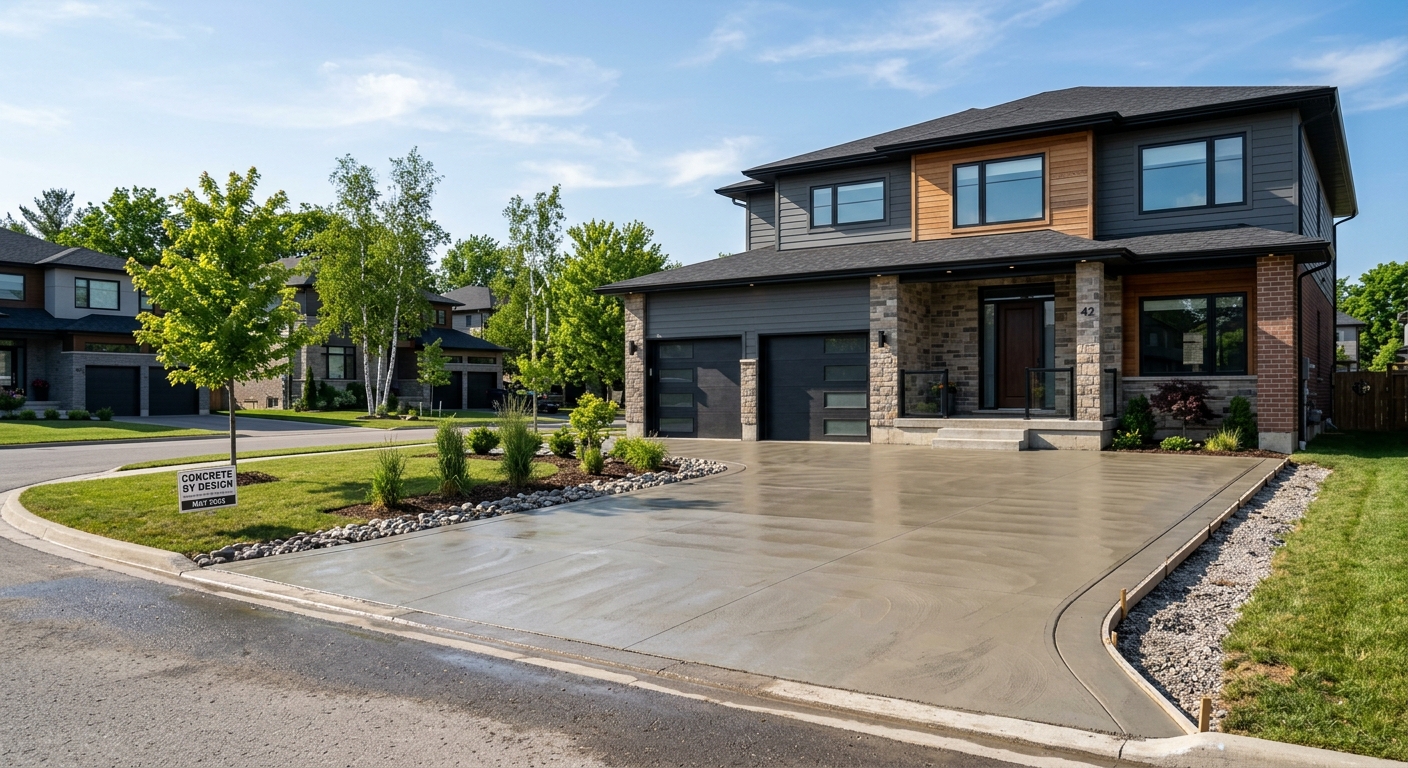
Concrete work options and costs in Dechene
Dechene homeowners typically choose concrete for driveways, patios and walkways because it’s durable and low-maintenance. With a population of 1,728 (Statistics Canada, 2021 Census), the local market is smaller, so contractor availability can be tighter than in larger Calgary-area communities. That’s especially true for flatwork demand around older residential pockets where resurfacing and expansion projects are common. In practice, concrete flatwork is often sized to match single-detached home lots and drive widths found throughout Dechene’s established neighbourhoods.
In Calgary’s broader market, cost is strongly influenced by cold continental winters. A design frost depth of about 1.2 m (roughly 4 ft) means exterior foundations and footings must be excavated and formed down on undisturbed soil to reduce frost heave and seasonal movement. Frequent freeze–thaw cycles also drive up the need for air-entrained mixes, correct granular base prep, and a control-joint plan that limits random cracking and surface scaling. For exterior slabs, the pour season is shorter, and cold-weather placement may require winter-grade mix, insulated blankets and careful curing—added labour that affects pricing.
On the labour side, crews that can handle deeper excavations and higher spec concrete (not just “standard” mixes) tend to command steadier schedules—another reason you may see meaningful quote differences. If you’re planning a driveway or patio in the Dechene area near established commuter routes toward Calgary, pricing usually reflects access, truck entry points, and how quickly the job can be scheduled before weather turns.
Here’s a realistic comparison of common options to help you line up scopes before you request detailed bids.
| Application |
Typical Size |
Key Spec |
Finish Option |
Price Range |
| Concrete driveway (standard broom finish) |
20 ft x 10 ft (200 sq. ft.) |
Air-entrained exterior slab; compacted granular base |
Broom finish with control joints |
$12,000–$18,000 |
| Exposed aggregate driveway |
20 ft x 10 ft (200 sq. ft.) |
Air-entrained mix; uniform aggregate exposure |
Exposed aggregate with sealer-ready surface |
$13,500–$20,500 |
| Stamped concrete driveway or patio |
250 sq. ft. driveway patio area |
Air-entrained mix; colour hardeners as required |
Stamped pattern with integral colouring |
$15,000–$26,000 |
| Plain concrete patio or walkway |
12 ft x 12 ft (144 sq. ft.) |
Exterior air-entrained concrete; proper drainage slope |
Float and broom finish |
$5,000–$9,000 |
| Garage floor (interior slab) |
22 ft x 20 ft (440 sq. ft.) |
Vapour barrier & base prep; welded wire reinforcement |
Broom finish or smooth trowel (per plan) |
$6,500–$13,500 |
| Foundation footings (structural, below frost) |
Typical single-detached footing system |
Excavate to undisturbed soil; engineered rebar |
Structural concrete; forms and inspection-ready |
$28,000–$45,000 |
Prices are estimates only and vary by project scope, site access and material selection.
What affects the price of concrete work in Dechene
In Dechene and across the Calgary region, you can see quotes for what seems like the “same” concrete job swing by 30–50%. The difference usually isn’t the concrete alone—it’s the engineered spec, excavation depth, base prep quality, reinforcement detail, and how long the contractor can protect curing concrete in a cold snap. Even for flatwork, one bid may include proper air-entrainment, granular base compaction and sealing prep, while another may treat it as a quick surface pour. That’s why a driveway in the $12,000–$18,000 band can end up closer to the top end when excavation and truck access are difficult.
The biggest technical driver is Calgary’s frost and freeze–thaw environment. Footings for exterior foundations must extend below the design frost depth to prevent frost heave and seasonal movement. Locally, that frost depth is engineered at about 1.2 m (roughly 4 ft). When excavation goes deeper (or wider) due to soil conditions, foundation footprints and frost-protection requirements, costs rise because formwork height, concrete volume and disposal all increase. For exterior slabs—driveways, patios and walkways—air-entrained concrete is essential to survive freeze–thaw cycles; if a contractor under-specs air content, you’re more likely to see spalling and scaling later.
Cold-weather curing precautions also matter. In shoulder seasons, crews may need insulated blankets and sometimes supplemental heat to reach proper curing conditions. That adds labour hours and equipment. Lastly, de-icing salt accelerates surface deterioration, so sealing (and doing it at the right time) often separates a driveway that stays looking good from one that roughens quickly. For example, moving from a broom-finish patio in the $5,000–$9,000 range to a stamped option closer to $15,000–$26,000 is usually justified when you’re improving appearance and durability with proper colour hardener and finishing discipline—assuming the base and jointing are still done correctly.
| Price Factor |
Why It Matters |
Cost Impact |
| Frost line depth — determines footing depth and form height |
Footings must bear below design frost to prevent frost heave |
Higher excavation and concrete volume can move structural work into the top portion of the $28,000–$45,000 band |
| Site preparation — excavation, grading, compacted granular base |
Freeze–thaw failures often start with poor base support |
More hauling/disposal and more base material can add thousands on exterior slabs |
| Reinforcement — rebar or wire mesh requirement |
Reinforcement controls cracking and improves slab performance under load |
Material and labour increase, especially for garage floors and heavier driveways |
| Mix design — air-entrainment and compressive strength spec |
Air entrainment is critical for durability in freeze–thaw conditions |
Better mix specs reduce long-term failure risk; sometimes pushes you to upper price bands |
| Finish type — broom vs. stamped vs. exposed aggregate |
Finishes require different workflow and finishing materials |
Stamped and exposed work typically shifts pricing toward the higher ends ($15,000–$26,000 for decorative) |
| Pour size and concrete truck access to site |
Access affects placement speed and how often trucks can deliver |
Limited access can require pumping or additional labour, raising unit costs |
| Cold-weather curing precautions — heating and blankets |
Protecting early-age strength prevents scaling and surface defects |
Equipment and extra crew time can be a meaningful add-on in late fall or early spring |
| Control joint pattern and sealing cost |
Joints reduce random cracking; sealing helps repel de-icing salt |
Proper jointing and sealer can add a few hundred to over a thousand, depending on surface area |
Permits & regulations in Alberta
In Alberta, structural concrete work—especially footings, foundation walls, and grade beams—normally requires a building permit and is often tied to engineered drawings that the municipality reviews. If your project changes the foundation layout, bearing conditions, or structural loads, assume permits are required. Concrete flatwork (driveways, patios, walkways) typically does not require a permit unless it impacts lot grading, affects impervious surface coverage limits, or intersects municipal right-of-way requirements. Because Dechene is part of the broader Calgary housing market, local compliance expectations can still affect how ties-in, drainage, and elevations are handled—so it’s worth confirming before excavation.
Step-by-step, here’s how a homeowner can verify a contractor in Alberta before work starts:
- Request the contractor’s current business details and confirm their trade status through the appropriate online registry (where applicable in Alberta for their business type).
- Ask for a Certificate of Liability Insurance showing adequate limits for construction work, and ensure it lists you or your property as an affected party if your agreement requires it.
- Verify WSIB/WCB coverage (Workers’ Compensation Board coverage) so you’re not exposed if an injury occurs on site.
- Get references from projects of similar scale—ideally exterior flatwork or foundations poured in cold weather—and ask for photos showing joints, base prep and curing protection.
- Confirm the permit responsibility in writing: who pulls it, what drawings are referenced, and what inspections are included.
If a contractor can’t provide insurance/WSIB documentation or seems unsure about whether permits apply, that’s a practical warning sign on a cold-weather concrete schedule.
Getting concrete right in Dechene's freeze-thaw climate
Concrete failures in Dechene almost always trace back to a few controllable items: base support, mix design, jointing, curing, and—if you want it to resist salt—sealing. Start with base preparation: exterior slabs should sit on a properly compacted granular sub-base sized for local soil conditions and engineered frost requirements. In this region, Calgary-area practice engineers footings and exterior bearing down below about 1.2 m (roughly 4 ft) design frost depth, and the same discipline applies to slab subgrade preparation to reduce pumping, settling and heave-related cracking.
Next is mix design. For outdoor flatwork, air-entrainment is non-negotiable; exterior exposure in freeze–thaw cycles typically targets about 5% to 7% air content. Many durable placements also specify a minimum compressive strength around 32 MPa (or higher if the design calls for it). Without enough air, water enters tiny pores and expands during freezes, leading to scaling and spalling—often visible as flaking at the surface edges of driveways and patios.
Control joints matter because they give the slab a planned crack location. Your contractor should lay out joint spacing to limit random cracking, then finish so joints are clean and not “buried” by excess paste. Curing is equally important: plan for minimum 7 days curing under proper conditions, and in colder pours, use insulated blankets and careful protection so early-age strength isn’t compromised. Finally, sealing is your line of defence against de-icing salt: apply a penetrating sealer after the concrete has cured (commonly around 28 days) to repel moisture and reduce surface deterioration.
Where does the money make sense? For instance, spending an extra amount to move from a plain broom-finish patio toward a decorative stamped look can be justified when the base, air-entrainment and joint plan remain correct. If the base prep is cut or air content isn’t right, paying for decoration doesn’t prevent the underlying failure mechanism—so the “cheapest” bid can become the most expensive over the next winter cycle.
| Spec |
Why It Matters in Dechene |
What to Ask For |
Impact if Skipped |
| Compacted granular base (depth?) |
Stable support reduces settling and frost-related movement |
Provide base depth and compaction specs matched to soil and frost conditions |
Cracking, uneven slabs, and pumping/voids under freeze–thaw cycles |
| Air-entrained concrete mix (target air %?) |
Controls freeze–thaw durability in Alberta winters |
Request target air content of about 5% to 7% for exterior flatwork |
Spalling and scaling at the surface, especially along edges |
| Compressive strength (MPa rating) |
Ensures the slab gains strength before cold weather stresses it |
Confirm minimum 32 MPa (or higher if engineered) |
Lower long-term strength and surface wear/rutting under load |
| Control joints (spacing per ACI guidelines) |
Reduces random cracking by giving the slab a planned place to crack |
Ask for joint spacing plan and where joints land relative to openings/edges |
Wider random cracks and premature water intrusion |
| Minimum 7-day curing period |
Cold snaps can interrupt early-age strength development |
Ask how curing will be protected; plan for at least 7 days of proper curing conditions |
Surface defects, scaling risk, and reduced durability over winters |
| Penetrating sealer (when applied after cure) |
De-icing salts accelerate surface deterioration |
Confirm seal type and timing, commonly after full cure (about 28 days) |
Faster surface roughening, staining, and moisture ingress |
How to choose a concrete work contractor in Dechene
Choosing the right concrete contractor in Dechene starts with verifying three essentials: Alberta licensing/registration where required, liability insurance, and WSIB/WCB coverage. For each, ask for current documentation before a contract is signed. Liability insurance protects you if there’s property damage during excavation, forms, or delivery. WSIB/WCB coverage matters because it shifts workers’ safety responsibility appropriately—if a worker is injured on site and coverage isn’t in place, the homeowner can be exposed to financial risk through change orders and delays.
Next, get 2–3 itemised written quotes. You want a breakdown that separates labour (excavation, forming, finishing, curing protection) from materials (concrete, rebar/wire mesh, base materials, vapour barrier where applicable, sealer, and joints/gear as needed). Ask whether disposal is included, whether permits are the contractor’s responsibility (for structural work), and what’s excluded—like snow removal before or after the pour, rework of unsuitable subgrade, or pumping if access is tight.
Then scrutinize warranty and schedule. Ask for a workmanship warranty length and confirm whether it covers cracking that results from jointing/base prep deficiencies, not just surface cosmetic issues. Also clarify if product/manufacturer warranties apply to admixtures, sealers, or decorative systems. Payment should follow a controlled schedule—never more than about 10% to 15% upfront, and hold back money until the job is complete and cleaned up. Finally, request the start date and an estimated completion timeline in writing so the crew isn’t forced into rushed curing because of weather.
- Ask who is responsible for permits for footings/foundations and list it in the contract.
- Request WSIB/WCB proof and confirm it covers the actual crews scheduled for your pour.
- Confirm liability insurance limits and get a certificate copy before excavation starts.
- Require an itemised scope: base prep, reinforcement, concrete spec, finishing, joints, and sealing.
- Ask how disposal and haul-away will be handled for excess soil and old concrete.
- Confirm whether concrete truck access is assumed; ask about pumping if access is limited.
- Get the planned joint layout and finish method in writing (broom vs. exposed vs. stamped).
- Ask what curing protection will be used in colder weather (blankets, coverings, timing).
- Clarify sealing: product type, application timing, and whether it’s included in the price.
- Set payment milestones: small deposit, then progress payments tied to inspections or stages.
- Verify warranty terms in plain language: what’s covered, what’s excluded, and claim process.
- Ensure the contract includes site protections (saw-cut cleanup, grading touch-ups, debris removal).
Red flags I commonly see in Dechene concrete contractor proposals include “standard mix only” without air-entrainment stated, skipping sealed curing protection plans in late season, not providing joint spacing or a joint plan, offering a single lump-sum without base prep or disposal details, and asking for large upfront payments without a clear schedule.
Frequently asked questions — concrete work in Dechene
How much does concrete work cost in Dechene?
In Dechene, typical pricing follows the Calgary-region bands, but your exact number depends heavily on excavation depth, base prep, access, and finish details. For exterior flatwork, a basic concrete patio or walkway commonly lands in the $5,000–$9,000 range for typical homeowner sizes, while a standard broom-finish driveway is often in the $12,000–$18,000 range. Decorative options usually cost more: stamped concrete often falls in the $15,000–$26,000 band depending on area and colour/texture complexity. Foundation costs are a different category—structural footings in this market typically fall around $28,000–$45,000 because the frost-depth excavation is deeper and the concrete volumes are larger. (Statistics Canada, 2021 Census)
How deep must footings be for Dechene's frost line?
For Dechene’s winter conditions, footings are engineered to extend below the local design frost depth so the soil under the bearing area can resist freeze–thaw movement. In the Calgary region, that design frost depth is about 1.2 m (roughly 4 ft). In practical terms, that means deeper excavation than in milder climates, and it often dictates formwork height, concrete volume, and how reinforcement is placed. If your contractor suggests bearing on “whatever depth is handy” without referring to engineered foundation drawings, that’s a major concern. Structural concrete work should be tied to approved plans and inspections, and the right depth isn’t something you guess at—it’s designed for frost performance and long-term movement control in Alberta winters.
Why does concrete crack in Dechene and how is it prevented?
Concrete in Dechene cracks for predictable reasons: temperature movement, shrinkage during early curing, and differential support when the base isn’t compacted or is improperly graded. In Alberta’s freeze–thaw cycles, water can also enter micro-gaps, which worsens surface deterioration if the concrete lacks the right air-entrainment. The prevention plan should include a compacted granular base to the right depth, exterior air-entrained mix, and a control-joint layout that limits random cracking. Good curing protection is also critical—minimum 7 days under proper conditions—because rushing early-age strength development can lead to surface defects. For homeowners comparing bids, make sure joint spacing and mix specs are actually written, not just “we’ll pour concrete and finish it.”
Stamped vs broom-finish concrete — cost difference?
Stamped concrete costs more than broom-finish because the finish process is more labour-intensive and uses additional materials. Broom-finish driveways are typically in the $12,000–$18,000 band for common Dechene sizes, assuming proper base prep and air-entrained exterior mix. Stamped concrete driveway or patio work often lands in the $15,000–$26,000 band because of added steps such as colouring (integral colour and/or hardeners), careful timing for stamping, release agents, and more detailed finishing. The key point: stamped looks won’t solve performance problems. If air-entrainment, jointing and curing protections are cut to hit a lower price, you can still get cracking or spalling—just with an upgraded finish.
When is the best time to pour concrete in Dechene?
The best time in Dechene is when temperatures allow concrete to cure properly without excessive risk of early-age freezing or surface scaling. In the Calgary area, exterior slabs are harder to pour late in the season, and freeze–thaw cycles mean crews may need winter-grade mixes and insulated blankets if cold weather hits. Ask your contractor what temperature thresholds they follow for placement and finishing, and how they plan to protect curing concrete if night temperatures drop. If you’re scheduling a driveway or patio, aim for a window with stable daytime temperatures and clear weather so you can achieve at least a minimum 7-day curing period under protected conditions. Foundation pours are typically more scheduled around inspections and engineering requirements, but the same cold-weather curing discipline applies.
How long does concrete take to cure?
Concrete curing has two timelines homeowners usually hear: early strength gain and long-term durability. For practical workmanship planning in Dechene, you should expect minimum 7 days of curing under proper conditions before the concrete is considered to have reached a safer handling/early performance level for many exterior uses. Full durability benefits continue developing over time. For surface protection choices like penetrating sealers, contractors commonly apply after the slab has fully cured—often around 28 days—so the concrete is ready to accept the sealer and repel moisture and de-icing salt. If you’re comparing bids, ask what curing protection is included (covers/blankets/heating if needed) because cold snaps can interrupt early-age strength development and increase long-term scaling risk.