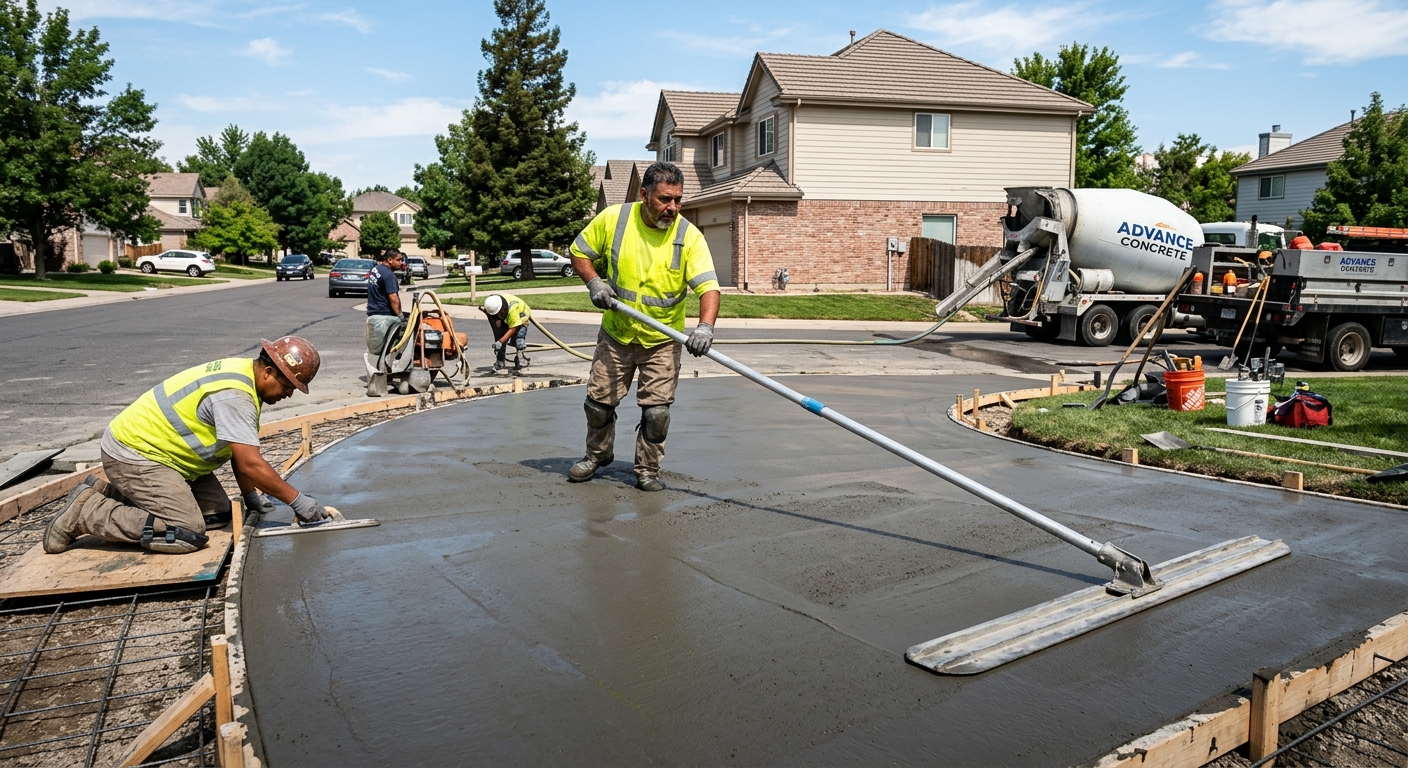
Concrete work options and costs in Killarney
Killarney, Alberta is a compact, family-focused community in the Calgary economic region, and it’s the kind of neighbourhood where homeowners notice the difference between “installed and forgotten” concrete and properly detailed concrete that survives the freeze-thaw seasons. With a population of 3,990 (Statistics Canada, 2021 Census), local demand is steady for driveways, patios, walkways, and the concrete elements tied to home renovations and infills. A large portion of Killarney’s housing stock is the typical Calgary pattern of single-detached properties—exact counts vary by area—but the day-to-day reality is the same: people want flatwork that stays level, drains well, and doesn’t scale after winter.
In this part of Alberta, Calgary’s cold continental climate is engineered into every estimate. Concrete must be placed with an air-entrained mix designed for freeze-thaw exposure, and excavation/foundation work is driven by deeper frost considerations (around 1.2 m as a practical design benchmark in the region). Frequent freeze–thaw cycles also increase labour time for granular base prep, joint layout, and the extra curing protection needed when temperatures swing near freezing. For exterior slabs, the practical pour season can be shorter, so crews may price around scheduling and winter-grade curing precautions.
In Killarney, concrete work is especially in demand around the older residential lanes and nearby infill corridors where driveways and sidewalks get replaced as homes are refreshed. Once you understand the options below, the next step is comparing finishes and structural scope so you can align your expectations with the local price bands.
| Application |
Typical Size |
Key Spec |
Finish Option |
Price Range |
| Concrete driveway (standard broom finish) |
24 ft x 10 ft (240 sq ft) |
Air-entrained exterior mix; compacted granular base; control joints |
Broom finish, simple edging |
$12,000–$18,000 |
| Exposed aggregate driveway |
24 ft x 10 ft (240 sq ft) |
Air-entrained mix; proper curing; base compaction for freeze-thaw |
Exposed aggregate surface |
$14,000–$22,000 |
| Stamped concrete driveway or patio |
20 ft x 14 ft (280 sq ft) or driveway segment |
Air-entrained exterior mix; thicker wear layer detailing |
Stamp pattern with release powder and integral colour (where chosen) |
$15,000–$26,000 |
| Plain concrete patio or walkway |
12 ft x 16 ft (192 sq ft) |
Air-entrained mix; drainage slope; joints sized for exterior movement |
Float and broom finish |
$5,000–$9,000 |
| Garage floor (interior slab) |
24 ft x 22 ft (528 sq ft) |
Vapour barrier (as needed); steel reinforcement; proper sub-base |
Light broom/smooth trowel (as selected) |
$10,500–$18,500 |
| Foundation footings (structural, below frost) |
Typical house + garage footprint |
Engineered design; excavation to design frost depth; reinforced footing concrete |
Structural concrete placement only (no decorative finish) |
$28,000–$45,000 |
Prices are estimates only and vary by project scope, site access and material selection.
What affects the price of concrete work in Killarney
In Killarney (and across Calgary), it’s normal to see quotes for the “same-looking” concrete job vary by 30–50%. The culprit is rarely the concrete itself—it’s the engineered details: excavation depth, base thickness and compaction quality, reinforcement choices, and how crews plan for frost protection and curing. Two contractors can both claim they’re pouring a “driveway,” but one may be building to survive freeze–thaw properly while the other is closer to a basic slab-on-grade approach. In a region where the practical design frost depth is about 1.2 m, foundation and exterior slab work can require noticeably more excavation and footing volume than in milder provinces, and that drives up both labour and disposal costs.
Freeze–thaw cycles also dictate higher-spec materials and placement precautions. Exterior slabs need air-entrained concrete to reduce freeze-related damage, and control joints must be spaced to limit random cracking. Cold-weather placement adds cost through insulated blankets, wind protection, and sometimes temporary heat to hit curing conditions. Add de-icing salts—very common in Calgary winters—and surface sealing becomes essential to slow spalling and scaling.
In Killarney, you’ll often see cost rise when a driveway ties into an existing slope, when access is tight for a concrete truck, or when removal requires heavier equipment. Conversely, costs can drop when the site is already well-graded and there’s room for proper base prep and forms. If you’re choosing between plain flatwork in the $5,000–$9,000 band (like a basic patio) and something decorative in the $15,000–$26,000 band (like stamped concrete), the price difference is usually justified by added labour for stamping/colouring, longer curing logistics, and higher tolerance work around borders and joints.
| Price Factor |
Why It Matters |
Cost Impact |
| Frost line depth — determines footing depth and form height |
Footings must bear below the design frost depth to prevent heave |
Can increase excavation and concrete volume significantly on structural pours |
| Site preparation — excavation, grading, compacted granular base |
Proper base compaction prevents settlement and helps drainage |
Extra haul-off, grading time, and compaction passes raise labour |
| Reinforcement — rebar or wire mesh requirement |
Controls cracking and adds structural capacity for heavier loads |
Material + placement time; increases cost more on larger slabs |
| Mix design — air-entrainment and compressive strength spec |
Freeze-thaw resistance depends on air content and strength targets |
Higher-spec mix and testing/verification may add per-yard cost |
| Finish type — broom vs. stamped vs. exposed aggregate |
Surface systems require different labour, curing discipline, and materials |
Stamped/exposed typically adds labour and product costs |
| Pour size and concrete truck access to site |
Smaller pours or difficult access can require multiple loads and extra labour |
Delays and extra handling can push the price up |
| Cold-weather curing precautions — heating and blankets |
Ensures concrete reaches adequate early strength without surface damage |
Winter protection and monitoring can add a meaningful surcharge |
| Control joint pattern and sealing cost |
Joints manage movement; sealing helps resist de-icing-salt deterioration |
More layout time and sealer material increase total scope |
Permits & regulations in Alberta
In Alberta, structural concrete work generally requires a building permit. That includes tasks like foundation footings, foundation walls, grade beams, and other structural elements that affect the building’s load path. In many situations, engineered drawings are reviewed as part of the permit process. By contrast, concrete flatwork such as patios, walkways, and driveways typically does not require a permit unless it affects lot grading, drainage, impervious surface coverage limits, or the municipal right-of-way (for example, works near curb/sidewalk areas). Before breaking ground in Killarney, confirm the requirements with the local authority—especially if you’re changing elevations, adding drainage, or touching any municipal edge.
For your contractor check-list, don’t just ask for “insurance”—verify it. Step-by-step: (1) confirm Alberta contractor licensing (and that the contractor is in good standing if applicable for their scope); (2) ask for a current certificate of liability insurance and make sure it lists your project address or is general with proper coverage limits; (3) request proof of WSIB/WCB coverage (coverage should be active for the timeframe of the work); (4) ask for a clearance letter or equivalent proof document if your contractor uses it in their process; and (5) obtain references for similar-sized concrete placements around the Calgary area so you can see workmanship under freeze–thaw conditions.
Getting concrete right in Killarney's freeze-thaw climate
Concrete failures in Killarney are usually about movement, moisture, and early curing—not about “bad luck.” The two big problems I see are (1) inadequate base preparation leading to settlement and (2) surface scaling/spalling from freeze-thaw exposure when the concrete isn’t properly air-entrained. To spec the job correctly, start from the ground up. Base prep means a compacted granular sub-base to the right depth for the local soil and drainage, not “whatever fits.” Then specify an exterior mix with air-entrainment (commonly 5–7% air content for exterior flatwork) and a minimum compressive strength of 32 MPa. After placement, control joints should be cut or tooled on a planned pattern to limit random cracking, and curing must meet conditions long enough to develop strength. In Calgary-area weather swings, curing attention matters—pouring too late in the season or skipping cold-weather measures can jeopardize durability.
Finally, plan for sealing. A penetrating sealer applied after the concrete has cured (commonly after 28 days) helps repel de-icing salt and reduces moisture intrusion—important when winter grit and meltwater sit on surfaces.
When you compare options, you’ll often find that spending for proper freeze–thaw specs prevents bigger costs later. For example, a basic patio may land in the $5,000–$9,000 band, but a “cheap” shortcut that skips proper air-entrainment and joint discipline can lead to premature scaling, effectively forcing an expensive redo—often far beyond the initial savings. Decorative options in the $15,000–$26,000 band are fine, but only when the foundation of the slab and curing plan are correct.
| Spec |
Why It Matters in Killarney |
What to Ask For |
Impact if Skipped |
| Compacted granular base (depth?) |
Killarney’s freeze–thaw drives the need for stable support and drainage control |
Base thickness to match soil conditions; compaction testing method (or documented passes) |
Settlement, uneven surfaces, and early cracking |
| Air-entrained concrete mix (target air %?) |
Freeze-thaw resistance depends on sufficient microscopic air bubbles |
Target air content of about 5–7% for exterior flatwork; specify air-entrainment use |
Higher risk of spalling and surface scaling in winter |
| Compressive strength (MPa rating) |
Strength supports durability and load performance under winter conditions |
Minimum 32 MPa compressive strength specified for the application |
Reduced durability and increased surface damage |
| Control joints (spacing per ACI guidelines) |
Controls where cracks form during temperature swings and drying shrinkage |
Planned joint layout and spacing that matches slab dimensions |
Random cracking and potential water infiltration |
| Minimum 7-day curing period |
Develops early strength and improves resistance before winter exposure ramps up |
Clear curing approach and timeframe; cold-weather protection if needed |
Lower strength at surface and higher long-term scaling risk |
| Penetrating sealer (when applied after cure) |
Helps block moisture and de-icing salt intrusion that accelerates spalling |
Specify penetrating sealer applied after adequate curing (often 28 days) |
Faster deterioration and more frequent patching |
How to choose a concrete work contractor in Killarney
Choosing the right contractor in Killarney starts with verification, not marketing. In Alberta, ask for proof of liability insurance (current certificate), and confirm WSIB/WCB coverage is active for the crew and timeframe. How to check: (1) request certificates and verify the coverage dates and project scope; (2) ask whether they can provide a clearance letter or proof of active coverage upon request; (3) verify Alberta licensing/eligibility for their scope (and confirm there are no issues related to current work); and (4) confirm the company has experience with freeze–thaw engineered concrete placements in Calgary—especially air-entrained exterior work and cold-weather curing protocols.
Then get 2–3 itemised written quotes. Avoid lump-sum only. You want labour and materials broken down: excavation/disposal, granular base, reinforcement, concrete supply/mix spec, forms, finishing, joints, and whether curing protection and sealing are included. Read the scope carefully: what’s excluded (spot repairs, removals beyond certain limits, snow/ice removal for safe access, permit handling if applicable)? Is site access and concrete truck placement included? Is the contractor responsible for hauling spoil and leveling to finished elevations?
For warranty, look for a workmanship warranty length and what it covers (cracking, spalling, settlement) plus product/manufacturer coverage if aggregates or specialty products are used. Payment schedule matters: never pay more than 10–15% upfront, and hold back until the job is substantially complete and cleaned up. Finally, insist on a written timeline with a start date and completion estimate; in Alberta, weather can affect pours, so ask how they’ll protect curing if temperatures drop.
- Ask for a written scope with concrete mix spec (air-entrainment) and target strength.
- Confirm the footing depth/structural design details match engineered drawings (where required).
- Verify liability insurance and WSIB/WCB coverage before work begins.
- Get at least two itemised alternatives: standard vs decorative, with joint/sealing differences explained.
- Check whether excavation, haul-off, and disposal are included or cost extra.
- Confirm base prep requirements (granular depth and compaction) are listed—not just “level and pour.”
- Ask about reinforcement: wire mesh vs rebar, spacing, and tie-in details for load areas.
- Ensure the quote includes control joint layout and saw-cut or tool timing.
- Ask who is responsible for cold-weather curing measures (blankets/heaters/monitoring) if temperatures fall.
- Confirm finishing details: broom vs stamped/exposed, edging, and pattern alignment.
- Require a stated curing period and when the surface can be used.
- Confirm warranty terms and what documentation you receive (batch/placement details if available).
In my experience around Killarney, concrete-red-flag signs include: quotes that don’t specify air-entrainment or compressive strength, missing details on base depth/compaction, crews proposing to pour late-fall without winter-grade curing protection, “cut corners” on joint layout and sealing, and a payment demand that’s too high before any prep or reinforcement is complete.
Frequently asked questions — concrete work in Killarney
How do I maintain concrete in Killarney's freeze-thaw climate?
In Killarney, maintenance is mainly about keeping moisture and salt exposure from building up on the surface. First, sweep loose grit regularly—sand and de-icing residue work like an abrasive and can speed up wear. For snow and ice, use plastic shovels and avoid aggressive scraping that chips corners. If your slab is exterior and exposed to winter de-icing, a penetrating sealer (typically applied after proper curing, often around 28 days) helps repel meltwater and salts, which reduces spalling risk over time. If you see early hairline cracking, don’t ignore it—ask a contractor whether a joint sealant or targeted crack repair is appropriate for your joint pattern. Annual checks for settled edges and drainage problems are especially important in Calgary-area freeze–thaw cycles.
What causes concrete to spall in Killarney winters?
Spalling in Killarney is most often linked to freeze–thaw damage where water gets into the concrete and expands as temperatures drop. The biggest technical cause is inadequate air-entrainment: exterior flatwork should have an air-entrained mix (commonly about 5–7% air) so freeze energy is managed. Another contributor is moisture movement from poor base prep—if the granular sub-base isn’t compacted properly or drainage isn’t right, water can sit under or at the slab surface. De-icing salts worsen the problem because they increase chemical stress while water is freezing. Finally, rushed curing—especially when temperatures swing near freezing—can leave the surface weaker. If you’re planning a patio around the $5,000–$9,000 range, insist the quote includes exterior freeze-thaw specs and proper curing discipline, not just the finish.
What is rebar and when is it required in Alberta?
Rebar is steel reinforcement bars that are embedded in concrete to improve strength and control cracking under load and movement. In Alberta, rebar requirements depend on the engineered design and the slab’s intended use. For most structural work—such as foundation walls, grade beams, and footings—reinforcement is typically specified by the structural engineer and approved as part of the permit package. For concrete flatwork like driveways and garage slabs, reinforcement may be required based on slab thickness, soil conditions, and expected vehicle loads, and many designs include rebar or wire mesh in specific areas. In Killarney’s freeze–thaw climate, reinforcement isn’t a substitute for proper base prep and air-entrainment, but it helps limit cracking pathways. When getting quotes, ask whether reinforcement is included and how it’s supported and positioned before the pour.
How long does a concrete project take in Killarney?
Timelines vary by scope, access, and weather, but most concrete projects follow a predictable sequence. For exterior flatwork, you’ll typically see excavation and base prep first, then reinforcement installation (if included), then forms and the pour. After placement, proper curing is crucial—minimum 7 days is commonly expected for adequate early strength, and longer timelines apply if cold-weather protection is needed. Weather can shorten or delay the usable window in Alberta’s colder months; Calgary-area freeze–thaw swings can require insulated blankets or temporary heat, which adds time. A small patio might be completed faster, while a driveway can take longer due to removal and base rebuild. If your contractor is quoting quickly to match a tight season, confirm they’re not rushing curing—this is where long-term durability gets compromised.
What is a concrete overlay and is it suited to Killarney?
A concrete overlay is a new wearing surface placed over an existing concrete slab, usually after prep like grinding/scarifying and patching. Overlays can be suited to Killarney when the existing slab is generally sound (not heavily spalled, severely cracked, or undermined) and when proper drainage and bond preparation can be achieved. However, overlays aren’t ideal if the base has settled, the slab has major structural cracking, or there are recurring moisture problems—those conditions can “telegraph” through the overlay and fail early in freeze–thaw cycles. In Calgary winters, an overlay still needs correct air-entrained mix design and joint/edge detailing so water isn’t trapped. If your driveway or patio is failing, a full removal and re-pour might cost more (often within bands like $12,000–$18,000 for driveways), but it can be the more durable option when the underlying slab is compromised.
How do I seal concrete to protect it in Killarney?
Sealing in Killarney should be planned as a durability step, not a cosmetic one. Use a penetrating sealer designed for concrete and apply it after the slab has properly cured—often around 28 days for exterior durability. Before sealing, the surface needs to be clean and dry; sealers don’t bond well over dust, paint overspray, or trapped moisture. Pay special attention to edges and areas where de-icing salt gets concentrated (driveway approaches and garage-front paths). If your slab has active cracks or unsealed joints, address those first—sealers don’t fix structural movement. Ask your contractor whether they’re sealing the whole surface or treating specific zones, and confirm the expected reapplication interval for Calgary winters. When done correctly, sealing helps repel meltwater and reduces spalling risk over time.