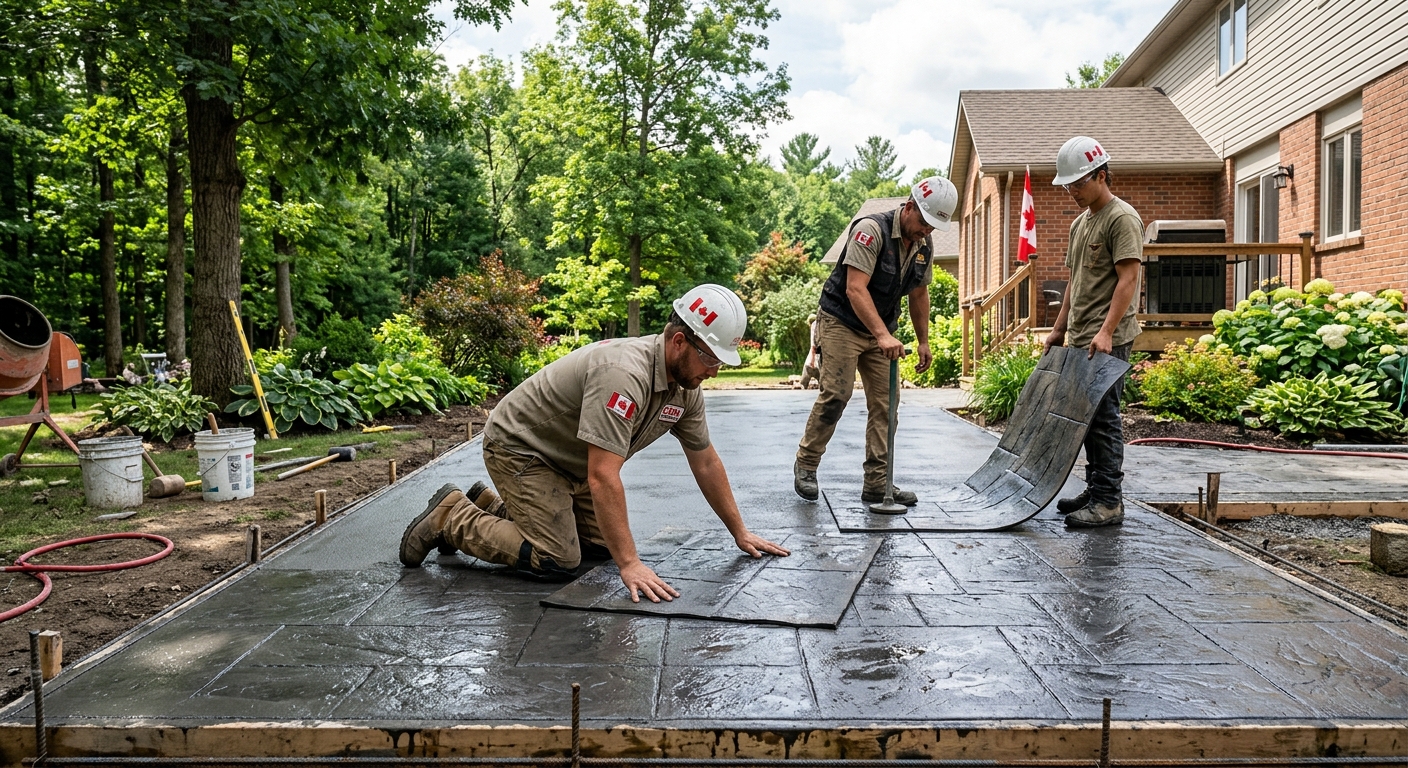
Concrete work options and costs in Malmo Plains
Malmo Plains is a small, growing community in the Calgary economic region, with 3,306 residents recorded in the 2021 Census (Statistics Canada, 2021 Census). In a market like this, concrete flatwork is usually driven by owner-occupied homes—especially single-detached properties on larger lots—so demand is steady for driveways, patios, walkways and garage slabs. In 2021, the housing mix reflected a community where family homes and long-term residents still shape building activity year-to-year (Statistics Canada, 2021 Census).
Pricing in Malmo Plains follows the same reality we see around Calgary: a cold continental climate means concrete is engineered around frost and freeze–thaw, not just summer convenience. Footings typically need to bear on undisturbed soil below a design frost depth of about 1.2 m (roughly 4 ft), and that pushes excavation and footing volume higher than in milder provinces. Exterior slabs also need air-entrained mixes and good control-joint detailing to reduce cracking, spalling and scaling. On top of that, the practical pour season for exterior flatwork is shorter, and late fall/early spring work may require winter-grade mixes, curing blankets and sometimes temporary heat—so labour and material costs can move quickly when contractors are busy.
In Malmo Plains, concrete contractors often see especially strong demand along newer infill residential lanes and areas where homeowners are upgrading curb appeal with fresh driveways and backyard patios—where access, grading and timing are the deciding factors. Use the table below as a starting point for comparing options for your project scope and finish level.
| Application |
Typical Size |
Key Spec |
Finish Option |
Price Range |
| Concrete driveway (standard broom finish) |
20 ft x 10 ft (200 sq ft) |
Air-entrained concrete, compacted base |
Broom finish |
$12,000–$18,000 |
| Exposed aggregate driveway |
20 ft x 10 ft (200 sq ft) |
Air-entrained mix, proper wash timing |
Exposed aggregate |
$13,500–$21,000 |
| Stamped concrete driveway or patio |
20 ft x 10 ft (200 sq ft) |
Stamped mix, release agent, seal |
Stamped pattern |
$15,000–$26,000 |
| Plain concrete patio or walkway |
12 ft x 12 ft (144 sq ft) |
Air-entrained concrete, control joints |
Plain/straight trowel |
$5,000–$9,000 |
| Garage floor (interior slab) |
22 ft x 20 ft (440 sq ft) |
Vapour barrier, rebar/wire mesh |
Broom finish or light trowel |
$10,500–$16,500 |
| Foundation footings (structural, below frost) |
Typical house perimeter (engineered) |
Below design frost depth bearing |
Structural concrete, forms/removal |
$28,000–$45,000 |
Prices are estimates only and vary by project scope, site access and material selection.
What affects the price of concrete work in Malmo Plains
In Malmo Plains, it’s common to see quotes for the “same” concrete job come in 30–50% apart once you account for base depth, reinforcement, mix design and winter curing. Two homeowners can both want a driveway, but one property may require heavier excavation for unsuitable topsoil and extra granular base, while the other is on firmer ground with easier truck access. In Calgary’s surrounding market, contractor scheduling also plays a role—when the short exterior pour season tightens, labour availability and material logistics can push pricing toward the top of the $12,000–$18,000 driveway band and beyond for premium finishes.
The biggest driver is frost performance. With a design frost depth of about 1.2 m (roughly 4 ft), foundation footings must extend below that depth to reduce frost heave risk. Exterior slabs and sidewalks also get air-entrained concrete designed to survive freeze–thaw cycles, and you need well-spaced control joints to control cracking paths. Cold weather is another cost lever: in late fall or early spring, contractors may use winter-grade mixes and insulating blankets to meet curing requirements, because rushing curing increases the chance of surface scaling and long-term deterioration. Also, in this region, de-icing salts are a practical reality—sealing is what helps reduce accelerated spalling at the surface.
Cost can move up or down in Malmo Plains because: (1) access changes labour—tight yards may require pump/tube setups or slower placement; (2) thicker granular base and deeper footing digs raise excavation and material costs; and (3) finish choice changes labour time—stamped work often lands in the $15,000–$26,000 range, while broom-finish driveways are usually closer to the middle of the $12,000–$18,000 band when base conditions are straightforward.
| Price Factor |
Why It Matters |
Cost Impact |
| Frost line depth — determines footing depth and form height |
Footings must bear below design frost to prevent heave and seasonal movement |
Higher excavation and concrete volume; can materially shift foundation pricing |
| Site preparation — excavation, grading, compacted granular base |
Improper base leads to settlement, cracking and uneven slab surfaces |
Unsuitable soil removal and added base raise labour and material costs |
| Reinforcement — rebar or wire mesh requirement |
Controls cracking and improves structural capacity |
More steel + placement labour; typically increases cost for slabs and footings |
| Mix design — air-entrainment and compressive strength spec |
Freeze–thaw durability depends on air content; strength affects service life |
Cold-weather and engineered mixes cost more than basic mixes |
| Finish type — broom vs. stamped vs. exposed aggregate |
Finish affects labour time and sealing requirements |
Stamped and decorative finishes push pricing toward the upper bands |
| Pour size and concrete truck access to site |
Distance, access limits and placement method affect productivity |
Long walks, barriers or limited turns can add labour and sometimes equipment |
| Cold-weather curing precautions — heating and blankets |
Concrete must cure properly to develop strength and resist scaling |
Winter-grade materials and insulation increase total project cost |
| Control joint pattern and sealing cost |
Joints manage where cracking happens; sealing protects from de-icing salts |
More layout/time plus sealant cost reduces future repair risk |
Permits & regulations in Alberta
In Alberta, structural concrete work typically needs a building permit because it forms part of the structural system—especially footings, foundation walls and grade beams. In many cases, engineered drawings are required or strongly expected, and the municipality will review those details before inspection. For Malmo Plains homeowners, the practical takeaway is simple: if your concrete is supporting a load-bearing foundation, it’s in permit territory.
Concrete flatwork like driveways, patios, sidewalks and garage slabs usually does not require a permit by default. That said, there are common exceptions: if the project changes lot grading, affects drainage patterns, increases impervious surface beyond municipal limits, or impacts municipal right-of-way or easements, the local approval process can be triggered. Always confirm with the local authority before breaking ground, especially if you’re changing elevations, adding swales, or tying into existing drainage.
Before work starts, verify contractor coverage and documentation. Step-by-step, ask for: (1) a copy of the contractor’s liability insurance certificate (ensure it lists the correct legal business name and covers the scope); (2) WSIB/WCB clearance or coverage confirmation (as applicable); and (3) project references for similar-size concrete in Calgary-area freeze–thaw conditions. Also ask whether they include permit/inspection coordination if your foundation scope requires it. If they can’t provide the paperwork promptly, it’s a red flag.
Getting concrete right in Malmo Plains's freeze-thaw climate
Concrete fails in Malmo Plains most often for predictable reasons: water gets into the surface, freeze–thaw expands it, and then the concrete scales or spalls—especially where de-icing salts accelerate surface deterioration. The fix is not “stronger cement” alone; it’s correct base preparation, the right air-entrained mix, proper reinforcement and a curing plan that meets colder temperature realities.
First, base preparation: the granular sub-base must be compacted to the right depth for your local soil and to support slab grade without settlement. In Calgary-area conditions, this is where contractors can save time—but you shouldn’t compromise it. Second, mix design: for exterior flatwork, air-entrainment typically targets about 5–7% air content to manage freeze–thaw durability, and the concrete should meet a minimum compressive strength around 32 MPa for typical residential scopes. Third, control joints: spacing should limit random cracking and guide where shrinkage cracks occur. Fourth, curing: plan for at least 7 days under proper conditions; in cold weather, curing blankets or temporary heat may be needed to avoid weak surface layers. Fifth, sealing: apply a penetrating sealer after the cure period—commonly at 28 days post-pour—so de-icing salts don’t aggressively attack the surface.
When homeowners compare options, the price difference is often justified by durability. For example, a stamped driveway may cost closer to the $15,000–$26,000 band, but if the base and mix are engineered the same as a broom-finish driveway, you’re primarily paying for finishing labour and sealing attention. If a quote is dramatically cheaper, it can be because it’s cutting corners on air content, base depth or curing—those are the failures that show up in a few winters, not immediately.
| Spec |
Why It Matters in Malmo Plains |
What to Ask For |
Impact if Skipped |
| Compacted granular base (depth?) |
Supports slab and reduces settlement under freeze–thaw movement |
State granular base depth and compaction method; confirm suitability to soil conditions |
Uneven slabs, cracking, and early failure around edges |
| Air-entrained concrete mix (target air %?) |
Freeze–thaw durability depends on managed air voids |
Ask for target air content in the mix (typically 5–7% for exterior flatwork) |
Spalling/scaling in winter seasons |
| Compressive strength (MPa rating) |
Affects how well the slab withstands wear and thermal stresses |
Confirm minimum strength (commonly 32 MPa for typical residential exterior flatwork) |
Surface wear, cracking, and reduced service life |
| Control joints (spacing per ACI guidelines) |
Controls where shrinkage cracks form as concrete contracts |
Request joint spacing and location plan |
Random cracking and moisture pathways |
| Minimum 7-day curing period |
Cold conditions slow strength gain; curing affects long-term durability |
Ask how they protect the pour (blankets/heating if needed) to reach cure targets |
Weak surface, scaling and premature deterioration |
| Penetrating sealer (when applied after cure) |
Repels water and slows de-icing salt damage |
Confirm application timing after cure (commonly 28 days post-pour) |
Faster surface breakdown and more spalling |
How to choose a concrete work contractor in Malmo Plains
Choosing the right concrete contractor matters in Malmo Plains because the climate is unforgiving: what looks fine at handover can scale or spall within a few freeze–thaw cycles if the base, air content, joints and curing weren’t done right. Start by verifying Alberta coverage. Ask for (1) liability insurance—your request is for a certificate of insurance that matches their legal name and confirms coverage for the type of work; (2) WSIB/WCB coverage confirmation or a clearance letter, depending on their employment/coverage structure; and (3) proof they’re operating legally for the scope being performed.
Next, get 2–3 itemised written quotes. Don’t accept a single “lump sum” without a breakdown: request a labour/materials separation, the assumed concrete thickness, reinforcement type, base depth and any permit-related work. Confirm what’s excluded (demo, disposal of excavated soil, regrading, saw cutting, sealers, and downtime/parking restrictions) so your quotes are truly comparable.
Then review warranty terms. Ask for the workmanship warranty length and whether it covers issues caused by workmanship (like early spalling/cracking), and whether manufacturer warranties for materials (if applicable) are included. Also confirm if the warranty is transferable to future homeowners.
Finally, agree on a sensible payment schedule. Never pay more than 10–15% upfront. Hold back the remainder until the job is complete, cleaned up and meets grade/finish expectations. Get the start date and completion estimate in writing, including winter-weather contingencies if the pour falls near colder periods.
- Request the mix design details (air-entrainment target) for exterior slabs and driveways.
- Confirm base scope: granular type, compaction method and the depth included in the quote.
- Ask whether reinforcement is included (wire mesh vs. rebar) and where it will sit (chairs/spacers).
- Get joint spacing and finishing method confirmed in the scope (broom, stamped, or exposed aggregate).
- Ask how they handle cold weather (blankets, heating, curing protection).
- Confirm sealing is included or optional, and the timing after pour (typically after cure).
- Require a written start date and completion target with weather-impact language.
- Ask who pulls permits if required and whether inspection coordination is included.
- Ensure disposal and haul-away for demo/excavation is clearly stated.
- Verify liability insurance certificate and ask what it covers for your specific project.
- Confirm WSIB/WCB clearance/coverage documentation before work begins.
- Review warranty terms in writing—workmanship vs. product, and any exclusions.
Concrete red flags I see in Malmo Plains include quotes that ignore air-entrainment, vague base depth or “whatever the ground needs,” no plan for control joints, cutting curing time (or pouring right before cold snaps without protection), and contractors who won’t provide insurance/WSIB documentation or written scope details.
Frequently asked questions — concrete work in Malmo Plains
How much does concrete work cost in Malmo Plains?
In Malmo Plains, pricing generally tracks the Calgary-area freeze–thaw reality: exterior work needs the right base, air-entrained mix and good jointing. As a starting point, a concrete driveway typically falls in the $12,000 – $18,000 range depending on access, excavation and finish. A plain patio or walkway is commonly around $5,000 – $9,000 for a typical homeowner size, while stamped/decorative options often move into the $15,000 – $26,000 band because of finishing labour and additional sealing attention. Foundation footings (below frost) are a bigger-ticket item and often land around $28,000 – $45,000 depending on engineered layout and excavation conditions. The fastest way to get accurate pricing is itemised quotes with the same base depth, reinforcement and cure plan.
How deep must footings be for Malmo Plains's frost line?
For Malmo Plains (Calgary economic region), concrete foundations and footings are designed around a frost depth of about 1.2 m (roughly 4 ft). That means structural footings typically need to extend below the design frost depth to bear on undisturbed soil and reduce frost heave risk. If the footing is too shallow or the soil is over-excavated and not properly replaced/compacted, seasonal movement can show up as settling cracks or differential movement in the foundation. Your engineer/structural designer determines the exact footing dimensions for your soil conditions and house layout, but you should expect the “below frost” requirement to be a core spec. When comparing quotes, ask contractors how they confirm bearing depth on-site and whether they include the necessary excavation and re-compaction scope.
Why does concrete crack in Malmo Plains and how is it prevented?
Concrete cracking in Malmo Plains is usually about shrinkage, freeze–thaw stresses and restraint—then moisture finds its way into tiny openings. The most common prevention steps are built into good specs: properly compacted granular base, correct air-entrained mix for freeze–thaw durability, and control joints planned to guide where cracks should form. Joints need sensible spacing so you don’t get random cracking across large panels, especially on driveways and patios where temperatures swing. In Calgary’s climate, cold-weather placement also matters: if curing is rushed, the surface can be weaker and more vulnerable to early cracking and scaling. Sealing after cure helps manage moisture/de-icer salt impact. If a quote is cheap but doesn’t mention jointing, air content or curing protection, that’s often where the future cracks start.
Stamped vs broom-finish concrete — cost difference?
The main difference is labour and finishing complexity. A broom-finish driveway is typically the most straightforward build: it focuses on correct base prep, air-entrained mix, finishing and sawcut/control joint timing, which is why many projects fall in the $12,000 – $18,000 driveway band. Stamped concrete requires additional steps—forms/release agents, careful finishing timing to capture the pattern and more curing/sealing attention—so it often lands in the $15,000 – $26,000 band depending on panel complexity and site conditions. Exposed aggregate is also labour-forward. The key point: if both options include the same base depth, reinforcement and air-entrainment, the price difference is usually justified by durability-focused finishing and the decorative process—not by “stronger concrete” alone.
When is the best time to pour concrete in Malmo Plains?
For exterior concrete in Malmo Plains, you want the best balance of workable temperatures and reliable curing. Practically, that means late spring through summer—when contractors can place, finish and cure without heavy reliance on heating and blankets. Calgary-area cold snaps can start earlier than homeowners expect, and pouring too late in the season can increase risk even if the mix is “winter-grade.” If you must pour near shoulder seasons, ask specifically how the contractor protects curing (insulating blankets, temperature monitoring and winter curing procedures) to meet strength gain targets. The best timing is also influenced by access and coordination—demolition, grading and base preparation should be planned so the pour happens when curing conditions are realistic. For decorative work like stamping, timing is even more sensitive, because finish steps depend on workable concrete temperatures.
How long does concrete take to cure?
Concrete curing has two timeframes: strength development and surface readiness. In Malmo Plains, a minimum of 7 days of curing under proper conditions is a common expectation for many residential concrete scopes, but what’s “right” depends on temperature and whether curing protection is used. Cold weather can slow strength gain, which is why heating/blankets may be needed to stay on spec during late-season pours. Even after the initial cure period, many contractors recommend waiting about 28 days before applying penetrating sealers—especially where de-icing salts are used—because you want the slab to reach a good state of cure to improve sealer performance. For driveways, patios and walkways, also confirm that joints and finishing allow the intended curing conditions, not just “set” time. Ask your contractor to document curing steps and expected timeline in writing.