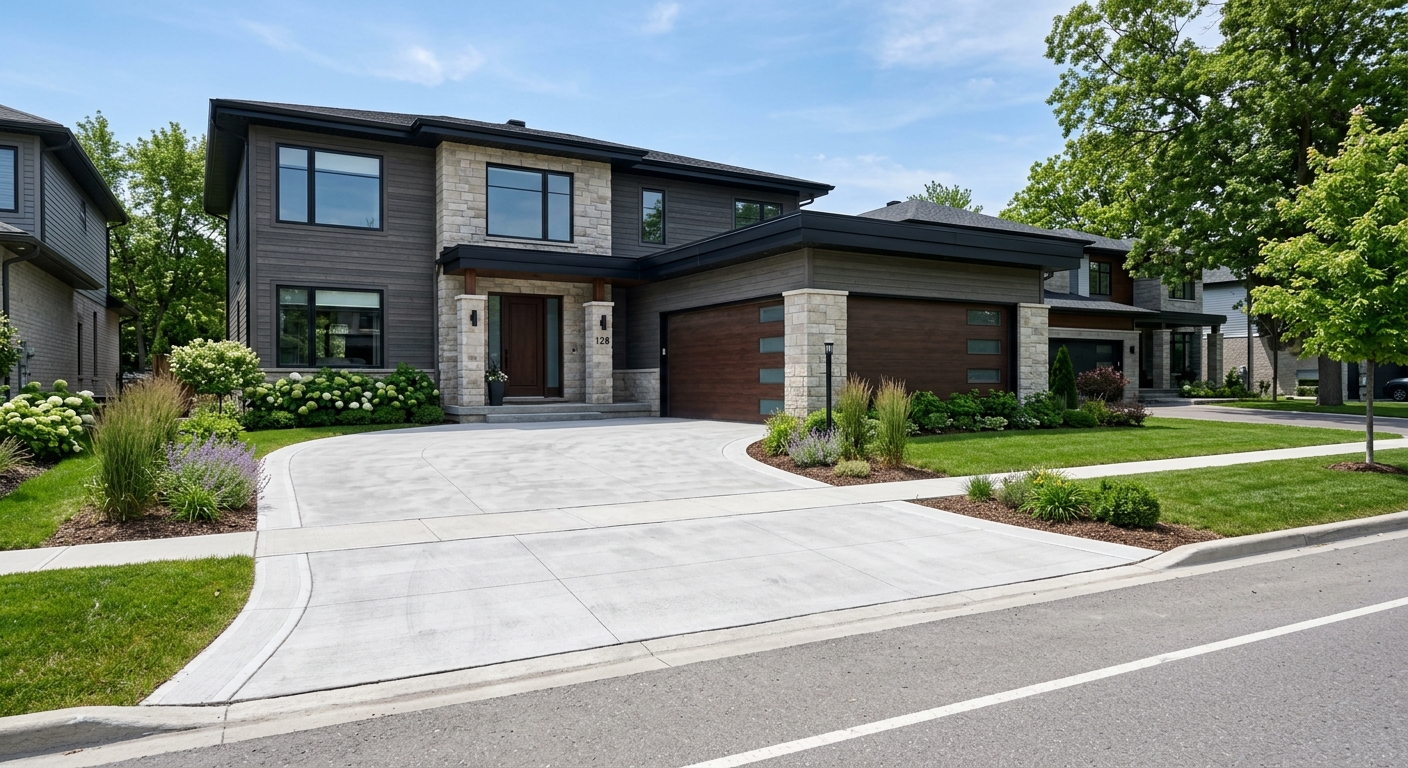
Concrete work options and costs in Beverly Heights
Beverly Heights, Alberta is a small, established community with a lot of homeowners focused on practical updates—most notably driveways, patios, walkways, and foundation work that has to perform through long Calgary-area winters. With a 2021 population of 3,190 (Statistics Canada, 2021 Census), local demand is steady but not huge, so scheduling can be tighter during peak exterior construction windows. Most flatwork is driven by the surrounding Calgary housing stock, where single-detached homes are the dominant style for many neighbourhoods, and that pattern shows up in contractor workload for residential slabs and garage floors.
In the Calgary and Calgary-region market, concrete pricing isn’t just about “square feet.” The cold continental climate means the design frost depth is engineered deeper—often around 1.2 m (roughly 4 ft) or more—so footings and reinforced base prep use more excavation and concrete than in milder provinces. Calgary’s frequent freeze–thaw cycles also push every exterior slab specification toward air-entrained mixes, properly spaced control joints, and curing protection. Add in a shorter pour season for exterior work, and you’ll see a premium for winter-grade placement, insulated blankets, and sometimes temporary heating to keep curing on track.
Trade demand is especially noticeable around family-oriented pockets and newer infill builds in and near the established residential streets close to schools and services, where homeowners frequently upgrade aging driveways and add patios as outdoor living spaces expand. Below is a clear comparison of common concrete options you’ll see in Beverly Heights, with price bands tied to typical scopes and finish selections.
| Application |
Typical Size |
Key Spec |
Finish Option |
Price Range |
| Concrete driveway (standard broom finish) |
400–600 sq ft |
Air-entrained mix; compacted granular base |
Broom finish with control joints |
$12,000–$18,000 |
| Exposed aggregate driveway |
400–600 sq ft |
Air-entrained mix; consistent wash/finish |
Exposed aggregate look with sealing |
$15,000–$22,000 |
| Stamped concrete driveway or patio |
300–500 sq ft |
Reinforcement per design; anti-spall detailing |
Stamped pattern + release + sealer |
$15,000–$26,000 |
| Plain concrete patio or walkway |
200–400 sq ft |
Air-entrained; proper drainage slope |
Light broom or smooth trowel (non-slip) |
$5,000–$9,000 |
| Garage floor (interior slab) |
400–600 sq ft |
Minimum 32 MPa; mesh or rebar as required |
Broom finish or light trowel |
$10,000–$16,000 |
| Foundation footings (structural, below frost) |
Per engineered design |
Reinforced footings bearing below design frost depth |
Structural concrete finish (functional) |
$28,000–$45,000 |
Prices are estimates only and vary by project scope, site access and material selection.
What affects the price of concrete work in Beverly Heights
In Beverly Heights, you can see the same general concrete project come back with quotes that vary by 30–50% across the Calgary market because contractors price risk differently. The biggest drivers are frost-depth engineering, freeze–thaw durability specs, and the “hidden” labour in excavation and base preparation. In cold climates, you’re not just pouring concrete—you’re building a system designed around a deeper design frost depth, and local practice expects exterior work to be prepared and finished to handle repeated temperature swings.
For footing and foundation work, engineered drawings and bearing below the design frost depth matter. While exact frost conditions vary by site, Calgary-area engineering typically aligns with deeper frost penetration (commonly about 1.2 m or more). That depth means additional excavation and thicker reinforced sections compared with regions where frost lines are shallower. For exterior slabs like driveways and patios, the freeze–thaw cycles dictate air-entrained concrete and strong base drainage, plus control joints that limit random cracking and reduce spalling.
Cold-weather placement also changes cost. Exterior pours in late fall or early spring often require winter-grade mixes, insulated blankets, and sometimes temporary heating so curing can happen properly. That curing window is critical; if the slab surface scales or starts to freeze before set, repairs later can wipe out any savings. And because de-icing salt accelerates surface wear, sealing becomes a practical add-on for driveways and walkways.
Examples you’ll feel in Beverly Heights: a narrow side-yard access can push labour and equipment time up fast, while good existing grades and straightforward truck access can keep driveway costs closer to the $12,000–$18,000 band. Conversely, upgrading to exposed aggregate or stamped finishes commonly moves the project into the higher $15,000–$26,000 range because of extra finishing steps, material coverage, and more complex sealing/detail work. If your driveway is also being rebuilt from scratch (not just patched), excavation and granular base prep can be a larger portion of the budget than homeowners expect—especially with the deeper frost-related excavation standard in the Calgary area.
| Price Factor |
Why It Matters |
Cost Impact |
| Frost line depth — determines footing depth and form height |
Ensures footings bear below frost movement risk. |
Higher excavation and concrete volume can add significant cost. |
| Site preparation — excavation, grading, compacted granular base |
Controls settlement and prevents voids under slab. |
Poor access or deeper dig can materially raise labour/materials. |
| Reinforcement — rebar or wire mesh requirement |
Resists cracking and improves performance under loads. |
Rebar layouts and chairs add labour plus material. |
| Mix design — air-entrainment and compressive strength spec |
Air content and strength help survive freeze–thaw and loading. |
Winter-grade and spec mixes can cost more per yard. |
| Finish type — broom vs. stamped vs. exposed aggregate |
Finish impacts workflow, labour time and materials. |
Stamped/exposed typically move into higher price bands. |
| Pour size and concrete truck access to site |
Determines pour efficiency and whether pump/extra handling is needed. |
Narrow streets or multiple lifts can increase time and equipment costs. |
| Cold-weather curing precautions — heating and blankets |
Prevents freezing before set and reduces scaling risk. |
Added equipment and labour during shoulder-season pours. |
| Control joint pattern and sealing cost |
Controls cracking and helps repel de-icing salt. |
Better jointing and sealer add line-item cost but reduce failure risk. |
Permits & regulations in Alberta
In Alberta, structural concrete work—like foundation walls, grade beams, and footing systems—typically requires a building permit, and engineered drawings are often reviewed as part of that approval process. Concrete flatwork (driveways, patios, walkways) usually does not require a permit by default, but it can if the project affects lot grading, stormwater flow, or impervious surface coverage and drainage requirements, or if you’re working within/near municipal right-of-way boundaries. In Beverly Heights, the practical step is the same: confirm what applies to your address before excavation begins, especially if you’re altering drainage or tying into existing hardscape near the curb.
No matter the permit requirement, verify your contractor is properly covered. Ask for proof of liability insurance and WSIB/WCB coverage (worker compensation coverage for their crews). Then request references from jobs similar in scale—driveway rebuilds and exterior slabs in this climate—so you can judge how they handle base prep, air-entrainment, joints, and winter curing precautions.
Step-by-step homeowner checks in Alberta:
- Look up the contractor’s business/registration details through Alberta’s online resources (and confirm the exact legal business name matches the quote and invoice).
- Request a current certificate of insurance and verify it includes general liability for concrete work.
- Ask for WSIB/WCB clearance or documentation showing their coverage status for workers on your site.
- Confirm they will provide an engineered drawing letter of assurance if your foundation design requires it.
- Check references and ask what mix spec and curing protection they used for cold-season pours.
Getting concrete right in Beverly Heights's freeze-thaw climate
Concrete failures in Beverly Heights are almost always linked to either water movement, inadequate base support, or a mix/curing mismatch for freeze–thaw conditions. The main failure you want to prevent is spalling: when water gets into the surface and freezes, it can pop off the top layer. To spec the job correctly, start with base preparation—compact a granular sub-base to the right depth for your site conditions so there’s no settlement or pumping. Next, lock down the mix design. Exterior flatwork in Calgary-area climates should use air-entrainment (commonly in the 5–7% range for exterior slabs) and a minimum compressive strength of 32 MPa so the slab handles repeated freeze–thaw cycles. Third, control joints. They’re what gives the slab permission to crack in a controlled way rather than randomly. Fourth is curing: plan for a minimum 7-day cure under proper conditions, and in cold weather use insulated blankets and/or heaters to protect set and early strength development. Finally, sealing matters locally—penetrating sealer applied after the cure (typically at about 28 days) helps repel de-icing salts that can accelerate surface breakdown.
When you ask questions, tie them to performance. For instance, it’s often worth paying for proper air-entrainment and base compaction, even if it adds cost up front. If a basic broom-finish driveway is in the $12,000–$18,000 band, the difference between that and a properly detailed rebuild that performs for years can be the handful of decisions around mix, thickness, and curing protection—rather than “upgrading” to decorative finishes. Stamped options at the $15,000–$26,000 level are a lifestyle choice; the technical specs should still be built to prevent spalling either way.
| Spec |
Why It Matters in Beverly Heights |
What to Ask For |
Impact if Skipped |
| Compacted granular base (depth?) |
Reduces settlement and keeps water from undermining the slab through freeze–thaw. |
Granular type and target compacted depth; confirm subgrade prep details in writing. |
Cracking, uneven slabs, pumping, and premature failure. |
| Air-entrained concrete mix (target air %?) |
Helps concrete withstand freeze–thaw cycles without spalling. |
Request air content target (typically 5–7% for exterior flatwork) and the mix spec sheet. |
Surface scaling and spalling, especially after salt exposure. |
| Compressive strength (MPa rating) |
Provides structural durability and better long-term performance under loads. |
Confirm minimum 32 MPa and how it’s verified (test cylinders or mix documentation). |
Reduced strength development and higher cracking risk. |
| Control joints (spacing per ACI guidelines) |
Controls where shrinkage cracks occur in a predictable way. |
Ask for joint layout and timing for cutting/finishing. |
Random cracking and water infiltration into cracks. |
| Minimum 7-day curing period |
Early strength and durability depend on protected curing in cold conditions. |
Confirm curing plan and protection method if temperatures drop. |
Weak surface, scaling, and reduced service life. |
| Penetrating sealer (when applied after cure) |
Repels moisture and de-icing salts that worsen freeze–thaw damage. |
Ask for penetrating sealer application at about 28 days post-pour (once cured). |
Faster surface deterioration and greater maintenance needs. |
How to choose a concrete work contractor in Beverly Heights
Choosing the right concrete contractor in Beverly Heights comes down to verifying coverage, getting comparable paperwork, and understanding what’s excluded from the quote. First, confirm Alberta licensing/registration where applicable (and make sure the business name on the quote matches the legal name), then verify liability insurance with a current certificate of insurance. For workers, ask for WSIB/WCB coverage documentation—don’t accept “we’ll cover it” wording. A solid contractor will also be comfortable explaining how they handle freeze–thaw curing on exterior slabs, including insulated blanket or heating practices when temperatures fall.
Next, request 2–3 itemised written quotes instead of one lump sum. The best quotes break down labour and materials separately (concrete supply, reinforcement, base prep, disposal, forms, finishing, joints, sealing if included). Read the scope carefully: is demolition included, is disposal included, is trucking access accounted for, and are seasonal/cold-weather protections priced as a specific line item? Also ask about permits for foundation work if your project involves structural concrete—ensure they know whether engineering is required.
For warranty, look for clear workmanship terms (often 1–2 years for typical residential flatwork, but confirm what they cover), plus whether manufacturer/product warranties apply for materials like sealers. Payment schedule matters too: never pay more than 10–15% upfront; hold back a portion until the job is complete and properly finished. Finally, get the start date and completion estimate in writing, including how weather might affect curing timelines.
- Ask for concrete mix design details (air-entrainment and 32 MPa minimum) for exterior work.
- Confirm base prep depth, granular material type, and compaction method.
- Check that reinforcement plans (mesh/rebar) match the slab size and thickness.
- Get a joint layout plan and confirm cutting timing.
- Ask what happens if temperatures drop mid-project (blankets/heating).
- Verify disposal and site cleanup are included.
- Confirm sealing is included or quoted as an add-on with timing (around 28 days).
- Request proof of liability insurance and WSIB/WCB coverage.
- Ensure quotes list concrete thickness and slab dimensions.
- Look for a detailed schedule: pour day, finishing day, and curing/sealer dates.
- Agree on colour/pattern approval for stamped work before production.
- Hold back final payment until forms are removed and the finish is accepted.
Concrete red flags in Beverly Heights: (1) they won’t specify air-entrainment or curing protection for exterior slabs; (2) quotes skip base prep details or assume “existing grade is fine” without compaction notes; (3) they ask for large upfront payments (beyond 10–15%); (4) their contract is light on scope items like disposal, joints, and sealing; and (5) they can’t provide insurance/WSIB/WCB documentation or credible references from similar cold-climate pours.
Frequently asked questions — concrete work in Beverly Heights
How long does a concrete driveway last?
In Beverly Heights and the Calgary region, a well-built concrete driveway commonly lasts 20–30 years, but that depends heavily on the “system” behind it: compacted granular base, proper thickness, air-entrained concrete, good drainage, control joints, and cold-weather curing. If your driveway was poured without air-entrainment or with inadequate joints, freeze–thaw and de-icing salt can cause scaling and spalling years earlier. A contractor’s approach matters: exterior broom-finish work is often in the $12,000–$18,000 range, but the best-value outcome is usually the one that protects the slab surface and controls cracking—not just the cheapest square foot price. If you’re replacing an older slab, ask whether the base is being rebuilt properly (not just patched).
What is air-entrained concrete and why does it matter here?
Air-entrained concrete is engineered with tiny, evenly distributed air bubbles so that when water inside the concrete freezes, it has space to expand without breaking the paste. In Alberta’s freeze–thaw climate around Beverly Heights, that protection is essential for exterior slabs exposed to temperature swings and de-icing salts. Without sufficient air entrainment, you can see early surface scaling and eventually spalling—especially near the edges and areas that get salted more often. When you compare quotes, look for a concrete mix spec that targets exterior air content (often 5–7%) and a minimum compressive strength of 32 MPa. That’s a durability requirement, not a luxury finish choice.
How do I prepare the base for a concrete slab?
Base preparation is where many driveway and patio problems start. For Beverly Heights projects, you want excavation to the correct depth for your site soils and the local frost considerations, then grading and compacting a properly designed granular sub-base. The goal is a firm, uniform support layer with correct slopes and good drainage so water can’t collect under the slab and undermine it during freeze–thaw cycles. Ask your contractor what granular material they’re using, how deep it’s being placed (compacted depth), and what compaction standard or test method they follow. Also confirm whether they’re rebuilding the base for a full replacement (not just adding concrete over poor subgrade).
How do I compare concrete quotes?
To compare quotes fairly in Beverly Heights, insist on itemised pricing that matches specs—not just totals. Make sure each quote lists slab thickness, reinforcement type (mesh or rebar as required), concrete mix requirements (including air-entrainment for exterior slabs), and base prep details (excavation and compacted granular depth). Check whether demolition and disposal are included, whether sealing is included, and how they handle cold-weather curing with insulated blankets or heat if needed. A broom-finish driveway often sits in the $12,000–$18,000 band; stamped work can land closer to $15,000–$26,000. If one quote is far below the others, it may be missing key durability items like air content, jointing, or curing protection.
Can concrete be poured in cold weather in Beverly Heights?
Yes, concrete can be poured in cold weather in Beverly Heights, but it must be engineered and protected to cure correctly. Calgary-area cold-weather placement typically requires a plan: winter-grade mixes, protection measures like insulated blankets, and sometimes temporary heating so the concrete doesn’t freeze before it reaches adequate strength. The curing window is critical—rushing it or skipping protection increases the risk of surface scaling and long-term performance issues, especially in freeze–thaw conditions. When comparing contractors, ask for their specific cold-weather procedure: what temperatures trigger protection, what equipment they use, and how long curing will be maintained on site. A quality winter-ready pour may cost more, but it protects your future repairs.
How do I maintain concrete in Beverly Heights's freeze-thaw climate?
Maintenance in Alberta comes down to reducing water and salt damage. Start with routine cleaning: remove debris that holds moisture against the slab surface. If your driveway or walkway is sealed, keep an eye on the “beading” effect—when water no longer beads, it may be time to reapply penetrating sealer. For Calgary-area freeze–thaw exposure, sealing is typically planned about 28 days after the pour so the concrete is cured first. Avoid using excessive de-icing salt where possible; it accelerates surface wear and can worsen spalling when combined with freeze cycles. During spring melt, ensure drainage stays clear so water doesn’t pond near joints and edges. If cracks appear, address them early according to the contractor’s recommended repair method to prevent water infiltration.