Concrete work options and costs in Valleyview
Concrete work in Valleyview, Alberta is mainly driven by the reality that your soils, frost depth, and freeze–thaw cycles are tougher than what most homeowners picture. In Valleyview, single-detached homes make up 57.6% of dwellings, so driveways, patios, walkways, and garage slabs are the most common concrete projects we see from homeowner orders. And because 46.2% of homes were built before 1981, many sites need regrading, drainage fixes, or thicker base repairs before we can even pour.
In the Athabasca–Grande Prairie–Peace River region, pricing is shaped less by “cement price” and more by logistics and durability specs. Frost lines in Alberta mean footings typically need to be set well below design frost to prevent heave, which increases excavation, forming, and concrete volume. Then you get repeated freeze–thaw cycles that demand air-entrained exterior mixes and tighter control-joint planning to reduce cracking and scaling. Add in a shorter reliable pour season for flatwork and cold-weather curing requirements—insulating blankets and extended curing—and labour and equipment can be tighter when crews are in peak use.
In Valleyview proper, concrete flatwork is especially in demand along residential corridors near the downtown core, where residents commonly update older driveways and improve drainage before winter. Below, you’ll find typical application sizes and realistic budget bands to help you compare options before we talk details like thickness, reinforcement, and site access.
| Application |
Typical Size |
Key Spec |
Finish Option |
Price Range |
| Concrete driveway (standard broom finish) |
400–600 sq. ft. |
5–6 in. slab, compacted granular base, air-entrained exterior mix |
Broom finish, control joints |
$6,000 – $12,000 |
| Exposed aggregate driveway |
400–600 sq. ft. |
Same structural thickness; specialty surface mix and exposure process |
Exposed aggregate, sealer recommended |
$8,000 – $16,000 |
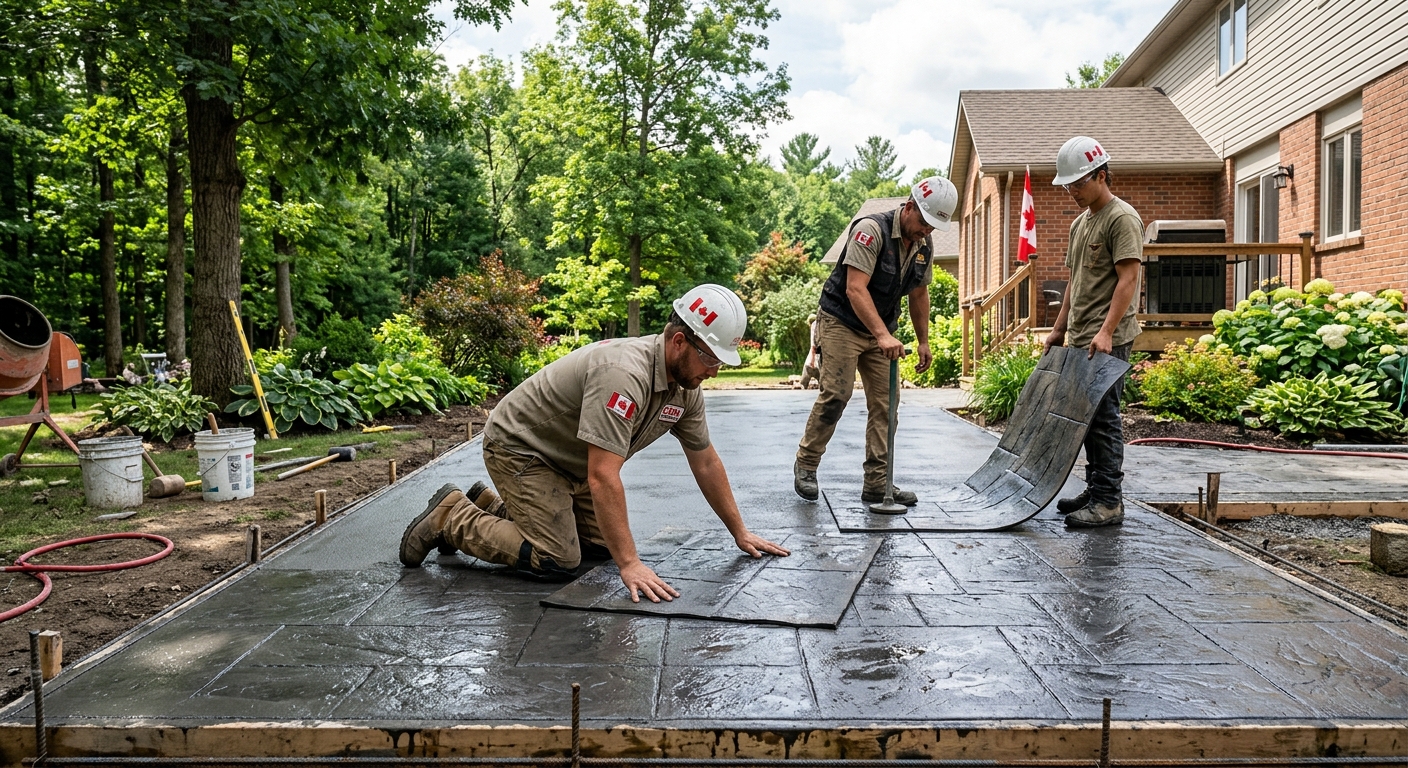
| Stamped concrete driveway or patio |
250–500 sq. ft. |
Air-entrained mix, minimum 4 in. for patios (often 5–6 in. for driveways), integral colour |
Stamp pattern + release agent + sealer |
$7,500 – $18,000 |
| Plain concrete patio or walkway |
120–300 sq. ft. |
4 in. thickness (typical), compacted base, proper slope/drainage |
Float + light broom or trowel-finish edges |
$2,000 – $6,000 |
| Garage floor (interior slab) |
400–600 sq. ft. |
4–5 in. slab, vapour barrier (if required), reinforcement if specified |
Powder-finish or light broom |
$6,000 – $13,000 |
| Foundation footings (structural, below frost) |
Typical foundation perimeter + isolated pads |
Below-design frost depth, reinforced footings, concrete volume dependent on house size |
Structural formed finish (not a decorative surface) |
$9,000 – $22,000 |
Prices are estimates only and vary by project scope, site access and material selection.
What affects the price of concrete work in Valleyview
In Athabasca–Grande Prairie–Peace River, two quotes for what looks like the same concrete job can land 30–50% apart once frost requirements, preparation, and curing are considered. That’s because Valleyview sits in a climate where freeze–thaw cycles are hard on slabs, and labour availability can tighten during the best pour window. For homeowners, the practical takeaway is this: the cheapest number often reflects either thinner-than-needed sections, less granular base, or less rigorous cold-weather curing—choices that can show up later as cracking, scaling, or spalling.
First, frost line depth dictates every spec. Exterior footings and foundation work must extend below the design frost depth to prevent frost heave, and that usually means more excavation and forming than people expect. Second, freeze–thaw cycles require air-entrained concrete mixes for exterior slabs and driveways so the surface can survive repeated expansion and contraction. Third, the region has a shorter reliable pour season—especially for flatwork—so when crews are in high demand, schedules can influence labour cost. Cold-weather curing precautions (heating, insulated blankets, and extended cure timelines) add both time and handling cost. Finally, de-icing salts accelerate surface deterioration, which is why sealing and proper joint spacing matter.
In Valleyview, older home sites built before 1981 (Statistics Canada, 2021 Census) frequently need extra base repair and drainage grading. For example, a plain broom-finished patio might start around the $12–$18 per sq. ft. band, but if your base is soft or undermined, that can push you toward a more complete “remove and rebuild” scope. On the other hand, stamped concrete can be a better value when you compare a full stamped patio at roughly the $22–$35 per sq. ft. decorative band to doing separate small projects (walkway + steps + landing), because one well-designed pour avoids multiple mobilizations.
| Price Factor |
Why It Matters |
Cost Impact |
| Frost line depth |
Determines how deep footings must go and increases excavation/haul |
Can add significant concrete and forming cost on foundations |
| Site preparation |
Excavation, grading, and compacted granular base set the slab up for longevity |
More removal/replacement drives cost upward, but improves performance |
| Reinforcement |
Rebar or wire mesh is required when spans, loads, or specs call for it |
Materials + labour increase cost, especially on thick slabs |
| Mix design |
Air-entrainment and strength rating protect against freeze–thaw scaling and spalling |
Higher-spec mix and QC/air testing can raise price slightly but reduces failures |
| Finish type |
Broom is faster; stamped/exposed requires additional labour and specialty processes |
Decorative work commonly adds the most per square foot |
| Pour size and concrete truck access to site |
Smaller pours or difficult access can mean extra labour and more truck trips |
Mobilizations and waiting time can inflate the bill |
| Cold-weather curing precautions |
Heating/blankets and extended curing time help reach design strength in cold conditions |
Adds time, equipment, and product handling costs |
| Control joint pattern and sealing cost |
Proper joint spacing controls random cracking; sealing improves resistance to salts |
Sealer + saw-cut/finish labour adds cost but reduces long-term deterioration |
Permits & regulations in Alberta
In Alberta, structural concrete work typically needs a building permit and often engineered drawings reviewed through the local municipal process. That includes the concrete parts that support the structure—foundation footings, foundation walls, grade beams, and other load-bearing structural elements. For concrete flatwork such as patios, walkways, and driveways, permits are commonly not required unless your project affects lot grading, impervious surface coverage limits, or municipal right-of-way requirements (for example, altering drainage or modifying the approach within setback/road allowance areas). Because Valleyview requirements can vary depending on how the work touches drainage and access, always confirm with the local authority before breaking ground.
Step-by-step, here’s how a homeowner in Valleyview can verify a contractor in Alberta: (1) confirm the contractor is properly registered/licensed for the scope they’re bidding (ask them for their business details and how they’re authorized for the specific work), (2) ask for a current certificate of liability insurance showing the effective dates and adequate coverage limits, (3) request proof of WSIB/WCB coverage (or clear documentation confirming coverage status and how payroll is handled), and (4) verify references for similar-sized jobs in your climate—especially exterior flatwork or cold-weather pours.
Look beyond the quote. A clear, itemized scope plus documentation (insurance certificates and coverage clearance) usually signals a contractor who builds to spec rather than cutting corners.
Getting concrete right in Valleyview's freeze-thaw climate
Concrete failure in Valleyview usually comes down to one thing: water and freezing get into a slab that wasn’t built with the right base, mix, joints, and curing. In a freeze–thaw climate like the Athabasca–Grande Prairie–Peace River region, inadequate air-entrainment is a common cause of surface scaling and spalling. When water migrates into the paste and freezes repeatedly, it expands and breaks the surface apart—especially on exterior driveways and patios where de-icing salts are used.
To spec the job correctly, start with (1) base preparation: build a compacted granular sub-base to the proper depth for local soil conditions and frost, and ensure correct slope for drainage. (2) Mix design: exterior flatwork should use air-entrainment (commonly 5–7% air content for durability in severe freeze–thaw) and a minimum 32 MPa compressive strength unless your engineer specifies more. (3) Control joints: plan the joint pattern to limit random cracking; joints should be cut at the right timing to “catch” shrinkage cracks. (4) Curing: plan for a minimum 7-day curing period under proper conditions; if you pour in cold weather, ask about heating, insulated blankets, and how long strength gain will be protected before form removal and traffic. (5) Sealing: apply a penetrating sealer after the concrete has cured—often around 28 days post-pour—to improve resistance to de-icing salts.
Here’s a practical dollars example: if a plain broom patio runs in the $12–$18 per sq. ft. band but sealing and better base drainage add a few hundred to a couple of thousand dollars, that extra cost is often justified compared to repairing pop-outs, re-sawing joints, or doing a full replacement later. For Valleyview homeowners, the cheapest “finish-only” approach tends to be the most expensive over time.
| Spec |
Why It Matters in Valleyview |
What to Ask For |
Impact if Skipped |
| Compacted granular base (depth?) |
Provides frost-resistance and stops pumping/movement under freeze–thaw |
Base depth and gradation per your soil conditions, plus proof of compaction |
Uneven settlement, cracking, and early scaling |
| Air-entrained concrete mix (target air %?) |
Air voids help concrete tolerate freezing in Valleyview winters |
Target air content (typically 5–7% for exterior flatwork) and air testing |
Spalling, scaling, and surface deterioration within seasons |
| Compressive strength (MPa rating) |
Strength gain protects durability and impact resistance |
Minimum 32 MPa (or higher if specified) with curing plan |
Soft concrete, increased cracking and wear |
| Control joints (spacing per ACI guidelines) |
Controls where cracks form instead of random cracking |
Joint spacing and cut timing schedule |
Random cracking and faster water intrusion |
| Minimum 7-day curing period |
Cold nights and wind can slow curing and strength development |
How curing will be protected (covers, blankets, temperature monitoring) |
Reduced strength and surface damage |
| Penetrating sealer (when applied after cure) |
Helps repel de-icing salts and water absorption |
Penetrating sealer after cure—commonly around 28 days post-pour |
Higher salt damage and faster surface breakdown |
How to choose a concrete work contractor in Valleyview
Choosing the right contractor in Valleyview starts with verification. In Alberta, confirm the company can legally perform the type of concrete work they’re proposing, then ask for proof of liability insurance and WSIB/WCB coverage before any schedule is locked in. For each document, check it’s current (effective dates), that it covers the work described, and that it matches the contracting business name on the quote and invoice. If the contractor can’t provide certificates quickly, that’s a red flag.
Next, get 2–3 itemised written quotes. You want line items that separate labour, concrete supply, reinforcement (if required), excavation/base preparation, forms, finishing, sealing (if included), and disposal/hauling. Avoid lump sums that don’t explain thickness, reinforcement, and drainage. Scope clarity matters because Valleyview projects often include extra base prep to deal with older soils and drainage patterns; the best contractor will show how they’ll handle it.
Read the exclusions carefully: is permit pulling included (if needed), is disposal included, who owns topsoil removed, and what’s included for site protection? Confirm warranty terms: workmanship warranty length, whether product/manufacturer warranties apply, and whether warranties are transferable if you sell your home. Finally, payment schedule matters—never agree to more than 10–15% upfront, and hold back a portion until the job is complete and any curing/sealer steps are done as specified. Put your timeline in writing with a start date and completion estimate.
- Ask for a written scope that includes slab thickness and compaction expectations.
- Confirm air-entrained mix and minimum compressive strength in writing.
- Request joint spacing and saw-cut timing details.
- Verify reinforcement plan (rebar/wire mesh) matches the design load.
- Check if cold-weather curing is included (blankets/heating plan).
- Confirm drainage slope is part of the base prep scope.
- Ensure concrete truck access and pumping plan are addressed.
- Ask whether sealing is included and the “when” (after cure).
- Look for disposal/hauling listed as included or excluded.
- Get details on curing protection and minimum curing period.
- Confirm cleanup and debris removal at substantial completion.
- Ask about aftercare guidance (snow clearing timing, salt restrictions).
Concrete red flags in Valleyview include: quotes that omit base prep thickness/compaction, no mention of air-entrained mix for exterior work, failure to discuss curing in cold weather, weak joint layout (or no joint cutting plan), and contractors asking for large upfront payments without a schedule and written scope.
Frequently asked questions — concrete work in Valleyview
How long does a concrete driveway last?
A properly built concrete driveway in Valleyview often lasts 25+ years, but longevity depends on build quality more than the brand of concrete. In our Athabasca–Grande Prairie–Peace River freeze–thaw climate, air-entrainment, a well-compacted granular base, correct slope, and joint spacing are what protect the slab from scaling and spalling. If your driveway sees a lot of de-icing salt, sealing becomes important once the concrete has cured (commonly after about 28 days). Also, older Valleyview properties—many built before 1981 (Statistics Canada, 2021 Census)—sometimes sit on soils that need regrading or base replacement, which affects lifespan.
When budgeting, you might see exterior driveway concrete in the $14–$20 band depending on thickness and finish. The “extra” cost of better base prep and an appropriate mix is usually what buys you years of service.
What is air-entrained concrete and why does it matter here?
Air-entrained concrete is designed with microscopic air bubbles that give freezing water space to expand without breaking the paste. In Valleyview and the surrounding Peace-region counties, repeated freeze–thaw cycles are a major reason slabs scale or spall if the mix isn’t correct. Exterior flatwork should also use the right air content (commonly 5–7% for durability targets) and proper curing, because even a good mix can perform poorly if it doesn’t reach strength under cold conditions.
If a driveway or patio is priced like a “plain” interior mix, that’s often the hidden trade-off: less durability for more failures. For homeowners comparing quotes, confirm the air-entrainment and minimum strength (commonly 32 MPa) are explicitly included. That line item helps prevent the most common failure we see in Alberta winters—surface damage that starts with scaling and progresses.
How do I prepare the base for a concrete slab?
Base preparation is where most Valleyview projects are won or lost. A contractor should excavate to the required depth, remove weak or saturated soils, and build a compacted granular base that’s dense enough to resist frost movement. The slab base also needs correct grading and drainage slope so water doesn’t pond near the edges—ponding accelerates freeze–thaw stress. Proper compaction matters just as much as thickness because a slab on an inconsistent base will crack even if the finish looks good.
Ask your contractor how they’ll confirm compaction, what granular material they’re using, and how they’ll handle drainage issues common around older homes. In many cases, reworking the base pushes the project from a “basic” budget toward a more complete one, but it’s still often cheaper than lifting and replacing later.
How do I compare concrete quotes?
When comparing quotes in Valleyview, focus on scope and specs, not just the total. Ask for itemised breakdowns for excavation/base prep, concrete supply, reinforcement (rebar or mesh if required), finishing, curing protection, control joints, disposal/hauling, and sealing if it’s included. Also confirm slab thickness and whether the exterior work uses air-entrained concrete with a minimum 32 MPa compressive strength.
Compare finishing options too. Decorative work typically changes the budget: plain broom-finish driveways often fall around the $14–$20 band, while stamped concrete commonly lands in the $22–$35 per sq. ft. range depending on complexity. If one quote is far below the others, ask what’s missing—often it’s base depth, air content, curing, or joint/sealing details.
Can concrete be poured in cold weather in Valleyview?
Yes, concrete can be poured in cold weather in Valleyview, but it must be done with a cold-weather plan. The main risk isn’t “pouring with winter air,” it’s curing—cold conditions slow strength gain and can leave the slab vulnerable before it reaches design strength. A reputable contractor will use insulated blankets, heating equipment when needed, and will manage temperature and curing time so the concrete reaches the required strength before exposure and traffic.
That cold-weather approach adds cost and time, which is why bids can vary across the Athabasca–Grande Prairie–Peace River region. For exterior flatwork, curing and protection are a big part of what keeps the slab durable through Alberta freeze–thaw cycles. If a quote doesn’t mention curing blankets/heating or minimum curing protection, it’s worth asking directly.
How do I maintain concrete in Valleyview's freeze-thaw climate?
Maintenance in Valleyview is mainly about keeping water and salts from attacking the surface. Start with sealing: a penetrating sealer applied after cure (commonly around 28 days post-pour) helps reduce water and de-icer penetration. Use proper winter practices—avoid harsh scraping that chips the surface, and consider less aggressive de-icers when possible. Clear snow promptly, but avoid letting ice melt chemicals sit long-term on exposed edges and joints.
Pay attention to joints: if joints crack or fill incorrectly, water can travel downward and worsen freeze–thaw stresses. For driveways and patios, prompt repairs to joint edges and spalled spots help prevent bigger failures. If your home has older surroundings (many built before 1981 per Statistics Canada, 2021 Census), drainage issues may have developed around the slab over time, so rechecking grading and downspout discharge can be just as important as surface cleaning.