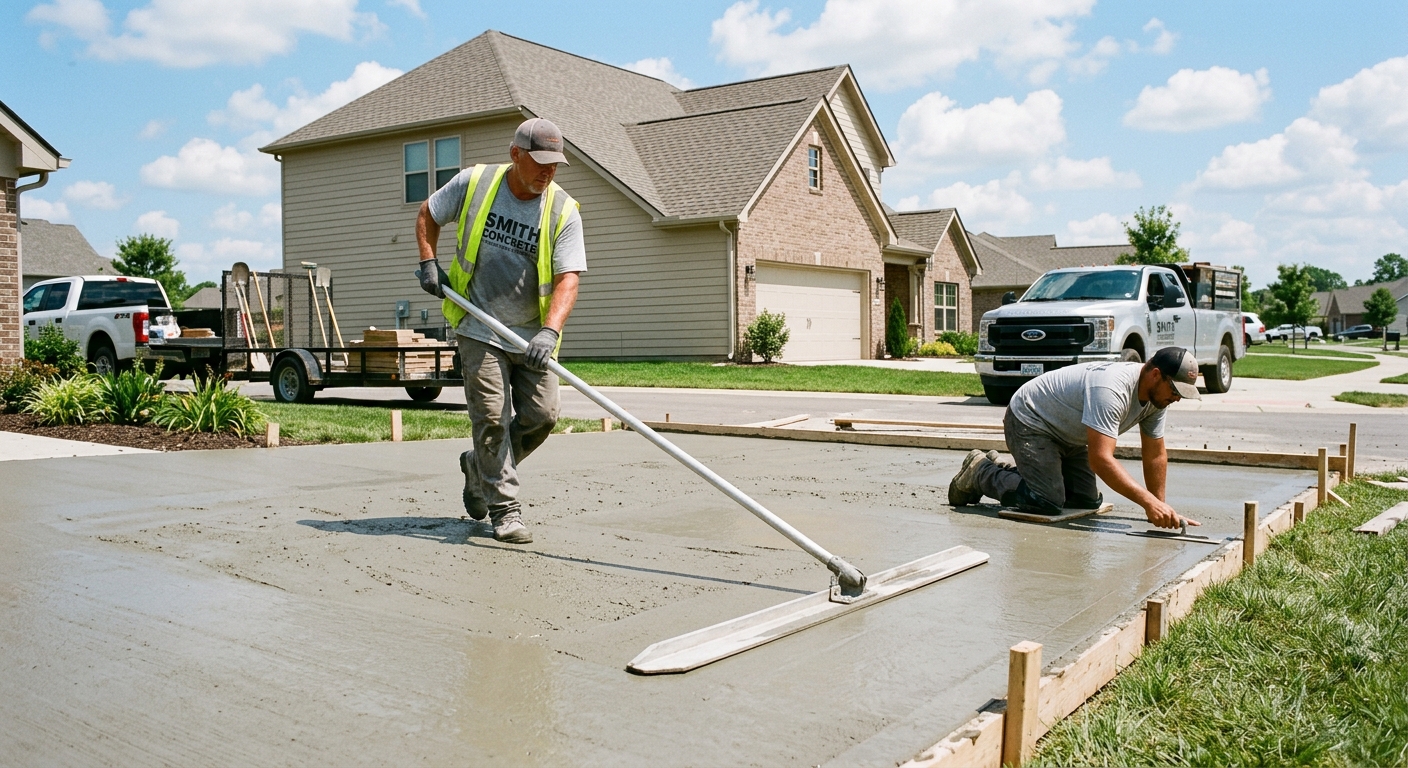
Concrete work options and costs in Tuscany
Tuscany, Alberta is a smaller community within the Calgary market, and that shapes how concrete pricing shows up on your quote. With a population of 19,700 (Statistics Canada, 2021 Census), most homeowners’ concrete flatwork demand clusters around driveway and walkway upgrades, especially where older lots are being refreshed. While Tuscany has a mix of housing types, many projects come from typical owner-occupied residential patterns—driveways, patios, garage slabs, and, on new builds, foundation footings that must be engineered for cold winters.
In this part of Alberta, the climate is the driver: cold continental weather means freeze–thaw cycles are frequent enough that concrete is engineered around frost depth and curing discipline. Calgary’s design frost depth is about 1.2 m (roughly 4 ft), so exterior foundations and footings must bear on undisturbed soil below that depth to reduce frost heave. For slabs and flatwork, contractors rely on air‑entrained mixes, granular base preparation, and well-spaced control joints to prevent cracking and surface scaling. The practical pour season is shorter, and in late fall or early spring you’ll often see higher costs tied to winter-grade mixes, insulated blankets, or temporary heating so concrete cures properly.
Concrete contractors are especially busy around family hubs and infill areas where driveways and backyard patios get expanded—commonly in established residential pockets near local amenities and older streets where grading changes are typical. Next, use the comparison table below to align your scope with realistic Tuscany price bands.
| Application |
Typical Size |
Key Spec |
Finish Option |
Price Range |
| Concrete driveway (standard broom finish) |
400–500 sq ft |
Air‑entrained mix; compacted base |
Broom finish |
$12,000–$18,000 |
| Exposed aggregate driveway |
400–500 sq ft |
Air‑entrained mix; polished aggregate exposure |
Exposed aggregate |
$15,000–$22,000 |
| Stamped concrete driveway or patio |
300–450 sq ft |
Reinforcement where needed; controlled joints |
Stamped patterns |
$15,000–$26,000 |
| Plain concrete patio or walkway |
200–350 sq ft |
Air‑entrained mix; compacted sub-base |
Smooth trowel or light broom |
$5,000–$9,000 |
| Garage floor (interior slab) |
500–700 sq ft |
Vapour barrier (as required); reinforcement |
Power trowel (light broom optional) |
$10,000–$17,000 |
| Foundation footings (structural, below frost) |
Varies by home size |
Engineered excavation; below frost bearing |
Structural concrete |
$28,000–$45,000 |
Prices are estimates only and vary by project scope, site access and material selection.
What affects the price of concrete work in Tuscany
In Tuscany and the broader Calgary area, you can see the same “type” of concrete job quoted 30–50% apart, even when the square footage looks similar. The spread usually comes down to engineered requirements for frost, how much base prep and excavation is needed, and whether winter placement measures are included. In cold climates, specs aren’t optional—contractors build around freeze–thaw cycles, and that means air‑entrained mixes, granular base prep, and a curing plan that protects concrete during the short, colder pour window.
Frost line depth and freeze–thaw cycles dictate every major spec. Footings must extend below the design frost depth of about 1.2 m (roughly 4 ft) in this region to prevent frost heave and seasonal movement. Exterior slabs and driveways should also be placed with air‑entrained concrete; otherwise, you’re inviting spalling and scaling when moisture migrates in and out with the freeze–thaw cycle. Cold-weather curing can add real cost: winter‑grade mix, insulated blankets, and sometimes temporary heating so concrete reaches proper early strength before it freezes. Finally, de-icing salt accelerates surface deterioration—sealing is often the difference between “it looks fine” and “it lasts.”
Two practical Tuscany examples: (1) A backyard walkway that’s only 150–200 sq ft might land in the $5,000–$9,000 band, but if your grade requires removing imported topsoil and bringing granular base up to frost-safe depth, the price trends toward the top end. (2) A driveway in the $12,000–$18,000 band can jump if truck access is tight and rebar/reinforcement is required due to slope or heavier use; labour and material handling become a bigger share of the total.
| Price Factor |
Why It Matters | |
Cost Impact |
| Frost line depth |
Determines footing depth and form height |
Deeper excavation increases concrete volume and labour (often the biggest driver on foundations) |
| Site preparation |
Excavation, grading, compacted granular base |
More haul-away, regrading, and compaction time can push flatwork toward the high end of bands |
| Reinforcement |
Rebar or wire mesh requirement |
Material + labour to place reinforcement well can add cost, especially on larger or thicker slabs |
| Mix design |
Air-entrainment and compressive strength spec |
Spec’d air content and strength can increase material cost but reduces spalling risk |
| Finish type |
Broom vs. stamped vs. exposed aggregate |
Decorative finishes add labour and set-up, typically moving jobs into higher bands |
| Pour size and concrete truck access to site |
Pumping, staging, and wheelbarrow distances affect time |
Poor access can increase labour and extend crew time |
| Cold-weather curing precautions |
Heating and blankets to protect early hydration |
Winter measures can add meaningful incremental cost on exterior pours |
| Control joint pattern and sealing cost |
Controls cracking; sealing helps manage de-icing salt damage |
Proper jointing and quality sealer reduce long-term repairs |
Permits & regulations in Alberta
In Alberta, structural concrete work generally requires more formal approvals than decorative flatwork. For Tuscany homeowners, building permits are typically required for concrete that forms part of the building structure—such as footings, foundation walls, grade beams, and any engineered structural elements. In many cases, municipalities will review engineered drawings for those foundation components before construction proceeds. That’s why foundation estimates often include engineering and inspection steps, not just “pouring concrete.”
Concrete flatwork (driveways, patios, sidewalks, and walkways) usually does not require a permit by itself. However, it can require approval if the work impacts lot grading, changes drainage, or affects impervious surface coverage limits or the municipal right-of-way (for example, work tied closely to a curb/sidewalk area). Because rules can depend on how your project interfaces with drainage and access, always confirm with the local authority before you break ground.
To verify a contractor in Tuscany step-by-step: (1) ask for their proof of Alberta liability insurance—review the certificate of insurance for coverage amount and the named insured; (2) confirm they carry WCB coverage (WSIB/WCB equivalent coverage in Alberta) and request clearance documentation if available; (3) verify the contractor’s licensing/registration status via the appropriate Alberta online resources; and (4) request references on similar-scale driveway, patio, and foundation work so you can confirm the quality matches what they’re quoting.
Getting concrete right in Tuscany's freeze-thaw climate
Concrete failures in Tuscany are usually traceable to a few repeat problems: inadequate base preparation, incorrect mix design, missing reinforcement where needed, and curing shortcuts during cold spells. In Calgary-area winters, the freeze–thaw cycle repeatedly expands and contracts moisture in and around concrete. If the base isn’t compacted to the right frost-safe depth, the slab can settle or lift. If air‑entrainment is wrong (or omitted), water that gets into the paste can expand as it freezes, leading to surface scaling and spalling—especially on driveways exposed to sand and de-icing salt.
To spec your project correctly, focus on five items. First, base preparation: contractors should build a properly compacted granular sub-base designed for local soil and the region’s frost depth (about 1.2 m, roughly 4 ft). Second, mix design: air‑entrainment is typically targeted in the 5%–7% range for exterior flatwork, with minimum 32 MPa compressive strength for many residential applications. Third, control joints: spacing should be planned to limit random cracking, and joints must be cut or tooled within a practical timing window. Fourth, curing: aim for minimum 7 days under proper conditions; cold-weather pours often require insulated blankets or temporary heat so early strength development isn’t interrupted. Fifth, sealing: use a penetrating sealer applied after the concrete has cured—commonly around 28 days—to repel de-icing salts.
Here’s a real cost justification example. A plain patio may fit the $5,000–$9,000 range, but spending extra on correct air‑entrained mix, adequate base depth, and a proper joint plan (rather than cutting corners) is often cheaper than replacing a failing slab later. Decorative options can cost more—stamped driveway/patio work often lands in the $15,000–$26,000 band—but the best-looking stamped jobs are still the ones engineered to survive the winter, not just the ones poured quickly.
| Spec |
Why It Matters in Tuscany |
What to Ask For |
Impact if Skipped |
| Compacted granular base (depth?) |
Prevents frost-related movement and slab settlement |
Granular base thickness based on your soil and the frost-safe design depth |
Uneven settlement, cracking, and early lifting |
| Air-entrained concrete mix (target air %?) |
Helps concrete resist freeze–thaw damage |
Documented air content target (commonly 5%–7% for exterior flatwork) |
Surface scaling and spalling in winter |
| Compressive strength (MPa rating) |
Ensures structural durability and proper early strength gain |
Minimum 32 MPa (or higher if engineered/required) |
Reduced durability and higher risk of damage from freeze–thaw and loads |
| Control joints (spacing per ACI guidelines) |
Controls where cracks will form to avoid random cracking |
Joint spacing plan and timing for cutting/tooling |
Random cracking and water intrusion that worsens spalling |
| Minimum 7-day curing period |
Curing affects strength development in cold weather |
Minimum 7 days under proper conditions (and winter measures if needed) |
Surface weakness, scaling, and reduced long-term performance |
| Penetrating sealer (when applied after cure) |
Reduces salt and moisture-related deterioration |
Penetrating sealer applied after cure—commonly around 28 days |
Faster wear from de-icing salts and moisture |
How to choose a concrete work contractor in Tuscany
Choosing the right concrete contractor in Tuscany is mostly about verifying credibility and matching what’s written to what’s actually built. Start with Alberta checks: ask for their liability insurance certificate and confirm the coverage is current. Then verify WCB coverage (WCB clearance/registration documentation where applicable). For licensing/registration, look up their status through Alberta’s contractor/registration resources; don’t rely on verbal claims. Finally, request references on similar-scale driveway, patio/walkway, and foundation projects so you can see finished work that survived winter.
Next, get 2–3 itemised written quotes—not just a lump sum. Good quotes separate labour from materials and should list items such as excavation and haul-away, granular base and compaction, reinforcement (if included), air‑entrained mix and strength spec, forming and finishing, and sealing. Check what’s excluded: disposal, saw cutting, drainage adjustments, permit pulls (if any), snow/ice protections during cure, and winter heat/blankets for cold-weather pours.
For warranty, look for a clear workmanship warranty length and confirm whether product/material warranties apply to sealers or specialty admixtures. Ask if warranties are transferable if you sell the home. Payment schedule should be conservative: never pay more than about 10–15% upfront, and keep a holdback until cleanup and final touch-ups are complete. Require a start date and estimated completion timeline in writing so you can plan around the shorter exterior pour season.
- Ask for proof of Alberta liability insurance (certificate with current dates and coverage).
- Confirm WCB clearance/coverage and keep a copy for your records.
- Verify contractor registration/licensing status through Alberta’s online resources.
- Require a written, itemised estimate (labour vs materials, not just one total).
- Check that exterior work includes air‑entrained mix and the specified strength.
- Make sure base prep and compaction are included (and that depth is discussed).
- Confirm reinforcement is addressed (rebar/wire mesh as required by the slab design).
- Ask for a control joint plan (spacing and timing for cutting/tooling).
- Require curing details—minimum 7 days and winter curing measures if temperatures drop.
- Include sealing scope and clarify whether it’s included after curing (often around 28 days).
- Get disposal/haul-away written in the scope if excavation is involved.
- Keep deposits low (10–15%) and hold back until final inspection and cleanup.
In Tuscany, watch for red flags: quotes that don’t mention air‑entrained mix or curing, “one-size-fits-all” base depth assumptions, missing insurance/WCB documentation, no clear control joint plan, and schedules that ignore cold-weather curing requirements (especially in late fall or early spring).
Frequently asked questions — concrete work in Tuscany
How do I maintain concrete in Tuscany's freeze-thaw climate?
For concrete in Tuscany and the Calgary area, maintenance is less about frequent washing and more about protecting the surface from moisture and de-icing salt. Use a penetrating sealer after the concrete cures (often around 28 days) so salts and water don’t move as easily into the pores. Keep an eye out for early surface scaling—especially on driveways where rubber flaps, tire chains, and salt exposure are common. Sweep debris away so it doesn’t hold moisture against the slab. When you plow or shovel, avoid scraping too aggressively. If you see small cracks, address them promptly with appropriate crack repair to prevent water intrusion and freeze–thaw expansion.
What causes concrete to spall in Tuscany winters?
Spalling in Tuscany winters usually comes from a mix of water entry and weak freeze–thaw resistance. The biggest technical culprit is inadequate air‑entrainment or mix design that doesn’t meet the exterior exposure requirements. When water gets into the paste and freezes, it expands and breaks the surface layer, leading to flaking/spalling. Bad base prep can also contribute: if the slab isn’t supported and moves slightly, micro-cracks form and moisture gets in. De-icing salt then accelerates deterioration of the surface paste. Another contributor is poor curing—if the concrete freezes too early after placement, early strength gain can be compromised.
What is rebar and when is it required in Alberta?
Rebar is reinforcing steel that’s embedded in concrete to help control cracking and add strength under load. In Alberta, whether rebar is required depends on the slab type, thickness, engineering design, and soil conditions—there isn’t one universal rule for every driveway or patio. For structural elements such as foundation footings and foundation walls, reinforcement is typically designed and engineered. For exterior flatwork, some projects need wire mesh or rebar (for example, larger driveways, thicker slabs, or areas with heavier vehicular load). The most homeowner-friendly approach is to require your contractor to specify the reinforcement plan in the written quote, including placement and tie spacing, rather than assuming “it’ll be fine.”
How long does a concrete project take in Tuscany?
The timeline depends on whether you’re doing flatwork or structural work, and on site conditions. For typical residential flatwork in Tuscany, demolition and base prep can take 1–3 days, the pour day is usually a single crew shift, and finishing/curing follow immediately after. While concrete needs time to cure, it’s important to separate “walk-on” time from “strength for loads.” Contractors generally plan around at least 7 days for curing for many exterior placements before you start heavier traffic, and sealing is commonly coordinated after full cure—often around 28 days. Decorative work (stamped or exposed aggregate) may add set-up and finishing time. In cold spells, winter curing measures can extend the schedule.
What is a concrete overlay and is it suited to Tuscany?
A concrete overlay is a bonded concrete layer installed over an existing slab, typically to refresh surface appearance or correct minor surface issues. In Tuscany, overlays can be suitable when the existing concrete is still structurally sound, the surface can be prepared properly (cleaning/scarification), and drainage isn’t an ongoing problem. However, overlays are usually not the right answer for slabs with significant settlement, deep cracking, or widespread frost-related movement—those issues can “telegraph” through and the overlay may fail prematurely. If your current driveway is spalling or the base has shifted, removal and re-pour often performs better long-term, even though it may cost more upfront (for example, driveway rebuilds commonly fall into the $12,000–$18,000 range, depending on scope).
How do I seal concrete to protect it in Tuscany?
Sealing helps manage moisture and de-icing salt exposure, which is especially important in Tuscany’s freeze–thaw winters. Use a penetrating sealer designed for exterior concrete rather than a film-forming coating that can trap moisture. Confirm the concrete has cured before sealing—commonly around 28 days for best results—so you don’t seal in excess moisture. Before application, the surface should be clean and dry; contractors often pressure wash (and allow drying) and may test moisture conditions. Apply the sealer evenly with the right coverage rate and don’t rush the cure window. If the concrete is new but you’re pouring in cooler weather, ask your contractor about curing blankets/heating first—sealing without proper cure won’t perform reliably.