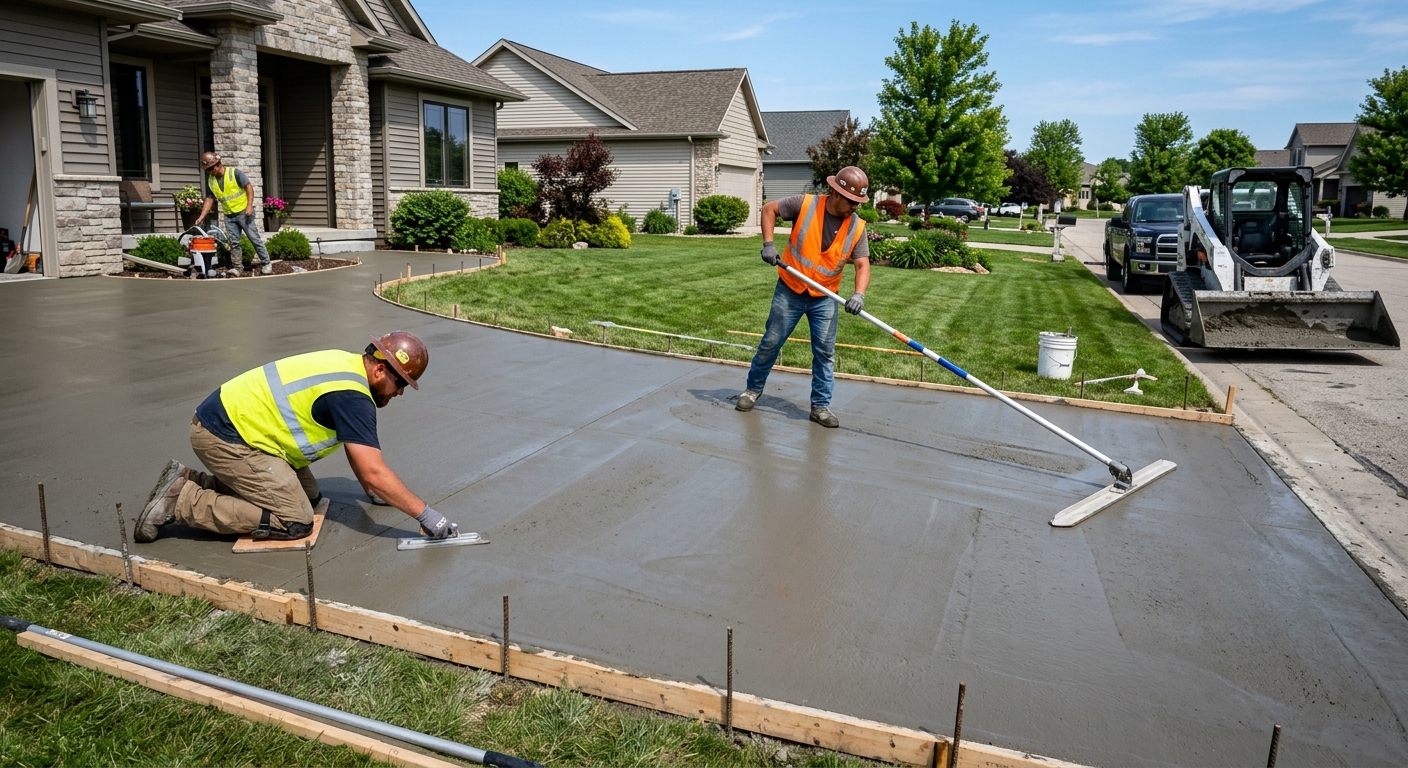
Concrete work options and costs in Airdrie
Airdrie homeowners typically get concrete installed as flatwork (driveways, patios and walkways) and as structural work (garage slabs and foundation footings). In Airdrie specifically, the market is heavily built around single-detached housing—65.4% of dwellings—and most households are homeowners (79.3% of households own, Statistics Canada, 2021 Census). That mix drives steady demand for everything from street-side driveway replacements to backyard patio upgrades in established areas.
Because Calgary-area weather is cold continental, concrete in Airdrie is engineered around frost and frequent freeze–thaw cycles. Local practice assumes a design frost depth of about 1.2 m (roughly 4 ft), which means excavation is more intensive and footing volumes are higher than in milder parts of Canada. The shorter exterior pour season also affects labour availability, and contractors often plan around cold-weather placement (winter-grade mixes, insulated blankets, and sometimes temporary heat) to protect curing. On top of that, Airdrie drivers commonly use de-icing salt during shoulder seasons; if the mix doesn’t have the right air-entrainment and the surface isn’t sealed after curing, you’ll see premature scaling and spalling.
Trade demand is especially strong in newer-but-established pockets with ongoing landscaping and replacement work—many homeowners in Coopers Crossing and Chinook Winds look to concrete contractors for driveways and patios that can handle long winter conditions. With that in mind, here’s a realistic cost range comparison to help you benchmark quotes before you book site visits.
| Application |
Typical Size |
Key Spec |
Finish Option |
Price Range |
| Concrete driveway (standard broom finish) |
480–600 sq. ft. |
Air-entrained mix, reinforced where needed, compacted granular base |
Broom finish |
$12,000–$18,000 |
| Exposed aggregate driveway |
480–600 sq. ft. |
Air-entrained mix, proper curing, sealed surface |
Exposed aggregate |
$15,000–$21,000 |
| Stamped concrete driveway or patio |
300–500 sq. ft. |
Air-entrained mix, base prep, colour hardener/release as specified |
Stamped + integral colour or overlay |
$15,000–$26,000 |
| Plain concrete patio or walkway |
160–320 sq. ft. |
Reinforcement where required, broom or smooth trowel, proper slope |
Plain (broom or light trowel finish) |
$5,000–$9,000 |
| Garage floor (interior slab) |
400–600 sq. ft. |
Vapour control/insulation if required, reinforced slab, consistent curing |
Plain or lightly finished |
$10,000–$16,000 |
| Foundation footings (structural, below frost) |
Varies by house |
Engineered design, excavation to undisturbed soil, rebar cage, concrete spec below frost depth |
Structural concrete |
$28,000–$45,000 |
Prices are estimates only and vary by project scope, site access and material selection.
What affects the price of concrete work in Airdrie
In the Calgary region, it’s not unusual to see quotes for the “same” concrete project swing by 30–50%. The difference usually isn’t the concrete itself—it’s what each contractor includes around it: excavation depth, granular base thickness, reinforcement level, mix design requirements, and the winter curing measures needed to protect strength and durability in freeze–thaw conditions. On top of that, labour availability can tighten during the short exterior pour season, which can raise rates if you’re trying to schedule late in the year.
The frost line depth drives much of the cost. In Alberta, footing depth is engineered to sit below the design frost depth (commonly up to about 2.4 m for certain Alberta conditions). That means more excavation and higher formwork height—both directly increase foundation/footings pricing. Exterior slabs and walkways also need air-entrained concrete mixes to survive freeze–thaw cycles. A contractor who spec’s the right air content and uses proper curing blankets in cold conditions will typically charge more than the cheapest option, but you’re paying to reduce the risk of scaling and spalling over the next few winters.
Concrete alternatives also change costs in predictable ways. For example, upgrading a standard driveway to stamped concrete often increases the budget into the $15,000–$26,000 range because you’re paying for labour-intensive forms/colour and additional surface protection. Meanwhile, a straightforward patio or walkway tends to stay nearer $5,000–$9,000, assuming straightforward access and minimal regrading. In Airdrie, the housing stock is older in parts of town—9.4% of homes were built before 1981 (Statistics Canada, 2021 Census)—and retrofits at older sites can require more demo and regrading, adding thousands versus a clean new base prep.
| Price Factor |
Why It Matters |
Cost Impact |
| Frost line depth |
Determines footing depth and form height |
Higher excavation and concrete volume can push foundation/footings toward the upper band |
| Site preparation |
Excavation, grading, compacted granular base |
Uneven access or poor subgrade increases granular material and machine time |
| Reinforcement |
Rebar or wire mesh requirement |
More steel and labour for tying/spacers raises cost, especially on drives |
| Mix design |
Air-entrainment and compressive strength spec |
Correct air content and strength typically adds material cost but reduces future repairs |
| Finish type |
Broom vs. stamped vs. exposed aggregate |
Stamped/exposed usually increases labour and materials; plain finishes cost less |
| Pour size and concrete truck access to site |
Logistics for placement and minimizing cold joints |
Limited access may require smaller loads, longer labour, or pumping |
| Cold-weather curing precautions |
Heating and blankets |
Winter-grade controls and insulated curing can add a noticeable premium |
| Control joint pattern and sealing cost |
Controls shrinkage cracking and protects surfaces from salt |
Quality joint layout and sealing adds cost but improves durability |
Permits & regulations in Alberta
In Alberta, the big line is between structural concrete and typical flatwork. Structural concrete work—like foundation footings, foundation walls, and grade beams—usually needs a building permit, and engineered drawings are commonly required (and reviewed by the municipality). For homeowners, that matters because permit approvals can affect timelines and what inspections you must schedule during and after the pour.
Concrete flatwork such as patios, walkways, and driveways typically does not require a permit on its own. However, it can require involvement if the project affects lot grading, stormwater flow, or impervious surface requirements, and if any work touches municipal right-of-way areas. In practice, I tell Airdrie homeowners to treat anything involving drainage re-routing, retaining elements, or changes near a property line as “check first.”
Before you sign a contract, verify the contractor’s coverage and credentials. Step-by-step: (1) Ask for their company liability insurance certificate and confirm the coverage limits match the scope; (2) Confirm they have WSIB/WCB coverage appropriate to their operations (and ask for a clearance letter if available); (3) Ask for references from similar-scale projects (driveways/patios or foundation work, depending on your scope); and (4) For structural work, ensure the permit is pulled under the correct party and that inspection milestones are listed in writing. If the contractor can’t provide certificates promptly, that’s usually a red flag.
Getting concrete right in Airdrie's freeze-thaw climate
Concrete fails in Airdrie mainly through freeze–thaw damage and poor moisture management. The most common issue I see is spalling and scaling from inadequate air-entrainment or weak curing—especially when projects are rushed in late fall or early spring. Another contributor is cracked slabs from insufficient base prep, improper joint spacing, or missing reinforcement on drives. In a cold continental climate, water gets into micro-cracks, freezes, expands, and gradually degrades the surface over repeated cycles.
To spec the job correctly for Airdrie, start with the base. Require compacted granular sub-base at the right thickness for local soil and design frost conditions, then ensure correct slope for drainage. Next, insist on an air-entrained concrete mix—typically 5–7% air content for exterior flatwork—and a minimum 32 MPa compressive strength so the slab develops durability and strength. Then, control cracking with properly placed control joints at intervals suited to the slab size (not random “as we go” joints). After placement, curing matters: aim for minimum 7-day curing under conditions that maintain temperature and moisture, and in cold weather use insulated blankets and/or approved heating to protect strength gain. Finally, seal after cure (commonly at about 28 days) with a penetrating sealer to help repel de-icing salt.
Here’s where the price difference can be justified: a standard broom-finished driveway might be around $12,000–$18,000, while a stamped upgrade can move you toward $15,000–$26,000. If both options have the same base prep, proper air-entrainment, joints, and curing, the added cost is mostly surface labour and colour/finishing—not extra “structural” value. Paying for the basics (base, air, joints, curing, sealing) is what keeps either driveway looking good through Alberta winters.
| Spec |
Why It Matters in Airdrie |
What to Ask For |
Impact if Skipped |
| Compacted granular base (depth?) |
Proper support reduces settlement and helps prevent cracking in freeze–thaw |
Granular base depth and compaction method/spec before pour |
Uneven slabs, premature cracking, and accelerated edge failure |
| Air-entrained concrete mix (target air %?) |
Air bubbles manage freeze–thaw stresses and reduce scaling/spalling |
Target air content for exterior flatwork (typically 5–7%) |
Surface scaling and spalling within a few winters |
| Compressive strength (MPa rating) |
Strength development supports durability under loads and cold conditions |
Minimum 32 MPa specified at the required age |
Lower performance and increased risk of early surface damage |
| Control joints (spacing per ACI guidelines) |
Joints give concrete a place to crack instead of random cracking |
Planned joint layout and spacing based on slab size |
Random cracking, difficult repairs, and water infiltration |
| Minimum 7-day curing period |
Curing protects strength gain before freeze–thaw cycling ramps up |
How they maintain moisture/temperature for at least 7 days |
Reduced strength and higher long-term deterioration risk |
| Penetrating sealer (when applied after cure) |
Repels salt and moisture at the surface |
Penetrating sealer applied after cure (commonly around 28 days) |
Faster salt-driven deterioration and more staining |
How to choose a concrete work contractor in Airdrie
Choosing the right contractor in Airdrie is mostly about verification and documentation. Start by confirming Alberta licensing where applicable for your scope, then review insurance and coverage. Ask for a current liability insurance certificate (and check the expiry date) and make sure the company has WSIB/WCB coverage for workers performing the work. If they provide a clearance letter, that’s even better—it shows their account status is in good standing.
Next, get 2–3 itemised written quotes. You want labour and materials separated (demo, excavation, granular base, reinforcement, concrete supply, finishing, sealing) rather than a single lump-sum number. Also read the exclusions: is disposal included? Will they remove and replace any unsuitable subgrade? Is the pour date and cold-weather protection included if temperatures drop? For structural work that needs permits, confirm whether permit pulling and inspections are included or excluded.
Warranty should be in writing. Ask how long the workmanship warranty lasts, whether it covers cracking and surface issues caused by freezing conditions, and what product/manufacturer warranties apply to concrete admixtures or sealers. Payment terms should stay conservative—never pay more than 10–15% upfront, and hold back a portion until the job is complete and surfaces are accepted.
Finally, insist on a schedule: start date, projected completion date, and any weather contingencies. In our climate, a clear plan for curing protection is what separates a “good” pour from one that survives.
- Ask what design frost considerations apply to your footing plan and how they’ll excavate to undisturbed soil.
- Require a detailed scope: excavation, granular base thickness, reinforcement type, and concrete spec.
- Confirm air-entrained mix for all exterior flatwork and ask the target air content.
- Get the planned control joint spacing and whether joints are cut or tooled on schedule.
- Ask about cold-weather measures (insulated blankets/heating) if working near shoulder seasons.
- Confirm whether sealing is included and when sealer will be applied after cure (commonly ~28 days).
- Request proof of liability insurance before work begins.
- Verify WSIB/WCB coverage and ask for clearance documentation if available.
- Get references from similar projects (driveways, patios, or footings) in the Calgary/Airdrie area.
- Use itemised quotes—labour vs materials vs equipment—so apples are compared to apples.
- Check the disposal/haul-away plan for demo and excavated soils.
- Agree on payment milestones tied to inspections and key stages (base prep, pour, finish, cleanup).
Concrete red flags in Airdrie include: quotes that don’t mention air-entrainment or curing protection, “standard” joint layouts with no spacing plan, vague promises like “we’ll deal with frost,” no proof of insurance/coverage, and payment requests above 10–15% upfront without a written schedule.
Frequently asked questions — concrete work in Airdrie
How deep must footings be for Airdrie's frost line?
For Airdrie and the wider Calgary region, footing depth is governed by design frost considerations and engineered plans, not guesswork. Local practice uses a design frost depth of about 1.2 m (roughly 4 ft), meaning the footing should bear below that depth to reduce frost heave risk. In Alberta, the exact excavation depth can vary by soil conditions and foundation design, and structural concrete work often requires engineered drawings submitted for review where applicable. The practical takeaway: a contractor should show you the engineered footing profile (depth and bearing) and explain how they’ll excavate to undisturbed soil. Avoid any quote that doesn’t address frost depth because footing volume and formwork height are major parts of the foundation/footings cost, often in the $28,000–$45,000 range depending on scope.
Why does concrete crack in Airdrie and how is it prevented?
Concrete cracks in Airdrie mainly due to shrinkage, thermal movement, and—if the base isn’t right—settlement. Then Alberta freeze–thaw cycles can worsen surface damage when water enters those cracks. Prevention is about controlling where cracking happens and ensuring the slab is durable: proper base preparation with compacted granular support, reinforcement sized for the load, and a control joint pattern with spacing planned to match slab dimensions. Equally important is using an exterior-appropriate air-entrained mix and curing properly so the concrete reaches strength before cold weather increases. Finally, sealing helps repel de-icing salt at the surface. If you compare driveways, the “finishing only” upgrade won’t fix cracking—skipping joints or curing is what leads to long-term issues. That’s why a well-built driveway near $12,000–$18,000 can outlast a cheaper install that never properly manages frost and water.
Stamped vs broom-finish concrete — cost difference?
In Airdrie, stamped concrete costs more than broom-finished concrete mainly because stamped work is labour-intensive and requires additional finishing steps like texture mats, release agents, and colour work. Both options should still use air-entrained concrete for exterior freeze–thaw durability and should include the same base prep and joint planning. If your quote jumps a lot, ask what changed besides the appearance. A typical broom-finished driveway often lands in the $12,000–$18,000 band, while stamped driveway or patio projects frequently fall into the $15,000–$26,000 band depending on area size and whether it’s a full driveway replacement or a smaller patio. If you’re quoted stamped pricing but the contractor won’t explain air-entrainment, curing, and joints, you’re not comparing equivalent durability.
When is the best time to pour concrete in Airdrie?
For Airdrie, the best time is typically the warmer portion of the year when concrete can be placed and cured without risking early freezing. Calgary-area freeze–thaw cycles arrive early and intensify through the winter, so exterior pours need a clear curing plan. If temperatures are expected to drop, a reputable contractor will discuss cold-weather precautions such as winter-grade mix requirements, insulated blankets, and sometimes approved heat to maintain curing conditions. Trying to push a late-fall pour without those measures is when you’re most likely to see scaling and surface deterioration later. For homeowners, the goal is not just “pour day,” but the 7-day curing period and protection until adequate strength is achieved. If a contractor can’t commit to a curing and weather contingency plan, it’s safer to schedule for a more reliable window—even if it means waiting a bit.
How long does concrete take to cure?
Concrete cure time depends on temperature and mix design, but for typical exterior work in Airdrie you should plan for a minimum 7-day curing period under proper conditions. Curing is what allows the concrete to gain early strength; it’s also when you want to protect it from freezing and excessive drying. After the minimum cure period, the slab continues to gain strength over time, and durability items like sealing are commonly timed after full cure—often around 28 days for penetrating sealers. That timing matters because Airdrie winters bring de-icing salts and freeze–thaw exposure, and sealed surfaces repel moisture better. If your contractor is offering shortcuts like sealing immediately or removing protection too early, ask for their curing method and how they’ll keep moisture/temperature controlled to support that minimum 7 days.
Do I need a permit for concrete work in Alberta?
In Alberta, it depends on what type of concrete work you’re doing. Structural concrete work like foundation footings, foundation walls, and grade beams typically requires a building permit and often engineered drawings reviewed as part of approvals. Concrete flatwork such as patios, walkways, and most driveways usually doesn’t require a permit by default, but it can if the work affects lot grading, drainage, impervious surface limits, or any areas near the municipal right-of-way. Because rules can hinge on site conditions, confirm with the local authority before breaking ground—especially if you’re changing drainage patterns or touching property lines. Also verify the contractor’s coverage and credentials: request a liability insurance certificate and proof of WSIB/WCB coverage, and make sure the correct party is pulling any needed permit for structural work.