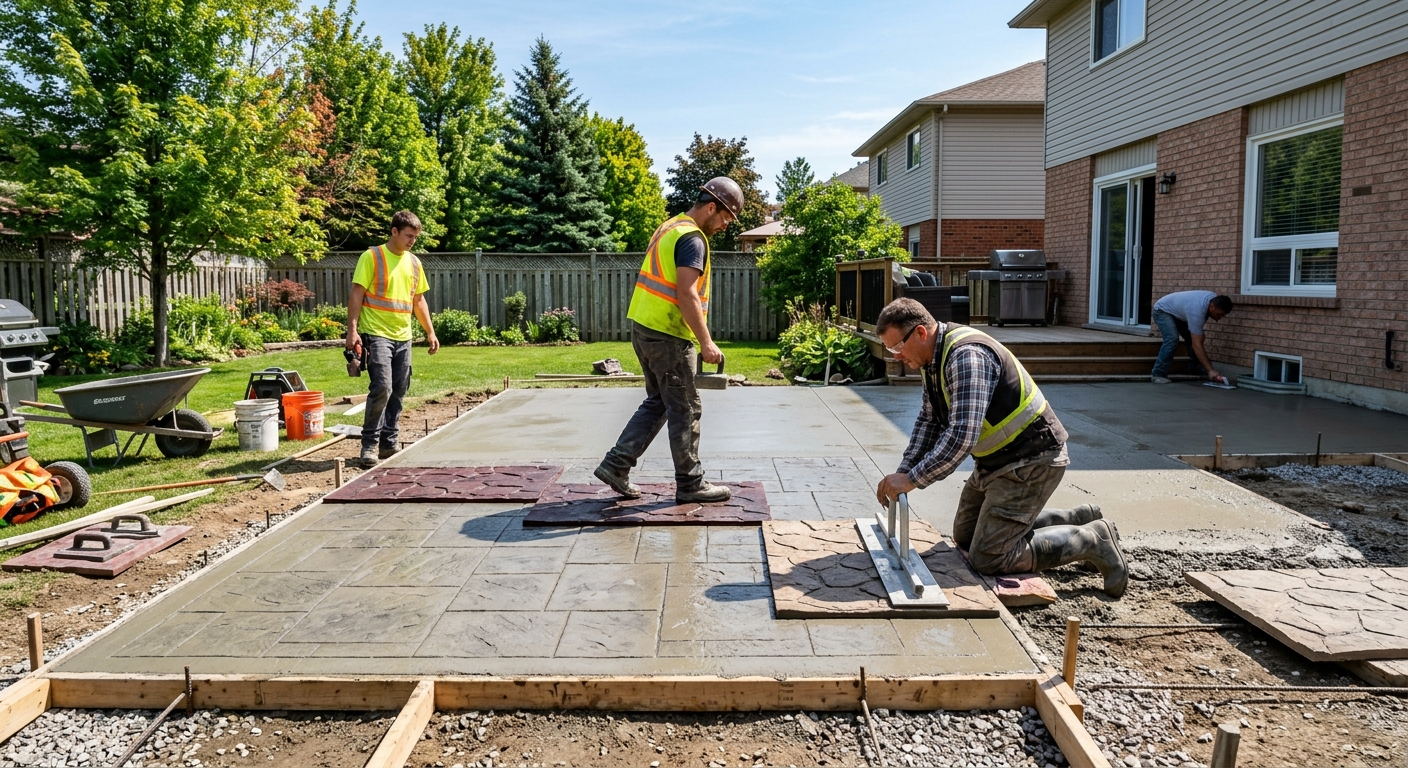
Concrete work options and costs in Hinton
In Hinton, concrete flatwork is a common upgrade for homeowners because the town’s housing mix is heavily oriented toward single-detached homes—55.6% of dwellings are that style. With 2,875 homeowner households (Statistics Canada, 2021 Census), there’s steady demand for driveways, patios, and walkways, plus periodic foundation and footing repairs as older housing stock (53.6% built before 1981) gets renovated or replaced. At the same time, the Banff–Jasper–Rocky Mountain House region’s freeze-thaw exposure and colder winter shoulder seasons drive up concrete costs compared with milder markets: contractors must manage frost depth, protect fresh pours, and reduce the risk of spalling and cracking with tighter specs and better curing controls.
We also see pricing tighten around construction crew availability and weather windows. Even when materials are similar, the job can cost more if extra protection is needed (insulated blankets, heated curing areas) or if access forces additional labour for excavation and formwork. In Hinton, trades are especially busy around Riverside and the Prairieview area where many homes are on established lots and require careful ties-in to existing grades, garage aprons, and walkways.
Use the table below to ballpark options for typical homeowners. If you want the most accurate range, compare quotes that use the same foundation/sub-base depth, rebar or mesh spec, concrete air content, and joint pattern.
| Application |
Typical Size |
Key Spec |
Finish Option |
Price Range |
| Concrete driveway (standard broom finish) |
12 ft x 24 ft (288 sq ft) |
Air-entrained exterior mix; compacted granular base; control joints |
Broom finish |
$4,000–$7,500 |
| Exposed aggregate driveway |
12 ft x 24 ft (288 sq ft) |
Air-entrained exterior mix; proper base; curing control; aggregate exposure |
Exposed aggregate |
$6,500–$11,500 |
| Stamped concrete driveway or patio |
12 ft x 18 ft (216 sq ft) |
Air-entrained exterior mix; compacted base; colour hardener/colour integral (as selected); joints |
Stamped patterns |
$5,000–$9,500 |
| Plain concrete patio or walkway |
12 ft x 12 ft (144 sq ft) |
Air-entrained exterior mix; compacted granular base; edging and joints |
Float + broom or smooth trowel (depending on request) |
$1,700–$3,200 |
| Garage floor (interior slab) |
22 ft x 24 ft (528 sq ft) |
Vapour barrier (if specified); wire mesh/reinforcement as required; proper curing |
Steel trowel finish (with broom strip where needed) |
$8,000–$18,000 |
| Foundation footings (structural, below frost) |
Typical 1,000–1,600 sq ft footprint (varies by design) |
Excavation to design frost depth; reinforced footings; waterproofing interface as required |
Structural concrete (not decorative) |
$14,000–$30,000 |
Prices are estimates only and vary by project scope, site access and material selection.
What affects the price of concrete work in Hinton
In Hinton and the broader Banff–Jasper–Rocky Mountain House region, it’s not unusual to see quotes for the “same” concrete project swing by 30–50% when the specs aren’t identical. That’s because freeze-thaw exposure, frost depth, and the local pour season dictate how deep we excavate, how much granular base we place and compact, how we reinforce, and what mix design we use. For exterior work, footings must extend below the design frost depth to reduce heave—commonly around 4 feet as a rule-of-thumb in Alberta applications—so excavation and form height costs rise quickly. Similarly, all exterior slabs should be air-entrained to survive repeated freeze-thaw cycles without spalling.
Cold-weather work also costs more. A shorter warm-weather window means fewer days to schedule trucks and finishing crews, and contractors may need heating/insulating blankets to control strength gain. After installation, de-icing salt can accelerate surface breakdown on non-sealed, improperly specified mixes; sealing becomes a value add rather than an afterthought in an Alberta winter. On top of that, labour availability can be tighter because not every crew can consistently meet cold-weather curing requirements and keep finishes within a narrow timing window.
Concrete age matters too: many Hinton homes built before 1981 were raised or renovated with varying past practices, so tying into existing foundations or reworking settling edges can add re-excavation and extra reinforcement. For budgeting, a plain patio often lands near the lower end of the $12–$22 per sq ft band, while stamped & decorative work tends to follow the $22–$40 per sq ft band once colour, stamping labour, and sealers are included. Foundation work is usually the most expensive category because frost-depth excavation and reinforcement drive the risk.
| Price Factor |
Why It Matters |
Cost Impact |
| Frost line depth |
Determines footing depth and form height to reduce frost heave |
Can add significant excavation and material; increases labour per linear foot |
| Site preparation |
Excavation, grading, and compacted granular base set the levelness and durability |
Higher if subgrade is soft, saturated, or requires hauling/disposal |
| Reinforcement |
Rebar or wire mesh reduces cracking and controls slab movement |
Price rises with steel quantity, chairs, and proper spacing/installation time |
| Mix design |
Air-entrainment and specified strength help concrete resist freeze-thaw damage |
More expensive mix and better quality control, especially for exterior exposure |
| Finish type |
Broom vs. stamped vs. exposed aggregate affects labour and weather timing |
Stamped/exposed requires extra steps (colour, forms, stamping, clean-up) |
| Pour size and concrete truck access to site |
Access limits can mean shorter pours or extra labour moving forms/material |
Can raise cost quickly if additional staff time is needed for placements |
| Cold-weather curing precautions |
Heating and insulated blankets protect strength gain and early-age damage |
Often adds daily costs during shoulder-season pours |
| Control joint pattern and sealing cost |
Joints manage shrinkage cracking; sealing helps repel salt and moisture |
Costs increase with labour for sawing/placement and sealer materials/application |
Permits & regulations in Alberta
In Alberta, the general rule is that structural concrete work needs municipal oversight, while many flatwork projects do not. Concrete that’s part of the structure—such as foundation footings, foundation walls, and grade beams—usually requires a building permit and often engineered drawings that the municipality can review. For concrete flatwork like patios, walkways, sidewalks, and driveways, a permit typically isn’t required unless the work affects lot grading, stormwater drainage, impervious surface coverage limits, or work within/near the municipal right-of-way. Because local conditions and bylaw enforcement can vary, confirm with the City of Hinton (or the applicable local authority) before you break ground.
To verify a contractor in Hinton step-by-step, start with Alberta’s contractor licensing/registry for the class of work they claim to do. Next, ask for a certificate of insurance showing liability coverage and confirm the dates cover your project. Then request proof of WSIB/WCB coverage (or an exemption letter if applicable) so you’re not left holding the bag if a worker is injured. Finally, check the contractor’s clearance letter/status details when they issue your quote, and ask for references on similar footing/frost-depth or exterior flatwork jobs so you can see their track record in Alberta weather.
Getting concrete right in Hinton's freeze-thaw climate
Concrete fails in Hinton most often for predictable reasons: water gets into a weaker surface or a porous, poorly protected mix, then it freezes and expands (freeze-thaw), causing scaling or spalling. Another common failure is cracking from shrinkage or settlement when the base isn’t compacted to the correct depth or when control joints aren’t placed and spaced correctly. To spec the job correctly in the Banff–Jasper–Rocky Mountain House market, you want five things nailed down before the first truck arrives.
(1) Base preparation: expect excavations and a compacted granular sub-base designed for local soil conditions and frost exposure, not “topsoil removal only.” If the base is too shallow or not compacted, the slab can pump under freeze-thaw and traffic. (2) Mix design: use air-entrained concrete with target 5–7% air for exterior flatwork and a minimum 32 MPa compressive strength (as specified). (3) Control joints: plan joints so shrinkage cracking happens in the right spots, and don’t leave random cracks to chance. (4) Curing: plan for at least 7 days of proper curing conditions; cold weather slows strength gain, so early loading or exposure can damage the surface. (5) Sealing: apply a penetrating sealer about 28 days post-pour to repel moisture and de-icing salts.
Where price differences make sense: a stamped patio may look expensive compared to broom-finish concrete, but the added labour for stamping, colour work, and weather-tight finishing windows can be justified. For example, moving from a plain patio near the $12–$22 per sq ft band to stamped & decorative work near $22–$40 per sq ft often buys better surface protection steps and more careful finishing. Where customers lose money is choosing the “lowest” quote with a non-air-entrained or underspecified mix—those failures are expensive to fix.
| Spec |
Why It Matters in Hinton |
What to Ask For |
Impact if Skipped |
| Compacted granular base (depth?) |
Controls settlement and supports freeze-thaw movement |
Base depth and compacted lift method (verified for your soil) |
Uneven slab, rocking edges, and premature cracking |
| Air-entrained concrete mix (target air %?) |
Helps concrete tolerate freeze-thaw cycling |
Target air range (typically 5–7% for exterior flatwork) |
Spalling/scaling, especially with winter de-icing salts |
| Compressive strength (MPa rating) |
Determines how quickly concrete can gain durability |
Minimum 32 MPa (or project-specified requirement) |
Surface damage, deeper wear, and reduced long-term performance |
| Control joints (spacing per ACI guidelines) |
Directs shrinkage cracks and reduces random failure |
Joint layout plan before pour; saw-cut timing |
Random cracking, moisture entry, and faster deterioration |
| Minimum 7-day curing period |
Ensures strength gain before cold exposure and traffic loads |
Curing plan for temperatures (blankets/heating if needed) |
Early-age cracking and reduced abrasion resistance |
| Penetrating sealer (when applied after cure) |
Repels water and salt intrusion over Alberta winters |
Application timing around 28 days after pour |
Accelerated spalling and discolouration from salt and moisture |
How to choose a concrete work contractor in Hinton
Choosing the right contractor in Hinton is mostly about confirming they can build for our freeze-thaw reality—not just pour concrete and hope for the best. Start by verifying Alberta licensing for the scope of work they’ll perform, then ask for a current certificate of liability insurance. Next, confirm WSIB/WCB coverage (or a valid exemption letter) before work begins. Don’t accept “we’re covered” verbally—have them provide documentation you can review.
Then request 2–3 itemised written quotes that break out labour and materials: excavation/base prep, reinforcement, concrete supply (including air-entrainment), finishing steps, joints, curing/blankets, and sealing if included. Avoid apples-to-oranges pricing—one contractor’s “driveway” can include proper base depth and air content, while another’s can be closer to a minimal-scope pour. Make sure the quote states what’s excluded: permit pull (if applicable), disposal/hauling, saw-cutting, and any concrete removal/replacement.
Warranty matters. Ask for a workmanship warranty length and whether it’s tied to maintenance steps (like sealing). Confirm if the warranty is transferable to future owners—important if you sell. On payment, never pay more than 10–15% upfront; hold back funds until completion and punch-list items are done. Finally, insist on a written start date and completion estimate that accounts for weather—cold snaps can change finishing windows and curing requirements in Alberta.
- Licence and trade registration for the scope of work they’re quoting
- Current liability insurance certificate with coverage limits shown
- WSIB/WCB proof (or exemption letter) provided with your contract
- Itemised labour/materials (base prep, rebar/mesh, mix spec, curing)
- Concrete mix details: air-entrainment and minimum strength noted
- Base prep spec: excavation depth, granular type, and compaction method
- Reinforcement details: where mesh/rebar is placed and how it’s supported
- Control joint layout and saw-cut timing included in the scope
- Cold-weather plan: blankets/heating and curing protection if required
- Sealing included or scheduled (especially for exterior flatwork)
- Site protection: debris removal, grind/smooth any transitions, grade control
- Payment schedule with retainage/holdback until final inspection
Concrete red flags I see in Hinton include: quotes that don’t mention air-entrainment or joints, “low” pricing that skips excavation depth and granular compaction, no written curing plan for colder pours, refusing to provide insurance/WSIB documentation, and vague scope language like “concrete to be determined” or “finishing as weather permits” without a defined standard.
Frequently asked questions — concrete work in Hinton
Stamped vs broom-finish concrete — cost difference?
In Hinton, stamped concrete typically costs more than a simple broom finish because it requires additional materials and labour: moulding tools, tighter finishing timing, and usually colour (either integral colour or colour hardener) plus more careful clean-up. In the Banff–Jasper–Rocky Mountain House region, the freeze-thaw environment also means you still need air-entrained exterior mix, proper base prep, and a joint plan—so the “look” upgrade doesn’t remove the durability requirements.
As a rough guide, broom-finish exterior flatwork often falls near the lower end of the $12–$22 per sq ft band for patios and walkway-style work, while stamped & decorative work aligns more with $22–$40 per sq ft. For a homeowner weighing options, a stamped patio of the same size can cost roughly 30% to 80% more depending on how colour, pattern complexity, and sealing are included in the quote. Always compare quotes item-by-item so you’re paying for the finish, not hidden substitutions in the mix or base spec.
When is the best time to pour concrete in Hinton?
The best time to pour concrete in Hinton is when temperatures allow proper finishing and curing without excessive protection. In practical terms, that usually means late spring through summer/early fall, when you can maintain good placement and curing conditions. Cold weather slows strength gain, so contractors may need insulated blankets or heating, which adds labour and material costs.
If you’re planning exterior work, schedule early enough that trucks can arrive and concrete can be finished within the normal window. If a pour lands close to a cold snap, ask the contractor for a written cold-weather curing plan and how they’ll protect the slab during the first 7 days. This is especially important for exterior slabs that face freeze-thaw cycling and de-icing salt abrasion.
Because Hinton’s season is tighter than in milder provinces, availability can also affect price—last-minute scheduling tends to cost more. A well-prepped job with the right air-entrained mix and curing controls will perform far better through Alberta winters than a rushed pour.
How long does concrete take to cure?
Concrete cure times depend on temperature and mix design, but for typical residential work in Hinton you should plan around two milestones: workable curing and strength development. For most slabs, crews treat at least 7 days of proper curing as the minimum practical window before assuming good early-age durability. That doesn’t mean concrete is “weak” after a week—it means you should avoid heavy loading or conditions that can damage the surface while strength gain is still progressing.
Decorative and exterior protection steps also matter. For penetrating sealing intended to help repel moisture and de-icing salts, many reputable contractors apply sealer at about 28 days post-pour, when the concrete has matured sufficiently to accept the treatment. If a job is poured cold, curing time may need to be extended with blankets/heating to reach the intended performance.
For budgeting, remember that skipping proper curing isn’t a “small saving.” It’s one of the most common reasons exterior concrete fails early in freeze-thaw climates like ours in Alberta.
Do I need a permit for concrete work in Alberta?
In Alberta, the permit question depends on what concrete work you’re doing. Structural concrete—like foundation footings, foundation walls, and grade beams—typically requires a building permit and often engineered drawings reviewed through the municipal process. Concrete flatwork like driveways, patios, and walkways usually does not require a permit unless it affects lot grading, stormwater/drainage, impervious surface limits, or work near the municipal right-of-way.
For Hinton homeowners, the easiest approach is to ask the contractor to confirm whether your scope affects grading/drainage and to check the municipal requirements before excavation. If your plan ties into a foundation, changes elevations, or redirects runoff, assume you may need review.
When you get quotes, clarify whether “permit pull included” is part of the price. It’s also worth noting that a well-documented scope (base depth, reinforcement, and drainage considerations) can reduce back-and-forth with approvals.
Concrete vs pavers for a patio in Hinton?
Both concrete and pavers can work well in Hinton, but concrete usually wins on durability per dollar when the base and drainage are done correctly. Pavers offer benefits like easier localized repairs (you can replace a section), and they can be visually flexible. However, paver performance depends heavily on base compaction, joint sand maintenance, and good edging so the surface doesn’t heave during freeze-thaw.
Concrete patios, when installed with air-entrained exterior mix, compacted granular base, and a proper joint pattern, generally handle Alberta freeze-thaw cycles effectively. Price-wise, a plain concrete patio often fits around the $12–$22 per sq ft band, while decorative stamped concrete can move toward $22–$40 per sq ft. Pavers can be competitive, but the total cost (excavation depth, base build-up, edging, and labour) can narrow the gap depending on the pattern and thickness.
Ask both contractors to describe their sub-base depth, compaction method, and how they manage drainage. If those details are vague, don’t assume either option will last.
How long does a concrete driveway last?
A properly built concrete driveway in Hinton can last 20 to 30 years or more, but the timeline depends on how it’s specified for freeze-thaw and de-icing salt exposure. The biggest performance drivers are: adequate excavation and a compacted granular base, air-entrained exterior mix, correct control joint placement, and curing done under the right conditions. If any of these are under-specified, surface scaling, cracking, or edge deterioration can show up much earlier.
Local climate matters. Freeze-thaw cycling plus winter salt can accelerate surface wear, which is why sealing is often recommended after curing (commonly around 28 days post-pour). A broom-finish driveway is usually the lowest-cost option, while decorative finishes like stamped concrete cost more (often within the $22–$40 per sq ft decorative band) due to additional labour and protection steps.
If you’re comparing quotes for a driveway, focus less on the headline number and more on whether the contractor includes air-entrainment, joint layout, and a realistic base prep spec. Those elements are what translate into lifespan in Alberta’s weather.