Concrete work options and costs in High Level
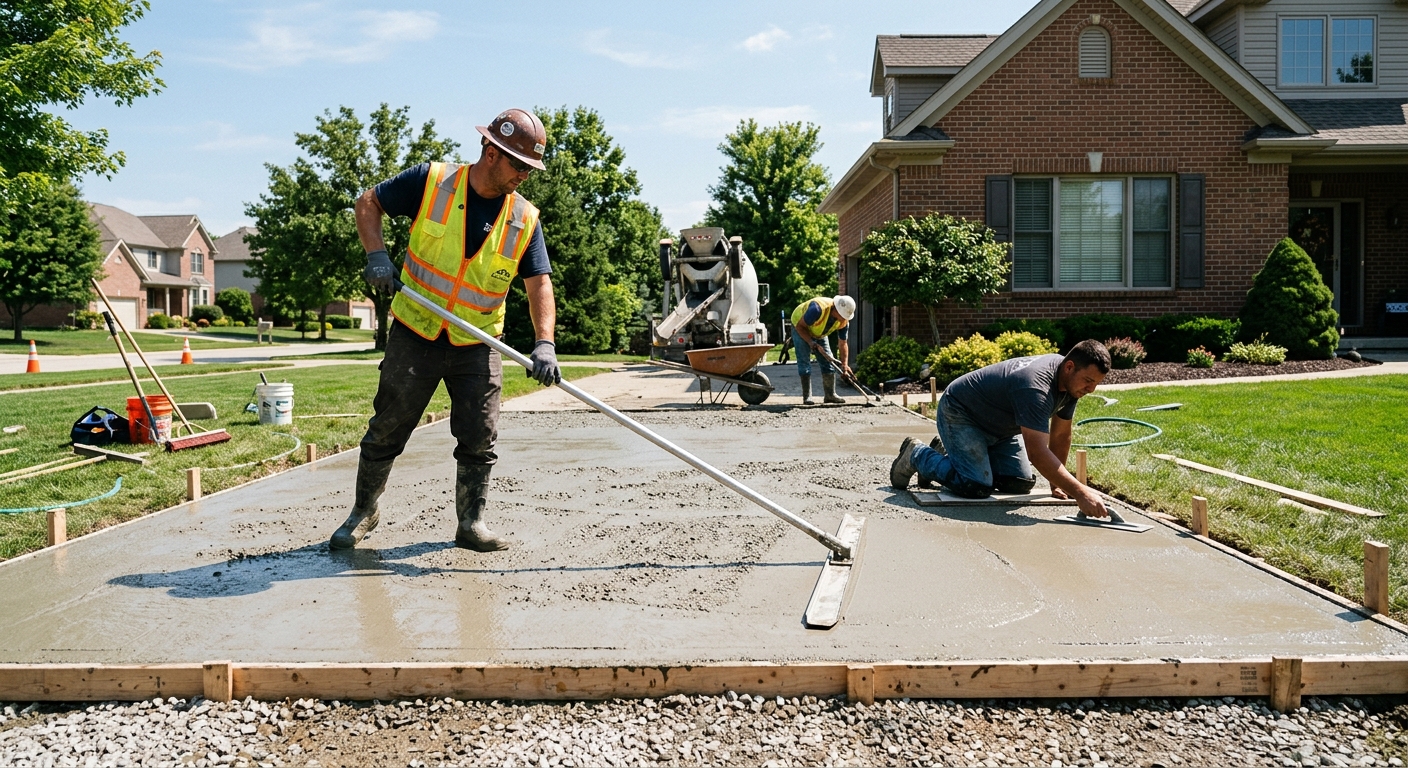
Concrete work in High Level tends to be most popular with homeowners who are updating or replacing exterior flatwork around single-detached homes, and that’s a big part of the local housing mix (47.9% of dwellings are single-detached). With 845 homeowner households (64.3% of households own) in town, there’s steady demand for driveways, patios and walkways, plus concrete touch-ups on older properties. A meaningful share of the housing stock is also older—26.6% of homes were built before 1981—so many jobs are repairs to existing slabs, steps, or garage floors rather than entirely new builds.
In the Athabasca–Grande Prairie–Peace River region, concrete pricing is driven heavily by climate and logistics. Frost lines typically run deep and repeated freeze–thaw cycles can be brutal on exterior surfaces, so contractors must build thicker bases, use air-entrained mixes, and plan for winter-cold curing when the pour season is tight. Crew availability can also affect scheduling in High Level because crews and equipment sometimes have to travel in from other Peace River communities. If you’re looking near areas like the High Level townsite, crews often prioritize driveways and entrances first because they’re visible and get used year-round.
Below are typical cost bands for common applications—use these to compare quotes, then fine-tune based on size, access, soil conditions, and the finish you want.
| Application |
Typical Size |
Key Spec |
Finish Option |
Price Range |
| Concrete driveway (standard broom finish) |
400–600 sq. ft. |
Air-entrained exterior mix, compacted granular base, control joints |
Broom finish |
$14,000–$20,000 |
| Exposed aggregate driveway |
400–600 sq. ft. |
Higher-cement consistency for wash exposure, air-entrained mix, sealed surface recommended |
Exposed aggregate |
$18,000–$26,000 |
| Stamped concrete driveway or patio |
300–550 sq. ft. |
Air-entrained exterior mix, integral colour, proper curing and joint layout |
Stamped |
$22,000–$35,000 |
| Plain concrete patio or walkway |
150–300 sq. ft. |
Compact base, air-entrained mix, slope to drain, edging |
Plain broom finish |
$12,000–$18,000 |
| Garage floor (interior slab) |
500–800 sq. ft. |
Vapour barrier (where required), fibre or mesh per design, proper thickness and flatness |
Float finish / trowel where requested |
$16,000–$24,000 |
| Foundation footings (structural, below frost) |
~1,000–1,800 sq. ft. bearing area (project dependent) |
Engineered reinforcement, excavation to design depth, below-frost concrete |
Structural concrete |
$45,000–$70,000 |
Prices are estimates only and vary by project scope, site access and material selection.
What affects the price of concrete work in High Level
In High Level and across the Athabasca–Grande Prairie–Peace River region, you can see the same basic project priced 30–50% differently between contractors. The material is only one slice of the total cost—what really changes the quote is how deep the frost protection needs to be, how much excavation and forming is required, and whether the contractor can execute quality curing despite the shorter reliable pour season. When crews are in peak demand, scheduling and travel also tighten availability, which pushes labour and mobilization costs up compared to southern Alberta averages.
Frost line depth and freeze–thaw cycles dictate nearly every specification. Exterior footings must be placed below the design frost depth to prevent frost heave, and exterior slabs typically require air-entrained concrete to survive repeated freeze–thaw scaling. In colder stretches, cold-weather curing precautions—like insulated blankets and sometimes heating—add both time and handling cost. Finally, de-icing salts can accelerate surface spalling, so sealing is often recommended; sealing isn’t just cosmetic in a northern climate.
Here are a few local examples from jobs we see in High Level: (1) a driveway replacement on previously frozen/softened subgrade can require extra granular base and re-compaction, raising the driveway cost within the $14–$20 band; (2) a stamped driveway can add significant formwork and finishing labour, which is why stamped work more commonly lands in the $22–$35 band; (3) older properties built before 1981 can have drainage issues or perimeter settling, meaning more demo, subdrain work, or regrading before the new concrete goes down.
When you compare quotes, ask what’s driving the difference—depth, base prep, reinforcement, curing method, and joint/sealing details—rather than assuming it’s “just concrete price.”
| Price Factor |
Why It Matters |
Cost Impact |
| Frost line depth — determines footing depth and form height |
Below-frost placement reduces heave risk in northern conditions |
Can swing structural costs markedly; often the biggest driver for foundations/footings |
| Site preparation — excavation, grading, compacted granular base |
Proper base thickness and compaction prevent settlement and cracking |
More excavation/base material increases labour, haul, and disposal |
| Reinforcement — rebar or wire mesh requirement |
Controls cracking and improves load capacity for slabs and garage floors |
Material + labour add cost, especially for mesh/rebar layout and chairs |
| Mix design — air-entrainment and compressive strength spec |
Air entrainment is critical for exterior freeze–thaw durability |
Specialty mix can increase material cost and requires careful batching/placement |
| Finish type — broom vs. stamped vs. exposed aggregate |
More decorative systems need colour, tooling, and tighter curing control |
Stamped/exposed finishes typically cost more due to labour and workflow |
| Pour size and concrete truck access to site |
Longer carries, pumping, or difficult access increases time and crew effort |
Access issues can add charges or reduce productivity |
| Cold-weather curing precautions — heating and blankets |
Ensures strength gain and reduces early-age freeze damage |
Heating/blanket time and materials can raise total price |
| Control joint pattern and sealing cost |
Joint spacing limits random cracking; sealing helps repel de-icing salts |
More joints and a sealing line item increase scope but improves service life |
Permits & regulations in Alberta
In Alberta, structural concrete work typically needs a building permit. That includes footings, foundation walls, and grade beams, especially when an engineered design is involved or when the scope affects structural integrity. Many municipalities also require engineered drawings to be reviewed as part of permit processing. For concrete flatwork like patios, walkways, and driveways, permits are often not required unless the work changes lot grading, impacts impervious surface coverage rules, or affects municipal right-of-way and drainage. Because municipal requirements can vary, confirm with the local authority before breaking ground.
For contractor compliance, always verify three things: (1) a valid business/contractor registration (where applicable), (2) liability insurance, and (3) WCB coverage. In Alberta, ask for proof of coverage in advance and ensure the certificate shows your project is covered for the contractor’s activities. For concrete work in High Level, also request references on similar northern flatwork or below-frost footing experience so you can compare outcomes over winter.
Step-by-step homeowner checks: first, request the contractor’s certificate of insurance and confirm liability limits and effective dates. Next, ask for proof of WCB clearance or coverage documentation. Finally, verify any required business listing details using public online resources (typically the relevant provincial business registry pages) and review past job photos/results. Don’t rely on verbal assurances—get copies with your quote.
Getting concrete right in High Level's freeze-thaw climate
Concrete fails in High Level mainly because water and freeze–thaw work together. If the base isn’t properly compacted or is too thin for local frost conditions, slabs and walks can settle and crack. If the mix isn’t air-entrained, freeze–thaw pressure can cause surface scaling and deeper spalling. And if the job is poured cold and curing isn’t managed, the slab may not reach strength quickly enough, leaving it vulnerable to early-age damage.
To spec the job correctly in the Athabasca–Grande Prairie–Peace River region, focus on five items: (1) base preparation—use a compacted granular sub-base to the correct depth and design grade so water doesn’t pool; (2) mix design—spec air-entrainment (commonly 5–7% air content for exterior flatwork) and a minimum 32 MPa compressive strength; (3) control joints—plan joint spacing and layout to reduce random cracking; (4) curing—aim for a minimum 7-day curing period under proper conditions, and in cold snaps use blankets/heating when needed; (5) sealing—apply a penetrating sealer 28 days post-pour to improve resistance to de-icing salt wear.
Here’s a practical example: homeowners sometimes compare a broom-finish patio quote with a decorative stamped option and balk at the difference. In High Level, adding stamping and integral colour can legitimately cost more—often pushing the project toward the $22–$35 decorative band—because of extra labour time, careful finishing, and higher risk if curing is rushed. However, for long-term durability, skipping air-entrainment or proper base prep is never a “savings”—it’s a repair bill waiting to happen.
Ask technical questions: “What air % are you targeting?” “How deep is the base and how is it compacted?” “What’s your joint spacing plan?” and “What curing method will you use if temperatures drop?” Those answers are where quality shows up.
| Spec |
Why It Matters in High Level |
What to Ask For |
Impact if Skipped |
| Compacted granular base (depth?) |
Prevents settlement and reduces frost-driven heave and cracking |
Base depth to design + compaction testing method (how they verify density) |
Premature cracking, uneven surfaces, and water trapping |
| Air-entrained concrete mix (target air %?) |
Protects the paste against freeze–thaw scaling in northern winters |
Target air content in the mix (commonly 5–7% for exterior flatwork) |
Spalling and surface scaling within a few winters |
| Compressive strength (MPa rating) |
Ensures sufficient strength development for exterior exposure |
Minimum 32 MPa compressive strength at specified test age |
Reduced wear resistance and higher risk of surface deterioration |
| Control joints (spacing per ACI guidelines) |
Controls shrinkage cracking to predictable locations |
Joint pattern and spacing plan, plus saw-cut timing |
Random cracks and water infiltration along edges |
| Minimum 7-day curing period |
Cold weather can slow strength gain and early freeze damage increases risk |
Curing plan (blankets/heating if needed) and when they remove coverings |
Early-age cracking, dusting, and weaker durability |
| Penetrating sealer (when applied after cure) |
Improves resistance to de-icing salt and moisture movement |
Confirm application around 28 days after pour (or once cure requirements are met) |
Faster surface breakdown and increased spalling risk |
How to choose a concrete work contractor in High Level
Choosing a concrete contractor in High Level comes down to proof, paperwork, and a scope that matches our freeze–thaw reality. Start by verifying Alberta requirements and risk coverage. Ask for a current liability insurance certificate and confirm the effective dates and the project description. Next, request evidence of WCB clearance/coverage so you’re not left exposed if an injury happens on your property. Also confirm the contractor is properly registered for their business activities and can provide references on comparable northern concrete work—driveways and patios built with air-entrained mixes and sensible jointing are the tell.
Then get 2–3 itemised written quotes that break labour and materials apart (not just a lump sum). Look for specific inclusions: site excavation and disposal, granular base type and depth, reinforcement/mix spec, curing/blankets, joint layout, and whether sealing is included and when it’s applied. A well-prepared quote will say what’s excluded too—like if they won’t replace sidewalks, fix existing drainage, or remove unsuitable subgrade.
Warranty matters. Ask for (1) workmanship warranty length and what triggers a repair, (2) product/manufacturer warranty details where coatings or sealers are used, and (3) whether warranties are transferable if you sell your home. Payment should be controlled: never pay more than 10–15% upfront. Hold back part of the balance until the final cure/cleanup items are complete and you’re satisfied with finish and joints. Finally, insist on a written start date and completion estimate.
- Insurance certificate provided before signing
- WCB clearance/coverage proof before work begins
- Itemised quote: base prep, reinforcement, mix, and finishes listed separately
- Clear slab/patio thickness and base depth in writing
- Air-entrained mix confirmed for exterior work
- Control joint spacing and timing (saw-cut plan) included
- Cold-weather curing plan stated (blankets/heating if needed)
- Disposal and haul included or clearly excluded
- Drainage plan: slope and any regrading details
- Sealer scope included (if recommended) with “when applied” noted
- Concrete truck access/pump method explained
- Payment schedule with holdback tied to completion and cure requirements
Concrete red flags in High Level: (1) a contractor who can’t state air-entrainment or joint spacing; (2) quotes that lump “concrete” without base depth, reinforcement, or curing; (3) crews who start pours in cold without a documented curing plan; (4) no insurance/WCB proof; and (5) aggressive upfront payments with no holdback tied to cure, sealing, and finish checks.
Frequently asked questions — concrete work in High Level
Stamped vs broom-finish concrete — cost difference?
In High Level, stamped concrete usually costs meaningfully more than broom-finish because it’s not just the slab—it’s the colour system, the stamping workflow, and tighter finishing/cure control. For plain broom-finish patios and walkways, many projects fit in the $12,000–$18,000 range depending on size and site access. Stamped driveways or patios typically land closer to the $22,000–$35,000 band because of extra labour and materials (integral colour, release agents, and more careful joint planning). In our Athabasca–Grande Prairie–Peace River freeze–thaw climate, durability still depends on air-entrainment and base prep, so a “cheaper stamp” that skips those details will disappoint. Ask each contractor to list air-entrainment, thickness, base depth, joint spacing, and whether curing blankets are used if nights are cold.
When is the best time to pour concrete in High Level?
The best time to pour concrete in High Level is during the period when temperatures stay reliably above the contractor’s cold-weather thresholds and the crew can protect curing. Even when it’s dry, late-season cold snaps can slow strength gain and increase early-age freeze risk, so a reputable contractor plans around forecasts and has a curing method ready. For exterior flatwork, we also think about drainage and snow/ice management so the base doesn’t get contaminated. In practice, you’ll see more consistent results when pours are scheduled for stretches that allow proper curing and finishing without forcing shortcuts. If temperatures drop, the contractor should explain how they’ll use insulated blankets and heating to keep curing steady. This planning is one reason quotes can vary across the region—cold-weather precautions are labour and time, not optional extras.
How long does concrete take to cure?
Concrete needs time to reach usable strength, and the timeline depends on temperature and the exposure conditions in High Level. As a general homeowner expectation, plan for at least a 7-day curing period for exterior slabs, with curing protected to prevent temperature swings and early freeze. Full strength development continues beyond that window, and many durability steps—like sealing—should wait until the concrete is properly cured. For penetrating sealers, a common guideline is application around 28 days post-pour once the slab has had time to develop strength and dry to a suitable moisture condition. If you’re pouring during colder weeks in the Athabasca–Grande Prairie–Peace River area, ask what insulating/heat plan is used so the slab actually achieves the intended performance. A contractor who tells you “it’s fine after two days” is cutting too close for northern exposure.
Do I need a permit for concrete work in Alberta?
In Alberta, you generally need a building permit for structural concrete work such as footings, foundation walls, and grade beams, especially where engineered drawings are involved. Concrete flatwork like patios, walkways, and driveways often does not require a permit unless it affects lot grading, impervious surface limits, or involves the municipal right-of-way/drainage. For High Level homeowners, the safest approach is to confirm scope with the local authority before work begins—don’t assume all “concrete” projects are treated the same. Also, while permits are about the work type, your contractor still must provide proof of liability insurance and WCB coverage. Ask for these documents before signing so you know you’re covered if something goes wrong on your property.
Concrete vs pavers for a patio in High Level?
In High Level’s freeze–thaw climate, both concrete and pavers can work well, but they fail differently. Concrete patios rely on correct base prep, air-entrained mix, proper jointing, and curing. Pavers rely heavily on bedding depth, compaction, and edge restraints; if water migrates underneath, settlement can show up as uneven joints and rocking. Cost-wise, plain concrete patios often sit near the $12,000–$18,000 band for typical residential sizes, while stamped/decorative concrete pushes higher toward the $22,000–$35,000 range. Pavers may look flexible because individual units can be replaced, but labour and materials can add up, and mistakes in base preparation are still common in northern sites. If your priority is a uniform, durable surface that handles de-icing salt well, a properly built air-entrained concrete patio—sealed when appropriate—is a strong choice.
How long does a concrete driveway last?
A concrete driveway in Alberta can last decades, but in High Level the service life depends on how it’s built for freeze–thaw and winter maintenance. The biggest durability drivers are: air-entrained concrete for freeze protection, a properly compacted granular base, and correct control joint spacing so cracks don’t wander. Sealing later helps with de-icing salt exposure, which can otherwise contribute to surface deterioration and spalling over time. Many well-built residential driveways can reasonably reach 20–30+ years, and longer when drainage is good and the driveway isn’t constantly flooded. If you’re planning a new pour or replacement and want longevity, don’t cut corners on base depth and curing—those are where you protect your investment. When comparing quotes, pay attention to the details; the lowest price that skips curing or air entrainment usually costs more later.