Concrete work options and costs in Fox Creek
Concrete work is a year-round need in Fox Creek, but the pricing and scheduling follow the seasons. In a community of 1,639 people (Statistics Canada, 2021 Census), most homeowners are planning for long-lived exterior surfaces: 63.6% of local dwellings are single-detached homes, which is exactly the kind of footprint that drives demand for driveways, patios and walkways. You’ll also see plenty of older housing stock—54.5% of homes were built before 1981 (Statistics Canada, 2021 Census)—meaning many projects are upgrades: replacing cracked slabs, improving drainage, and rebuilding approaches that have heaved over time.
In the Athabasca–Grande Prairie–Peace River region, costs are shaped more by frost depth, freeze–thaw cycles and logistics than raw material pricing. Footings and exterior slabs need protection against heave, so contractors typically build with robust base preparation and air-entrained concrete. Repeated cycles also affect how closely we control joints and sealing timing. On top of that, the pour season is shorter, so crews and finishing labour are busier during the windows when weather allows proper placement and curing.
In Fox Creek, this trade is especially in demand around the residential pockets near local schools and main access routes (where driveways, sidewalks and approaches get heavy seasonal traffic). Once we understand access, drainage, and finish expectations, we can compare options side-by-side in the table below.
| Application |
Typical Size |
Key Spec |
Finish Option |
Price Range |
| Concrete driveway (standard broom finish) |
12 ft x 30 ft (360 sq ft) |
Air-entrained, compacted base, control joints |
Broom finish |
$5,040 – $7,200 |
| Exposed aggregate driveway |
12 ft x 30 ft (360 sq ft) |
Air-entrained, higher finishing labour, retarder timing |
Exposed aggregate |
$6,120 – $9,540 |
| Stamped concrete driveway or patio |
10 ft x 24 ft (240 sq ft) |
Air-entrained, integral colour, release agent |
Stamped pattern |
$5,280 – $8,400 |
| Plain concrete patio or walkway |
10 ft x 16 ft (160 sq ft) |
Air-entrained, compacted base, light broom |
Plain finish |
$1,920 – $2,880 |
| Garage floor (interior slab) |
22 ft x 24 ft (528 sq ft) |
Vapour barrier where needed, good base, joints |
Float and light broom |
$7,920 – $11,880 |
| Foundation footings (structural, below frost) |
Typical 2-storey home perimeter (varies) |
Excavation, forming, rebar, below-frost set |
Structural finish (no decorative finish) |
$25,000 – $37,000 |
Prices are estimates only and vary by project scope, site access and material selection.
What affects the price of concrete work in Fox Creek
In the Athabasca–Grande Prairie–Peace River region, two quotes for what looks like the “same” concrete job can differ by 30–50%. That gap usually comes from specs and site realities: how deep the footings must go, how much excavation is required, the amount of reinforcement, and whether the weather window allows efficient production. Concrete itself is only part of the story—labour, equipment time, and curing support matter just as much when you’re dealing with freeze–thaw cycles.
Frost line depth is the biggest driver of structural concrete cost. In Alberta, footings typically need to extend well below design frost depth to prevent frost heave, which means taller forms and more concrete volume than many people expect. Exterior slabs also need air-entrained concrete to survive repeated freeze–thaw cycles without scaling or spalling. Then there’s the cold-weather curing factor: in Fox Creek, crews may need insulated blankets, heating, and extended curing to protect strength gain during the shorter reliable pour season. Finally, de-icing salt in winter accelerates surface damage—sealing is often recommended, and that adds a modest line item compared with replacing a failed surface.
Here are a few local examples that routinely shift the budget:
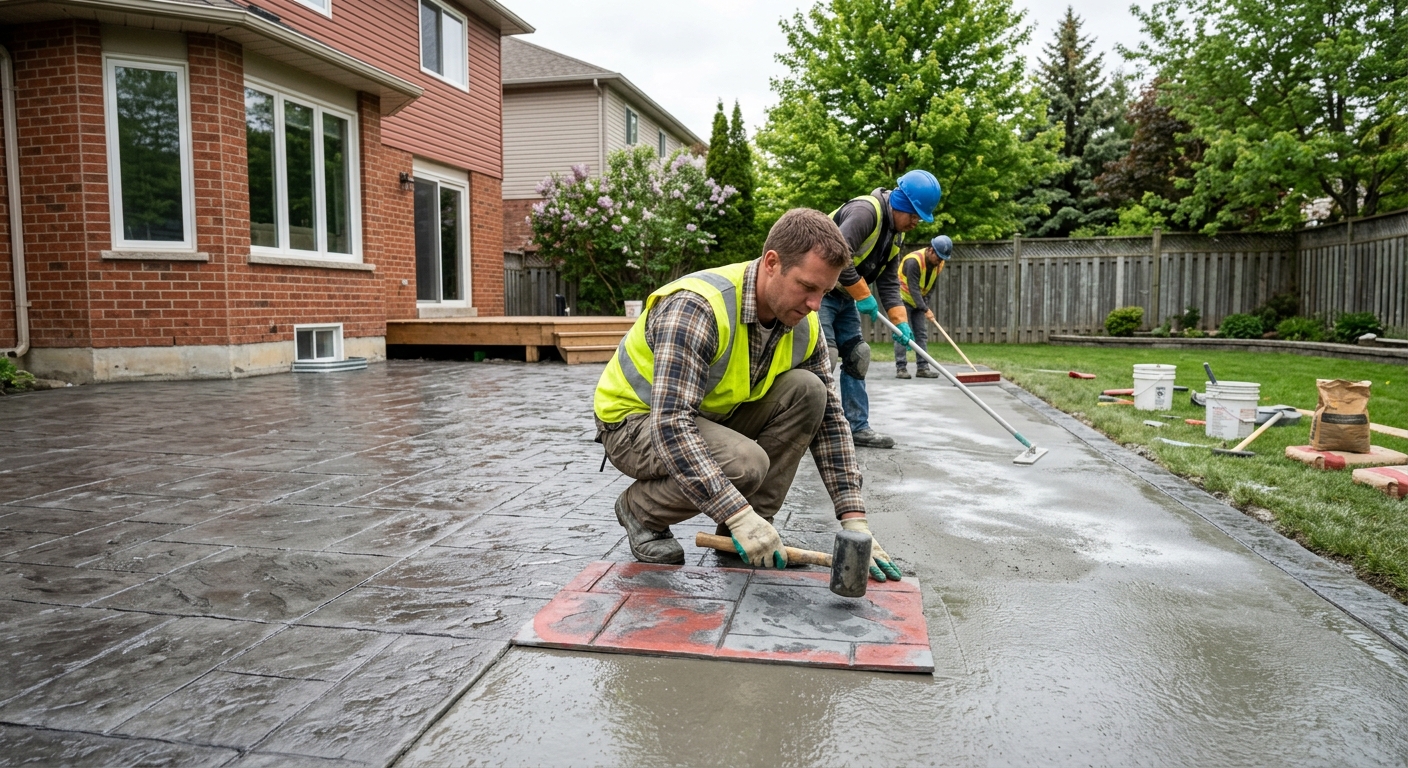
- Switching from a plain patio to a stamped driveway can push your project from the $12–$18/sq ft patio band into the $22–$35/sq ft stamped & decorative range, largely because of colour, stamping, and extra finishing time.
- A driveway replacement on a sloped or poorly draining site often costs more because excavation and base regrading take longer.
- Older homes (built before 1981) are more likely to need drainage corrections, and that can add concrete saw-cutting and patching costs before the new slab goes in.
When you’re comparing bids, ask what’s different in the prep, mix, reinforcement and curing—not just the final square footage. That’s where the 30–50% variation usually comes from in Fox Creek.
| Price Factor |
Why It Matters |
Cost Impact |
| Frost line depth — determines footing depth and form height |
Controls excavation volume and concrete quantity below frost |
High: deeper frost requirements can add significant labour and material |
| Site preparation — excavation, grading, compacted granular base |
Stable base reduces settlement and cracking after freeze–thaw |
Medium to high: rocky/poor drainage sites increase time and hauling |
| Reinforcement — rebar or wire mesh requirement |
Improves load transfer and reduces cracking in exterior slabs |
Medium: materials + placement labour |
| Mix design — air-entrainment and compressive strength spec |
Air-entrainment helps resist scaling/spalling in Alberta winters |
Low to medium: small material cost, big performance value |
| Finish type — broom vs. stamped vs. exposed aggregate |
Finishing labour and timing are more demanding for decorative work |
Medium to high: stamp/reveal steps add cost |
| Pour size and concrete truck access to site |
Long pushes/limited access increase labour and placement risk |
Medium: affects crew size and equipment time |
| Cold-weather curing precautions — heating and blankets |
Ensures concrete reaches strength in freezing conditions |
Medium: added materials, monitoring and time |
| Control joint pattern and sealing cost |
Joints and sealing manage shrinkage cracking and salt scaling |
Low to medium: relatively small cost to reduce long-term failure |
Permits & regulations in Alberta
In Alberta, structural concrete work generally requires a building permit. That includes footings, foundation walls, grade beams, and other elements that support the building structure and transfer loads. Often, municipalities expect engineered drawings for these structural components, particularly where soil conditions, foundation type, or rebar details need sign-off. For Fox Creek homeowners, the practical takeaway is simple: if the concrete is part of the structure or affects how the foundation performs, treat it as “permit territory” and confirm before any excavation starts.
Concrete flatwork (driveways, patios, walkways, garage approach slabs) usually does not require a permit by default. However, you may need municipal review if the project affects lot grading, drainage patterns, impervious surface coverage limits, or the municipal right-of-way (for example, changing access where a driveway meets the road). When in doubt, ask before you break ground.
To verify a contractor in Alberta step-by-step, ask for: (1) a current certificate of insurance—liability coverage matching your project scope; (2) confirmation of WSIB/WCB coverage; and (3) their business details. Then cross-check the company information, and review the certificate of insurance: it should list the insured party correctly, have active coverage dates, and align with the type of work being done. Finally, request clearance/standing information where applicable and ask for references on similar-scale slabs or below-frost footing work.
Getting concrete right in Fox Creek's freeze-thaw climate
Concrete failure in Fox Creek is usually about water and timing. When water gets into the slab surface or around poorly prepared base layers, freeze–thaw cycles expand it, prying at the surface and widening cracks. The most common performance issues we see are spalling and scaling from inadequate air-entrainment, random cracking from missing or poorly spaced control joints, and settlement from a base that isn’t compacted to the right depth.
To spec the job correctly for the Athabasca–Grande Prairie–Peace River climate, focus on five areas. First, base preparation: use compacted granular sub-base sized and compacted for the local soil and frost conditions, with the correct thickness before any concrete is placed. Second, mix design: for exterior flatwork, air-entrained concrete should target about 5–7% air content and a minimum compressive strength of 32 MPa for durable performance in cold weather. Third, control joints: spacing should limit random cracking, especially on large driveways and patios. Fourth, curing: plan for minimum 7 days, and if temperatures fall, curing becomes critical—insulated blankets or heating may be needed so the slab reaches design strength. Fifth, sealing: apply a penetrating sealer after the concrete has cured (commonly around 28 days) to repel de-icing salt and reduce moisture uptake.
Ask the crew direct questions—“What is your air content for exterior slabs?”, “How many joints and what spacing?”, and “How will you cure if we get a cold night?”—and you’ll avoid the costly “cheap now, replace sooner” trap. For example, a broom-finished driveway at roughly the $14–$20 band may seem close in price to a decorative option, but stamped or exposed aggregate is justified when the added finishing labour and mix colour are clearly in the scope. If a bid is missing air-entrainment or proper curing details, the low price isn’t a deal—it’s a risk.
| Spec |
Why It Matters in Fox Creek |
What to Ask For |
Impact if Skipped |
| Compacted granular base (depth?) |
Prevents settlement and limits water movement under the slab during freeze–thaw |
Granular base depth and compaction method/spec based on site conditions |
Cracking, dips, and premature failure from movement |
| Air-entrained concrete mix (target air %?) |
Reduces scaling/spalling caused by repeated freezing cycles |
Target air content 5–7% for exterior flatwork and verify mix design |
Surface scaling and spalling within a few winters |
| Compressive strength (MPa rating) |
Supports strength gain and durability in cold-weather placement |
Minimum 32 MPa compressive strength and curing plan |
Lower strength and increased cracking under thermal stress |
| Control joints (spacing per ACI guidelines) |
Controls where cracks form when concrete shrinks |
Proposed joint layout and spacing consistent with industry guidance |
Random cracking patterns and water ingress |
| Minimum 7-day curing period |
Ensures concrete reaches safe strength before exposure to cold/wet conditions |
How curing will be protected during cold nights (blankets/heating if needed) |
Weak surface, greater risk of scaling and early deterioration |
| Penetrating sealer (when applied after cure) |
Helps repel de-icing salts and slows moisture penetration in Alberta winters |
Confirm product type and timing after curing (often ~28 days) |
Faster salt-related surface damage and reduced service life |
How to choose a concrete work contractor in Fox Creek
Choosing the right concrete contractor matters in Fox Creek because freeze–thaw performance depends on details—air content, base prep, curing and jointing. Start with verification. In Alberta, ask the contractor for proof of liability insurance and WSIB/WCB coverage. A certificate of insurance should be current, show active coverage dates, and match the legal name of the business that will be on-site. For coverage confirmation, request documentation rather than verbal assurances, and confirm the scope relates to your project type (flatwork vs. structural foundation work).
Next, get 2–3 itemised written quotes—not a lump-sum with vague wording. You want line items that separate excavation/base preparation, reinforcement, concrete supply, forming, finishing, joints, disposal, and any curing/heating measures. Confirm whether a permit pull is included (structural work typically needs it), and whether disposal/haul-off of removed material is included or excluded. Ask about warranty in writing: workmanship warranty length, any limits, and whether product/manufacturer warranties apply to admixtures, sealers, or other components. Clarify if the warranty is transferable if you sell the home.
Payment schedule also protects you. Avoid paying more than 10–15% upfront; hold back a portion until the job is complete and the final surface checks out. Finally, insist on a timeline: a start date window and completion estimate in writing. In a shorter pour season, scheduling clarity is part of quality.
- Ask for proof of liability insurance and verify dates and named insured.
- Request WSIB/WCB coverage documentation for their workers.
- Get quotes with line items (base, rebar/mesh, concrete, finishing, disposal).
- Confirm whether air-entrainment is included for exterior work.
- Ask how they handle curing during cold nights (blankets/heating).
- Verify joint layout and sealing are included (and timing for sealer).
- Check whether reinforcement is specified for your slab type and loads.
- Review scope for excavation depth and granular base thickness.
- Confirm truck access plan and pumping/placement method if needed.
- Ask for examples of similar Fox Creek projects in winter conditions.
- Clarify warranty terms and what triggers warranty repairs.
- Confirm payment terms and keep a final holdback until completion.
Concrete red flags in Fox Creek: bids that don’t mention air-entrained mix, no written curing plan for cold weather, joint spacing that isn’t discussed, vague wording like “standard base” without depth/compaction detail, and crews asking for large upfront payments before forms or base work are done.
Frequently asked questions — concrete work in Fox Creek
What is rebar and when is it required in Alberta?
Rebar (reinforcing steel) is used to strengthen concrete and control cracking by improving how the slab or footing handles tension. In Alberta, rebar is typically required for structural concrete elements like foundation footings, foundation walls, and grade beams—these are load-bearing parts of the building and normally need engineered detailing and a permit. For exterior flatwork such as driveways, rebar or mesh may be recommended depending on slab thickness, soil conditions, expected loads (like heavier vehicles), and the base preparation. In Fox Creek, freeze–thaw cycles can worsen surface deterioration if the slab moves, so the right reinforcement and a compacted base work together. If you’re comparing quotes, ask: what reinforcement is included, what size/wire grade, and how it’s supported off the base before concrete placement.
How long does a concrete project take in Fox Creek?
In Fox Creek, the timeline depends on weather and curing needs, not just square footage. For typical exterior flatwork, a driveway or patio often takes a few working days for excavation/base, forming (if required), placing, finishing, and curing protection—while concrete gains strength over time. Minimum curing expectations are commonly at least 7 days before you consider light use; full performance continues beyond that. In cold or wet conditions, crews may need insulated blankets or heating, which extends the “protected curing” window and can change scheduling. Decorative work like stamping or exposed aggregate also takes extra finishing time. If your driveway is being bid in the general $14–$20 range for standard broom finishes, ask the contractor whether their schedule accounts for cold-weather curing or if they plan to rush based on a warm forecast.
What is a concrete overlay and is it suited to Fox Creek?
A concrete overlay is a new concrete layer placed over an existing slab after preparation, often including surface profiling, crack repair, and bonding materials. It can be a cost-effective option when the original slab is mostly stable, the structure is sound, and the failure is limited to the top surface. In Fox Creek’s freeze–thaw climate, overlays can perform well if the base and original slab are not already heaving or settled—otherwise, movement telegraphs up through the overlay. If the old slab has significant lift, drainage problems, or widespread cracking, replacement is usually the better long-term fix. Also consider de-icing salt exposure: sealing and correct mix design matter. If you’re trying to keep costs closer to the $12–$18 band for plain patios/walkways, ask whether the overlay system includes proper prep, bonding, and a curing/sealing plan that can withstand Alberta winters.
How do I seal concrete to protect it in Fox Creek?
Sealing helps repel moisture and de-icing chemicals that can drive surface scaling in Alberta winters. The key is timing and product choice. Most homeowners should plan for a penetrating sealer applied after the concrete has cured—commonly around 28 days—so you’re sealing a mature surface rather than trapping excess moisture. For Fox Creek, where freeze–thaw cycling and salt are routine, ask for a penetrating sealer intended for exterior concrete. Before sealing, the surface must be clean and ready—any dirt, curing compounds, or contaminants should be removed. Some contractors include sealing in the scope, while others offer it as an add-on. When you compare quotes, don’t just ask “is it sealed?” Ask what sealer type, when it’s applied, and whether it’s included for driveways and walkways that see snow melt and salt.
What is the difference between concrete and cement?
Cement is an ingredient; concrete is the finished building material. Cement (often Portland cement) is mixed with water and aggregates (like sand and gravel), and sometimes with admixtures such as air-entraining agents for cold-weather durability. So when someone says “the price of cement went up,” that affects part of concrete supply, but concrete performance in Fox Creek depends heavily on the full mix design—especially air content for freeze–thaw resistance. For example, exterior work should use air-entrained concrete to reduce spalling/scaling risk, and structural components use designs specified to meet strength requirements. When reviewing quotes, you’ll get clearer value comparing the mix specs, air-entrainment, strength target (commonly minimum 32 MPa for many exterior placements), reinforcement and curing plan—not just the word “cement.”
How much does concrete work cost in Fox Creek?
Concrete costs in Fox Creek generally track regional bands, but your final price depends on excavation, base prep, reinforcement, finish type, access, and curing needs in cold weather. As a reference, concrete driveway work for a standard broom finish is commonly in the $14–$20 range in the Athabasca–Grande Prairie–Peace River tier, while patios and walkways often land in the $12–$18 range depending on thickness and site conditions. Decorative work like stamped concrete typically ranges higher, often in the $22–$35 band due to extra materials and finishing labour. Foundation and footing work is priced separately because it’s structural and below frost—those projects commonly run in the $45–$70 range depending on scope and engineering requirements. If you’re budgeting, ask for itemised pricing and compare what’s included (air-entrainment, joints, curing blankets if needed, and sealing for exterior surfaces).