Concrete work options and costs in Southview
Southview, Alberta is a small community (population 1,550 in 2021, Statistics Canada, 2021 Census) where concrete flatwork shows up everywhere—driveways for day-to-day access, patios for backyard living, and walkways that need to stay solid through winter. A big driver of demand is the housing mix typical of Calgary’s surrounding bedroom communities: single-detached homes are the most common context for new or replacement driveways and garage slabs. In Southview, contractors often see repeat work around older properties where surfaces have started to show hairline cracking, scaling, or uneven settling.
Pricing here isn’t just about square footage. Calgary’s cold continental climate means we engineer for frost and freeze–thaw cycles more than in milder parts of Canada. The design frost depth is about 1.2 m (roughly 4 ft), so footings for houses, garages, decks, and retaining structures must bear on undisturbed soil below that depth to reduce frost heave and seasonal movement. That deeper excavation and larger footing volumes push foundation costs toward the higher end of regional price bands.
You’ll also notice the market is busy in neighbourhoods where infill or upgrades are active—Southview-side homes near the main access routes and expanded lots tend to generate the most frequent driveway and walkway replacements, especially before winter. The practical pour season for exterior slabs is shorter, and cold-weather placements may require air-entrained “winter-grade” mix, insulated blankets, and sometimes temporary heat to protect curing.
Below are realistic cost ranges you can use to compare options before you request itemised quotes.
| Application |
Typical Size |
Key Spec |
Finish Option |
Price Range |
| Concrete driveway (standard broom finish) |
24 ft x 10 ft (240 sq ft) |
Air-entrained exterior mix; compacted granular base |
Broom finish, control joints |
$12,000–$18,000 |
| Exposed aggregate driveway |
24 ft x 10 ft (240 sq ft) |
Air-entrained mix; proper curing for full exposure |
Exposed aggregate with sealer |
$14,500–$20,500 |
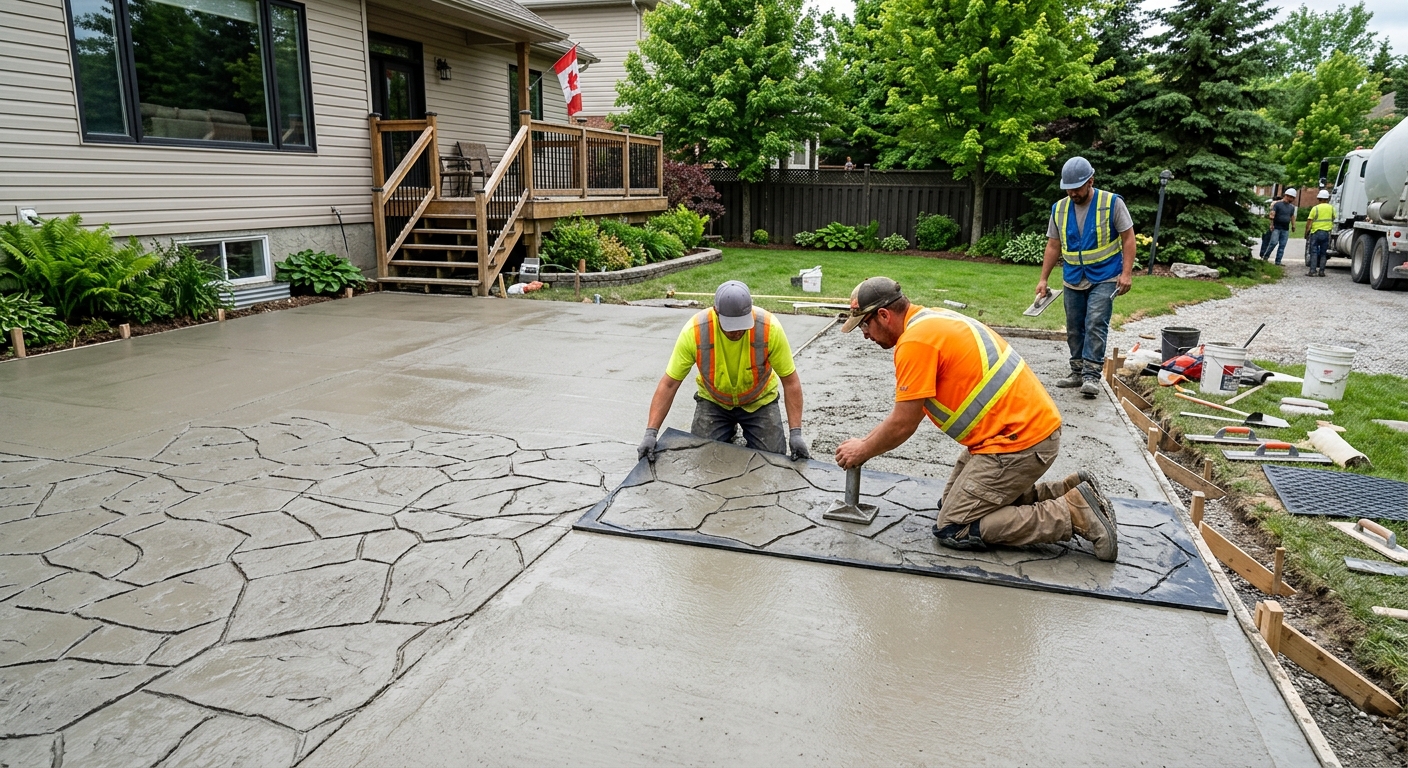
| Stamped concrete driveway or patio |
24 ft x 10 ft driveway or 16 ft x 12 ft patio (192–240 sq ft) |
Air-entrained mix; integral colour where applicable |
Stamp mats + release agent |
$15,000–$26,000 |
| Plain concrete patio or walkway |
12 ft x 12 ft patio (144 sq ft) or 4 ft x 20 ft walk (80 sq ft) |
Air-entrained mix; proper base drainage |
Float + light broom; joints as needed |
$5,000–$9,000 |
| Garage floor (interior slab) |
22 ft x 20 ft (440 sq ft) |
Vapour barrier; fibre or mesh; 30+ MPa mix |
Light broom; may include saw-cut joints |
$10,000–$16,000 |
| Foundation footings (structural, below frost) |
Typical house/garage footing system (variable linear ft) |
Reinforced concrete; extends below design frost depth |
Engineered formwork + inspection-ready rebar |
$28,000–$45,000 |
Prices are estimates only and vary by project scope, site access and material selection.
What affects the price of concrete work in Southview
In Southview and across the Calgary region, two bids for what looks like the same concrete project can still differ by 30–50%. The biggest reason is that concrete isn’t just “cement and pour”—in cold-weather climates, engineered excavation depth, base preparation quality, mix design, reinforcement detailing, and curing protection all vary from one contractor to the next. If a crew underbuilds the granular base or schedules a cold pour without proper curing measures, the slab may look fine at first and fail prematurely, which is why the more careful contractors price higher.
Frost line depth and freeze–thaw cycles dictate every major spec here. Footings must extend below the design frost depth to prevent frost heave and seasonal movement; in Alberta, that generally means deeper excavation than warmer regions. Exterior slabs also require air-entrained concrete mixes to survive the freeze–thaw cycle, and cold-weather placement typically needs winter-grade mix and curing precautions (insulated blankets and/or temporary heating). That added labour and equipment shows up in bids, particularly for driveways and patios where the practical exterior pour season is shorter.
De-icing salt accelerates surface spalling when the mix, air content, and curing aren’t correct—so sealing is often recommended for driveways and walkways in Southview. Local conditions can raise or lower cost fast: heavier excavation and trucking increases price on tight lots; good subgrade and easy access can keep driveway work closer to the low end of the $12,000–$18,000 band; and choosing stamped or exposed finishes pushes projects toward the $15,000–$26,000 decorative range.
Finally, Southview’s steady replacement demand—driven by older homes settling and winter surface wear—means contractors stay busy. When schedules tighten, premium labour rates and earlier booking can move a project upward within the same price band.
| Price Factor |
Why It Matters |
Cost Impact |
| Frost line depth — determines footing depth and form height |
Footings must bear below frost depth to reduce heave and movement |
Higher excavation/formwork can add substantial cost to foundations and footings |
| Site preparation — excavation, grading, compacted granular base |
Sub-base thickness and compaction control settlement and cracking |
More hauling and grading usually pushes total cost upward |
| Reinforcement — rebar or wire mesh requirement |
Reinforcement improves structural capacity and controls crack width |
Material + labour time increases, especially for slabs with higher loads |
| Mix design — air-entrainment and compressive strength spec |
Air content and strength are critical for freeze–thaw durability |
Winter-grade mixes and stricter specs increase material costs |
| Finish type — broom vs. stamped vs. exposed aggregate |
Decorative finishes require extra steps and higher material handling |
Stamped/exposed work often moves projects into the premium price tier |
| Pour size and concrete truck access to site |
Access limits affect how efficiently a crew can place and finish concrete |
Long carries/pumping or additional labour can raise costs |
| Cold-weather curing precautions — heating and blankets |
Curing needs stable conditions to avoid scaling and surface damage |
Temporary heat/blankets can meaningfully add to labour and equipment |
| Control joint pattern and sealing cost |
Joints manage cracking; sealing helps repel de-icing salt effects |
More saw cuts and a proper sealer program increase scope and cost |
Permits & regulations in Alberta
In Alberta, structural concrete work—like house and garage foundation footings, foundation walls, and grade beams—typically requires a building permit and often engineered drawings that get reviewed by the municipality. For concrete flatwork (patios, walkways, and most driveways), a permit is usually not required unless the project changes lot grading, affects impervious surface coverage limits, or ties into municipal right-of-way/sidewalk considerations. That said, rules can be specific to your lot and drainage plan, so it’s smart to confirm with the local authority before any excavation begins.
Before hiring, verify the contractor carries liability insurance and WSIB/WCB coverage (or the equivalent required coverage for the work and workers involved). Also ask for references on similar-scale projects in the Calgary region—especially exterior slabs done with winter-grade practices.
Step-by-step for Southview homeowners:
- Confirm licensing/qualification: ask for proof the contractor is properly registered/eligible for the scope they’re doing in Alberta (and that they’re insured for the class of work).
- Request certificate of insurance: check the certificate is current and lists general liability coverage relevant to your project.
- Verify worker coverage: ask for WSIB/WCB documentation (and match it to the contractor and subcontractors on the invoice).
- Get references: request 2–3 recent projects like your footing type or exterior slab finish—then confirm with the past client.
- Document everything: ensure the quote, schedule, and scope reference what is included (excavation depth, reinforcement, curing measures, and sealing timing).
If anything is vague—especially around frost depth bearing requirements for footings—treat it as a red flag and request clarification in writing.
Getting concrete right in Southview's freeze-thaw climate
Concrete failures in Southview usually come down to water, weak base support, and inadequate durability engineering for freeze–thaw. The biggest symptom you’ll notice over winters is spalling—surface flaking and scaling—often caused by insufficient air-entrainment, poor curing, or de-icing salt getting into a porous surface. To spec the job correctly for Calgary-area cold weather, focus on the five pillars: (1) base preparation, (2) mix design, (3) control joints, (4) curing, and (5) sealing.
First, base preparation means compacted granular sub-base to the correct depth and profile for your local soil and drainage. In a climate with about a 1.2 m design frost depth, exterior and structural elements must be placed with the right below-grade bearing so seasonal frost doesn’t lift and move the slab or footing.
Second, for exterior flatwork, require an air-entrained concrete mix (target air content typically in the 5–7% range) and a minimum compressive strength specification (often 32 MPa for exterior durability). Third, install control joints with a spacing that limits random cracking. Fourth, curing matters: you want minimum 7-day curing under proper conditions, and in cold snaps this may mean insulating blankets or controlled heating so the concrete achieves early strength before freeze events.
Lastly, sealing is a practical protection step: apply a penetrating sealer after the concrete cure cycle (commonly 28 days post-pour) to help repel de-icing salts. If you’re budgeting, a sealing step often costs less than repairs: for example, a driveway in the $12,000–$18,000 range that’s sealed properly may cost materially less than replacing a spalled surface section after a winter or two.
| Spec |
Why It Matters in Southview |
What to Ask For |
Impact if Skipped |
| Compacted granular base (depth?) |
Prevents settlement and supports the slab through frost movement risks |
Granular base depth for your slab type + compaction testing method |
Uneven settling, cracking, and shortened service life |
| Air-entrained concrete mix (target air %?) |
Air voids help concrete resist freeze–thaw damage and scaling |
Target air content (typically 5–7% for exterior flatwork) |
Higher spalling/scaling risk after winter cycles |
| Compressive strength (MPa rating) |
Adequate strength supports durability and structural performance |
Minimum 32 MPa compressive strength (exterior spec) |
Surface weakness, cracking, and increased maintenance |
| Control joints (spacing per ACI guidelines) |
Controls where cracking occurs during shrinkage and temperature swings |
Joint spacing plan and saw-cut timing |
Random cracking paths and aesthetic/structural concerns |
| Minimum 7-day curing period |
Ensures strength development before freeze conditions intensify |
How curing is protected during cold weather (blankets/heating if needed) |
Scaling, weak surface, and early deterioration |
| Penetrating sealer (when applied after cure) |
Repels de-icing salt and reduces water ingress into pores |
Sealer type + application timing (commonly 28 days post-pour) |
Faster spalling and staining; more winter maintenance |
How to choose a concrete work contractor in Southview
For Southview homeowners, choosing the right concrete crew is mostly about verification and documentation—not just the lowest line price. Start with Alberta requirements and real coverage. Ask for proof of liability insurance (and confirm the certificate is active for your policy dates). Then request WSIB/WCB coverage documentation for the contractor and any subcontractors who will be on your site. If a contractor can’t provide clear proof, assume higher risk—on-site injuries and workmanship disputes can get expensive fast.
Next, get 2–3 itemised written quotes. “Itemised” should mean you can see labour and materials components, not only a lump-sum number. Make sure the quote spells out excavation depth and base prep, reinforcement type, concrete mix spec (including air-entrainment for exterior), curing protection in cold weather, and whether sealing is included (and when it will be applied). Ask if permits are handled when required (typically for structural foundation work) and confirm disposal/hauling is included or excluded.
Warranty matters too: require a workmanship warranty length in writing, clarify whether product/manufacturer warranties are separate, and ask if they’re transferable if you sell the home. For payment scheduling, never agree to pay more than about 10–15% upfront—then use a holdback until key milestones are complete (base inspection, reinforcement set, pour completion, and final finish). Finally, confirm the timeline: get a start date and a completion estimate in writing, including what weather contingencies trigger a delay.
- Ask for a copy of liability insurance certificate (current dates, right coverage limits).
- Verify WSIB/WCB coverage for the people working on your site.
- Confirm the contractor’s experience with exterior flatwork engineered for freeze–thaw durability.
- Request 2–3 itemised quotes (labour + materials), not just one total.
- Check scope inclusions: excavation depth, granular base, compaction, and drainage.
- Make sure the concrete mix spec mentions air-entrainment for exterior work.
- Confirm reinforcement details (mesh vs. rebar) match the slab/usage.
- Ask about curing plan for cold snaps (blankets/heating if temperatures drop).
- Confirm control joint spacing and saw-cut timing are part of the written scope.
- Clarify sealing: product type + timing (often after full cure).
- Confirm disposal/hauling is included in the quote or listed as an extra.
- Use milestone payments with a holdback until inspection-ready completion.
Concrete red flags in Southview include: vague curing plans (“we’ll just pour and hope”), no mention of air-entrainment for exterior slabs, quotes that don’t specify base prep depth or compaction, missing documentation for insurance/WSIB/WCB, and refusal to provide an itemised scope for reinforcement, joints, or sealing.
Frequently asked questions — concrete work in Southview
Can concrete be poured in cold weather in Southview?
Yes, concrete can be poured in Southview during cold weather, but it has to be engineered for it. In Calgary’s freeze–thaw season, the concern isn’t only the pour day temperature—it’s keeping the concrete warm enough for proper curing so it doesn’t scale or lose durability. A reputable crew will use winter-grade mix, protect the slab with insulated blankets, and sometimes provide temporary heat to maintain curing conditions through the critical early window. You should also expect a tighter scheduling window for exterior work, since contractors often need stable conditions for finishing and early strength gain. If your project lands in the later fall or early spring shoulder period, ask how they’ll handle curing protection, because it directly affects long-term performance and spalling resistance.
How do I maintain concrete in Southview's freeze-thaw climate?
Maintenance in Southview is mostly about keeping water and de-icing salts from attacking the surface repeatedly. Start with the basics: clear snow and use de-icers that are appropriate for concrete (avoid aggressive chemicals in heavy doses). Use a broom or plastic shovel so you don’t gouge the finish. If your contractor recommends sealing, plan on a penetrating sealer after full cure—commonly around 28 days post-pour—so the surface repels moisture better through winter cycles. Inspect joints after each winter for gaps and re-seal if needed so water doesn’t migrate into cracks. Also, don’t ignore early hairline cracking; in a cold climate, small cracks can turn into larger freeze-related issues if water is allowed to keep entering the slab.
What causes concrete to spall in Southview winters?
Spalling in Southview is usually linked to freeze–thaw durability issues. The most common cause is inadequate air-entrainment or poor mix quality for exterior exposure—without the right air void system, water inside the concrete expands when it freezes and breaks down the surface layer. Poor curing (for example, rushing early strength development or placing without proper insulation/heat when it’s cold) also increases scaling risk. Another contributor is water pathways: if base prep or drainage is off, water can sit against the slab and intensify freeze damage. Finally, repeated de-icing salt exposure accelerates surface deterioration when the concrete isn’t sealed or when the mix and finishing aren’t consistent. This is why exterior projects often land closer to the mid-to-upper range of the local $12,000–$18,000 driveway band when the durability steps are done correctly.
What is rebar and when is it required in Alberta?
Rebar (reinforcing steel) is used to improve a concrete element’s ability to resist cracking and bending stresses. In Alberta, when you’re building structural concrete—like foundation walls, grade beams, and reinforced footings—rebar requirements are set by engineering and the design loads for your home. For exterior slabs like patios and driveways, reinforcement may be required depending on slab thickness, soil support, and intended use (for example, heavier loads or larger areas). Some designs use wire mesh or fibre reinforcement, but the key is matching the reinforcement strategy to the engineering/contracted spec rather than guessing. For any structural work, confirm the permit/engineered drawings review process and ask your contractor to explain what’s being installed, where, and why it meets the design for your site conditions and frost depth considerations.
How long does a concrete project take in Southview?
Timing depends on whether it’s flatwork or structural concrete. For a typical exterior flatwork project like a patio or walkway, the “on-site work” (excavation, base, formwork, pour, finishing) is often just a few days, but completion depends on curing protection. You should plan for at least a week of meaningful cure time for durability, and for sealing decisions you’ll often wait to apply sealer after the concrete has fully cured (commonly around 28 days). Driveways may take longer due to more base work, longer finishing time, and traffic/access constraints; if you’re doing decorative work (stamped or exposed aggregate), the curing/finishing steps can extend the schedule and sometimes move pricing toward the $15,000–$26,000 decorative range. Structural foundation work can be staged around inspections and engineered steps, so the timeline is usually longer and more dependent on permit/inspection scheduling.
What is a concrete overlay and is it suited to Southview?
A concrete overlay is a resurfacing method applied on top of existing concrete to restore appearance and create a new wearing surface without completely replacing the slab. In Southview, an overlay can be suited to driveways or walkways when the existing concrete is structurally sound—meaning it isn’t lifting significantly, and cracks/spalling are limited and properly assessed. However, overlays are not a cure-all: if water is already working its way through a failing slab due to base issues or inadequate drainage, an overlay may not last as long through Calgary’s freeze–thaw cycles. A contractor should evaluate the slab condition, joint condition, and any underlying base settlement. If the existing concrete is badly spalled or uneven, removal and replacement (often within the local $12,000–$18,000 driveway band) may be the more durable long-term solution.