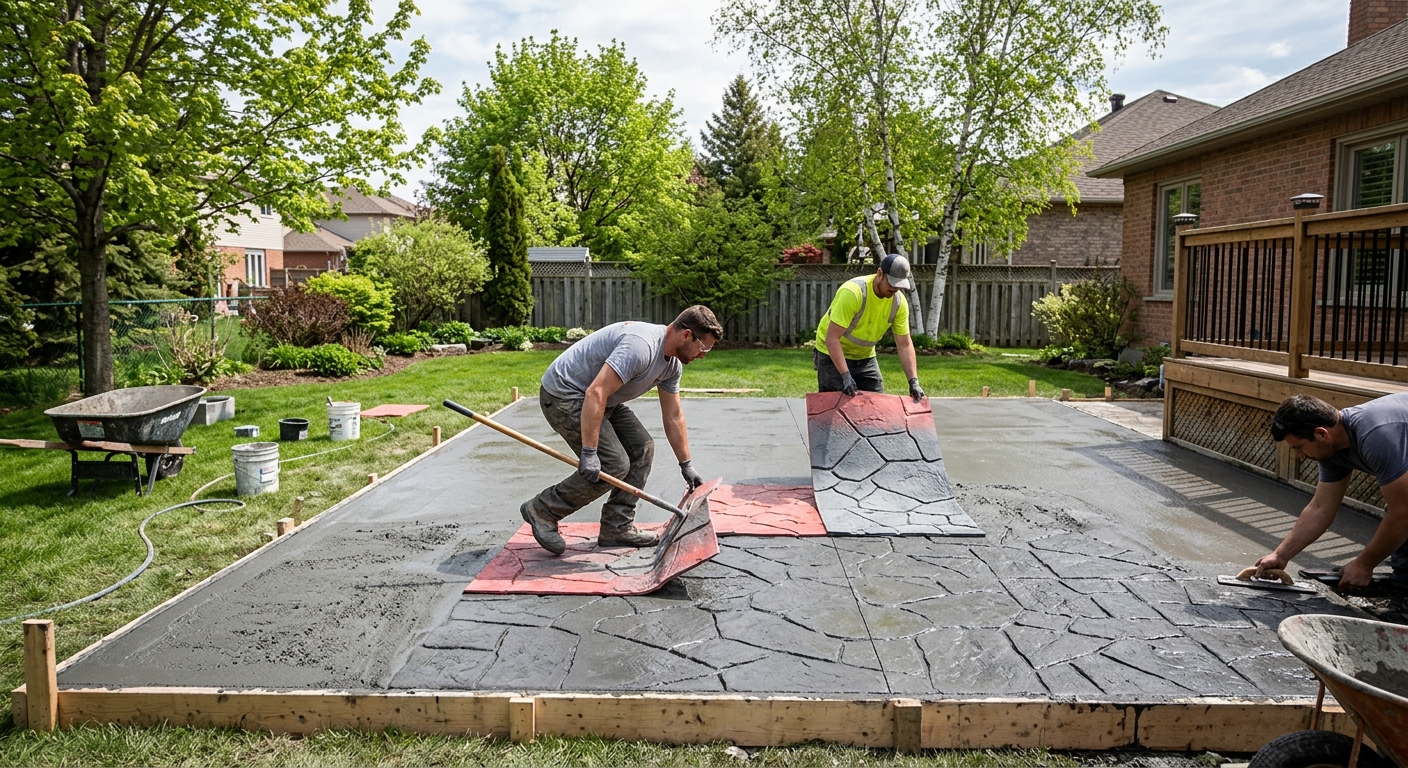
Concrete work options and costs in Crawford Plains
Crawford Plains, Alberta is a smaller community within the Calgary economic region (population 4,381 per the Statistics Canada, 2021 Census), and most concrete flatwork here is driven by what homeowners build and maintain—driveways, patios, walkways, garage floors, and, for many homes, the concrete foundation system underneath. In practical terms, concrete contractors tend to be busiest on properties on the outskirts where infill and replacement projects are common, and where proper frost protection is non-negotiable.
Calgary’s cold continental climate changes the “how” and the “how much” of concrete work. With a design frost depth around 1.2 m, exterior footings and structural concrete must bear on undisturbed soil below that depth, which pushes excavation and footing volumes higher than in warmer parts of Canada. On the slab side, frequent freeze–thaw cycles demand air-entrained concrete and good drainage, along with well-spaced control joints to reduce cracking and spalling. The practical exterior pour season is shorter, so crews often schedule farther out—and cold-weather placement may require winter-grade mixes, insulated blankets, and sometimes temporary heat to keep curing on track.
If you’re in a neighbourhood corridor where lots turn over or where backyards commonly get upgraded—think the more developed residential pockets like near the main access routes—demand for driveway and patio upgrades is especially steady. From a homeowner perspective, that means you’ll see a wider range of finishes and price points, even for similar square footage. Use the table below to benchmark options before you compare quotes.
| Application |
Typical Size |
Key Spec |
Finish Option |
Price Range |
| Concrete driveway (standard broom finish) |
16 ft x 20 ft (320 sq ft) |
Air-entrained mix, control joints, granular base |
Broomed |
$12,000–$18,000 |
| Exposed aggregate driveway |
16 ft x 20 ft (320 sq ft) |
Higher cement/aggregate mix design, frost-focused curing |
Exposed aggregate |
$15,000–$22,000 |
| Stamped concrete driveway or patio |
12 ft x 18 ft (216 sq ft) |
Air-entrained base mix, integral colour, release and curing plan |
Stamped |
$15,000–$26,000 |
| Plain concrete patio or walkway |
10 ft x 16 ft (160 sq ft) |
Air-entrained mix, compacted base, joints where needed |
Float/steel trowel + light broom or broom texture |
$5,000–$9,000 |
| Garage floor (interior slab) |
20 ft x 20 ft (400 sq ft) |
Vapour barrier (if required), steel reinforcement plan |
Light broom or smooth finish (depending on use) |
$9,500–$15,500 |
| Foundation footings (structural, below frost) |
Typical house + garage perimeter |
Excavate to design frost depth, reinforce and pour structural concrete |
Structural (not decorative) |
$28,000–$45,000 |
Prices are estimates only and vary by project scope, site access and material selection.
What affects the price of concrete work in Crawford Plains
In Crawford Plains and across the Calgary market, it’s common to see quotes for the “same” concrete job swing by 30–50%. The variation usually isn’t the concrete itself—it’s the engineered reality underneath it: frost protection depth, base preparation quality, reinforcement decisions, and how the contractor protects curing during cold snaps. A driveway might look like a simple slab from the street, but if one contractor over-excavates and builds a proper granular base while another tries to keep excavation shallow, the final cost and long-term performance can diverge dramatically.
Here, the design frost depth is about 1.2 m, so footings for houses, garages, and retaining structures must extend below that depth on undisturbed soil. That drives higher foundation costs relative to regions with shallower frost penetration. For exterior slabs—driveways, patios, walkways—freeze–thaw cycles also dictate air-entrained mixes and a good jointing plan. Calgary’s shorter pour season means cold-weather curing precautions can add labour and equipment costs (insulated blankets, heating and temperature control), especially in late fall or early spring.
De-icing salt is another cost driver: it accelerates surface spalling when concrete isn’t properly air-entrained or when sealing is skipped. In Crawford Plains, you’ll often see this show up in real dollars—if a standard broom driveway lands in the $12,000–$18,000 range, a decorative option like stamped concrete can move toward $15,000–$26,000 when colour, labour intensity, and finishing time are accounted for.
Two local examples: (1) older homes being renovated often trigger unexpected rework when the existing subgrade is poor and must be rebuilt for frost stability; (2) narrow access near mature landscaping can increase excavation time and truck placement costs. With a small but steady local population (Statistics Canada, 2021 Census), crews may also consolidate work—so booking timing can affect price and availability.
| Price Factor |
Why It Matters |
Cost Impact |
| Frost line depth — determines footing depth and form height |
Footings must bear below design frost to prevent heave |
Higher excavation and concrete volume; can move structural pricing significantly |
| Site preparation — excavation, grading, compacted granular base |
Good subgrade reduces settlement and cracking |
More hours and haul-off/add-back if soil is unsuitable |
| Reinforcement — rebar or wire mesh requirement |
Helps control cracking and improves slab durability |
Material and labour add cost, especially for larger slabs |
| Mix design — air-entrainment and compressive strength spec |
Air entrainment is critical through freeze–thaw cycles |
Usually modest material increase, but prevents costly failures |
| Finish type — broom vs. stamped vs. exposed aggregate |
Finish systems require additional labour steps |
Stamped/exposed typically adds time and materials |
| Pour size and concrete truck access to site |
Long carries and limited access slow the crew and add equipment |
Can increase labour and pumping/placement costs |
| Cold-weather curing precautions — heating and blankets |
Protects strength gain and reduces scaling/spalling risk |
Adds equipment and operational labour |
| Control joint pattern and sealing cost |
Joints guide cracking; sealing improves resistance to de-icing salt |
Materials plus extra scheduling to apply sealer after cure |
Permits & regulations in Alberta
In Alberta, the key distinction is whether the concrete is part of the building’s structure. Structural concrete work—such as house or garage footings, foundation walls, and grade beams—typically requires a building permit and is often supported by engineered drawings that the municipality reviews. For concrete flatwork (driveways, patios, and walkways), a permit is usually not required unless the work affects lot grading, impervious surface coverage limits, drainage patterns, or municipal right-of-way requirements. Even when a permit isn’t normally required for the slab itself, drainage and grading still matter because they can impact compliance and downstream settlement.
For your Crawford Plains project, verify the contractor’s credentials before breaking ground. Step-by-step: (1) Confirm their business/company registration and credentials through available Alberta directories (and ask for the specific contractor information they use on permits). (2) Request a Certificate of Insurance for general liability—match the jobsite address on the COI and ensure it lists your property as an appropriate interested party if offered. (3) Ask for proof of WSIB/WCB coverage (or applicable coverage documentation). (4) Get clearance/letters or confirmation documents if their coverage system uses them, and keep copies with your contract. (5) Request references on similar-scale jobs in the Calgary region, not just small decorative patios.
Getting concrete right in Crawford Plains's freeze-thaw climate
Concrete problems in Crawford Plains usually trace back to three things: weak base support, insufficient freeze–thaw durability, and rushed curing. In a cold continental climate with frequent freeze–thaw cycles, the most common failure homeowners see is spalling—surface scaling or flaking—often caused by inadequate air-entrainment and poor finishing/cure practices. To spec the job correctly, you want a process that starts below grade and continues through the cure period.
Base preparation: Build a compacted granular sub-base to the right depth for your soil conditions and frost considerations. Don’t “thin out” the base to save money; if the slab settles or freezes, it cracks. Mix design: for exterior flatwork, ask for air-entrainment typically in the 5–7% air range and a minimum 32 MPa compressive strength. Control joints: include a jointing plan that limits random cracking—especially for driveways and patios where daily freeze cycles widen hairline cracks. Curing: plan for at least 7 days of proper curing conditions; cold weather placement should include insulated blankets or other approved measures so the concrete achieves strength gain. Sealing: apply a penetrating sealer about 28 days post-pour to improve resistance to de-icing salts.
When comparing options, understand what’s actually worth paying for. For example, if a standard broom driveway comes in near the $12,000–$18,000 band, adding decorative stamped work toward the $15,000–$26,000 band can be justified if you want colour and texture—but only when the contractor still meets the same frost and durability specifications. The finish is the “visible part”; the durability is what keeps it looking good.
| Spec |
Why It Matters in Crawford Plains |
What to Ask For |
Impact if Skipped |
| Compacted granular base (depth?) |
Controls settlement and frost movement under exterior slabs |
Confirm excavation depth and granular base thickness for your soil; specify compaction testing/verification approach |
More cracking, uneven slab, and early failure risk |
| Air-entrained concrete mix (target air %?) |
Freeze–thaw durability depends on correct air entrainment |
Ask for exterior target air content, typically 5–7% |
Higher chance of spalling and scaling |
| Compressive strength (MPa rating) |
Strength gain supports long-term structural and surface durability |
Minimum 32 MPa for typical exterior flatwork specs |
Surface wear accelerates and cracking control suffers |
| Control joints (spacing per ACI guidelines) |
Joints manage where cracks form during temperature swings |
Ask for joint spacing plan and saw-cut timing |
Random cracking across drive/ walkway areas |
| Minimum 7-day curing period |
Temperature and moisture conditions protect strength development |
Confirm cure method and cold-weather measures if below thresholds |
Scaling, weak surface, long-term durability issues |
| Penetrating sealer (when applied after cure) |
Helps resist de-icing salts and moisture ingress |
Apply about 28 days after pour (after cure) |
Faster deterioration and more frequent repairs |
How to choose a concrete work contractor in Crawford Plains
Choosing the right contractor in Crawford Plains is mostly about proof: proof they can build to spec, and proof they’re properly insured. Start with Alberta licensing/credentials—ask what credentials apply to the scope they’re doing and request their business information. Next, confirm liability insurance by requesting a current Certificate of Insurance (COI). Then verify WSIB/WCB coverage (or applicable documentation) before you sign. If they can’t provide clear documentation, that’s a red flag.
After credentials, get 2–3 itemised written quotes instead of one lump sum. You want a labour + materials breakdown and line items for excavation, granular base, reinforcement, concrete supply, finishing, saw cutting, sealing, and disposal/haul-off. Read the scope carefully: is permit pulling included (if needed for structural work)? Are forms included? What’s excluded—existing slab removal, regrading, or off-site disposal? Ask for clarity on concrete truck access and whether they plan to use pump or chutes when space is tight.
Warranty matters too. Ask for the workmanship warranty length and whether it covers finish defects and cracking within a defined period, plus any manufacturer warranty for materials. Confirm if warranty is transferable to future owners if you sell. For payment, avoid large deposits—keep upfront to 10–15% and hold back a portion until completion and cleanup are verified. Finally, insist on a written timeline: start date and completion estimate, especially given Calgary’s shorter exterior pour window.
- Verify insurance and WSIB/WCB documents before work begins.
- Ask what engineered frost protection approach they use for footings (below design frost depth).
- Request itemised quotes: excavation, base, reinforcement, concrete, finishing, and sealing.
- Confirm air-entrainment and minimum compressive strength in the written scope.
- Check whether they include joint layout and saw-cut timing.
- Ask about cold-weather procedures: blankets, heating, and curing plans.
- Confirm disposal/haul-off is included if removal is required.
- Review who supplies rebar/wire mesh and what size/spacing is planned.
- Ask for references from similar projects in the Calgary region.
- Get the payment schedule in writing and keep deposits modest (10–15% max).
- Confirm warranty terms in plain language—what’s covered, how long, and exclusions.
- Ensure the contract states start date and completion timeline, not “as weather permits” only.
Concrete contractor red flags in Crawford Plains: (1) promises of “no need for proper base prep” or vague excavation depths; (2) no mention of air-entrainment for exterior work in freeze–thaw conditions; (3) refusing to provide proof of insurance or WSIB/WCB coverage; (4) quoting decorative finishes without clear jointing and curing steps; (5) asking for large upfront payments with no written schedule or scope detail.
Frequently asked questions — concrete work in Crawford Plains
Concrete vs pavers for a patio in Crawford Plains?
In Crawford Plains, both concrete and pavers can work, but the choice usually comes down to maintenance preferences and freeze–thaw performance. Pavers can be more flexible if your base shifts, because individual units can be lifted and reset. Concrete patios, when built correctly with a compacted granular base, proper joints and air-entrained mix, typically hold up well through Calgary’s freeze–thaw cycles. The cost comparison often favours concrete for straightforward rectangles and where truck access is good. If you want colour and texture, stamped concrete can be worth it—especially since decorative driveway/patio work commonly falls into the $15,000–$26,000 band, while plain patio/walkway work often starts around the $5,000–$9,000 range. For durability, ask both options about drainage and whether the contractor has a jointing and curing plan for cold-weather placement.
How long does a concrete driveway last?
A concrete driveway in Alberta can last 25 to 40 years, but that “lifespan” depends on specs and how it’s built for freeze–thaw. The big drivers are air-entrainment, base preparation, joint spacing, and curing—especially because de-icing salt accelerates surface wear if the mix and surface protection aren’t right. In Crawford Plains and the wider Calgary region, crews often see early surface scaling when homeowners skip air-entrainment or when sealing is delayed or omitted. If your driveway is built within typical budget ranges (for example, standard broom driveways often land around the $12,000–$18,000 band), the long-term outcome is usually better when the contractor also plans control joints and uses proper granular base thickness. Decorative finishes may add upfront cost (often $15,000–$26,000 depending on scope), but the durability should still be determined by the same freeze–thaw durability choices.
What is air-entrained concrete and why does it matter here?
Air-entrained concrete is designed to include tiny, evenly distributed air bubbles in the mix. In Alberta’s cold continental climate, water in concrete expands during freeze cycles; without properly entrained air, that pressure can crack the surface and lead to spalling. With the right air-entrainment, the concrete has “room” for ice expansion, improving durability in freeze–thaw conditions. For Crawford Plains exterior flatwork, contractors typically target about 5–7% air content and use a minimum strength spec like 32 MPa (as part of a durable mix design). This is why two “similar” quotes can differ: the contractor who plans for air-entrainment and correct curing costs a bit more upfront but reduces the risk of early surface failure. When you’re comparing bids, ask for the written mix spec and confirm the curing plan for cold weather—late pours without blankets often scale sooner.
How do I prepare the base for a concrete slab?
For a concrete slab in Crawford Plains, “base prep” is the part you can’t see—but it’s what controls cracking, settlement, and frost-related movement. A proper base begins with excavation to a depth that fits your soil and frost considerations, then installing and compacting a granular sub-base in layers. The goal is firm, well-graded material with consistent compaction so the slab doesn’t sink or shift seasonally. Ask your contractor how they’ll handle existing soils (especially if you’re replacing older concrete) and whether they’ll remove unsuitable material rather than just placing fresh concrete on top. They should also describe drainage considerations so water doesn’t stay under or at the edges. If the quote is around the typical patio range ($5,000–$9,000) or driveway range ($12,000–$18,000), you should still expect thorough excavation, granular base construction, and compaction verification—otherwise you’re paying for visible thickness without the structural support that makes it last.
How do I compare concrete quotes?
To compare concrete quotes in Alberta, insist on itemised scope details—not just the final number. Start by checking whether the quotes include the same elements: excavation and disposal/haul-off, granular base depth and compaction approach, reinforcement (rebar or mesh as required), air-entrainment and minimum compressive strength, finish type, joint layout, and cure/sealer timing. Verify whether cold-weather curing precautions are included in the scope. In Calgary-area conditions, late-season work can require insulated blankets or heating to achieve proper curing, and that can change the price. Ask whether control joints and sealing are included or excluded; sealing is often applied around 28 days post-pour, which affects scheduling. Finally, confirm the contractor’s insurance and WSIB/WCB documentation before deciding. If one quote is noticeably lower than others in the driveway band ($12,000–$18,000), ask what got removed—often it’s base prep or durability specs.
Can concrete be poured in cold weather in Crawford Plains?
Yes, concrete can be poured in cold weather in Crawford Plains, but it’s not a “standard pour any time” situation. In a Calgary-region freeze–thaw climate, winter placement relies on achieving strength gain during the early curing window. Contractors typically use cold-weather practices such as winter-grade mixes, insulating blankets, and sometimes temporary heating to keep concrete temperatures in a safe range so curing isn’t compromised. The key is planning: you need the right curing protection and scheduling, otherwise the surface can scale or the slab can become weaker than expected. When you’re evaluating a quote for a patio, walkway, or driveway, ask how they’ll protect curing if temperatures drop, and whether they’ll adjust for the shortened pour season. If your project timeline pushes toward late fall or early spring, be prepared for added costs for blankets/heating—those costs are part of doing it properly, not a premium for “convenience.”