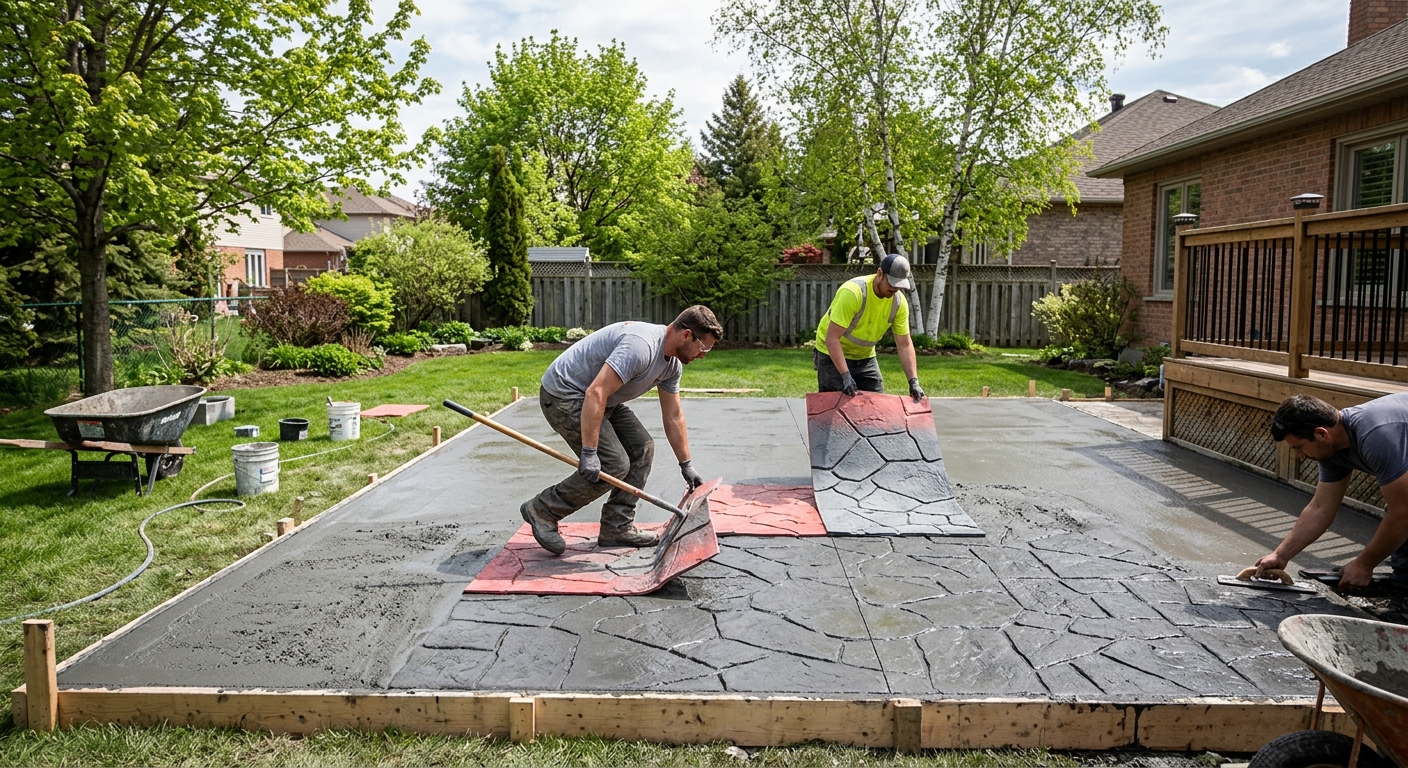
Concrete work options and costs in Westwood
Concrete work in Westwood, Alberta is all about building for a long, cold freeze–thaw season. Westwood’s population was 3,315 in 2021 (Statistics Canada, 2021 Census), and it’s a community where most homeowners and new builds lean heavily on single-detached housing, which drives steady demand for driveways, patios, walkways and basement/garage concrete. In the Calgary economic region, pricing is shaped by a deeper design frost depth (about 1.2 m in local engineering practice) and frequent freeze–thaw cycles that require air-entrained mixes, well-compacted granular base, and thoughtful control joints to limit cracking and surface spalling. That engineering reality is why foundation and exterior slab work can trend higher than in milder parts of the country.
Contractor availability also tightens with the seasons. Exterior concrete placement has a shorter practical window, and late-fall or early-spring pours often need winter-grade mixes, insulated curing blankets, and sometimes temporary heat to reach proper strength before the weather drops. If your project is near where homeowners typically improve access and outdoor living—think the established residential pockets around local streets off major routes—you’ll see faster scheduling but still seasonal constraints.
Below is a practical comparison of common concrete options for Westwood, with realistic price bands you can use when you’re reviewing quotes. Once you pick the finish and confirm frost-protection details, the numbers usually tighten quickly.
| Application |
Typical Size |
Key Spec |
Finish Option |
Price Range |
| Concrete driveway (standard broom finish) |
24 ft x 18 ft (432 sq. ft.) |
Air-entrained mix; compacted granular base; control joints |
Broom finish |
$12,000–$18,000 |
| Exposed aggregate driveway |
24 ft x 18 ft (432 sq. ft.) |
Air-entrained mix; exposed aggregate wash; curing care |
Exposed aggregate |
$15,000–$21,000 |
| Stamped concrete driveway or patio |
18 ft x 12 ft (216 sq. ft.) or 20 ft x 16 ft (320 sq. ft.) |
Air-entrained mix; correct base and joint layout |
Stamped patterns with sealer |
$15,000–$26,000 |
| Plain concrete patio or walkway |
12 ft x 16 ft (192 sq. ft.) |
Air-entrained mix; slope to drain; joints as needed |
Plain trowel-to-broom depending on texture needs |
$5,000–$9,000 |
| Garage floor (interior slab) |
24 ft x 24 ft (576 sq. ft.) |
Vapour barrier; proper sub-base; fibre or mesh depending on spec |
Power trowel or broom finish |
$8,500–$14,000 |
| Foundation footings (structural, below frost) |
Per engineered foundation design (typical home/garage) |
Excavate to below design frost; reinforced structural concrete |
Structural finish below grade |
$28,000–$45,000 |
Prices are estimates only and vary by project scope, site access and material selection.
What affects the price of concrete work in Westwood
In Westwood and the broader Calgary region, quotes for the same “type” of concrete job can vary by 30–50% because the hidden work is where costs live: excavation, granular base depth, reinforcement details, winter protection, and finishing complexity. A driveway priced at the lower end usually means a straightforward broom finish, standard reinforcement strategy, and uncomplicated access. The higher end often reflects deeper excavation to reach frost-safe bearing, more rebar/wire mesh, additional drainage work, and winter-grade curing measures—especially when weather pushes the pour outside the comfortable window.
Two climate-driven factors drive the engineering costs in this area. First is frost line depth and freeze–thaw: local engineering practice uses a design frost depth of about 1.2 m, so footings for houses, garages, and retaining elements must extend below that depth into undisturbed soil to avoid frost heave and seasonal movement. Second is durability: exterior slabs should use air-entrained concrete to survive repeated freeze–thaw cycles, and control joints must be spaced and sealed appropriately to reduce cracking and spalling. When colder temperatures arrive, cold-weather curing precautions like insulated blankets and sometimes temporary heat add labour and material costs—and rushing curing increases the risk of scaling.
In Westwood, you’ll also see upsizing or downsizing based on site conditions. For example, a backyard patio with good access and stable soil may land near the lower end of the $5,000–$9,000 band, while the same patio on a slope with extra excavation and drainage improvements can move toward the higher end. Likewise, an exterior driveway that requires thicker base for utility trenches or a tight curb-to-garage approach can push from $12,000–$18,000 toward the top of the range, because truck access, forms, and compacted granular volume increase.
| Price Factor |
Why It Matters |
Cost Impact |
| Frost line depth |
Determines footing depth and form height |
Deeper excavation and more concrete can add thousands on foundations and below-grade elements |
| Site preparation |
Excavation, grading, compacted granular base |
Unstable soil, slopes, and poor access increase labour and granular supply/hauling |
| Reinforcement |
Rebar or wire mesh requirement |
Extra steel weight and positioning time raise costs, especially for driveways and footings |
| Mix design |
Air-entrainment and compressive strength spec |
Winter-grade materials and stricter specs cost more but reduce future spalling risk |
| Finish type |
Broom vs. stamped vs. exposed aggregate |
Stamped/exposed finishes require specialized labour and additional sealer steps |
| Pour size and concrete truck access to site |
Volume and logistics |
Tighter sites can mean pumping, extra labour, or more time for setup and placement |
| Cold-weather curing precautions |
Heating and blankets |
Insulated blankets/temporary heat can materially increase day-of costs in late fall/early spring |
| Control joint pattern and sealing cost |
Limits random cracking and helps protect surfaces |
Proper joint layout and sealing add cost now, but prevent more expensive repairs later |
Permits & regulations in Alberta
In Alberta, structural concrete work generally needs a building permit and often engineered drawings that are reviewed as part of the permit process. That includes concrete elements like footings, foundation walls, and grade beams—basically anything that forms part of the structural foundation system. Concrete flatwork such as patios, walkways, and typical driveways usually does not require a permit, unless it affects lot grading, drainage patterns, impervious surface coverage limits, or the municipal right-of-way. Even when a permit isn’t typically required, it’s still smart to confirm with the local authority before you break ground so you don’t run into drainage or setback issues after the pour.
To verify your contractor in Westwood/Alberta, use a simple step-by-step approach. First, request their proof of liability insurance and confirm it matches your project address and scope. Second, ask for Workers’ Compensation coverage documentation (commonly WCB/clearance). Third, check the Alberta contractor licensing/registration status through the appropriate provincial registry where contractors are listed and/or licensed for the work they’re advertising. Finally, ask for references tied to similar concrete scopes (for example, exterior slabs and driveways in the freeze–thaw climate), and make sure their crew and foreman can explain frost-safe base and jointing.
If a quote is “too easy” and doesn’t mention frost depth, drainage, or jointing for exterior pours, treat it as a red flag and ask questions before you sign.
Getting concrete right in Westwood's freeze-thaw climate
Concrete fails in Westwood when the job is built for a milder season and the details aren’t engineered for our freeze–thaw cycles. The biggest failure we see is spalling and surface scaling caused by inadequate air-entrainment, poor base preparation, and curing that doesn’t achieve early strength. To spec the job correctly, start with base preparation: excavate to the required depth and compact a granular sub-base that supports the slab without moving. In Calgary-area frost conditions, footings are engineered to bear below the local design frost depth (about 1.2 m), and for slabs-on-grade you still need the right thickness and compaction so the slab doesn’t “pump” over time.
Next is mix design. Exterior flatwork should use air-entrained concrete—typically targeting about 5–7% air content—and a minimum compressive strength of 32 MPa unless your engineer specifies otherwise. Control joints are what limit random cracking; they need to be placed at sensible intervals and aligned with the slab geometry so cracks don’t wander into visible areas. Curing matters just as much: plan for at least 7 days of proper curing, and in cold weather that usually means insulated blankets and careful temperature control. Finally, sealing is the protective step: apply a penetrating sealer after the concrete has cured (commonly at 28 days) to help repel de-icing salts and reduce moisture penetration.
For example, adding the correct air-entrained mix and curing protection on a driveway may move the price toward the middle-to-upper range of $12,000–$18,000, but it’s a small cost compared with repairing spalled areas later or redoing a slab that has failed. “Cheaper” pours often pay for themselves with callbacks—especially once salt hits in winter.
| Spec |
Why It Matters in Westwood |
What to Ask For |
Impact if Skipped |
| Compacted granular base (depth?) |
Prevents slab movement during freeze–thaw cycles |
Confirm excavation depth and granular thickness; ask for compaction method and testing/criteria |
Settlement and “pumping” leads to cracking and uneven surfaces |
| Air-entrained concrete mix (target air %?) |
Improves freeze–thaw durability in Calgary-area winters |
Ask for target air content (typically 5–7%) and that the mix is explicitly air-entrained |
Higher risk of spalling and surface scaling from de-icing exposure |
| Compressive strength (MPa rating) |
Ensures structural capacity and better long-term performance |
Confirm minimum 32 MPa (or project-specific engineering requirement) |
Weak early strength can cause damage before the slab fully cures |
| Control joints (spacing per ACI guidelines) |
Controls where cracks happen to protect the slab |
Ask for joint layout plan and spacing based on slab dimensions |
Random cracking, water intrusion, and faster deterioration |
| Minimum 7-day curing period |
Cold nights can slow strength gain |
Ask how they maintain curing conditions; confirm protection plan in cold weather |
Reduced strength and increased shrinkage cracking/scaling risk |
| Penetrating sealer (when applied after cure) |
Helps repel salt and reduce moisture penetration |
Ask for penetrating sealer applied after full cure (commonly at 28 days) |
More water/salt ingress and faster surface deterioration |
How to choose a concrete work contractor in Westwood
Choosing the right concrete contractor in Westwood starts with verification, because concrete failures are rarely “one thing”—they’re usually a chain of missed specs. In Alberta, verify three items before you accept a bid: liability insurance, Workers’ Compensation coverage (WCB/clearance), and the appropriate Alberta contractor registration/licensing status for the scope they’re proposing. Where to look: (1) request a current certificate of insurance directly from the insurer/broker—don’t rely on screenshots; (2) ask for WCB clearance or documentation that matches the company name; and (3) confirm their listing/registration in the relevant Alberta contractor registry for the work type they advertise.
Then get 2–3 itemised written quotes that separate labour and materials (concrete mix, rebar/mesh, base/gravel, formwork, sealing, and disposal). A lump-sum-only quote is harder to compare and often hides exclusions like “no permit work,” “no winter curing,” or “site conditions may change price.” Read the scope carefully: is permit pull included (for structural elements), is hauling/disposal included, and what’s excluded for landscaping tie-ins?
Warranty matters too. Ask for the workmanship warranty length and whether they stand behind joints, sealing, and cracking within reasonable limits. Clarify the product/manufacturer warranty for sealer or specialty materials and whether it’s transferable if you sell your home.
Finally, manage payment: never pay more than 10–15% upfront. Hold back until the slab is complete, cleaned, sealed if included, and protected properly for curing. Get a written start date and completion estimate, and insist the crew can explain how they’ll cure properly if temperatures shift.
- Provide proof of current liability insurance (certificate with your project address if possible).
- Provide WCB clearance/documentation matching the legal company name.
- Confirm Alberta licensing/registration status for the type of work they’re doing.
- Use itemised quotes (labour vs. materials vs. equipment/pumping).
- Clearly list base thickness and excavation depth, not just “prep included.”
- Specify mix requirements (air-entrainment and 32 MPa minimum or project spec).
- Include reinforcement details (mesh vs. rebar, placement and tie-off method).
- Show joint layout plan and whether joints will be saw-cut/formed correctly.
- Confirm cold-weather curing plan (blankets/heating if needed) in writing.
- State whether sealing is included and when it will be applied (after cure).
- List disposal/haul-off for excavated material and concrete waste.
- Use a payment schedule with only a small deposit and a final holdback.
In Westwood, watch for red flags like: quotes that ignore frost-safe base/footing depth, promises of “no need for air-entrainment,” no mention of curing in cold weather, vague joint spacing, or a contract that doesn’t clearly cover sealing/cleanup and disposal. If they can’t explain the specs, they can’t reliably control the outcome.
Frequently asked questions — concrete work in Westwood
How do I seal concrete to protect it in Westwood?
In Westwood, sealing is about reducing moisture and salt penetration during our winter freeze–thaw cycle. For exterior flatwork, the most common approach is a penetrating sealer applied after the slab has fully cured—often around 28 days—so the concrete isn’t sealed too early. Ask your contractor what product type they use (penetrating vs. film-forming), because penetrating sealers are typically better at repelling water without trapping vapour. You should also confirm they’re sealing after any joint work is complete and the surface is clean and dry. If your driveway or walkway is exposed to heavy de-icing, sealing becomes even more important to help reduce scaling and spalling. Pricing depends on size, but sealing is usually small compared with redo costs—often only a few hundred to low-thousands dollars depending on scope.
What is the difference between concrete and cement?
Cement is an ingredient; concrete is the final building material. Cement (usually Portland cement) is blended with water and aggregates (sand and gravel), plus—when required by the job—admixtures like air-entrainment for freeze–thaw durability. In Westwood and the Calgary region, we care about the concrete mix design because exterior slabs and driveways need air-entrainment to survive repeated thawing and freezing and to resist de-icing salt damage. When you see “32 MPa” or “air-entrained,” that’s describing the concrete performance and mixture, not just the cement. A contractor who talks only about “cement quantity” without specifying air content, strength, curing, and base prep isn’t giving you the technical details that drive long-term performance.
How much does concrete work cost in Westwood?
Concrete costs in Westwood typically follow the same bands used across Calgary-area pricing, but your exact site conditions can shift the number. For example, a standard concrete driveway commonly lands in the $12,000–$18,000 range depending on size, excavation depth, reinforcement, and whether cold-weather curing measures are required. A plain patio or walkway often fits within $5,000–$9,000 for typical homeowner-sized scopes, while stamped work can move higher into the $15,000–$26,000 band depending on pattern complexity and area. Foundation/footings are the biggest variable—often $28,000–$45,000 because footings must be engineered below the local design frost depth (about 1.2 m) into undisturbed soil. Always ask for itemised quotes so you can compare prep, base thickness, and curing—not just the concrete line.
How deep must footings be for Westwood's frost line?
For Westwood/Calgary-area projects, local engineering practice uses a design frost depth of about 1.2 m (roughly 4 ft). That means structural footings for houses, garages, retaining elements, and similar foundation components must generally bear on undisturbed soil below that depth to reduce frost heave and seasonal movement. The exact footing elevation should come from the engineered foundation drawings for your specific home (soil conditions, drainage, and loads can change details). In practice, it’s the excavation depth and bearing condition that matter, not just the “number.” If a contractor says they can pour on shallow soil “because it’s hard enough,” that’s not how frost protection is engineered in this region. In cold climates like ours, getting below frost depth is a non-negotiable part of a durable foundation system.
Why does concrete crack in Westwood and how is it prevented?
Concrete cracks in Westwood mainly because of shrinkage, temperature change, and movement within or under the slab during freeze–thaw cycles. Even well-built concrete will crack occasionally—what matters is controlling where it cracks. Prevention comes from correct base preparation (compacted granular base), proper mix design (air-entrainment for exterior durability), and a smart control joint plan so cracking happens along planned joints rather than randomly. Joint spacing and timing matter too: slabs should have joints placed to manage shrinkage and thermal stress, and exterior slabs typically benefit from sealing after curing. Cold-weather placement also plays a role—if curing is rushed or temperatures drop too fast, strength gain can be compromised and surface issues increase. The best contractors in Alberta build the crack-control plan into the scope and explain it clearly before the pour.
Stamped vs broom-finish concrete — cost difference?
Stamped concrete costs more than broom-finish because it requires additional materials (release agents, specialty finishing steps, sometimes more labour-intensive layout) and more careful timing. For Westwood, you can generally expect stamped driveway or patio pricing to sit in the $15,000–$26,000 band, while a standard broom-finish driveway commonly fits in the $12,000–$18,000 range for typical scopes. The “difference” is often justified when you want a decorative finish that mimics stone or brick, but it’s not always worth it for every layout—especially if the priority is heavy vehicle traffic and long-term straightforward durability. If you’re trying to control cost, ask your contractor to compare an exposed aggregate or broom option first and then decide where aesthetics matter most. Whatever finish you choose, ensure air-entrainment, correct base prep, control joints, and proper curing are built into the quote.