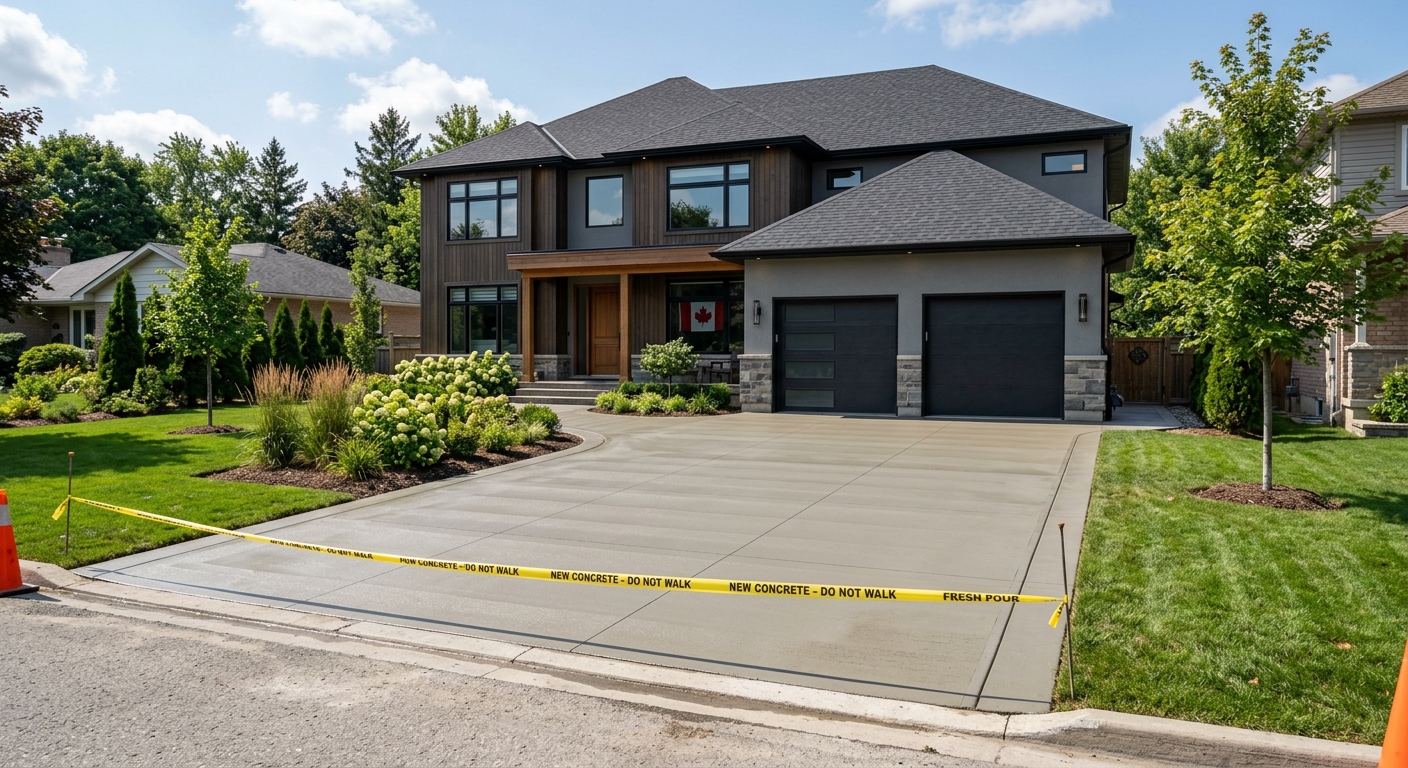
Concrete work options and costs in Avonmore
In Avonmore, Alberta, homeowners usually start their concrete plans with driveways, patios and walkways, then move to larger structural work like garage slabs or foundation footings as they age into repairs or renovations. With a population of 2,087 (Statistics Canada, 2021 Census), the local contractor pool is smaller than in Calgary proper, so availability and scheduling can influence your total price—especially in peak exterior pour months. Avonmore’s housing base is dominated by single-detached home activity (a typical driver of demand for flatwork in small communities like this), and that shows up when neighbours line up projects in the same spring window.
Across the Calgary economic region, costs are engineered around a cold continental climate with frequent freeze–thaw cycles. Concrete in this area needs the right air-entrained mix, granular base prep, and well-spaced control joints to reduce cracking and spalling. The design frost depth is about 1.2 m (roughly 4 ft), so excavation and footing volume increase compared with milder regions—one reason foundation work can land toward the upper end of price bands. Exterior slabs also have a shorter practical pour season, and cold-weather protection (insulated blankets, sometimes heat) is often required to achieve proper curing.
In Avonmore, you’ll typically see the trade in demand around residential pockets such as the busier driveway-and-lot areas near town services, where older approaches and entrances are most often replaced or upgraded. Next, use the table below to compare common concrete options and what you can realistically expect to pay.
| Application |
Typical Size |
Key Spec |
Finish Option |
Price Range |
| Concrete driveway (standard broom finish) |
24 ft x 10 ft (240 sq ft) |
Air-entrained, compacted granular base |
Broom finish + control joints |
$12,000–$18,000 |
| Exposed aggregate driveway |
24 ft x 10 ft (240 sq ft) |
Air-entrained, higher finishing labour |
Exposed aggregate (surface reveal) |
$14,000–$20,500 |
| Stamped concrete driveway or patio |
16 ft x 12 ft (192 sq ft) |
Air-entrained, colour hardeners |
Stamp mats + integral/toned colour |
$15,000–$26,000 |
| Plain concrete patio or walkway |
12 ft x 16 ft (192 sq ft) walkway/patio |
Air-entrained, proper edge forms |
Float + broom or light broom texture |
$5,000–$9,000 |
| Garage floor (interior slab) |
24 ft x 22 ft (528 sq ft) |
Vapour barrier + reinforcement as needed |
Steel trowel (lightly textured for traction) |
$9,500–$14,500 |
| Foundation footings (structural, below frost) |
Typical single-detached spread footings |
Excavation to frost depth + reinforced concrete |
Engineered rebar + proper curing |
$28,000–$45,000 |
Prices are estimates only and vary by project scope, site access and material selection.
What affects the price of concrete work in Avonmore
In Avonmore, you can see the same “size” of concrete project quoted 30–50% apart because the real cost drivers aren’t just the cubic metres—it’s how the contractor solves for frost, drainage, access and curing in Calgary’s cold continental conditions. A driveway that looks similar on paper can have very different excavation depth, base thickness, reinforcement, and finish time, and those items move the needle quickly.
The frost line depth and freeze–thaw cycles dictate the entire spec. Footings and foundation elements must be built below the design frost depth (about 1.2 m in this region) to limit frost heave and seasonal movement. Exterior slabs also need air-entrained concrete to survive repeated cycling; without it, surface scaling and spalling are more likely, especially when de-icing salts are used. Cold-weather placement adds cost because the pour season shortens and contractors must use winter-grade materials, insulated blankets, and sometimes temporary heat to keep curing on track. The cost impact often shows up when a job shifts later into fall or earlier into spring.
Concrete decisions also respond to neighbourhood realities and site conditions. In Avonmore, narrower access or limited staging can require smaller pours or extra labour for concrete handling, nudging driveway costs toward the higher end of the $12,000–$18,000 range. If your plan includes a stamped or exposed aggregate finish, labour and material time increase, often placing pricing nearer the $15,000–$26,000 band for stamped work. For foundations, deeper excavation to reach undisturbed bearing soil can push structural footing pricing closer to $28,000–$45,000, particularly on older lots where soils may be disturbed.
| Price Factor |
Why It Matters |
Cost Impact |
| Frost line depth — determines footing depth and form height |
Controls excavation volume and ensures foundation movement is minimized |
Can move costs significantly on footings and grade beams |
| Site preparation — excavation, grading, compacted granular base |
Proper base reduces settlement and keeps slabs flat through cycles |
Often a top driver; poor prep raises rework risk |
| Reinforcement — rebar or wire mesh requirement |
Helps control cracking for slabs, garage floors, and structural work |
Adds material and labour, especially for larger slabs |
| Mix design — air-entrainment and compressive strength spec |
Air-entrainment is essential for freeze–thaw durability outdoors |
Higher-spec mixes can add modest material cost, lowers failure risk |
| Finish type — broom vs. stamped vs. exposed aggregate |
More complex finishes require more labour time and materials |
Stamped/exposed can increase price relative to standard broom |
| Pour size and concrete truck access to site |
Access affects how fast and efficiently concrete can be placed |
Limited access can raise labour and scheduling premiums |
| Cold-weather curing precautions — heating and blankets |
Ensures concrete gains strength and resists early surface damage |
Can increase costs if added to late-season projects |
| Control joint pattern and sealing cost |
Joints manage cracking; sealing helps resist de-icing salt damage |
Small line items individually, but meaningful across the whole system |
Permits & regulations in Alberta
In Alberta, structural concrete work—such as foundation footings, foundation walls, and grade beams—typically falls under the building permit process, and engineered drawings are commonly reviewed by the municipality. Concrete flatwork like patios, walkways and driveways usually does not require a permit on its own, unless the project affects lot grading, drainage design, impervious surface limits, or work occurs within the municipal right-of-way. Before you break ground in Avonmore, confirm the requirements with your local authority so your project stays compliant and your contractor’s plan matches the inspection expectations.
No matter whether your job is structural or flatwork, verify your contractor is properly set up: ask for current liability insurance and coverage for workers (WSIB/WCB as applicable), plus references on projects of a similar scale in the Calgary region. Then, check details step-by-step:
- Request their insurance certificate (COI) showing liability limits that match your job size.
- Ask for proof of WSIB/WCB clearance or coverage documentation for their workers.
- Confirm they are licensed/registered for the work category they’re doing (where required) and that their name matches the COI.
- Ask for permit and inspection handling—who pulls the permit if it’s required, and when.
- Review the written scope for engineered drawings when the foundation elements are part of the scope.
- Verify references are concrete projects completed within Alberta’s cold-weather context (not only warmer regions).
If you’re planning foundation work near the design frost depth, inspections and engineered details matter even more, because the cost of “fixing it later” is far higher than getting it right at pour day.
Getting concrete right in Avonmore's freeze-thaw climate
Concrete fails most often in Avonmore when the system isn’t built for Calgary’s repeated freeze–thaw cycles. The biggest pattern I see is spalling and surface scaling caused by inadequate air-entrainment or rushed curing—especially on exterior slabs exposed to de-icing salt. The fix is to spec the whole assembly: base preparation, mix design, joints, curing and sealing, not just “the concrete itself.”
First, base prep must be compacted granular sub-base placed to the right depth for local soil and frost protection. If the base is thin, poorly graded, or not compacted, slabs settle and start cracking early. Second, use an air-entrained mix (typically 5–7% air content for exterior flatwork) with a minimum compressive strength of 32 MPa so the concrete can endure expansion and contraction. Third, control joints must be planned so cracking happens in the right locations, not randomly. Fourth, curing should be at least 7 days under proper conditions; in cold snaps, that can require insulated blankets and/or temporary heat to keep curing effective. Fifth, seal with a penetrating sealer after the cure—commonly applied 28 days post-pour—so de-icing salts have less direct access to the pores.
When these elements are correctly specified, you’re paying to prevent expensive callbacks. For example, a broom-finished driveway in the $12,000–$18,000 range may cost less than stamped work, but the real value is in durability specs. If you “save” on air-entrainment or skip proper curing, the cost difference can disappear quickly—repairs and re-pour work often cost far more than the upgrade would have.
| Spec |
Why It Matters in Avonmore |
What to Ask For |
Impact if Skipped |
| Compacted granular base (depth?) |
Prevents settlement and movement through frost cycles |
State base thickness and compaction method; confirm excavation to suitable sub-base |
Cracking, uneven slabs, and recurring repair issues |
| Air-entrained concrete mix (target air %?) |
Protects against freeze–thaw scaling and spalling outdoors |
Specify 5–7% air content for exterior flatwork |
Higher risk of surface scaling/spalling in winter |
| Compressive strength (MPa rating) |
Ensures strength gain for durability and load performance |
Minimum 32 MPa compressive strength for typical exterior flatwork |
Weaker surface layers; increased cracking and wear |
| Control joints (spacing per ACI guidelines) |
Directs cracks into manageable lines |
Joint layout plan (spacing and location) based on slab dimensions |
Random cracking that weakens the slab and impacts sealing |
| Minimum 7-day curing period |
Builds strength before traffic and cold exposure |
Confirm curing plan and protection on cold days |
Surface damage, scaling and compromised long-term performance |
| Penetrating sealer (when applied after cure) |
Repels de-icing salt intrusion into the pores |
Apply after cure—commonly around 28 days post-pour |
Faster deterioration and increased spalling risk over winters |
How to choose a concrete work contractor in Avonmore
Choosing the right concrete contractor in Avonmore comes down to verification and clear scope—not just the lowest number. Start with Alberta compliance: ask for a certificate of liability insurance and confirm it covers concrete-related work (including jobsite activities). Then verify WSIB/WCB coverage or clearance for their workers—your quote should be backed by proper documentation, not verbal promises. If they can’t provide current paperwork quickly, that’s a red flag.
Next, request 2–3 itemised written quotes that break out labour and materials. You want line items for excavation/site prep, base materials, reinforcement, concrete supply, finishing, joints, curing protection (if cold-weather work is expected), and sealing where included. A true itemised quote helps you compare apples-to-apples and see what’s excluded—like disposal, saw-cutting timing, formwork removal, or permit handling (for structural work that needs it).
Warranty should be specific: confirm workmanship warranty length, whether it covers cracking/spalling issues under normal use, and the product/manufacturer warranty for any sealers or specialty materials. Also ask whether any warranty is transferable if you sell the property. For payment, never accept a plan that demands most of the money upfront—commonly cap deposits around 10–15%, then hold back part of the payment until the work is complete and cleaned up. Finally, get a start date and completion estimate in writing, especially if you’re scheduling around weather and the exterior pour window.
- Ask for proof of liability insurance (COI) before signing.
- Verify WSIB/WCB coverage/clearance documentation for workers.
- Request references for similar jobs completed in Alberta’s freeze–thaw conditions.
- Use itemised quotes (labour + materials), not one lump-sum number.
- Confirm what’s included for site access, excavation, hauling and disposal.
- Ask what concrete mix design is used (air content and strength rating).
- Confirm base depth and compaction details—not just “granular base.”
- Get control joint spacing and method in writing.
- Ask how cold-weather curing will be handled if temperatures drop.
- Confirm whether sealing is included and when it’s applied (after cure).
- Check warranty terms and whether they cover spalling/scaling risks.
- Review payment schedule; avoid large upfront payments and include a holdback.
Concrete contractor red flags in Avonmore include: vague specs (no air content or strength rating), quotes that only reference the finish and ignore base prep, skipping or minimizing curing/blankets in cold snaps, pressure to pay a large deposit upfront, and refusal to provide COI/WSIB/WCB documents or written scope details.
Frequently asked questions — concrete work in Avonmore
What causes concrete to spall in Avonmore winters?
In Avonmore (and across the Calgary region), spalling usually comes from moisture moving into the concrete and then expanding during freeze–thaw cycles. The most common contractor-side cause is insufficient air-entrainment or the wrong mix for exterior exposure. If the concrete doesn’t have the proper air content, tiny freeze–thaw pressure points build up and the surface flakes or scales, especially when de-icing salts are used on driveways and walkways. Another contributor is poor base prep or inadequate curing, which can weaken the surface before the winter freeze cycle hits. The practical takeaway: insist on an air-entrained exterior mix (typically 5–7% air) and a curing plan that protects the pour long enough to reach strength. If you’re budgeting, that durability work is often what separates a standard driveway in the $12,000–$18,000 band from cheaper, short-sighted installs.
What is rebar and when is it required in Alberta?
Rebar is steel reinforcement bars used to strengthen concrete and help control cracking by holding tensile areas together. In Alberta, the “when” is driven by engineering and the structural role of the slab or wall—not by region marketing. For structural concrete like foundation footings, grade beams, and foundation walls, reinforcement is common because the design needs it to resist loads and distribute stresses. For flatwork such as driveways, reinforcement may be required depending on slab thickness, soil conditions, and intended loads; some designs use wire mesh or reinforcement bars, while others rely on thicker slabs and base prep. In Avonmore, where freeze–thaw movement can stress the slab at edges, reinforcement decisions should be made with site conditions in mind. The best way to confirm is to ask for the spec: slab thickness, reinforcement type, spacing, and whether an engineer’s design is being followed for your application.
How long does a concrete project take in Avonmore?
Typical timelines in Avonmore depend on scope and weather, but there’s a reliable rhythm behind most jobs. Site prep (excavation, grading, compaction, forming) often takes 1–3 days. The pour day is usually short—often hours—followed by finishing and jointing. The curing period matters: even though concrete can be walked on earlier, it generally needs at least 7 days of proper curing before you treat it like finished, load-ready pavement. If temperatures are cold, contractors may add insulated blankets or temporary heat, which can extend the overall calendar but protects the strength development. For small patios and walkways, projects may complete within about a week. For larger driveway and garage slabs, you may be closer to 1–2 weeks including prep and curing protection. If you’re comparing quotes for example driveway work in the $12,000–$18,000 band, make sure the contractor explains curing and protection—because “fast” without curing is where long-term failures start.
What is a concrete overlay and is it suited to Avonmore?
A concrete overlay is a new concrete layer placed over an existing slab to restore appearance and add service life—sometimes with grinding prep and bonding agents, sometimes with a thicker engineered approach. Overlays can be suited to Avonmore if the existing concrete is structurally sound: the slab should not be heavily broken, continuously failing from underlying settlement, or badly spalled across large areas. Freeze–thaw cycles in this region can amplify problems if the original slab is already moving; in those cases, a proper removal and replacement is safer than “covering” it. The decision comes down to condition assessment: check for differential settlement, loose edges, water intrusion, and widespread scaling. If the existing surface is mostly stable, an overlay can sometimes be a cost-effective option versus a full replacement. Still, if de-icing salt has already caused deep surface deterioration, overlays may not hold up as expected. Ask your contractor how they plan to prep, bond, and specify the overlay mix for Alberta freeze–thaw durability.
How do I seal concrete to protect it in Avonmore?
Sealing helps protect concrete by reducing how easily water and de-icing salts penetrate the pores—important in Avonmore winters where freeze–thaw cycles can drive spalling. The key rule is timing: apply penetrating sealer after proper curing, commonly around 28 days post-pour for exterior slabs. Before sealing, the concrete should be clean and fully cured; any trapped moisture or dust can interfere with uptake. Use a penetrating sealer suited for exterior exposure and salt resistance, and follow coverage rates carefully. You don’t want to “seal too early” just to look good sooner—early sealing can lock in moisture and reduce performance. If your driveway is in the standard finish category, this is often a small cost relative to the benefit, and it’s typically included (or offered) alongside the base build. If you opted for a decorative finish such as stamped concrete in the $15,000–$26,000 band, sealing is still essential to protect the surface from winter scaling and wear.
What is the difference between concrete and cement?
In everyday conversation, people use “cement” and “concrete” interchangeably, but they aren’t the same. Cement is one ingredient—a powder (typically Portland cement) that reacts with water to form the binding paste. Concrete is the final composite material: cement plus water plus aggregates (sand and gravel/crushed stone) plus, for exterior work in Alberta, air-entraining admixtures and sometimes other performance additives. This distinction matters because the durability problems we worry about in Avonmore winters—like freeze–thaw spalling—are controlled by the full concrete mix design, not cement alone. For example, the contractor must specify air-entrainment for exterior flatwork and a minimum strength rating (often 32 MPa in typical specs). Cement by itself won’t tell you whether the freeze–thaw performance will be right; the complete concrete specification and curing plan do. When reviewing quotes, ask for the mix design details, not just the word “cement.”