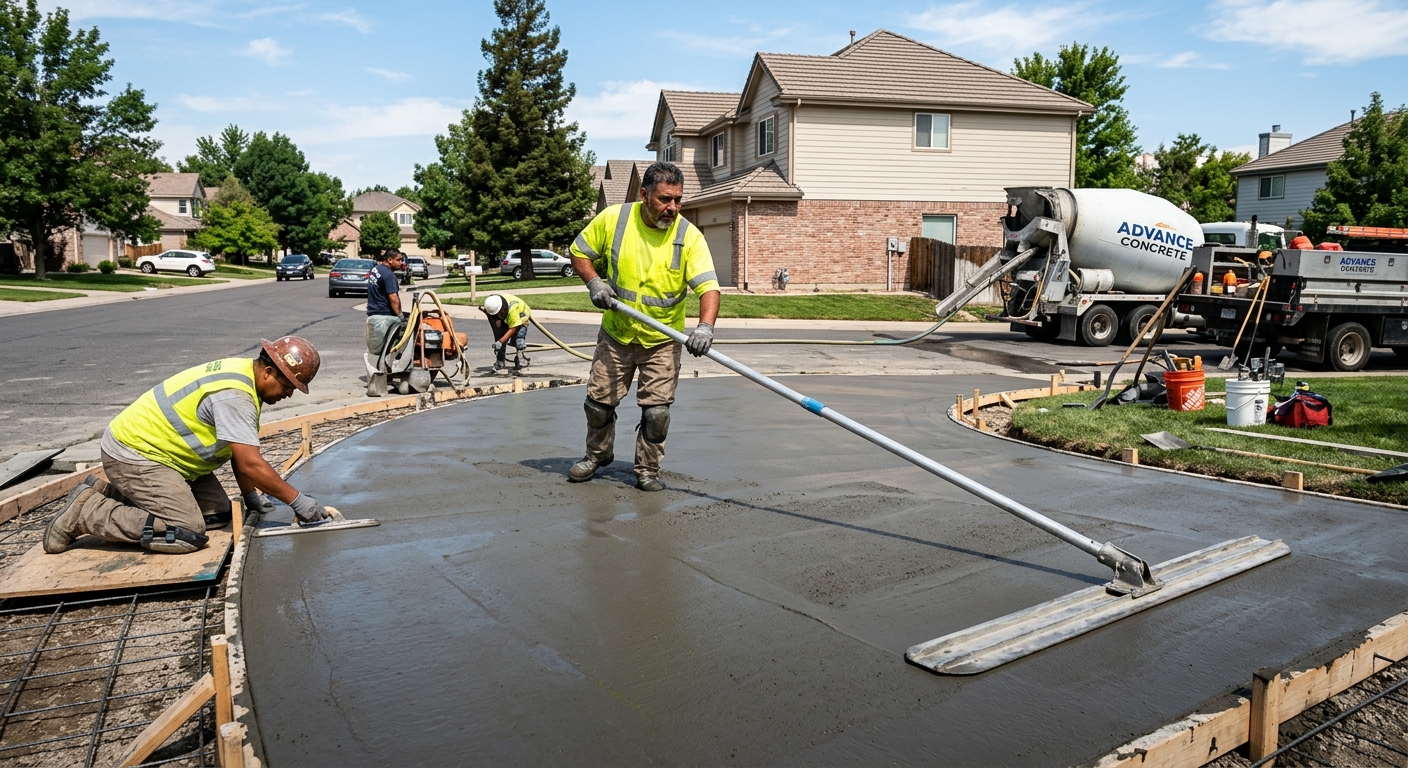
Concrete work options and costs in Clairmont
Clairmont, Alberta is a practical market for concrete because most homeowners need durable flatwork and foundations that can handle winter freeze–thaw. With a population of 2,799 (Statistics Canada, 2021 Census), the area is smaller than Calgary proper, so you’ll often see crews pulled from the wider Calgary region when exterior work ramps up. That matters for availability and scheduling, especially around local neighbourhoods like the newer growth pockets along the Clairmont perimeter, where driveways and rear patio upgrades are common.
In this part of the Calgary economic region, climate is the big cost driver. Cold continental winters and a design frost depth around 1.2 m (roughly 4 ft) mean footings for houses, garages, decks and retaining structures must bear on undisturbed soil below the frost line. Add frequent freeze–thaw cycles, and the specs change: air-entrained concrete, properly graded and compacted granular base, and control joints become non-negotiable for exterior slabs. Contractors also engineer for a shorter practical pour season, so cold-weather curing (insulation blankets and sometimes temporary heat) can add to foundation and exterior slab budgets.
Concrete pricing can also swing based on finish and access. For example, a standard broom driveway is a reliable baseline, while exposed aggregate and stamped finishes increase material, forming time, and labour for finishing and (in some cases) multiple crews. Use the ranges below as a budgeting starting point, then we’ll break down the factors that move quotes up or down across Clairmont.
| Application |
Typical Size |
Key Spec |
Finish Option |
Price Range |
| Concrete driveway (standard broom finish) |
400–600 sq. ft. |
Air-entrained; reinforced as required; control joints |
Broom finish, sealer recommended |
$12,000–$18,000 |
| Exposed aggregate driveway |
400–600 sq. ft. |
Air-entrained; bond/broom prep; edging & jointing |
Exposed aggregate (chemical or mechanical wash) |
$16,000–$22,500 |
| Stamped concrete driveway or patio |
250–450 sq. ft. |
Engineered base and reinforcement; anti-freeze-friendly mix |
Stamp pattern + colour options |
$15,000–$26,000 |
| Plain concrete patio or walkway |
200–400 sq. ft. |
Sloped for drainage; compacted base; joints |
Smooth/plain with broom edge or light broom |
$5,000–$9,000 |
| Garage floor (interior slab) |
300–600 sq. ft. |
Vapour barrier (if specified); reinforcement; proper thickness |
Float/smooth finish (trowel finish optional) |
$7,500–$13,500 |
| Foundation footings (structural, below frost) |
Whole house/garage system |
Excavation to design depth; engineered rebar; waterproofing as needed |
Structural concrete (no decorative finish) |
$28,000–$45,000 |
Prices are estimates only and vary by project scope, site access and material selection.
What affects the price of concrete work in Clairmont
In the Calgary region, it’s common to see quotes for the “same” concrete job land 30–50% apart once you look at engineering details and site conditions. The reason is simple: in Alberta—especially around Clairmont and the broader Calgary area—concrete specs are engineered for frost and freeze–thaw, not just for looks. Footings must extend below the design frost depth (commonly up to about 1.2 m in this region) to avoid frost heave and seasonal movement. Exterior slabs also need air-entrained concrete, and contractors must plan for cold-weather curing when late fall or early spring temperatures threaten proper set and strength gain.
Those climate-driven choices change labour and materials. For example, a driveway in winter may require winter-grade mix, insulated curing blankets, and tighter coordination for truck scheduling—pushing the job toward the upper end of the concrete driveway/slab band ($12,000–$18,000). A stamped driveway or patio adds finishing steps and often more colour/texture labour, which is why decorative projects are typically higher (often within $15,000–$26,000 depending on size and details).
Local site realities move costs too. In Clairmont, a few common scenarios raise budgets: (1) longer excavations and more import/grading when the soil profile isn’t uniform, (2) limited truck access that increases labour for wheelbarrowing/placing, and (3) higher repair complexity when you’re replacing older slabs with poor drainage or failed base prep. Conversely, costs can come down when the site is already graded, access is straightforward, and the footprint is compact with simple jointing.
| Price Factor |
Why It Matters |
Cost Impact |
| Frost line depth — determines footing depth and form height |
Footings must bear below the design frost depth to prevent heave |
Higher excavation/formwork can add several thousand dollars |
| Site preparation — excavation, grading, compacted granular base |
Base thickness and compaction control settlement and cracking |
Unfavourable soils or poor drainage increase costs |
| Reinforcement — rebar or wire mesh requirement |
Supports structural integrity and controls shrinkage cracking |
Reinforcement type/placement can noticeably raise labour/materials |
| Mix design — air-entrainment and compressive strength spec |
Air-entrainment improves freeze–thaw durability |
Proper cold-rated mix and required strength raise material cost |
| Finish type — broom vs. stamped vs. exposed aggregate |
Finish drives labour time and complexity of curing/processing |
Stamped/exposed aggregate typically pushes you into higher bands |
| Pour size and concrete truck access to site |
Truck access affects labour efficiency and placement time |
Long carries, tight gates, and multiple access points add cost |
| Cold-weather curing precautions — heating and blankets |
Curing must reach strength safely despite lower temps |
Insulation/heating can add direct labour and equipment expenses |
| Control joint pattern and sealing cost |
Jointing reduces random cracking; sealing helps protect from de-icing damage |
Better joint/finish detailing usually adds some cost but reduces failures |
Permits & regulations in Alberta
In Alberta, the permitting conversation depends on whether the concrete is structural or simply finishes on the ground. Structural concrete work—such as foundation footings, foundation walls, grade beams, and other load-bearing elements—typically requires a building permit and often engineered drawings that the municipality reviews. Concrete flatwork like patios, walkways, and driveways usually does not require a permit on its own, but it can trigger requirements if the work changes lot grading, affects impervious surface coverage limits, alters drainage patterns, or impacts municipal right-of-way conditions.
For a Clairmont homeowner, the safest approach is step-by-step verification before anyone digs. First, confirm the contractor carries liability insurance and WSIB/WCB coverage. If you’re working with a larger crew, you should also request a copy of their certificate of insurance showing current coverage amounts and the correct insured party. Second, verify licensing and standing through Alberta’s online contractor resources (and look for clear, consistent business details). Third, ask for references on similar-scale projects—foundation work is especially detail-sensitive in this frost-depth environment.
Finally, make sure you’re clear on scope: who pulls the permit (if required), what inspections are scheduled, and whether excavation and disposal are included. That clarity prevents last-minute cost surprises once engineering and municipal requirements are introduced.
Getting concrete right in Clairmont's freeze-thaw climate
Concrete failure in Clairmont usually isn’t about “bad concrete”—it’s about specs that don’t match the local freeze–thaw reality. Over time, inadequate air-entrainment, weak base prep, poor jointing, or rushed curing can lead to surface scaling, spalling, and random cracking that won’t behave like the original drawings. The goal is to engineer for frost movement: excavate and build a compacted granular base to the right depth, place footing concrete below the design frost depth, and detail exterior slabs so water can’t sit under or on the surface.
To spec the job correctly, start with (1) base preparation: compacted granular sub-base sized to local soils and engineered frost conditions; (2) mix design: exterior flatwork typically requires air-entrained concrete (commonly targeting about 5–7% air) and a minimum 32 MPa compressive strength so the paste has durability and strength; (3) control joints: space joints to limit random cracking—joints should be planned, not improvised mid-pour; (4) curing: minimum 7-day curing under proper conditions, with extra protection in cold weather; and (5) sealing: apply a penetrating sealer 28 days after pour so de-icing salts and moisture have less direct pathways into the concrete.
Here’s a real-world dollar example: choosing sealed, air-entrained concrete and proper jointing on a driveway often costs more upfront, but it’s commonly less than the price difference between redoing a failed surface. If your driveway budget is around $12,000–$18,000, “value engineering” that skips sealing or under-specifies base can lead to early surface problems—especially where winter road grit and de-icing salts accelerate scaling. The cheaper quote can turn into a costly second mobilization.
| Spec |
Why It Matters in Clairmont |
What to Ask For |
Impact if Skipped |
| Compacted granular base (depth?) |
Controls settlement and supports freeze–thaw performance |
Base thickness, compaction method/testing, and drainage slope |
Uneven settling, cracking, and premature failure |
| Air-entrained concrete mix (target air %?) |
Protects against freeze–thaw scaling/spalling |
Confirm air content target (often 5–7% for exterior flatwork) |
Surface scaling and spalling within a few seasons |
| Compressive strength (MPa rating) |
Strength gain supports durability in Alberta conditions |
Minimum 32 MPa for exterior applications |
Lower strength and reduced resistance to wear and freeze damage |
| Control joints (spacing per ACI guidelines) |
Directs cracking to predictable lines |
Joint layout drawings or a clear spacing plan |
Random cracking and wider long-term repairs |
| Minimum 7-day curing period |
Cold weather slows curing; proper protection is essential |
Curing plan (blankets/heating if needed) and temperature targets |
Reduced surface strength and increased cracking risk |
| Penetrating sealer (when applied after cure) |
Repels moisture and helps resist de-icing salt intrusion |
Apply penetrating sealer 28 days after pour |
Faster deterioration and more frequent maintenance |
How to choose a concrete work contractor in Clairmont
Choosing the right concrete contractor in Clairmont comes down to proof, not promises. In Alberta, verify the company’s credentials and insurance before work starts. Ask for their liability insurance certificate (confirm the policy is current and includes the correct named insured), and request evidence of WSIB/WCB coverage. For contractor licensing/standing, check Alberta’s online registry tools using the legal business name—don’t rely on a social media page or a past nickname.
Next, get 2–3 itemised written quotes instead of one lump sum. You want a breakdown that separates labour and concrete materials, and clearly states what’s included: excavation, granular base, reinforcement, formwork, finishing, joints, and curing protection. Clarify disposal (spoils/old concrete) and whether permit pulling is included if the work is structural. If you’re comparing a standard broom driveway versus decorative options, make sure the finish and jointing spec are equally detailed.
Warranty matters too. Ask for the length of workmanship warranty, whether product/manufacturer warranties apply to any special materials (like sealers or membranes), and whether the warranty is transferable if you sell the home. For payment, keep it safe: never pay more than 10–15% upfront, and use a holdback until the final walk-through and closeout are complete. Finally, insist on a written start date and a completion estimate—cold-weather curing and scheduling logistics can shift timelines when crews coordinate with truck arrivals.
- Confirm liability insurance and verify coverage dates on the certificate.
- Verify WSIB/WCB coverage for workers before excavation starts.
- Request references from similar jobs in the Calgary area (driveways, patios, or footings).
- Get 2–3 itemised quotes with labour and material breakdowns.
- Ask what’s excluded: permit fees, disposal, regrading, electrical/lighting disconnects, or curbs.
- Ensure the base build-up depth and compaction method are written in the scope.
- Confirm mix design includes air-entrainment for exterior slabs.
- Ask for the reinforcement plan (mesh/rebar type, placement, and cover thickness).
- Require a jointing plan: locations, spacing, and which joints are saw-cut vs formed.
- Clarify cold-weather curing protection (blankets/heating) if temps drop.
- Confirm sealing: product type and whether penetrating sealer is included (and timing).
- Keep payment conservative: 10–15% upfront maximum, with holdback until completion.
Red flags in Clairmont: (1) a quote that doesn’t specify base thickness or compaction, (2) claiming “we don’t need air-entrainment” for exterior concrete, (3) offering a noticeably cheaper decorative price that skips reinforcement/jointing details, (4) asking for most of the payment before any verification or prep work is done, and (5) no written curing or cold-weather plan when pours happen near shoulder seasons.
Frequently asked questions — concrete work in Clairmont
How deep must footings be for Clairmont's frost line?
In Clairmont and the broader Calgary area, footing depth is based on the design frost depth and engineered foundation requirements. Practically, contractors build footings below the design frost depth (around 1.2 m, roughly 4 ft in this region) so the foundation sits on undisturbed soil and doesn’t move with freeze–thaw. The exact depth can vary by soil conditions, site drainage, and the foundation type shown on the engineered plans. For structural projects, treat depth as an engineered spec—not a guess—because the form height, excavation volume, and rebar details all depend on it. Before signing, confirm the quote references “below frost” and aligns with your engineering drawings and municipality requirements.
Why does concrete crack in Clairmont and how is it prevented?
Concrete cracks for several reasons in Alberta, but the big drivers in Clairmont are shrinkage plus movement from freeze–thaw and drainage issues. Even well-made concrete will crack—what matters is whether cracks are controlled and predictable. The prevention strategy is three-part: proper compacted granular base (so the slab doesn’t settle), air-entrained exterior mix (to reduce freeze damage), and a planned control joint layout with appropriate timing. If the job is done with rushed curing or poor joint spacing, random cracking becomes more likely and can open pathways for moisture and de-icing salts. For homeowners, ask your contractor to show the joint plan and confirm the exterior mix includes air-entrainment; skipping those details is one of the fastest ways to move from a $12,000–$18,000 driveway into costly early repairs.
Stamped vs broom-finish concrete — cost difference?
Stamped concrete usually costs more than a standard broom finish because it adds material handling and extra finishing steps—colour, stamp texture, and careful curing/finishing timing. In Clairmont, where exterior slabs face freeze–thaw, both options should still have the same durable base prep and air-entrained mix; the price difference is mostly labour and the finishing system. A broom-finish driveway typically sits in the $12,000–$18,000 range for typical sizes, while stamped decorative projects commonly fall within $15,000–$26,000 depending on area, pattern complexity, and colour work. If someone quotes stamped concrete but leaves out jointing or doesn’t describe curing protection, that’s a warning sign—decorative appearance shouldn’t come at the expense of durability.
When is the best time to pour concrete in Clairmont?
The best time for most exterior concrete pours in Clairmont is during the warmer part of the year when temperatures support proper curing without heavy intervention. In Calgary’s cold continental climate, late fall and early spring can still work, but only if the contractor plans cold-weather precautions: winter-grade mix, insulated blankets, and—if needed—temporary heating to keep the concrete within safe curing temperature ranges. A poor curing window increases the risk of surface scaling and reduced long-term durability, especially where de-icing salts are used. That’s why scheduling matters: contractors in this region often tighten their pour calendar. When you request quotes, ask the contractor what temperatures they’ll pour at, how they protect curing, and what your job timeline will be if weather shifts.
How long does concrete take to cure?
Concrete curing is a process, not a single day. For typical exterior flatwork in Clairmont, plan for at least a 7-day curing period under proper conditions to reach early strength and stability. Full durability development continues beyond that, and that’s why sealer timing is tied to cure. For penetrating sealer, many exterior specs require application around 28 days after the pour, once the concrete has matured enough for consistent penetration and performance. If a contractor opens forms too early or exposes the slab to freeze conditions before curing protections are in place, you can see early surface deterioration. When comparing quotes, ask for their curing plan in writing—particularly if your pour date sits near colder temperatures.
Do I need a permit for concrete work in Alberta?
Often, structural concrete work in Alberta—like foundation footings, foundation walls, and grade beams—requires a building permit and may involve engineered drawings reviewed by the municipality. For exterior flatwork such as patios, walkways, and driveways, a permit is usually not required on its own, unless the project changes lot grading, affects impervious surface coverage limits, or impacts drainage and right-of-way considerations. Because rules can depend on scope, it’s smart to confirm with the local authority before breaking ground. On the contractor side, ensure you’re clear whether they handle permit pulling (when required) and what inspections are expected. Also verify the contractor’s liability insurance and WSIB/WCB coverage so you’re protected if something goes wrong during excavation and placement.