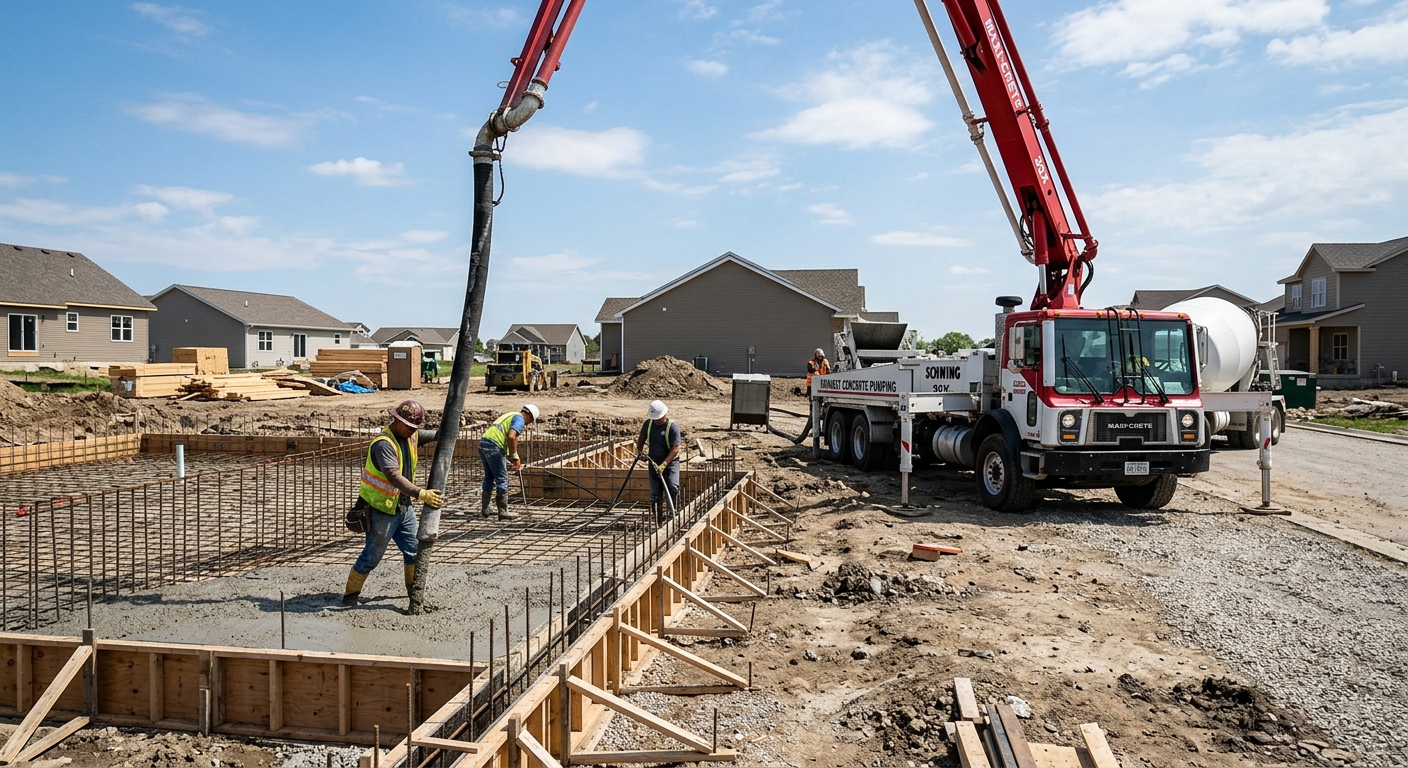
Concrete work options and costs in Deer Run
In Deer Run, Alberta, homeowners typically invest in concrete for driveways, patios, walkways, garage slabs, and—on larger projects—foundation footings. Deer Run is a smaller community with a population of 4,910 (Statistics Canada, 2021 Census), and the housing stock is dominated by single-detached family homes, which is exactly where flatwork demand comes from (driveways to garages, rear patios, and walk paths). In practice, that means local crews often get booked around the same peak exterior work windows, so scheduling can affect your total cost.
Calgary-area pricing is engineered around a cold continental climate with frequent freeze–thaw cycles. A design frost depth of about 1.2 m (roughly 4 ft) means exterior footings, retaining structures, and any foundation elements must bear below the frost line to reduce frost heave and seasonal movement. For slabs, that same freeze–thaw reality drives granular base preparation, air-entrained mixes, and control joint placement to prevent spalling and cracking. If you’re pouring in late fall or early spring, crews may need winter-grade concrete, insulated blankets, or temporary heat to protect curing—small changes like that can swing a quote.
In Deer Run, trade activity is especially noticeable around the newer residential pockets where lots are still being developed and driveways and patios get upgraded quickly after landscaping. Once you’re ready to compare finishes, the most useful starting point is a clear per-project range for each scope below.
| Application |
Typical Size |
Key Spec |
Finish Option |
Price Range |
| Concrete driveway (standard broom finish) |
24 ft x 10 ft (240 sq ft) |
Air-entrained concrete, compacted granular base |
Broom finish + control joints |
$12,000–$18,000 |
| Exposed aggregate driveway |
24 ft x 10 ft (240 sq ft) |
Air-entrained mix, proper mix placement + curing |
Exposed aggregate (surface reveal) |
$14,500–$22,500 |
| Stamped concrete driveway or patio |
20 ft x 12 ft (240 sq ft) |
Reinforcement as required, base prep for exterior durability |
Stamped pattern + integral colour |
$15,000–$26,000 |
| Plain concrete patio or walkway |
12 ft x 12 ft (144 sq ft) |
Air-entrained concrete, compacted base, joints |
Float/smooth + broom edges (or light trowel) |
$5,000–$9,000 |
| Garage floor (interior slab) |
22 ft x 20 ft (440 sq ft) |
Vapour barrier, reinforcement, proper slab thickness |
Plain finish (broom or light trowel) |
$9,500–$15,500 |
| Foundation footings (structural, below frost) |
Typical house system |
Excavation to frost depth, engineered steel/formwork |
Unfinished structural concrete |
$28,000–$45,000 |
Prices are estimates only and vary by project scope, site access and material selection.
What affects the price of concrete work in Deer Run
If you get two quotes for the same general “concrete driveway + base + finish” scope in the Calgary region, it’s not unusual to see swings of 30–50%. A big reason is that concrete pricing isn’t only about the cubic yards—it's about how each contractor designs for freeze–thaw performance and how much labour goes into excavation, forms, and protection during curing. In Alberta’s cold continental climate, the frost line depth and freeze–thaw cycles dictate every step: footings must extend below the design frost depth (about 1.2 m in Alberta-area engineering practice) to prevent frost heave, and exterior slabs need air-entrained concrete mixes to handle repeated expansion and contraction.
Also, the practical pour season is shorter than in milder provinces. When temperatures drop, contractors may need cold-weather curing precautions like insulated blankets and sometimes temporary heat, especially to maintain curing conditions long enough to reduce scaling risk. De-icing salts are common on Calgary-area driveways; without proper sealing and a well-designed surface, salt can accelerate surface deterioration. That’s why a “standard broom driveway” can land near the $12,000–$18,000 band, while stamped work often moves into the $15,000–$26,000 range—because the labour, colouring, and finishing steps are higher.
Two local examples that can shift your cost up or down in Deer Run: (1) a driveway requiring deeper excavation and more granular base because of soft subgrade can add major material and compaction time; (2) a straightforward site with good truck access may keep labour efficient, keeping you closer to the lower end of the slab bands. Even in a community of 4,910 (Statistics Canada, 2021 Census), lot conditions and yard layouts vary a lot from home to home, and those realities show up in the estimate.
| Price Factor |
Why It Matters |
Cost Impact |
| Frost line depth |
Determines footing depth and form height |
More excavation and concrete; can push foundation/footing scopes toward the top of the $28,000–$45,000 range |
| Site preparation |
Excavation, grading, compacted granular base |
Loose or wet soils increase granular volume, time, and compaction equipment use |
| Reinforcement |
Rebar or wire mesh requirement |
Added steel, chairs/ties, and labour; also affects total slab thickness |
| Mix design |
Air-entrainment and compressive strength spec |
Proper air content and strength may cost slightly more but reduces premature cracking/spalling |
| Finish type |
Broom vs. stamped vs. exposed aggregate |
Stamped/exposed are labour-intensive, driving pricing toward $15,000–$26,000 |
| Pour size and concrete truck access to site |
Logistics affect placing efficiency |
Limited access can require smaller pours or additional labour for shovelling/forming |
| Cold-weather curing precautions |
Heating and blankets |
Winter-grade measures can add day(s) of crew time and extra materials |
| Control joint pattern and sealing cost |
Limits random cracking and protects surfaces from salts |
Correct joint layout prevents cosmetic-only failures from turning into maintenance issues |
Permits & regulations in Alberta
In Alberta, concrete work isn’t treated as “one size fits all” for permits. Structural concrete work—things like foundation walls, grade beams, and footings that support the building—typically requires a building permit, and it’s commonly tied to engineered drawings reviewed through the municipal process. That’s the category where you want to be most formal: the depth to frost, reinforcement details, and load paths are what engineers approve.
Concrete flatwork (patios, walkways, standard driveways, and garage slabs) usually does not require a permit unless it affects lot grading, drainage, or impervious surface coverage limits, or it involves municipal right-of-way concerns. Because lot drainage is one of the most common trouble spots in new subdivisions, always confirm whether your scope could change runoff patterns.
To verify a contractor in Deer Run, Alberta step by step, ask for three things before you sign: (1) proof of liability insurance—request a certificate of insurance showing you as an interested party when available; (2) proof they have WSIB/WCB coverage (and that the coverage is active); and (3) a contractor licence/business registration appropriate for the work scope. For licence and compliance, start with provincial directories and the contractor’s own documentation package. Then, call your insurer or request endorsements if you’re unsure.
Finally, request references for similar-scale exterior pours in Calgary-area winters. If they’ve done foundation/footing work recently, ask for proof of engineering engagement and how they handled subgrade and frost protection.
Getting concrete right in Deer Run's freeze-thaw climate
Concrete failures in Deer Run almost always trace back to one of five issues: inadequate base preparation, wrong mix design, missed reinforcement needs, improper control joints, or rushed curing. In a Calgary-area freeze–thaw cycle, water gets into hairline cracks and expands when temperatures swing, which drives spalling and deeper deterioration. The solution is to spec the job as an engineered system, not just “pour and finish.”
Start with base preparation: excavate to the correct depth and build a compacted granular sub-base designed for local soil conditions and frost performance. Next is mix design: exterior flatwork should use air-entrainment (commonly targeted at 5–7% air depending on exposure and mix selection) and meet a minimum 32 MPa compressive strength requirement suited to exterior exposure. Then control joints: they need a spacing plan to limit random cracking to manageable locations. After placement, curing matters more in cold weather; plan for at least 7 days under proper conditions. Finally, sealing isn’t cosmetic in this climate—apply a penetrating sealer about 28 days post-pour so de-icing salts don’t accelerate surface breakdown.
Here’s where pricing can make sense: upgrading from broom-finish to stamped concrete might cost you more (often landing in the $15,000–$26,000 band), but it’s justified when the contractor also commits to the correct base, reinforcement, joint layout, and cold-weather curing protections—not just the colour and stamps. If you skip those “boring” steps, both broom and stamped surfaces can fail quickly in freeze–thaw conditions.
| Spec |
Why It Matters in Deer Run |
What to Ask For |
Impact if Skipped |
| Compacted granular base (depth?) |
Base determines drainage and frost resistance under freeze–thaw cycles |
Stated excavation depth, granular type, moisture conditioning and compaction method |
Settlement, cracking, and early surface failure |
| Air-entrained concrete mix (target air %?) |
Air pockets provide space for freezing water to expand without destroying paste |
Target air content of 5–7% for exterior flatwork (per contractor mix design) |
Increased risk of spalling and scaling during winter |
| Compressive strength (MPa rating) |
Strength supports durability and load performance |
Minimum 32 MPa for exterior exposure as specified |
Premature wear, chipping, and reduced structural longevity |
| Control joints (spacing per ACI guidelines) |
Controls where cracking occurs and reduces random crack growth |
Joint spacing plan and timing of saw-cut or formed joints |
Wider random cracking and higher maintenance costs |
| Minimum 7-day curing period |
Proper curing develops strength and reduces early surface damage |
What “cold weather curing” looks like if pouring is near freezing |
Surface scaling, weaker concrete, and long-term durability issues |
| Penetrating sealer (when applied after cure) |
Repels de-icing salt intrusion |
Applied about 28 days post-pour by schedule and product type |
Faster salt-related deterioration and more frequent repairs |
How to choose a concrete work contractor in Deer Run
Choosing the right concrete contractor in Deer Run usually comes down to verification plus clarity in the paperwork. In Alberta, confirm they can legally carry the right insurance for the job and that they’re covered for worker injuries. Start by asking for their liability insurance certificate (showing policy limits and coverage dates). Next, request proof of WSIB/WCB coverage—this protects you if someone gets hurt on-site. For contractor registration and licence status, check Alberta-appropriate directories and verify the business information matches the quote and invoice.
Then get 2–3 itemised written quotes. I recommend you insist on a breakdown that includes labour, excavation/site prep, granular base, reinforcement (if needed), concrete supply and air-entrained mix selection, finishing, saw-cutting/control joints, and sealing (if included). Avoid “lump sum” quotes that don’t describe disposal and prep depth—those are where change orders happen later.
Read exclusions carefully: is permit handling included for structural scopes, is debris removal/disposal included, and what happens if access is limited? Ask about warranties: separate workmanship warranty from product/manufacturer warranty and clarify whether the warranty is transferable if you sell the home. For payment, never pay more than about 10–15% upfront; hold back a portion until the final walk-through and surface cure/finishing requirements are complete. Finally, get the timeline in writing: start date, pour day logistics, and completion estimate.
- Request proof of liability insurance and ensure coverage is active for the project dates.
- Confirm WSIB/WCB clearance for their workers before work begins.
- Ask whether they design for frost performance (base depth and/or footing depth to frost).
- Require the quote to list air-entrained concrete for exterior flatwork.
- Insist on a control joint plan (spacing and method) in the scope.
- Ask who will handle cold-weather curing if temperatures are near freezing.
- Confirm whether reinforcement (mesh/rebar) is included where needed.
- Get written details on site access, concrete truck placement, and any pumping/extra labour.
- Verify disposal is included (spoils/old concrete hauling) or stated separately.
- Clarify the sealing plan—if included, ask for product type and application timing.
- Review the warranty length and what defects it covers (and how long after completion claims are accepted).
- Agree on payment schedule with a holdback until final acceptance.
Concrete red flags I see with underprepared contractors in Deer Run include: vague quotes with no base depth or joint spacing details, skipping air-entrainment “to save money,” rushing curing during cold snaps, refusing to provide WSIB/WCB proof, and offering a short/unclear warranty that doesn’t address workmanship or cracking/spalling outcomes over time.
Frequently asked questions — concrete work in Deer Run
Why does concrete crack in Deer Run and how is it prevented?
In Deer Run and the broader Calgary area, cracking is often driven by freeze–thaw cycling combined with how the slab shrinks as it cures. If water gets into pores or hairline cracks, it can expand when temperatures drop, widening damage and turning cosmetic cracks into durability problems. Prevention starts with compacted granular base, correct air-entrained concrete for exterior exposure, and a control joint plan that limits where cracking occurs. Joints should be cut/formed at the right time so the slab relieves stress predictably. Also, curing is critical—if the contractor rushes cold-weather curing, surface scaling and micro-cracking become more likely. When properly built, even a broom-finish driveway in the $12,000–$18,000 range can perform well for years, while poorly specified slabs may need patching much sooner.
Stamped vs broom-finish concrete — cost difference?
The cost difference is mainly labour and finishing complexity, not just the “look.” Broom-finished concrete is comparatively straightforward: base prep, air-entrained mix, proper joints, then a broom texture for traction in Alberta winters. Stamped concrete requires additional steps like colour application (often integral or densifier), stamp timing, release materials, and more intricate finishing. In Deer Run, a standard driveway often lands around the $12,000–$18,000 band, while stamped driveway or patio scopes commonly fall into the $15,000–$26,000 range depending on area, reinforcement needs, and access. The best value comes when the contractor isn’t treating stamping as the only priority—confirm they still specify air entrainment, the right base depth, and a control joint layout. That’s what keeps stamped surfaces from cracking and spalling.
When is the best time to pour concrete in Deer Run?
For exterior slabs in Deer Run, the best window is late spring through summer when temperatures stay reliably above freezing and curing conditions are stable. Calgary-area freeze–thaw means early pours in shoulder seasons can be expensive because contractors may need insulating blankets, temporary heat, and stricter curing control to reach proper early strength. That said, experienced crews can pour near colder dates if they have a winter plan: suitable winter-grade concrete, protection measures, and a clear cure schedule for at least the initial curing period (commonly a minimum 7 days under proper conditions). If you’re planning a driveway or patio, scheduling earlier typically reduces costs and risk. If you must pour later in the year, expect your quote to reflect the extra cold-weather precautions.
How long does concrete take to cure?
Concrete curing has two “timelines”: early strength gain and long-term strength development. For homeowners in Alberta, a practical minimum is that the slab should cure for at least 7 days under appropriate conditions before you expect normal handling. Cold-weather placement can extend protection needs because curing slows when temperatures drop. Full strength development continues for weeks, and many sealing products are best applied after the concrete has cured appropriately—often around 28 days—so the surface isn’t too wet and can accept the sealer. If you want sealing for salt protection (important for Calgary-area winters), confirm the sealing date relative to your pour date. A contractor who can’t provide a clear curing and sealing schedule should be a concern.
Do I need a permit for concrete work in Alberta?
In Alberta (including Deer Run), permit requirements depend on what you’re building. Structural concrete work—like footings, foundation walls, and grade beams—typically requires a building permit and often engineered drawings reviewed through municipal processes. Concrete flatwork such as patios, walkways, and standard driveways usually does not require a permit unless your work affects lot grading, drainage, or municipal right-of-way concerns, or triggers impervious surface limits. Because drainage issues can impact neighbouring lots and municipal acceptance, confirm details with your local authority before breaking ground. Whichever scope you choose, don’t skip contractor verification: ask for liability insurance and proof of WSIB/WCB coverage. A proper permit path and well-documented job plan are part of a safe, durable outcome in winter conditions.
Concrete vs pavers for a patio in Deer Run?
Both concrete and pavers can look great in Deer Run, but they fail differently in freeze–thaw climates. Concrete patios rely on a well-prepared base, air-entrained mix, control joints, and proper curing—then sealing about 28 days later helps resist de-icing salt intrusion. A simple plain patio or walkway often fits into the $5,000–$9,000 band depending on size and site conditions. Pavers can perform well when installed on a properly graded base with correct compaction and drainage; if the base shifts, pavers can heave or become uneven, which can be more visible and require re-leveling. If you want a consistent, monolithic surface that’s straightforward to maintain, concrete usually wins on long-term predictability. If you value easy section replacement, pavers may suit you better—but both need careful base work.