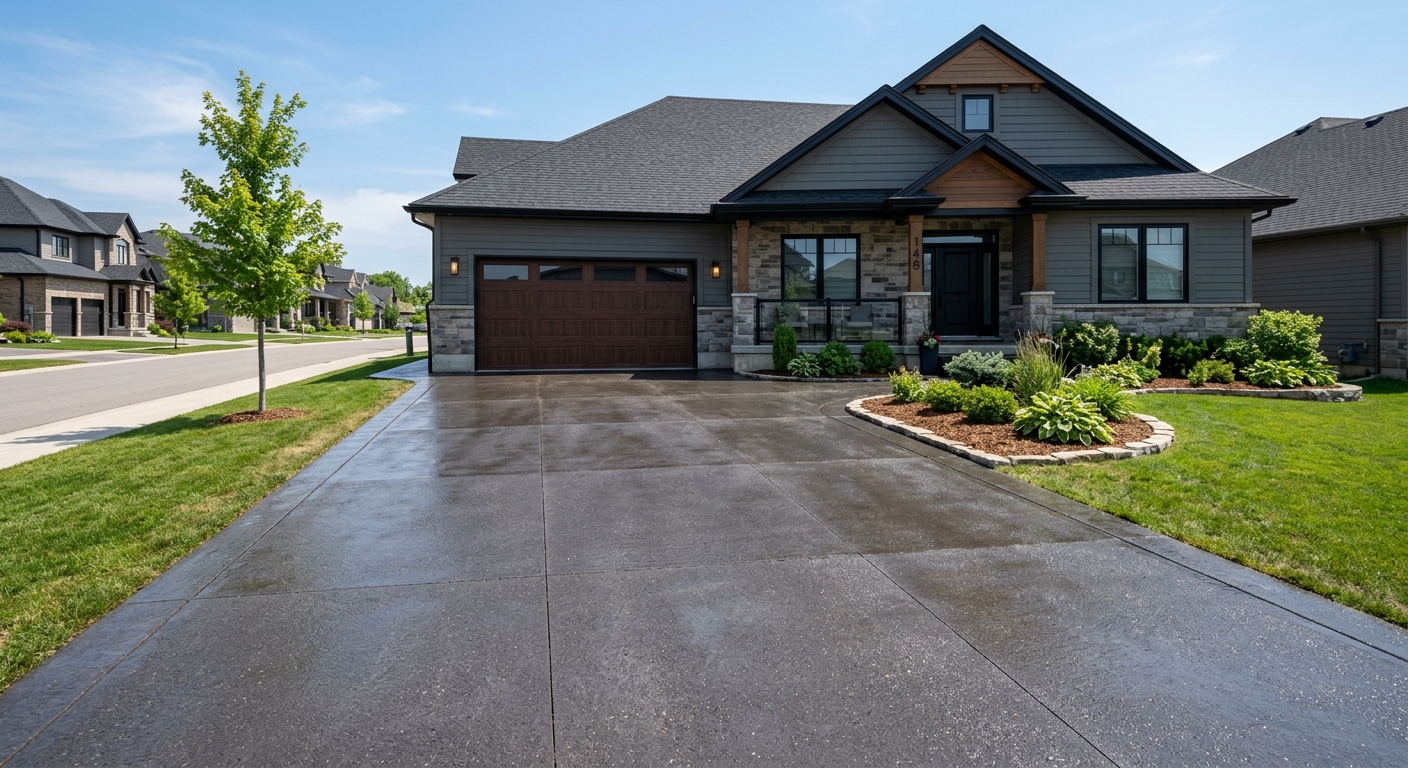
Concrete work options and costs in Glengarry
Concrete work in Glengarry is all about building for the long Alberta winter—and for many homeowners that starts with driveways, patios and walkways. In a community of 2,906 people (Statistics Canada, 2021 Census), the primary demand tends to come from single-detached neighbourhoods where residents want durable exterior flatwork and clean transitions from driveway to entry. Calgary’s broader housing market also keeps crews busy, which is why timing and material availability can affect quotes in the same week.
Because Glengarry sits in a cold continental climate, contractors design concrete around freeze–thaw cycles and a design frost depth of about 1.2 m (roughly 4 ft). That means more excavation and deeper, properly compacted granular base for exterior slabs, and foundations that bear on undisturbed soil below the frost line. The region’s practical pour season for exterior slabs is shorter, and when frost threatens, you’ll often see cold-weather curing precautions—insulated blankets, temperature monitoring, and winter-grade mixes—added into the price.
In Glengarry, this trade is especially active around the newer-growth pockets near the Calgary commuter belt, where homeowners frequently upgrade driveways and backyard patios within the first few years of taking possession. If you’re comparing options, the finish choice matters too: a standard broom finish can be the most cost-effective, while stamped and decorative work (plus proper sealing) is engineered for performance and appearance in our freeze–thaw environment.
Below is a practical side-by-side for common projects you’ll hear about in Glengarry, Alberta—then you can align the finish and structural specs to your budget.
| Application |
Typical Size |
Key Spec |
Finish Option |
Price Range |
| Concrete driveway (standard broom finish) |
400–600 sq. ft. |
Air-entrained exterior mix, compacted granular base |
Broomed |
$12,000–$18,000 |
| Exposed aggregate driveway |
400–600 sq. ft. |
Air-entrained exterior mix, exposed surface wear layer |
Exposed aggregate |
$14,000–$21,000 |
| Stamped concrete driveway or patio |
300–500 sq. ft. |
Air-entrained exterior mix, integral colour or stains |
Stamped (pattern + colour) |
$15,000–$26,000 |
| Plain concrete patio or walkway |
200–350 sq. ft. |
Air-entrained exterior mix, control joints |
Float + broom/scored |
$5,000–$9,000 |
| Garage floor (interior slab) |
400–600 sq. ft. |
Vapour barrier, minimum thickness spec, reinforcement as needed |
Plain trowel finish (or broom if required) |
$10,000–$16,000 |
| Foundation footings (structural, below frost) |
Per engineered house layout |
Structural concrete, rebar, formwork; below ~1.2 m design frost depth |
Not decorative (structural) |
$28,000–$45,000 |
Prices are estimates only and vary by project scope, site access and material selection.
What affects the price of concrete work in Glengarry
Homeowners in Glengarry often see quotes for the “same” concrete job that vary by 30–50%. In the Calgary region, that spread usually isn’t because contractors are guessing—it’s because key specs change: footing depth, granular base design, reinforcement needs, and finish detailing. Two driveways that both measure 500 sq. ft. can still land in different price bands if one crew excavates deeper for proper frost protection and compacts a full engineered base, while the other skimps and relies on a thinner build-up.
The biggest driver is Calgary-area cold performance. Footings and many exterior slab components must be engineered to the design frost depth of about 1.2 m to reduce frost heave and seasonal movement. Exterior slabs also require air-entrained concrete mixes to survive repeated freeze–thaw cycles, and that mix design can shift cost. In colder shoulder months, the pour season is shorter, and cold-weather curing precautions—heating, insulated blankets, and longer curing time—add both labour and equipment costs. Finally, Calgary-area de-icing habits can accelerate surface spalling if concrete isn’t properly specified; sealing is a practical add-on because it helps resist moisture and salt intrusion.
In Glengarry, cost can rise when excavation hits hard or uneven ground (more trucking and formwork), or when reinforcement is required beyond basic mesh. Conversely, costs can be lower on interior slabs like garage floors when access is straightforward and the scope stays “plain”—for example, a simple broomed driveway often fits the $12,000–$18,000 backbone range, while stamped decorative work tends to move into the $15,000–$26,000 band once integral colour, pattern mats, and extra labour are included.
| Price Factor |
Why It Matters |
Cost Impact |
| Frost line depth |
Determines footing depth and form height |
Deeper excavation increases labour and concrete volume |
| Site preparation |
Excavation, grading, and compacted granular base |
Hard soils, tight access, and hauling raise costs |
| Reinforcement |
Rebar or wire mesh requirement for load and durability |
Additional steel and labour for placement increases price |
| Mix design |
Air-entrainment and compressive strength spec |
Winter-grade and higher spec mixes cost more |
| Finish type |
Broom vs. stamped vs. exposed aggregate |
Labour-intensive finishes and colour systems raise totals |
| Pour size and concrete truck access to site |
Impacts batching, crew size, and pumping needs |
Pumping, wait time, or limited access can add significant charges |
| Cold-weather curing precautions |
Heating and blankets to protect early strength gain |
Equipment and monitoring add cost, especially late fall |
| Control joint pattern and sealing cost |
Controls cracking and reduces moisture/salt attack |
More joints and sealing material/labour increase price |
Permits & regulations in Alberta
In Alberta, concrete work isn’t all treated the same. Structural concrete work—such as footings, foundation walls, and grade beams—typically requires a building permit, and engineered drawings are often required and reviewed by the municipality. Concrete flatwork (patios, walkways, and driveways) usually does not require a permit on its own, unless it affects lot grading, drainage, impervious surface coverage limits, or the municipal right-of-way (for example, work tied to a driveway approach or changes near the curb/sidewalk).
For Glengarry homeowners, the simplest path is to confirm two things before breaking ground: (1) whether your scope touches grading/drainage or any public area, and (2) whether the project includes structural elements. Then, verify the contractor properly. Start with Alberta licence status: check the contractor’s registration on the appropriate online registry (the province’s business/contractor listings and any trade-specific registration they claim). Next, request a clearance letter or proof of good standing, and ask for current liability insurance (often called a “Certificate of Insurance”) showing coverage and project details. For worker coverage, ensure they carry WSIB/WCB coverage (and that it’s active). Also ask for references on similar-scale jobs in the Calgary region—footing or flatwork projects with comparable access and schedule constraints.
Step-by-step, you’re looking for: permit needs (municipality confirmation), active licence/registration, current COI liability insurance, WSIB/WCB clearance/proof, and references that match your scope and freeze–thaw timeline.
Getting concrete right in Glengarry's freeze-thaw climate
In Glengarry, concrete failures almost always trace back to three things: inadequate base preparation, poor mix/air entrainment, or rushing curing in cold weather. When freeze–thaw cycles hit poorly prepared slabs, water moves into micro-spaces. That’s how spalling starts—surface scaling, flaking, and premature roughness that then accelerates salt damage. To spec the job correctly, you want a clear checklist tied to Calgary’s cold performance.
First, base preparation: the concrete needs a compacted granular sub-base to the proper depth for local soil conditions, with good drainage so water can’t sit under the slab. Second, mix design: specify air-entrained concrete for exterior work, typically targeting about 5%–7% air content, with a minimum 32 MPa compressive strength for durability. Third, control joints: a designed joint pattern limits random cracking so cracks happen where they’re intended, not through garage thresholds or walkways. Fourth, curing: plan for at least 7 days of curing under correct conditions; in cold weather, curing can require insulated blankets and sometimes temperature management so the concrete gains strength reliably. Fifth, sealing: apply a penetrating sealer after the slab cures—commonly around 28 days post-pour—so de-icing salts and moisture don’t attack the surface.
Ask yourself whether you’re paying for durability or paying twice. For example, opting for a standard broom finish driveway may land closer to $12,000–$18,000, while moving to stamped concrete can land in the $15,000–$26,000 range. That higher cost is justified when the contractor is also rigorous on base, air-entrainment, joints, and curing—because the finish is what you see, but the specification is what determines whether it lasts through Alberta winters.
| Spec |
Why It Matters in Glengarry |
What to Ask For |
Impact if Skipped |
| Compacted granular base (depth?) |
Prevents frost movement and reduces water pumping under the slab |
Engineered compacted granular base depth based on site/soil and frost protection needs |
Settlement, cracking, and heaving that show up seasonally |
| Air-entrained concrete mix (target air %?) |
Protects against freeze–thaw damage and reduces spalling risk |
Exterior mix with target 5%–7% air content (verified by mix tickets/test cylinders as applicable) |
Surface scaling and spalling within a few winters |
| Compressive strength (MPa rating) |
Ensures the slab reaches adequate strength in cold conditions |
Minimum 32 MPa compressive strength spec for exterior flatwork |
Lower durability and higher risk of early surface failure |
| Control joints (spacing per ACI guidelines) |
Limits uncontrolled cracking during temperature swings |
Joint plan (layout + spacing) aligned to ACI guidance and slab dimensions |
Random cracks, water infiltration, and more freeze–thaw damage |
| Minimum 7-day curing period |
Cold weather can slow strength gain and increase damage risk |
Confirm curing method and minimum curing period; ask about blankets/heating if temps drop |
Reduced strength and early deterioration |
| Penetrating sealer (when applied after cure) |
Repels moisture and helps resist de-icing salt attack |
Schedule and product for penetrating sealer applied after full cure (commonly ~28 days) |
More salt scaling and faster surface wear |
How to choose a concrete work contractor in Glengarry
Choosing a concrete contractor in Glengarry comes down to proof, not promises. In Alberta, confirm trade licensing/registration where applicable, and verify they have active liability insurance before any work starts—ask for the Certificate of Insurance showing your address and appropriate coverage. Then check WSIB/WCB coverage: request proof/clearance documents and ensure it’s current. If a contractor won’t provide documents up front, treat that as a serious warning.
Get 2–3 itemised written quotes, ideally split by labour and materials (concrete volume, reinforcement, excavation/granular base, forms, finishing, sealing, and disposal). Avoid quotes that only show a single lump sum without telling you what’s included. Confirm whether the quote includes permit pull (if structural work is involved), hoisting/pumping if required, and excavation disposal/haul-off—these items are where “cheap” quotes often end up costing more later.
Warranty matters: ask for the workmanship warranty length, what it covers (cracks, scaling, joint seal issues, settlement), and whether manufacturer product warranties are included for admixtures/sealers where relevant. Also ask if warranties are transferable to future owners.
For payment, keep it practical: never pay more than 10–15% upfront. Hold back a portion until the job is complete, cleaned up, and you’ve done a walkthrough. Finally, insist on a start date and completion estimate in writing—Alberta’s cold snap can shrink the pour window, so delays affect curing and surface quality.
- Confirm Alberta licence/registration details and request supporting documentation.
- Request a current Certificate of Insurance (liability) naming your project/address.
- Verify WSIB/WCB coverage with proof/clearance before work begins.
- Ask for recent photos of similar Glengarry-area freeze–thaw concrete (driveways/patios/foundations).
- Get 2–3 itemised quotes (labour + materials), not just one total price.
- Check the scope includes excavation, granular base supply and compaction, and disposal/haul-off.
- Confirm reinforcement details (mesh vs rebar, and where it’s used).
- Ask for mix design confirmation: air-entrainment for exterior and minimum strength spec.
- Request a joint layout plan (where joints go and how they’ll be finished).
- Clarify curing: blankets/heating if temperatures drop during the first days.
- Confirm sealing: product type and schedule (often after curing, commonly ~28 days).
- Use a payment schedule with 10–15% max upfront and holdback until final acceptance.
In Glengarry, red flags include: “no need for air-entrainment” statements, missing/unclear joint plans, contractors who won’t provide insurance/WSIB/WCB proof, vague scope exclusions (especially disposal and base prep), and pressure to pay large deposits before forms and base are verified.
Frequently asked questions — concrete work in Glengarry
How long does a concrete project take in Glengarry?
Most concrete flatwork in Glengarry can be poured in a single day, but completion depends on curing and weather. For a typical driveway or patio, plan on mobilization and prep the day before or morning of, the pour itself (often one workday), then curing time before you can put it into regular use. Even though the slab may look “ready” quickly, proper curing and protection matter in Alberta’s freeze–thaw climate; you’ll generally want at least 7 days of curing under suitable conditions, and sealing is often done around 28 days post-pour. If temperatures fall and cold-weather curing precautions are needed, timelines can extend. As a homeowner, ask your contractor to schedule curing protection (blankets/heating) in writing when temps drop.
What is a concrete overlay and is it suited to Glengarry?
A concrete overlay is a new concrete layer placed over an existing slab after surface prep. It can be suited to Glengarry when the original concrete is still structurally sound (no major settlement, deep spalling, or widespread failure), and when the old surface is properly prepared to bond and drain correctly. The challenge in Alberta is that overlays can trap problems if moisture pathways weren’t addressed during prep—freeze–thaw can worsen bond failure or lift sections. In many cases, homeowners choose an overlay to avoid full removal, but you should require a site-specific assessment and a detailed prep plan (chipping, cleaning, bonding considerations). If the existing slab is failing, full replacement is often closer to the $12,000–$18,000 driveway backbone range; overlays may cost less upfront, but only if the base is truly stable.
How do I seal concrete to protect it in Glengarry?
In Glengarry, sealing is about reducing moisture and de-icing salt damage that can lead to scaling and spalling over repeated freeze–thaw cycles. Use a penetrating sealer designed for exterior concrete. The key is timing: you generally seal after the slab has cured—commonly around 28 days post-pour—so the sealer can perform correctly rather than trapping excess moisture. Before sealing, the surface needs to be clean and dry (no heavy residue, and no curing compound left from other processes). Ask your contractor what product they use and whether they recommend reapplication intervals. A properly sealed, air-entrained driveway built on a well-compacted base will typically age better than an unsealed slab, especially in Alberta winters when salts are used frequently.
What is the difference between concrete and cement?
Concrete is the final construction material—cement plus water plus aggregates (sand and gravel), and sometimes admixtures like air-entrainment or winterizing agents. Cement is one component inside concrete, usually Portland cement, that reacts with water to help bind everything together. Homeowners in Glengarry don’t usually specify cement directly, but you can absolutely request the concrete specs: exterior air-entrainment target (commonly around 5%–7% for freeze–thaw resistance), minimum compressive strength (often at least 32 MPa for durability in exterior flatwork), and confirming cold-weather curing procedures when temps drop. When quotes differ by a noticeable amount in Calgary and area, it’s usually because the concrete mix design and curing precautions differ—not because someone used “a different cement” in a casual way.
How much does concrete work cost in Glengarry?
Concrete pricing in Glengarry typically lines up with the Calgary-area climate realities: deeper excavation for frost protection, air-entrained mixes for exterior durability, and sometimes cold-weather curing precautions. For a concrete patio or walkway, many homeowners fall in the $5,000–$9,000 range depending on square footage and preparation. Driveways are commonly in the $12,000–$18,000 backbone range for standard broom finishes, while stamped concrete driveways or patios often land in the $15,000–$26,000 band due to added labour for colour and pattern work. Foundations/footings are structurally engineered and commonly fall in the $28,000–$45,000 range. Always compare quotes by scope—especially base depth, reinforcement, and curing method—because those specs explain most of the 30–50% variation.
How deep must footings be for Glengarry's frost line?
In the Calgary region where Glengarry is located, design practice uses a frost depth of about 1.2 m (roughly 4 ft). That means structural footings and foundation elements are typically engineered to bear below that frost depth, on undisturbed soil, to reduce frost heave and seasonal movement. Exact depth can vary based on soil conditions, drainage, and the engineered design for your specific house layout, but the frost-depth concept is the baseline. The important homeowner takeaway is that “estimated” footing depth is not enough—your engineered drawings and contractor’s excavating plan should reference the local frost depth requirement and match your site conditions. If you’re comparing foundation quotes, ask where they’re placing the bottom of footing relative to frost protection and what base prep and compaction they’ll complete.