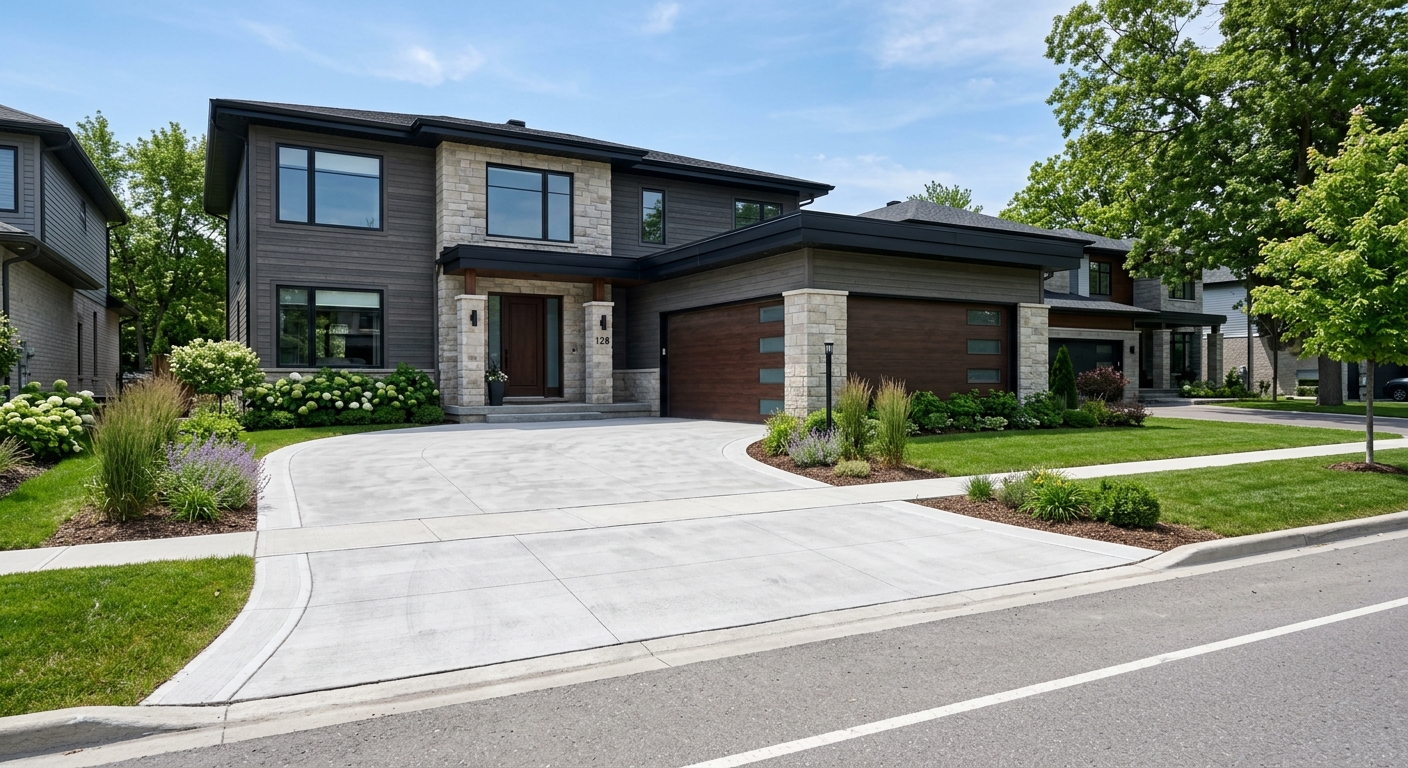
Concrete work options and costs in Lorelei
In Lorelei, concrete is one of those trades where the “same” job can land in very different price lanes, mainly because frost and freeze–thaw don’t forgive shortcuts. Lorelei’s small population (4,030 residents, Statistics Canada, 2021 Census) means crews often travel in from the wider Calgary region, so site access and scheduling can matter. It also fits the way people build locally: most homeowners are looking for durable exterior flatwork—driveways, patios, and walkways—that can handle Alberta winters without early spalling or heaving.
In the Calgary economic region, concrete costs are engineered around a design frost depth of about 1.2 m (roughly 4 ft). For foundations, that translates into deeper excavation and more concrete volume than in milder climates. For exterior slabs, frequent freeze–thaw cycles drive the need for air-entrained concrete, granular base prep, and a proper control joint pattern to control random cracking. The practical pour window for exterior work is shorter, and cold-weather placement may require winter-grade mixes, insulated blankets, or temporary heat to protect curing.
If you’re in the thicker-development pocket near the older neighbourhood corridor along the main road into the community, demand tends to be steady for driveways and small slab work—especially when new builds and regrades trigger repairs to existing entrances. From there, it’s easier to budget once you compare the common scopes side-by-side.
| Application |
Typical Size |
Key Spec |
Finish Option |
Price Range |
| Concrete driveway (standard broom finish) |
400–600 sq ft |
Air-entrained exterior mix; compacted base; control joints |
Broom finish |
$12,000–$18,000 |
| Exposed aggregate driveway |
400–600 sq ft |
Same foundation prep as broom finish; higher material finish requirements |
Exposed aggregate |
$15,000–$22,000 |
| Stamped concrete driveway or patio |
300–500 sq ft |
Air-entrained mix; integral colouring; proper curing window |
Stamped pattern + release agent |
$15,000–$26,000 |
| Plain concrete patio or walkway |
200–350 sq ft |
Engineered base; air-entrained mix for exterior exposure |
Broom or light trowel finish |
$5,000–$9,000 |
| Garage floor (interior slab) |
400–500 sq ft |
Vapour barrier; control joints; minimum strength spec |
Broom or light trowel |
$10,000–$16,000 |
| Foundation footings (structural, below frost) |
Typical detached home scope |
Footings designed below frost depth; rebar reinforcement; formwork |
Structural concrete placement |
$28,000–$45,000 |
Prices are estimates only and vary by project scope, site access and material selection.
What affects the price of concrete work in Lorelei
In Calgary and across Alberta, two quotes for the “same” driveway or patio can swing 30–50% because the hidden work is where costs live: excavation volume, granular base thickness, reinforcement details, and the quality of curing and finishing. Contractors price the job based on how your site will perform through our freeze–thaw cycles—not just on the number of square feet poured. If one crew designs for long-term durability and the other cuts back on base prep or curing, you’ll feel it later in cracking, scaling, and uneven settlement.
The biggest driver is frost depth and freeze–thaw. Footings for houses, garages, decks, and retaining structures must bear on undisturbed soil below the design frost depth (about 1.2 m in the local practice), which means deeper excavation and higher concrete volumes. For exterior slabs, air-entrained concrete isn’t optional in this region; it’s how we reduce the damage from repeated freezing and thawing. Add the fact that the pour season for exterior slabs is shorter, and cold-weather curing precautions—insulating blankets, controlled heat, and winter-grade materials—can push labour and material costs up.
Local conditions in Lorelei can also move the number. For example, if your driveway ties into an existing entrance with poor drainage, contractors may need extra sub-drainage and regrading before they can pour—raising costs beyond the typical $12,000–$18,000 driveway band. On the other hand, a small, well-drained patio with straightforward access often stays closer to $5,000–$9,000. And if your property is older and has settled over time, removing and rebuilding affected sections can add demolition and haul-away fees on top of the concrete.
| Price Factor |
Why It Matters |
Cost Impact |
| Frost line depth |
Determines footing depth and form height |
Major: deeper digs increase concrete volume, labour, and shoring |
| Site preparation |
Excavation, grading, compacted granular base |
Major: poor access or thick unsuitable soil drives additional truck time and materials |
| Reinforcement |
Rebar or wire mesh requirement |
Medium: depends on slab design, thickness, and expected loads |
| Mix design |
Air-entrainment and compressive strength spec |
Medium: exterior air content and winter-grade requirements add material cost |
| Finish type |
Broom vs. stamped vs. exposed aggregate |
Medium to high: stamping/revealing work and materials require extra labour and controls |
| Pour size and concrete truck access to site |
Limits equipment, pump needs, and placement time |
Medium: tight access can mean pumping/extra crew or smaller pours |
| Cold-weather curing precautions |
Heating and blankets |
High in late season: materials + time to protect curing |
| Control joint pattern and sealing cost |
Controls cracking and helps repel de-icing salts |
Low to medium: usually small line items, but big savings on future repairs |
Permits & regulations in Alberta
In Alberta, structural concrete work—like footings, foundation walls, and grade beams—typically requires a building permit and, in many cases, engineered drawings reviewed through the municipal process. Concrete flatwork (such as patios, walkways, and driveways) usually does not require a permit on its own, unless it impacts lot grading, stormwater drainage, impervious surface coverage limits, or the municipal right-of-way. Because these details vary by address and scope, the safe approach in Lorelei is to confirm with the local authority before any formwork or excavation begins.
For a homeowner verifying a contractor in Alberta, use a simple step-by-step checklist. First, ask for proof of liability insurance—the certificate of insurance should list the insured party and show coverage limits appropriate for concrete placement and site work. Second, confirm their WSIB/WCB coverage status; they should be able to provide clearance documentation or current account confirmation. Third, verify whether the contractor is properly registered/licensed for the type of work they’re doing (and whether subcontractors are properly covered).
Where to look: start with the contractor’s website and formal documents you receive with the quote, then cross-check licensing/registration information through Alberta’s online resources when available. Finally, ask for references on projects of similar scale in the Calgary region—especially recent exterior work where cold-weather procedures were used.
Getting concrete right in Lorelei's freeze-thaw climate
In Lorelei, concrete most often fails from issues that show up after the first tough winters: freezing and thawing that causes surface scaling (spalling), random cracking that lets water into the slab, and heaving from inadequate base or improper bearing depth. The fix is not more “grout” or patch—it's specifying the right build-up and then protecting curing when temperatures drop.
1) Base preparation: Use a compacted granular sub-base sized to suit local soil and the frost depth expectation in Calgary-area practice. If the base isn’t compacted to spec, the slab can settle and crack, even with the best finish. 2) Mix design: For exterior flatwork, target 5–7% air content and minimum 32 MPa compressive strength (or the project-spec minimum). That air entrainment is what helps resist freeze–thaw damage. 3) Control joints: Plan the joint spacing so cracks happen where you designed them, not randomly. 4) Curing: Protect the slab for at least 7 days under proper conditions; in cold weather, curing may require insulated blankets and/or temporary heat to avoid weak surface development. 5) Sealing: Apply a penetrating sealer after the cure period (often around 28 days) to repel de-icing salts.
Ask better questions: “What’s your air-entrainment target?”, “What’s the base depth and compaction method?”, and “How do you protect curing if temps drop overnight?” If one contractor proposes skipping air-entrainment or rushing curing in late fall, you’re buying low now and paying high later.
Dollar example: upgrading from a basic broom-finish driveway to a more engineered exterior slab (proper winter-grade approach, correct base, and air entrainment) can keep you inside the typical $12,000–$18,000 driveway band, while a cheaper “fast pour” approach that cuts base depth and curing protection often leads to early repairs—turning a one-time pour into a repeated cost cycle.
| Spec |
Why It Matters in Lorelei |
What to Ask For |
Impact if Skipped |
| Compacted granular base (depth?) |
Prevents settlement and reduces frost-related movement in cold climates |
Base depth plan + compacted granular layer spec (with proof/records if available) |
Uneven settling, cracking, and shortened slab service life |
| Air-entrained concrete mix (target air %?) |
Improves freeze–thaw durability and limits surface scaling/spalling |
Target air content range of 5–7% for exterior flatwork |
Spalling, scaling, and deterioration after winter cycles |
| Compressive strength (MPa rating) |
Ensures the slab has adequate durability and load capacity |
Minimum 32 MPa (or higher if engineered/spec’d for your use) |
Early wear, chipping, and structural weakness |
| Control joints (spacing per ACI guidelines) |
Controls where shrinkage and thermal cracks occur |
Joint spacing plan + sawcut timing (as applicable) |
Random cracking patterns and water infiltration into joints |
| Minimum 7-day curing period |
Builds early strength before freeze risk and traffic/load exposure |
How they protect curing; blanket/heat plan if cold weather is expected |
Weak surface, scaling, and reduced long-term durability |
| Penetrating sealer (when applied after cure) |
Helps repel de-icing salts that accelerate deterioration |
Apply after full cure (commonly around 28 days post-pour) |
Faster spalling and staining from salt exposure |
How to choose a concrete work contractor in Lorelei
Choosing the right concrete contractor in Lorelei is mostly about verification and documentation, not just price. Start by confirming Alberta coverage requirements: request a current certificate of liability insurance (and make sure it covers concrete placement and jobsite work). Next, ask for proof of WSIB/WCB coverage or a clearance letter—contractors should provide this without delay because it’s standard for working on occupied and insured properties. If a contractor uses subcontractors, ask who is on the crew and request proof of coverage for their trades as well.
Then get 2–3 itemised written quotes. You want a breakdown that separates labour, concrete supply, reinforcement, base prep, forms, finishing, cutting/sawing, and any disposal/haul-away. A lump-sum quote can hide exclusions—like whether pump fees, winter curing measures (blankets/heat), or sawcut timing are included. Ask whether the permit pull is included for structural work, and confirm what happens with removed soil and old slab demolition.
Warranty matters too: ask the length of the workmanship warranty, whether it covers labour for repairs, and whether the product/manufacturer warranty is included and transferable to future owners. On payment, avoid large deposits—never pay more than 10–15% upfront, and hold back a portion until the job is complete and cleaned. Finally, insist on a start date and completion estimate in writing so you’re not left waiting during the shorter exterior pour season.
- Ask for liability insurance certificate and verify dates/coverage limits.
- Request WSIB/WCB clearance or proof of active coverage.
- Confirm who does the base prep and who performs forming, finishing, and sawcutting.
- Get 2–3 itemised quotes with labour + materials + disposal separated.
- Clarify exclusions (pump fees, rebar chairing, sawcut timing, winter curing supplies).
- Ask for the concrete mix spec: air-entrainment target and minimum MPa rating.
- Require a control joint plan (spacing and where joints will be located).
- Ask how they handle cold weather (blankets/heat plan if night temps drop).
- Confirm curing and protection steps, including curing duration.
- Ask whether a penetrating sealer is included (and when applied).
- Review warranty terms in writing: workmanship duration and what’s covered.
- Use a payment schedule with holdback until finishing and cleanup are complete.
Concrete contractor red flags in Lorelei: vague “we use good concrete” statements without mix specs; quotes that don’t mention air-entrainment for exterior slabs; promises to pour and immediately remove curing protection in late season; no proof of WSIB/WCB/insurance; and workmanship warranties that only cover materials or are too short to be meaningful.
Frequently asked questions — concrete work in Lorelei
Do I need a permit for concrete work in Alberta?
In Alberta, structural concrete work such as footings, foundation walls, and grade beams typically requires a building permit and often engineered drawings reviewed through the municipal process. For concrete flatwork like driveways, patios, and walkways, permits are usually not required by default, but they may become necessary if the project affects lot grading, stormwater/drainage, impervious surface limits, or ties into municipal right-of-way rules. In Lorelei, the best approach is to confirm your address and scope before digging, especially if you’re regrading or changing drainage patterns. A reliable contractor should ask about these factors upfront and tell you whether they’re pulling any required permits as part of the scope.
Concrete vs pavers for a patio in Lorelei?
For patios in Lorelei and the Calgary region, both concrete and pavers can work well, but concrete is often the better value when you want a smooth, durable surface with fewer settling points—provided the base is done right. Freeze–thaw here is real, so both options need proper compaction and drainage. Concrete patio pricing commonly sits in the $5,000–$9,000 band for typical residential sizes, while pavers can be competitive but may cost more when you add edge restraint, underlayment, and labour-intensive layout. The big difference is long-term maintenance: pavers can heave slightly and may need resetting, while a properly built concrete patio should be more stable. If your patio requires frequent snow storage or de-icing salt use, ask how each system handles water movement and surface protection.
How long does a concrete driveway last?
In Lorelei, a concrete driveway can last many decades when it’s built for freeze–thaw durability: air-entrained mix, compacted granular base, correct thickness, proper control joints, and curing that isn’t rushed. The Calgary-area climate makes “how it was cured” and “how it was sealed” just as important as the finish. If you use de-icing salts, sealing after full cure can help reduce surface deterioration. Budget typically lands around $12,000–$18,000 for standard exterior driveway work with broom finish; stamped options usually cost more. A cheaper job that cuts base depth or skips winter curing often shows problems sooner—cracking, spalling, and unevenness—because freeze–thaw finds weak points quickly.
What is air-entrained concrete and why does it matter here?
Air-entrained concrete is engineered with microscopic air bubbles that give freezing water somewhere to expand without breaking the concrete matrix. In Alberta—including Lorelei—freeze–thaw cycles are frequent, and that’s why exterior slabs need air-entrainment to resist scaling and spalling. If a contractor doesn’t specify an air target (commonly 5–7% for exterior flatwork), the concrete may look fine in the first year but degrade faster after winters. This is one of the most important specs behind the pricing difference you’ll see between quotes. A durable driveway or walkway built for freeze–thaw typically stays within the local bands like $12,000–$18,000 for driveways (standard broom finish) and aligns with the curing and protection plan for cold nights.
How do I prepare the base for a concrete slab?
Base preparation is where the “real” structure starts. For a concrete slab in Lorelei, the contractor should remove topsoil/unsuitable material, then place a compacted granular base to the required depth for your soil and intended slab thickness. The key is compaction and drainage: the slab needs a stable, well-compacted sub-base and a surface that won’t trap water under or beside the concrete. In Calgary-area freeze–thaw conditions, insufficient base preparation leads to settlement, random cracking, and increased frost-related movement. Ask your contractor: what’s the base depth, what granular material is used, how is it compacted, and how will drainage be handled? If they can’t answer clearly, or if the quote doesn’t mention base prep in detail, be cautious—because it’s one of the most common causes of early repairs.
How do I compare concrete quotes?
Start by getting 2–3 written, itemised quotes for the exact same scope: slab size, thickness, reinforcement, base prep depth, finishing, and curing measures. Compare line items—not just the bottom line. In Lorelei, make sure each quote includes air-entrainment for exterior flatwork, a minimum strength spec (often 32 MPa or per design), control joint layout, and how they handle cold-weather curing with blankets/heat if temperatures drop. Confirm whether excavation, haul-away, and any drainage corrections are included, and whether sealing is part of the plan. If one quote is dramatically lower than the others but leaves out these essentials, it’s usually not a “better deal”—it’s missing durability requirements. Use local bands as a check: for example, driveway pricing often lands around $12,000–$18,000 for standard broom finish, while stamped concrete typically rises toward $15,000–$26,000 depending on scope.