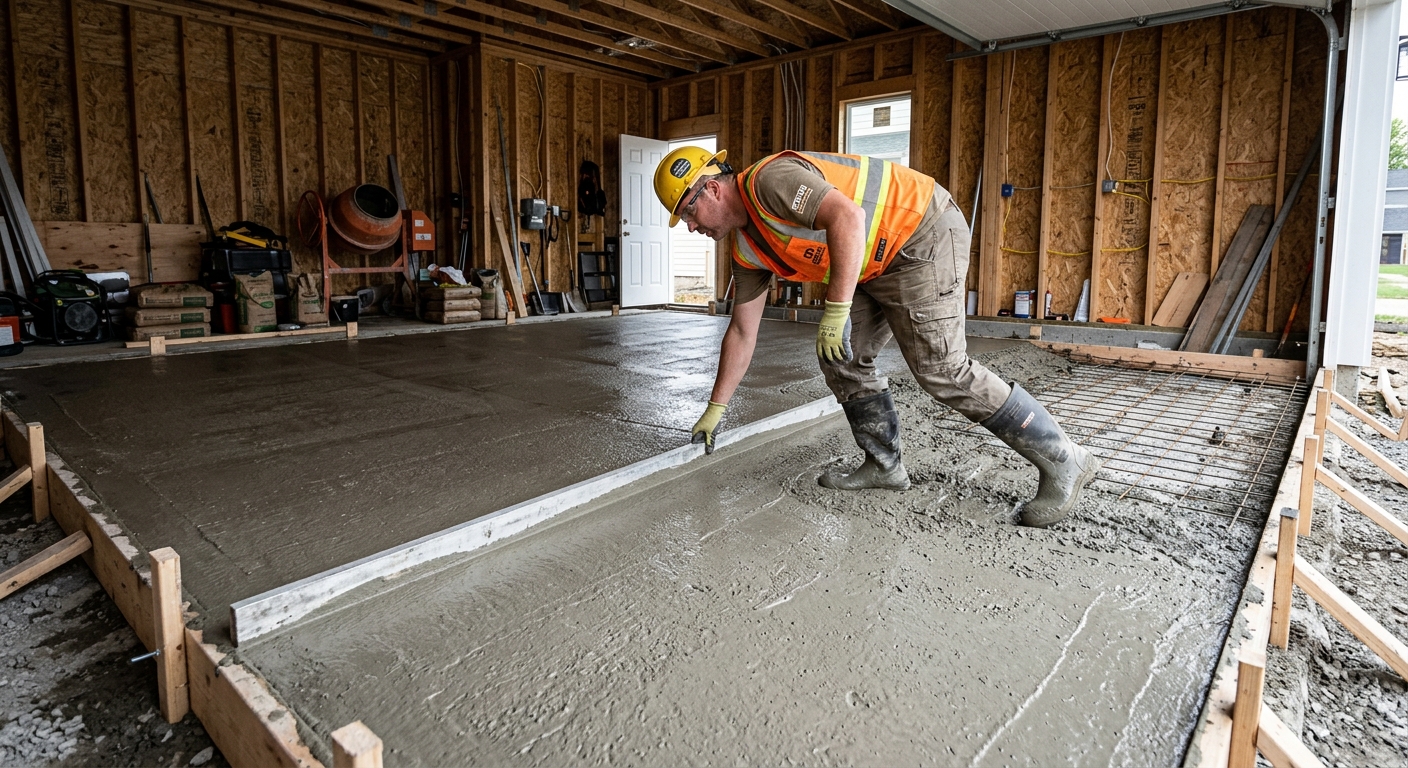
Concrete work options and costs in Picture Butte
Picture Butte is a small community in southern Alberta where concrete flatwork gets real use, and it shows in how we price projects. With single-detached houses making up 81.2% of dwellings, most driveways, patios, and walkways we build are tied to homeowner schedules and long-term durability. The housing profile also reflects a stable owner-occupied base—homeowner households are 79.7%—so homeowners typically want repairs done once, not repeatedly.
In the Lethbridge–Medicine Hat economic region, costs are driven by deep frost requirements and aggressive freeze–thaw cycles. For structural work, footings are taken below frost (often in the 5–6 ft range), which increases excavation and forming. For exterior slabs, we spec air-entrained concrete and we pay close attention to granular base preparation, drainage, and control joint spacing to manage cracking. The practical pour season is also shorter than in milder climates, so exterior work often concentrates in warmer months, while shoulder-season pours may require blankets, heaters, or accelerators to protect curing and help reach strength in time.
Demand is especially steady around downtown Picture Butte and the surrounding residential streets, where homeowners are upgrading aging homes (63.8% of homes were built before 1981) with new driveways, front steps, and patio replacements. That means more scheduling competition in peak weeks, and quotes can differ based on site access, subgrade conditions, and finish selection. Below is a practical comparison to help you budget before you ask for an itemized quote.
| Application |
Typical Size |
Key Spec |
Finish Option |
Price Range |
| Concrete driveway (standard broom finish) |
24 ft x 10 ft (2-car: ~240 sq ft) |
4 in slab, air-entrained, rebar/wire where required |
Broom finish, standard control joints |
$3,400 – $5,200 |
| Exposed aggregate driveway |
24 ft x 10 ft (~240 sq ft) |
4 in slab, air-entrained, proper curing and wash timing |
Exposed aggregate with sealer-ready surface |
$4,200 – $6,500 |
| Stamped concrete driveway or patio |
20 ft x 12 ft (~240 sq ft) |
4 in slab, air-entrained, integral color |
Stamp pattern + release + border detailing |
$5,100 – $7,800 |
| Plain concrete patio or walkway |
12 ft x 10 ft (~120 sq ft) |
4 in slab, compacted base, air-entrained |
Broom or smooth-trowel (non-slip) |
$1,400 – $2,400 |
| Garage floor (interior slab) |
22 ft x 20 ft (~440 sq ft) |
4 in slab, vapor barrier, air-entrained |
Steel trowel + light broom texture edges |
$6,400 – $10,200 |
| Foundation footings (structural, below frost) |
Per linear foot (typical residential footing) |
Below frost depth, engineered rebar, proper base |
Formed concrete, reinforced grade beam prep |
$18 – $35 |
Prices are estimates only and vary by project scope, site access and material selection.
What affects the price of concrete work in Picture Butte
In the Lethbridge–Medicine Hat region, two quotes for the “same” concrete job can easily swing by 30–50% once you factor in frost depth, base preparation, reinforcement, and finish complexity. Alberta projects are built around a deep frost line and strong freeze–thaw cycling, so specifications are rarely interchangeable. For example, exterior slabs and driveways need air-entrained mixes to reduce internal pressure when moisture freezes. Structural items—like footings—must extend below the design frost depth to prevent frost heave, and that drives excavation, hauling, and forming costs.
Pour season also matters. Even though southern Alberta is drier than coastal areas, cold-weather curing still slows strength gain and can affect schedule. If concrete arrives too cold, we may need insulating blankets, heaters, or accelerators—each adds labour and material costs. Another local factor is de-icing salt: it can accelerate surface spalling if the mix and finishing aren’t right. That’s why sealing is often recommended, especially for broom-finished driveways that see heavy winter traffic.
In Picture Butte, older homes (63.8% built before 1981) are common, and many sites have existing slabs, settled approaches, or drainage issues that require extra demo and grading. Conversely, a straightforward greenfield pour with good access and stable subgrade can land near the lower end of typical bands—for instance, plain driveway/slab work is often budgeted using the $14–$22 per sq ft range in this tier, while stamped work usually pulls from the $20–$32 per sq ft band because it needs integral color, release agents, stamping tools, and more skilled finishing time.
| Price Factor |
Why It Matters |
Cost Impact |
| Frost line depth |
Determines footing depth and form height |
Higher excavation depth can add significant labour and haulage |
| Site preparation |
Excavation, grading, compacted granular base |
Unstable soil or poor drainage increases base depth and time |
| Reinforcement |
Rebar or wire mesh requirement |
Extra steel + spacing/chaire work adds both material and labour |
| Mix design |
Air-entrainment and compressive strength spec |
Air-entrained mixes can cost more and require correct placement |
| Finish type |
Broom vs. stamped vs. exposed aggregate |
Decorative finishes add steps, timing, and skilled labour |
| Pour size and concrete truck access to site |
Truck location affects pumping, labour, and schedule |
Tight access can force pumping or smaller batch pours |
| Cold-weather curing precautions |
Heating and blankets |
May add daily time, equipment rental, and material costs |
| Control joint pattern and sealing cost |
Controls cracking and protects against salt scaling |
Proper jointing reduces repairs; sealing adds a later material step |
Permits & regulations in Alberta
In Alberta, it’s important to separate structural concrete from typical flatwork when thinking about permits. Structural concrete work—such as foundation footings, foundation walls, and grade beams—generally requires a building permit. Many of these projects also need engineered drawings, and the municipality may review them before work begins. Flatwork like driveways, patios, and walkways usually does not require a permit, unless the work affects lot grading, impacts municipal requirements for drainage/impervious surface coverage, or touches areas governed by the right-of-way.
Before breaking ground in Picture Butte, homeowners should confirm with the local authority—especially if you’re changing elevations, reworking drainage, or tying into an existing foundation. Next, verify the contractor is properly insured and licensed for the work they’re doing. At minimum, ask for proof of liability insurance and coverage through the Alberta work system (commonly WSIB/WCB coverage, depending on the contractor’s setup).
Step-by-step checks you can do:
- Ask for the contractor’s company name and Alberta trade/licensing details.
- Look for an online registry listing for the contractor and/or their associated business details.
- Request a certificate of insurance showing liability coverage limits and coverage dates.
- Ask for evidence they have WSIB/WCB coverage (or the applicable worker coverage documentation) and that it matches the crew doing the work.
- Verify via references that they’ve completed similar-sized driveways or footing work in the region.
Getting concrete right in Picture Butte's freeze-thaw climate
Concrete fails in Picture Butte when moisture and freeze–thaw cycles get into the wrong places—then the freeze expands water and pushes surfaces apart. The biggest causes we see are inadequate base prep (weak or poorly compacted subgrade), poor drainage (water trapped under or at slab edges), and mix/finishing problems that lead to spalling. In the Lethbridge–Medicine Hat market, the fix isn’t just “stronger concrete”—it’s correct specification for the environment.
To spec the job correctly, start with base preparation: we install a properly graded, compacted granular sub-base sized to the frost and subgrade conditions. Next is the mix design: for exterior flatwork, we target air-entrainment in the range of 5–7% to give the concrete places to relieve freezing pressure, and we use a minimum 32 MPa compressive strength for durability. Control joints are laid out to limit random cracking, and we keep spacing consistent so cracks form where we want them. Curing matters more in shoulder seasons; we plan for at least 7 days of curing under suitable protection. Finally, sealing is applied after the concrete has cured—typically around 28 days—to repel de-icing salts that otherwise contribute to surface scaling.
If you’re comparing options, this is where the dollars make sense. For example, a broom-finished driveway might land closer to the low end of the $14–$22 per sq ft tier, but stamped concrete usually costs more (often within the $20–$32 per sq ft band) because the job includes integral color, stamp timing, and more labour. The key is that both options must still be built with the same freeze–thaw durability specs—air, base, joints, and curing—otherwise you’re paying for looks without the structure.
| Spec |
Why It Matters in Picture Butte |
What to Ask For |
Impact if Skipped |
| Compacted granular base (depth?) |
Controls frost protection and prevents pumping/settlement |
Base depth and compaction testing method for your soil conditions |
Early cracking, uneven settlement, and edge failure |
| Air-entrained concrete mix (target air %?) |
Reduces freeze–thaw pressure and helps prevent spalling |
Target air content range and confirmation it’s exterior-rated |
Surface scaling and freeze-related flaking |
| Compressive strength (MPa rating) |
Affects long-term durability in a cold climate |
Minimum 32 MPa (or the specified structural requirement) |
Slower strength gain and easier surface damage |
| Control joints (spacing per ACI guidelines) |
Directs shrinkage cracking to planned locations |
Proposed joint spacing and whether joints will be sealed |
Random cracks and water intrusion at slab edges |
| Minimum 7-day curing period |
Strength development is slower when it’s cold |
How they will protect the pour in cool/shoulder weather |
Reduced strength and increased long-term deterioration |
| Penetrating sealer (when applied after cure) |
Helps repel salts and water at the surface |
Sealer type and application timing (around 28 days post-pour) |
More salt scaling, quicker surface roughening |
How to choose a concrete work contractor in Picture Butte
Choosing the right concrete contractor in Alberta comes down to proof and process. First, verify licensing and insurance. Ask for a copy of their liability insurance certificate and confirm it covers the exact job type you’re hiring them for. For worker coverage, request documentation showing they carry WSIB/WCB coverage appropriate to the work. Next, confirm their business registration details through Alberta’s public business or trade-related registry resources (you can usually search by company name and the responsible individuals).
Then get 2–3 itemised written quotes rather than a single lump-sum number. A good quote breaks labour and materials separately—such as excavation/grading, granular base, rebar or wire mesh (if needed), forms, concrete supply, finish labour, and any protective curing/blankets for cold weather. Read the scope line by line: what’s excluded (old slab removal, disposal fees, drainage repairs, sealing), whether the permit pull is included (if required), and how the contractor plans for truck access and any pumping needs.
Warranty should be in writing. Ask for the workmanship warranty length, whether it’s tied to specific failure causes, and whether any manufacturer product warranty is included and transferable. For payment, a safe approach is to keep upfront deposits to 10–15%, and hold back payment until the job is complete and you’ve accepted the final finish.
- Ask for start date and completion estimate in writing.
- Confirm who does finishing and how many crews will be on site.
- Require their plan for frost protection, especially for footings.
- Get the mix type and air-entrainment confirmation for exterior work.
- Request base preparation details (depth and compaction process).
- Clarify reinforcement placement—where mesh/rebar sits, not just “included.”
- Confirm control joint layout and whether joints will be sealed.
- Ask about curing protection in cool temperatures (blankets/heaters).
- Know if sealing is included or a separate line item.
- Check disposal/excavation hauling is included if demo is required.
- Review traffic/access cleanup responsibilities.
- Verify they can provide references from similar-sized local projects.
Concrete red flags in Picture Butte include: promises of “standard concrete” without specifying air-entrainment, vague answers on footing depth below frost, skipping or under-specifying compacted granular base, no written joint layout (or joints “where it looks good”), and crews asking for large deposits early without a clear construction schedule.
Frequently asked questions — concrete work in Picture Butte
What causes concrete to spall in Picture Butte winters?
Spalling in Picture Butte is usually a freeze–thaw problem amplified by moisture and de-icing salt. When water gets into the concrete—through surface pores, unsealed joints, or poorly sealed edges—it freezes and expands. If the mix isn’t properly air-entrained, there’s less internal room to relieve that pressure, and the surface can flake or pop off. Poor base prep and drainage can also trap water under slabs, speeding deterioration. Another common contributor is finishing too early or inadequate curing when temperatures are cool, which weakens the near-surface layer. To reduce risk, ask your contractor to specify exterior-rated air-entrained concrete and control joint spacing, then plan for sealing after cure (often around 28 days) to better handle salt spray. (Picture Butte is within the same freeze–thaw conditions seen across the Lethbridge–Medicine Hat region.)
What is rebar and when is it required in Alberta?
Rebar (reinforcing steel bars) is used to add tensile strength to concrete, controlling cracking and improving structural performance. In Alberta, rebar is required when the concrete element is designed to carry loads and resist bending or movement—most clearly for structural work like foundation footings, foundation walls, and grade beams. For flatwork such as driveways and garage floors, steel may be required depending on design loads, slab thickness, soil conditions, and engineering/contract specs. For example, if you’re building or replacing a driveway expecting heavier vehicle use, your contractor may recommend wire mesh or rebar to help manage cracking. In Picture Butte, freeze–thaw cycles also make good reinforcement detailing important because movement and moisture exposure can stress the slab over time. If a quote doesn’t mention reinforcement placement and spacing, ask how they arrived at the requirement for your specific site and intended use.
How long does a concrete project take in Picture Butte?
Typical timelines depend on size, access, and whether it’s an exterior flatwork project or structural concrete. For a driveway or patio in Picture Butte, the pour day is usually the fastest part—often one day for forming, placing, finishing, and jointing. Curing and protection then govern “usable time.” A common reality is that you may need to plan for at least several days before light foot traffic, and longer before heavier vehicles or full backfilling around structural elements. In shoulder-season conditions, cold-weather curing can extend the schedule because we may use blankets, heaters, or accelerators to ensure concrete gains strength appropriately. If it’s a foundation/footing job, the sequence is longer: excavation, below-frost preparation, forming, reinforcing, pour, then curing prior to backfill. When you request a quote, ask for a written start date, completion estimate, and whether weather contingencies affect the schedule—this is a real cost factor in southern Alberta timing.
What is a concrete overlay and is it suited to Picture Butte?
A concrete overlay is a new concrete layer poured over an existing concrete slab, typically after surface preparation (often grinding/chipping) and repair of failing areas. Overlays can be suited to Picture Butte when the existing slab is structurally sound—meaning it’s not heavily cracked, heaving, or failing at the base. If the underlying issue is frost-related movement, drainage problems, or a weak sub-base, an overlay may fail early because the new layer follows the old slab’s movement. That’s why we evaluate the surface and edges carefully before recommending overlay work. If your existing driveway is mostly cosmetically worn and stable, an overlay can be a cost-effective way to refresh it compared with full removal. But if there’s spalling or frost heave, full replacement is often the durable option. If you’re comparing costs, remember that typical driveway replacement using standard concrete commonly fits the $14–$22 per sq ft tier in this area, while decorative stamped work trends higher.
How do I seal concrete to protect it in Picture Butte?
Sealing helps protect against moisture and de-icing salt, which are major durability challenges in Alberta winters. The right approach is timing: wait until the concrete has cured sufficiently—commonly around 28 days—so the sealer bonds properly and doesn’t trap excess moisture. Use a penetrating sealer (rather than a surface film) for better salt and water resistance in freeze–thaw climates. Before sealing, the slab should be clean and fully dry; wash off dirt and let it cure/dry after any repairs. Ask your contractor for the sealer type, coverage rate, and whether they recommend a joint/sealant strategy for control joints. Also plan for application temperature and weather—sealing in cold, damp conditions can lead to patchy penetration. A sealed, air-entrained exterior slab with properly placed control joints is the best combination to reduce spalling and scaling risk in Picture Butte.
What is the difference between concrete and cement?
Concrete and cement aren’t the same thing. Cement is the main binding ingredient (a fine powder), while concrete is the full engineered material made by mixing cement with aggregates (sand and gravel), water, and sometimes admixtures like air-entrainment. In practical terms for Picture Butte homeowners, the key durability performance comes from the whole concrete mix design—not just the cement. For exterior flatwork in the Lethbridge–Medicine Hat region, air-entrainment and correct water content matter because freeze–thaw cycles can otherwise cause spalling and scaling. That’s why a good contractor should specify the concrete mix intended for your use: driveway/patio/exposed aggregate all require the right air and strength requirements for southern Alberta’s climate. When you compare quotes, don’t just ask “what cement brand”—ask for air content targets, minimum strength (commonly 32 MPa for exterior durability specs), curing approach, and whether the finish system is compatible with sealing.