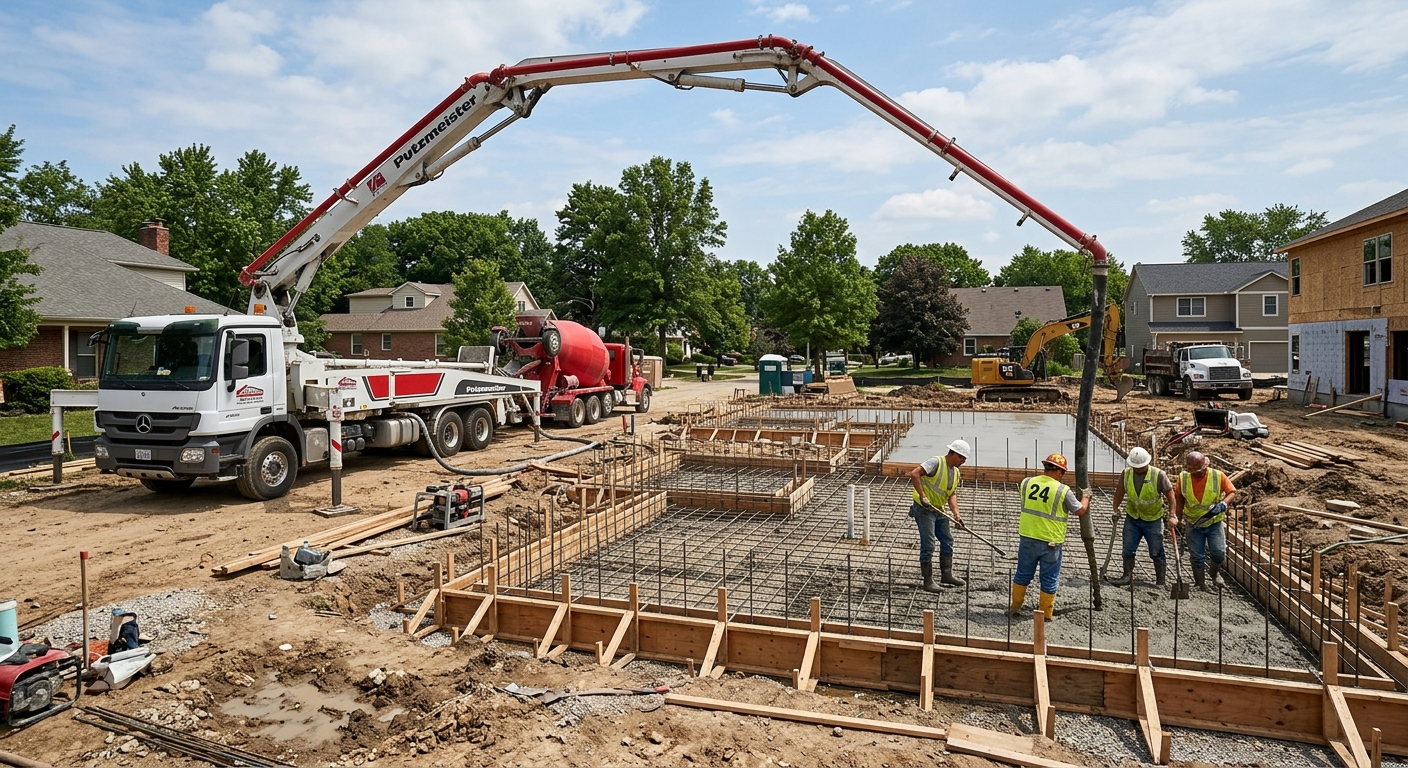
Concrete work options and costs in Sage Hill
Sage Hill, Alberta is a growing community in the Calgary area, and that steady homebuilding pace shows up in demand for concrete flatwork and foundations. With a 2021 population of 9,345 (Statistics Canada, 2021 Census), local projects range from new driveways for owner-occupants to backyard patios that keep getting added as families settle in. Just as important, the neighbourhood housing mix in this region tends to favour single-detached homes—the type of property most homeowners ask us to service with driveways, walkways, patios, garage floors, and frost-protected footings. Those flatwork projects are especially active in the newer pockets of Sage Hill where residents are laying out long-term landscaping and hardscaping around the same time.
In Calgary’s cold continental climate, concrete is engineered around frost and freeze–thaw, and that impacts everything from excavation depth to mix design. The practical result is that footings for houses, garages, and retaining structures must bear below the design frost depth (about 1.2 m in this market), and exterior slabs need air-entrained concrete plus a well-planned curing approach. Placement windows can also be tighter in late fall and early spring, because rushed curing increases the odds of scaling and long-term surface wear. Labour availability can tighten during the busy pour months, which is why two quotes for similar work can still land at different totals.
Below is a practical comparison of common concrete options and what they usually cost for Sage Hill homeowners, so you can budget with confidence before you contact contractors.
| Application |
Typical Size |
Key Spec |
Finish Option |
Price Range |
| Concrete driveway (standard broom finish) |
18 ft x 20 ft (360 sq. ft.) |
Air-entrained mix, control joints, granular base |
Broom finish |
$12,000–$18,000 |
| Exposed aggregate driveway |
18 ft x 20 ft (360 sq. ft.) |
Air-entrained mix, proper wash schedule, sealed surface |
Exposed aggregate |
$15,500–$22,500 |
| Stamped concrete driveway or patio |
18 ft x 15 ft (270 sq. ft.) driveway or patio |
Air-entrained mix, colour hardener/release (as specified) |
Stamped & textured |
$15,000–$26,000 |
| Plain concrete patio or walkway |
10 ft x 16 ft (160 sq. ft.) patio or 4 ft x 12 ft (48 sq. ft.) walkway |
Air-entrained mix, slope/drainage, joints |
Plain broom or smooth trowel |
$5,000–$9,000 |
| Garage floor (interior slab) |
22 ft x 20 ft (440 sq. ft.) |
Fibre or mesh (as specified), vapour control, joints |
Broom finish |
$10,500–$16,500 |
| Foundation footings (structural, below frost) |
Typical house footing length 120–180 ft (varies) |
Engineered design, excavation to frost level, rebar |
Structural concrete with forms |
$28,000–$45,000 |
Prices are estimates only and vary by project scope, site access and material selection.
What affects the price of concrete work in Sage Hill
In the Calgary region around Sage Hill, you’ll often see price quotes for “the same” concrete project differ by 30–50%. That’s not just contractor markup—it’s the cost of building the right system for frost and freeze–thaw, plus differences in how each crew manages excavation, reinforcement, and curing. In cold climates, the frost line depth drives how much concrete and how much excavation you need before the slab or foundation can be poured. Locally, the design frost depth is about 1.2 m, meaning footings must extend down into undisturbed soil to prevent frost heave. On top of that, exterior slabs need air-entrained concrete and the right joint layout, because freeze–thaw cycles can otherwise lead to spalling and surface scaling.
Another major driver is the short pour season for exterior work and the curing requirements when temperatures drop. When a pour happens in late fall or near early spring swings, contractors may add winter-grade mixes, insulation blankets, and sometimes temporary heat to ensure curing quality. That protects long-term performance but increases material and labour time. De-icing salts also matter here: if the slab isn’t sealed at the right time after cure, chloride exposure can accelerate deterioration, especially on driveways and walkways where cars and snowbanks bring salt repeatedly.
For Sage Hill homeowners, examples that commonly raise cost include a driveway that needs deeper base excavation for poor subgrade, or a stamped patio with extra thickened edges and more labour-intensive finishing. Costs can be lower when truck access is straightforward and the site needs minimal grading. As a quick budgeting anchor, standard driveways usually fit the $12,000–$18,000 band, while stamped or decorative work often lands closer to $15,000–$26,000 depending on square footage and detailing. If your home is newer, there’s still often good access, but foundation sites can be tight with grading that brings higher excavation volumes—so your footing scope can feel “bigger” than on paper.
| Price Factor |
Why It Matters |
Cost Impact |
| Frost line depth |
Determines footing depth and form height |
Higher excavation and concrete volume can add thousands |
| Site preparation |
Excavation, grading, compacted granular base |
Poor access or soft subgrade increases hauling and granular supply |
| Reinforcement |
Rebar or wire mesh requirement |
Extra steel, chairs/ties, and labour raise cost for slabs and footings |
| Mix design |
Air-entrainment and compressive strength spec |
Correct exterior mix costs more but reduces spalling risk |
| Finish type |
Broom vs. stamped vs. exposed aggregate |
Decorative systems add materials and labour time |
| Pour size and concrete truck access to site |
Shorter/longer placing times and fewer delays |
Access issues can mean smaller pours, extra crews, and overtime |
| Cold-weather curing precautions |
Heating and blankets |
Winter protection increases labour and equipment rentals |
| Control joint pattern and sealing cost |
Manages cracking and protects from de-icing salts |
Joint tooling and sealant add line items but reduce long-term repairs |
Permits & regulations in Alberta
In Alberta, structural concrete work typically needs municipal oversight. For Sage Hill homeowners, that usually means a building permit and, in many cases, engineered drawings for concrete elements that carry structural load. Work that typically requires a permit includes foundation footings, foundation walls, grade beams, and other structural concrete that supports the house or major additions. Concrete that is primarily cosmetic or flatwork—such as patios, walkways, and driveways—often does not require a permit by itself, unless it affects lot grading, drainage, or impervious surface coverage limits, or it impacts municipal right-of-way conditions (for example, tie-in to sidewalks or changes to drainage flow toward neighbouring property).
Before breaking ground, confirm the permit requirements with your local authority. Then verify the contractor’s compliance: they should carry liability insurance and WSIB/WCB coverage (or the applicable clearance for their situation) and be able to provide references on similar-scale foundation and flatwork projects. A practical step-by-step homeowner check in Alberta:
1) Ask for the contractor’s licence/registration details (where applicable), plus their certificate of insurance. 2) Verify the insurance is current and matches the work scope (concrete supply and installation). 3) Request WSIB/WCB clearance proof and confirm the dates. 4) Check references for projects with similar winter curing conditions (Calgary-area experience matters). 5) If structural concrete is involved, ask for the engineered drawings and the responsibility for permit processing.
Getting concrete right in Sage Hill's freeze-thaw climate
Concrete failures in Sage Hill usually come down to three things: weak base support, incorrect mix design for freeze–thaw, and shortcuts on curing and sealing. In Calgary’s cold continental climate, water movement during freeze–thaw expands stress at the surface and along joints. If the base isn’t compacted properly to the right depth for local soil and frost considerations, slabs can settle or heave. If exterior concrete isn’t air-entrained, the freeze–thaw cycle can quickly damage the paste, leading to spalling and scaling.
To spec the job correctly, start with base preparation: use a compacted granular sub-base and build to the proper frost-and-drainage intent for your site. Next, mix design: for exterior flatwork, ask for air-entrainment in the 5%–7% range and a minimum 32 MPa compressive strength (as commonly specified for durable exterior work in this market). Then plan control joints: spacing should be adequate to limit random cracking and guide where cracks occur. Curing is critical—plan for at least a 7-day curing period under proper conditions. When it’s cold, crews may need insulated blankets or temporary heat to keep temperatures stable early on. Finally, sealing: apply a penetrating sealer after the concrete has cured (commonly around 28 days post-pour) to repel de-icing salts and reduce chloride-related surface deterioration.
Ask these technical questions to prevent the most common failure: “What air content will you use for the exterior mix, and can you show your mix ticket?” and “How will you handle curing if the forecast drops?” A local budgeting example: a plain broom-finish patio typically sits within the $5,000–$9,000 band, while stamped work can push toward $15,000–$26,000. If your priority is long-term performance rather than appearance, the extra cost for stamping may not be justified—spending that budget on better base prep, correct air-entrainment, and sealing usually delivers the biggest durability payoff in Sage Hill’s winters.
| Spec |
Why It Matters in Sage Hill |
What to Ask For |
Impact if Skipped |
| Compacted granular base (depth?) |
Supports the slab through frost and freeze–thaw movement |
Base depth and compaction requirements based on site soil and frost considerations |
Settlement and cracking, uneven slab, accelerated wear |
| Air-entrained concrete mix (target air %?) |
Reduces freeze–thaw damage on exterior surfaces in Calgary winters |
Air content in the 5%–7% range for exterior flatwork and correct mix ticket documentation |
Spalling and scaling, especially where salts splash |
| Compressive strength (MPa rating) |
Ensures durability under traffic loads and winter stress cycles |
Minimum 32 MPa compressive strength (or higher if engineered for your design) |
Surface breakdown and premature cracking |
| Control joints (spacing per ACI guidelines) |
Controls where cracks form during seasonal movement |
Joint spacing plan and timing for saw-cutting or tooling |
Random cracking and water infiltration at uncontrolled breaks |
| Minimum 7-day curing period |
Builds strength so concrete survives early winter temperature swings |
Concrete protection plan for cold weather (blankets/heating if required) |
Weak early-age strength and higher risk of scaling |
| Penetrating sealer (when applied after cure) |
Helps repel de-icing salts used in the Calgary area |
Confirm application around 28 days after pour (after proper cure) |
Faster salt-related deterioration and costly surface repairs |
How to choose a concrete work contractor in Sage Hill
Choosing the right concrete contractor in Sage Hill starts with proof, not promises. In Alberta, verify that the company carries liability insurance and WSIB/WCB coverage (or provides the applicable clearance/coverage documentation they’re required to maintain). Ask for a certificate of insurance—make sure it’s current, covers the actual work being performed, and lists the correct parties. For WSIB/WCB, request clearance proof and confirm the coverage is active during the planned work dates.
Next, get 2–3 itemised written quotes. Ideally, you want a breakdown that separates excavation/site prep, granular base, forms, rebar/mesh, concrete supply, finish labour, joints, sealing, and disposal. Avoid “lump sum” quotes that don’t state what’s included—especially for cold-weather curing items like insulated blankets or heating. Read the scope carefully: is permit processing included (if required), is disposal of excavated material included, and is drainage/edge detailing accounted for? For warranties, ask for both workmanship warranty length and any product/manufacturer warranty. Also confirm whether the warranty is transferable if you sell your home.
For payment schedule, don’t agree to large upfront amounts. A common safe approach is keeping deposits around 10%–15% and holding back money until key milestones and final quality checks are complete. Timeline matters too—get start date and completion estimate in writing, and ask how they’ll protect curing if temperatures drop.
- Provide a certificate of liability insurance (current dates, correct job address).
- Provide WSIB/WCB clearance or coverage proof for the crews assigned.
- Give an itemised quote (labour, materials, disposal, curing protection, sealer).
- State concrete mix design requirements, including air-entrainment for exterior work.
- Explain base prep depth and compaction method, not just “we prep the base.”
- Confirm reinforcement plan (mesh vs rebar, tie/chair support details).
- Specify control joint timing (tooling vs saw-cut) and spacing targets.
- Confirm curing duration and cold-weather precautions (blankets/heating plan).
- Include sealing scope (when sealer is applied and what product type).
- Describe site access logistics (truck route, pump needs, cordoning and cleanup).
- Provide references for similar Calgary-area winter projects.
- Offer a written warranty for workmanship and clarify exclusions.
Concrete red flags in Sage Hill include: quotes that won’t state air-entrainment and curing protection for exterior slabs, missing or outdated insurance/WSIB documentation, “driveway in a day” claims with no joint plan, vague wording like “sub-base as needed” without depth details, and payment terms that demand large upfront amounts with no milestone holds.
Frequently asked questions — concrete work in Sage Hill
What is the difference between concrete and cement?
In everyday Alberta terms, people often say “cement” when they mean the finished concrete slab. Technically, cement is one ingredient: a fine powder that, when mixed with water, helps bind the other materials. Concrete is the full engineered mixture—cement plus water, aggregates (sand and gravel), and sometimes additives like air-entrainment for exterior freeze–thaw durability. In Sage Hill, the difference matters because the concrete mix design is what we tune for winter performance. For example, for exterior driveway and walkway work, air-entrainment (commonly 5%–7%) is essential to reduce spalling risk during freeze–thaw cycles. So when you compare quotes, look for mix ticket details, not just brand names.
How much does concrete work cost in Sage Hill?
Concrete costs in Sage Hill typically track the Calgary-area pricing bands, with scope and winter curing precautions doing most of the heavy lifting. A standard broom-finish driveway is commonly in the $12,000–$18,000 range for typical sizes, while plain patios and walkways often land around $5,000–$9,000 depending on square footage and site prep. Foundation footings are higher because excavation and reinforcement are substantial; they often fit the $28,000–$45,000 band based on house size and footing layout. If you choose stamped or decorative finishes, you should expect more labour and materials—often closer to $15,000–$26,000. The biggest quote differences usually come from base depth, reinforcement, access constraints, and whether cold-weather curing protection is needed.
How deep must footings be for Sage Hill's frost line?
For Sage Hill in the Calgary region, local engineering practice uses a design frost depth of about 1.2 m (roughly 4 ft). That’s why structural footings for houses, garages, and retaining structures must bear on undisturbed soil below that depth to reduce frost heave and seasonal movement. The exact footing depth and size can still vary based on your engineered foundation design, soil conditions, and whether there are slope or drainage considerations. When you get quotes, ask how the contractor will confirm frost depth compliance on your specific site—especially if the ground is filled or if drainage needs correction. If a quote doesn’t clearly address excavation depth and structural design, it’s a sign you may be comparing apples to oranges.
Why does concrete crack in Sage Hill and how is it prevented?
Cracking in Sage Hill is often normal—but the goal is controlled, expected cracking instead of random fractures that let water in. In Alberta’s freeze–thaw climate, concrete expands and contracts seasonally, and temperature gradients plus moisture movement create stress. Prevention starts with correct base prep and reinforcement (so the slab doesn’t settle unevenly) and with the right joint strategy. Control joints should be placed to guide where shrinkage cracks occur, and the timing of saw-cutting or tooling matters. Also, exterior slabs must use air-entrained concrete to survive winter cycles without scaling that can undermine surfaces. Finally, curing quality is critical: insufficient curing—especially in cold weather—can increase early-age cracking and surface weakness. A contractor who can explain their joint spacing plan, curing steps, and air-entrainment specs is the right one.
Stamped vs broom-finish concrete — cost difference?
Stamped concrete costs more than broom-finish because it’s not just “trowel work”—it involves additional materials and more labour time. Stamping typically includes colour hardeners or integral colour, release agents, textured mats, and more careful sequencing to maintain consistent patterns and edges. In Sage Hill, you’ll usually see broom-finish driveways land around the $12,000–$18,000 range, while stamped concrete driveways or patios commonly fall into the $15,000–$26,000 band depending on square footage, complexity, and border/detail work. If you’re mainly focused on durability against Calgary winters and de-icing salts, broom-finish with excellent base prep, air-entrainment, curing, and sealing can be the better value. Stamping is best when aesthetics are the priority and you still insist on the same durability specs underneath.
When is the best time to pour concrete in Sage Hill?
The best time is when temperatures support proper curing without excessive winter protection costs. In the Calgary area, exterior slabs are often poured during warmer stretches of spring and summer so you can meet curing needs reliably. Late fall and early spring pours are doable, but only when contractors plan cold-weather precautions—insulated blankets, controlled temperature, and winter-grade mix adjustments—because early-age strength and surface durability depend on curing conditions. Rushing curing in cold weather is where scaling risk rises over time, especially on driveways and walkways exposed to freeze–thaw and salt. Ask your contractor what the forecast-based protection plan is and how they’ll maintain curing for at least 7 days. A solid crew will schedule to protect the pour and explain what happens if temperatures drop overnight.