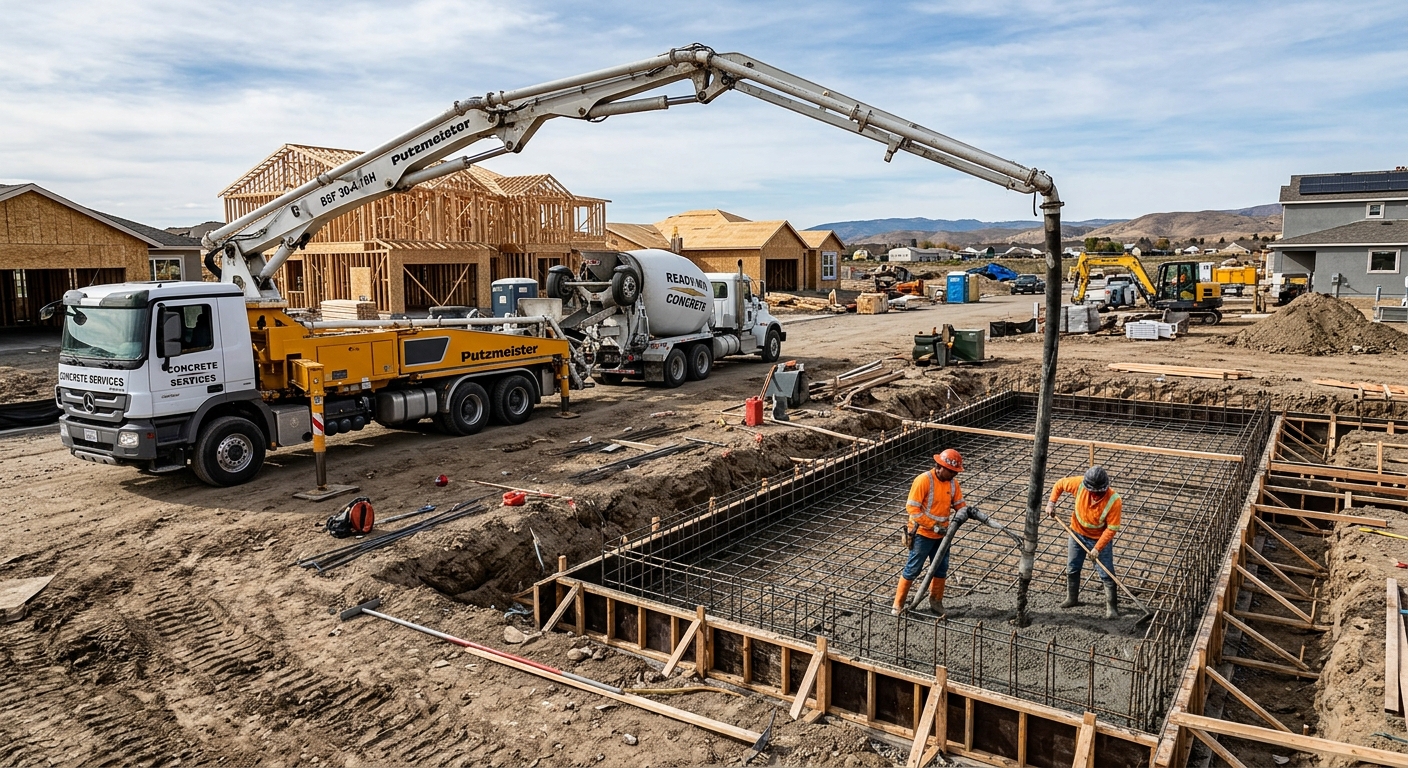
Concrete work options and costs in Edgemont
Edgemont homeowners typically start with concrete flatwork because it looks sharp, stays functional through long winters, and fits the way Calgary families plan their yards and garages. With a population of 15,225 in 2021 (Statistics Canada, 2021 Census), demand is steady for driveways, patios, and walkways—especially in neighbourhood pockets where homes sit on winter-exposed grades and access paths. In practical terms, this trade is especially busy for projects in and around the Edgemont community area where street parking, sloped approaches, and utility locations make excavation and forming more labour-intensive.
In Calgary’s cold continental climate, concrete pricing isn’t just about “pouring a slab.” Freeze–thaw cycles are the reason we engineer for frost movement, and local practice uses a design frost depth of about 1.2 m (roughly 4 ft) for exterior and structural work. That means deeper excavation and higher footing volumes than in milder regions. Frequent winter conditions also drive specifications: air-entrained mixes for exterior slabs, granular base prep, and properly spaced control joints to reduce cracking and surface deterioration.
Availability and timing affect cost too. The exterior pour season is shorter, and in late fall or early spring you may need insulated blankets and sometimes temporary heat to protect curing. For many Edgemont projects, that’s why quotes can shift noticeably even when the finished square footage looks similar. Below is a comparison of common options and what homeowners in Edgemont usually budget for, to help you read the rest of the guide and line up accurate expectations.
| Application |
Typical Size |
Key Spec |
Finish Option |
Price Range |
| Concrete driveway (standard broom finish) |
400–600 sq. ft. |
Air-entrained, 4 in. slab on compacted base |
Broom finish + control joints |
$12,000–$18,000 |
| Exposed aggregate driveway |
400–600 sq. ft. |
Air-entrained, properly prepared wash/top-layer system |
Exposed aggregate + joint sealing |
$14,000–$20,000 |
| Stamped concrete driveway or patio |
300–500 sq. ft. |
Air-entrained, coloured base and release system |
Stamped patterns + border options |
$15,000–$26,000 |
| Plain concrete patio or walkway |
200–400 sq. ft. |
Air-entrained, 4 in. slab where applicable |
Broom finish |
$5,000–$9,000 |
| Garage floor (interior slab) |
500–700 sq. ft. |
Typically 4 in. with vapour/ground prep as required |
Light trowel + densifier or broom (optional) |
$9,000–$15,000 |
| Foundation footings (structural, below frost) |
Varies by house plan |
Engineered sizing, placed below design frost depth |
Formed/formed top with foundation walls as applicable |
$28,000–$45,000 |
Prices are estimates only and vary by project scope, site access and material selection.
What affects the price of concrete work in Edgemont
In Edgemont, the same “driveway replacement” can produce bids that are 30–50% apart because the quote is really about how much engineering, excavation, and protection work the contractor includes—not just the concrete. One crew may price a straightforward broom finish slab, while another prices the full package Calgary requires: frost-safe base prep, reinforcement where needed, air-entrained mix design, and a curing plan that protects strength gain. Labour availability also shifts through the year; when crews are booked for footings, retaining walls, and foundations, driveway and patio work can carry higher scheduling costs.
Frost depth and freeze–thaw cycles dictate the specs. In Alberta, footings and structural elements must extend below the design frost depth (about 1.2 m in local engineering practice) to prevent frost heave and seasonal movement. Exterior slabs also need air-entrained concrete to survive repeated freezing and thawing. On top of that, cold-weather placement has a shorter practical pour season; when temperatures drop, you may need winter-grade mix, insulated blankets, and sometimes temporary heat so the concrete can cure properly. Finally, winter de-icing salts accelerate surface wear—so sealing and surface protection become more than “cosmetic” in Calgary.
Two common Edgemont examples: (1) a driveway on a sloped approach often costs more because grading and sub-base thickness increase, which pushes the job toward the upper end of the concrete driveway band of $12,000–$18,000; (2) upgrading from plain broom to stamped or decorative work can be justified when you want texture and visual control for curb appeal, but it typically moves you into $15,000–$26,000 territory depending on square footage and complexity. Home age can matter too—older properties may have non-uniform base under existing slabs, meaning extra demo and hauling that adds dollars quickly.
| Price Factor |
Why It Matters |
Cost Impact |
| Frost line depth — determines footing depth and form height |
Deeper excavation and higher formwork for structural stability |
Often the biggest driver for foundation/footings scope |
| Site preparation — excavation, grading, compacted granular base |
Proper base reduces settlement and cracking during freeze–thaw |
More cut/fill and haul-off can add significant labour and equipment time |
| Reinforcement — rebar or wire mesh requirement |
Controls cracking and improves slab performance under loads |
Material cost plus additional labour for placement and chairs/dowels |
| Mix design — air-entrainment and compressive strength spec |
Air entrainment improves durability in Alberta winters |
Winter-grade or engineered mix can raise material cost |
| Finish type — broom vs. stamped vs. exposed aggregate |
Finish systems require different crews, timing, and curing coordination |
Decorative work typically increases price faster than plain work |
| Pour size and concrete truck access to site |
Access affects pumping, staging, and turnaround time |
Limited access can add pump/placement costs and labour |
| Cold-weather curing precautions — heating and blankets |
Protects strength gain and reduces scaling/spalling risk |
Winter setups can add days and equipment line-items |
| Control joint pattern and sealing cost |
Joints manage cracking; sealing reduces salt-driven surface damage |
Sealers and saw-cut/installation steps add a measurable premium |
Permits & regulations in Alberta
In Alberta, concrete work that’s part of a building’s structure needs the proper approvals. For Edgemont homeowners, the key distinction is this: structural concrete such as footings, foundation walls, grade beams, and other load-bearing elements typically require a building permit, and engineered drawings are often reviewed as part of the permit process. Flatwork like driveways, patios, walkways, and garage floors usually does not require a permit by itself—unless the work affects lot grading, drainage/impervious surface limits, or municipal right-of-way conditions. If you’re tying into existing drains, changing swales, or modifying how water sheds across the lot, always check first before breaking ground.
To verify a contractor in Alberta step-by-step, start with their licensing and insurance documents. Ask for: (1) proof of liability insurance (certificate of insurance showing coverage limits), (2) WSIB/WCB coverage clearance (or the equivalent proof of account/coverage), and (3) references on similar-size projects in the Calgary area. Then check their Alberta licence/registration through the appropriate online registry your contractor provides or you can search for their entity name and business category. Finally, request a certificate holder name that matches your project details—so the coverage applies to your job, not just general business operations. This saves you from the most expensive scenario: discovering too late that coverage or compliance paperwork doesn’t match the work.
Getting concrete right in Edgemont's freeze-thaw climate
Concrete fails in Edgemont mostly because water and salt get into vulnerable surfaces and then the freeze–thaw cycle expands stresses. The fix starts before the pour. First, base preparation must reach the right depth and be well-compacted—especially in Calgary where frost movement and seasonal moisture can magnify small grading mistakes. Second, the mix design has to be correct for exterior exposure: an air-entrained concrete mix (commonly targeted at about 5–7% air content for exterior flatwork) and a minimum compressive strength typically specified at around 32 MPa. Third, control joints need a sensible pattern and spacing so cracking happens where you planned it, not randomly through the slab. Fourth, curing is non-negotiable; when cold weather slows hydration, crews must protect curing (insulated blankets, sometimes heat) to reach the required strength before freezing. Fifth, sealing matters in Edgemont because de-icing salts drive spalling when surfaces aren’t protected—penetrating sealer is typically applied after the slab has cured, commonly around 28 days post-pour.
If you’re comparing options, the money should follow the durability choices. For example, upgrading from a basic broom finish patio to properly engineered exterior specs may cost more in the short term, but it’s not the same category as paying for stamped work. Decorative finishes like stamping can land in $15,000–$26,000 depending on complexity, while a correctly built plain patio/walkway usually fits the $5,000–$9,000 band for typical scopes. The durable path is: correct air-entrainment and curing first—then choose finish.
Ask technical questions upfront: “What air content are you targeting for exterior exposure?” “How will you protect curing if we’re approaching freezing at night?” “What’s your control joint spacing and saw-cut timing?” These are the questions that prevent spalling caused by inadequate air-entrainment.
| Spec |
Why It Matters in Edgemont |
What to Ask For |
Impact if Skipped |
| Compacted granular base (depth?) |
Reduces frost-related movement and settlement under freeze–thaw cycles |
Confirm base depth and compaction method for your soil conditions |
Premature cracking, uneven slab, early edge failure |
| Air-entrained concrete mix (target air %?) |
Improves durability against freeze–thaw water expansion |
Target air content (commonly 5–7% for exterior flatwork) and mix design sheet |
Spalling/scaling within a few winters |
| Compressive strength (MPa rating) |
Strength gain supports long-term performance under loads and weather |
Minimum 32 MPa spec (or higher if required by design) |
Lower strength and surface wear in freeze–thaw conditions |
| Control joints (spacing per ACI guidelines) |
Controls where cracks form to protect edges and water intrusion |
Planned joint spacing and saw-cut timing |
Random cracking and more water infiltration at edges |
| Minimum 7-day curing period |
Allows hydration and strength gain before exposure to cold |
Protect curing schedule; confirm temperature protection plan |
Scaling risk and weaker surface resistance |
| Penetrating sealer (when applied after cure) |
Repels de-icing salts and reduces moisture uptake |
Penetrating sealer applied after cure (commonly around 28 days post-pour) |
Faster spalling and surface deterioration |
How to choose a concrete work contractor in Edgemont
Start with compliance checks. In Alberta, confirm the contractor’s liability insurance—ask for a certificate of insurance showing project coverage and appropriate limits—and verify WSIB/WCB clearance for the company doing the work. If you’re unsure what you’re looking at, ask for the clearance letter or proof of coverage associated with the legal entity named on the quote. Then request references for similar projects (same scope type and comparable square footage) from the Calgary area, because Edgemont freeze–thaw performance depends on how they handle base prep, air-entrained mix, and cold-weather curing.
Next, get 2–3 itemised written quotes instead of one lump sum. You want labour and materials broken out: demo and disposal (if any), excavation and hauling, granular base, reinforcement, concrete supply, forming, finishing, joints, and sealing (if included). Carefully read the exclusions—what’s not included in “concrete replacement”? Is permit support included where required? Is disposal and grading included, or is it an add-on? Finally, compare warranties: workmanship warranty length, product/manufacturer warranty coverage, and whether the warranty is transferable if you sell your home.
Payment schedule matters. Never pay more than 10–15% upfront, and hold back a portion until you’ve confirmed the work is complete and curing/finishing steps are done. Ask for a start date and a realistic completion estimate in writing, including weather contingency. In Edgemont, scheduling around frost and curing protection is part of the service, not an afterthought.
- Ask for certificate of insurance and confirm coverage applies to your project address.
- Confirm WSIB/WCB clearance documentation matches the contractor doing the work.
- Request itemised quotes (labour, materials, equipment, disposal, reinforcement, finishing).
- Verify whether air-entrainment and winter-grade requirements are included for exterior concrete.
- Check base preparation scope: excavation depth, granular type, compaction requirements.
- Ask what reinforcement is used (and where) rather than assuming “mesh for everything.”
- Confirm control joint spacing plan and saw-cut timing.
- Ask about cold-weather curing protection (blankets/heat plan, who supplies it, who manages it).
- Confirm whether sealing is included and the application timeline (typically after full cure).
- Get the concrete pour schedule, truck access plan, and any pump/placement costs in writing.
- Review warranty details in writing: workmanship term, exclusions, and transferability.
- Agree on payment milestones tied to completion of defined steps—not “progress” alone.
Concrete red flags I see in Edgemont include: vague pricing with no line items for base prep or reinforcement; skipping documentation for air-entrained mix or curing protection; promising “same-day sealing” or no mention of 28-day curing timing; charging high upfront deposits; and avoiding questions about control joints or disposal/grading responsibilities.
Frequently asked questions — concrete work in Edgemont
What is air-entrained concrete and why does it matter here?
Air-entrained concrete is mixed with tiny, evenly distributed air bubbles that give freezing water a place to expand without destroying the concrete paste. In Edgemont and across Alberta’s Calgary region, freeze–thaw cycles repeatedly stress exterior surfaces, especially driveways, patios, and walkways that see moisture and de-icing salt. That’s why exterior concrete in this market is engineered with air entrainment rather than relying on “regular” mix. When air-entrainment is missing or too low, homeowners typically notice scaling or spalling after one or two winters, even if the slab looks fine at first. If you’re budgeting, the durability spec is built into the price of exterior flatwork in the usual bands—many standard driveway projects still land around $12,000–$18,000, but the quote should clearly state the mix design and exposure requirements.
How do I prepare the base for a concrete slab?
Base preparation is what determines whether a slab performs or cracks prematurely in Edgemont’s freeze–thaw climate. A contractor should excavate to the required depth, remove soft/organic material, grade to the right elevations, then place and compact a granular sub-base designed for local soil and frost considerations. For exterior work, compaction quality matters as much as thickness—weak compaction leads to settlement, and settlement leads to cracking and edge spalling under winter cycling. Ask your contractor what base depth they’re using and how they’ll verify compaction. If the job includes frost-sensitive areas (like structural elements below frost), engineering dictates the footing depth below the design frost depth (about 1.2 m in local engineering practice). Good base work is one reason quotes can differ materially within the common exterior pricing ranges.
How do I compare concrete quotes?
Comparing concrete quotes in Alberta is easiest when you compare apples to apples. Ask each contractor for an itemised quote showing: excavation and haul-off/disposal, granular base type and depth, reinforcement (if any), concrete mix design/exposure (air-entrainment for exterior), forming and finishing, control joint plan, and curing/weather protection measures. Also confirm what’s included for sealing (if you want it) and when it will be applied—typically after cure, commonly around 28 days. If two quotes look different, the cause is often scope: one includes heating/blankets for cold-weather curing or proper joint sealing, while the other assumes summer conditions and basic placement. If you’re looking at decorative upgrades, stamped work often moves into $15,000–$26,000 territory because the finishing process and timing are more labour-intensive. Use those bands to sanity-check whether the proposal makes sense for your scope.
Can concrete be poured in cold weather in Edgemont?
Yes, concrete can be poured in cold weather in Edgemont, but it should be approached as a controlled curing problem, not just a scheduling choice. In Calgary’s cold continental climate, overnight temperatures can slow hydration and increase the risk of scaling or other surface issues if curing isn’t protected. A competent contractor will plan for winter placement—using appropriate winter-grade mix, insulating blankets, and sometimes temporary heat—so the concrete can reach adequate early strength and cure safely. The quote should describe the protection plan and responsibilities. If a contractor can’t explain how they’ll maintain curing temperatures and protect the surface during freezing conditions, that’s a warning sign. For homeowners, it’s normal for cold-weather precautions to add cost, and that can be part of why driveway and slab pricing sometimes trends toward the higher end of the band.
How do I maintain concrete in Edgemont's freeze-thaw climate?
Maintenance in Edgemont is mainly about moisture and salt control. Start with sealing: a penetrating sealer applied after the slab has cured—commonly around 28 days post-pour—helps repel de-icing salts and slows moisture penetration, which reduces spalling risk. Use proper de-icers and avoid aggressive sandblasting-style practices that can abrade surfaces. Keep an eye on drainage and thaw-water pathways so water doesn’t pool on expansion joints or at low spots; water pooling accelerates freeze–thaw damage. Clean off salt residue when practical and avoid oil/chemical spills that can weaken or stain surfaces. If you used decorative finishes like exposed aggregate or stamped concrete, be extra consistent with cleaning and avoid high-pressure washing that can lift weak surface paste. Well-maintained slabs that were built with air entrainment and correct curing typically last longer and keep appearance better, even under Alberta winters.
What causes concrete to spall in Edgemont winters?
Spalling in Edgemont winters usually happens when the concrete surface is repeatedly cycled through freezing and thawing while moisture and de-icing salts get into the near-surface material. The most common technical causes are inadequate air entrainment (too little air content), poor curing conditions, and/or weak surface finishing that leaves the slab more permeable. If control joints and drainage aren’t planned, water can concentrate at edges and joints, widening damage over time. Poor base prep and settlement can also create micro-cracks that become water pathways. In Edmonton/Alberta weather like Calgary’s, spalling often shows up first as scaling, then chips and flakes, especially around drive edges where ploughing and salt exposure are greatest. If you’re budgeting, ask whether the quote includes air-entrained mix and curing protection—those details are built into realistic exterior pricing, including the common driveway band of $12,000–$18,000 for many Edgemont driveways.