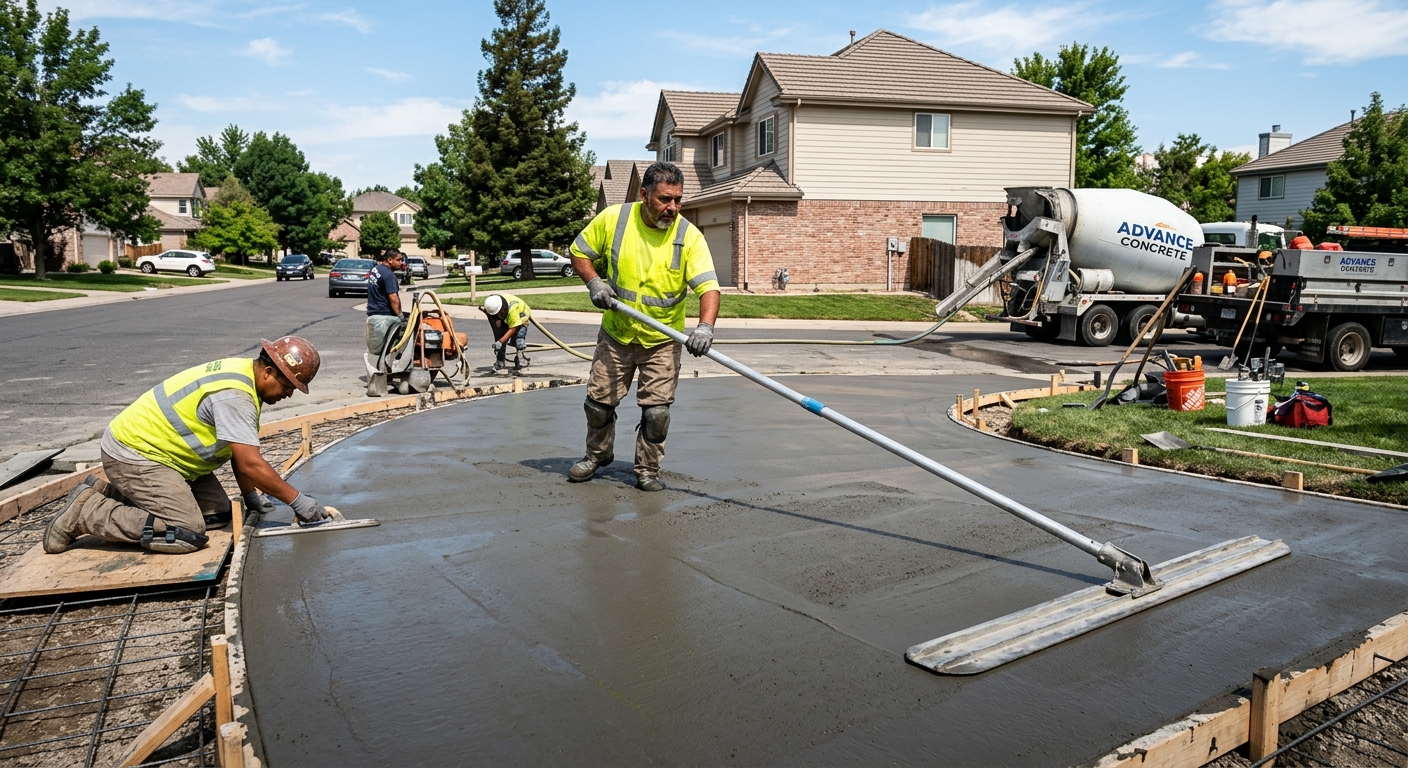
Concrete work options and costs in Kiniski Gardens
Kiniski Gardens, Alberta is the kind of community where concrete gets tested every winter. With a population of 6,637 (Statistics Canada, 2021 Census), it’s also a market where homeowners frequently refresh driveways, add patios, and extend walkways as new landscaping matures. That matters because flatwork is a go-to upgrade for the area’s typical housing stock—concrete flatwork is especially common on single-detached style properties where vehicles, snow storage, and foot traffic are part of daily life.
In Calgary’s cold continental climate, pricing is shaped less by “standard concrete” and more by frost and freeze–thaw engineering. Local practice targets a design frost depth of about 1.2 m, so footing-bearing excavation and foundation-related concrete can be heavier than in milder regions. Exterior slabs also need air-entrained mixes and more attention to joints and curing to reduce scaling and spalling. That’s why you’ll see contractors in Kiniski Gardens focus on granular base prep, proper drainage, and control joint patterns—especially for driveways and patios exposed to de-icing salt.
Demand is steady around established neighbourhood pockets such as the areas near community amenity corridors in Kiniski Gardens, where homeowners commonly retrofit hardscaping and improve access routes. As a result, availability can tighten in spring and early summer, which can affect scheduling and labour rates. Below is a quick comparison of the most common projects, with realistic price bands for this part of the Calgary region.
| Application |
Typical Size |
Key Spec |
Finish Option |
Price Range |
| Concrete driveway (standard broom finish) |
16 m x 4 m (about 64 m²) |
Air-entrained exterior mix, compacted granular base, control joints |
Broom finish |
$12,000–$18,000 |
| Exposed aggregate driveway |
16 m x 4 m (about 64 m²) |
Air-entrained exterior mix, well-graded aggregate, base prep for freeze–thaw |
Exposed aggregate (seeded/granular reveal) |
$14,000–$22,000 |
| Stamped concrete driveway or patio |
40 m² driveway apron or 3.7 m x 6.1 m patio (about 23 m²) |
Air-entrained exterior mix, heavier forming, integral colouring |
Stamped patterns (brick/fieldstone/wood look) |
$15,000–$26,000 |
| Plain concrete patio or walkway |
3.0 m x 6.0 m (about 18 m²) or 1.2 m x 6.0 m walkway (about 7 m²) |
Air-entrained mix, compacted base, edge finishing |
Broom or light trowel with broom texture |
$5,000–$9,000 |
| Garage floor (interior slab) |
6.1 m x 6.1 m (about 37 m²) |
Vapour barrier (as required), engineered base, proper curing |
Plain trowel/steel trowel finish |
$6,500–$11,500 |
| Foundation footings (structural, below frost) |
Typical house perimeter + piers (varies by plan) |
Reinforced concrete footings bearing below design frost depth |
Structural finish (not decorative) |
$28,000–$45,000 |
Prices are estimates only and vary by project scope, site access and material selection.
What affects the price of concrete work in Kiniski Gardens
In Kiniski Gardens and the broader Calgary region, two quotes for the “same” concrete project can differ by 30% to 50% because the hidden work isn’t always the same: excavation depth, base thickness, reinforcement, curing controls, and finish labour. A driveway that’s poured over a shallow or loosely compacted base may look fine in summer, but the freeze–thaw cycles in Alberta expose weak prep quickly—so contractors who build to the local frost requirements often price higher, but they’re buying long-term performance.
Frost line depth is the driver. Calgary’s design frost depth is about 1.2 m, meaning exterior footings and below-frost structural elements must bear on undisturbed soil below that level to limit frost heave. Exterior slabs and flatwork also need air-entrained concrete mixes to survive repeated freeze–thaw. On top of that, the effective pour season is shorter; when winter placement is required or late-season pours happen, cold-weather curing precautions (insulated blankets, temperature control, longer protection time) add labour and materials.
De-icing salt accelerates surface wear and can contribute to spalling if the mix and finishing aren’t right, so sealing and joint detailing become more valuable here. For example, upgrading from a broom-finished driveway to stamped or exposed aggregate adds cost, but it’s not purely “cosmetic”—it often includes extra steps like integral colour, tooling complexity, and careful finishing. If your base and joints are done properly, you might still keep costs closer to the $12,000–$18,000 driveway band for standard work; decorative concrete typically moves you into the $15,000–$26,000 range depending on pattern and reinforcement needs.
| Price Factor |
Why It Matters |
Cost Impact |
| Frost line depth — determines footing depth and form height |
Footings must extend below design frost to prevent movement |
Higher excavation and concrete volume; can add significant cost to foundations |
| Site preparation — excavation, grading, compacted granular base |
Weak sub-base leads to settlement, cracking, and premature failure |
More granular material and labour; often explains quote differences |
| Reinforcement — rebar or wire mesh requirement |
Controls shrinkage cracking and supports slabs/walkways/driveways |
Material + placement labour; depends on slab thickness and loading |
| Mix design — air-entrainment and compressive strength spec |
Freeze–thaw resistance and durability depend on the mix |
Air-entrained and winter-grade mix costs can raise totals |
| Finish type — broom vs. stamped vs. exposed aggregate |
Finish affects labour time, curing timing, and surface durability |
Stamped/exposed typically adds finishing and materials |
| Pour size and concrete truck access to site |
Smaller access routes or tight staging increases time and equipment needs |
Extra mobilization charges; sometimes pump vs. chute impacts cost |
| Cold-weather curing precautions — heating and blankets |
Proper curing prevents scaling and strength loss |
Temporary heat/blankets can add noticeable line-item cost |
| Control joint pattern and sealing cost |
Joints control cracking; sealing helps resist de-icer damage |
More detailing time plus sealer product and application |
Permits & regulations in Alberta
In Alberta, structural concrete work typically requires a building permit, especially when you’re changing a building’s load path or basement foundation elements. That includes footings, foundation walls, grade beams, and other reinforced structural components—those are the jobs where municipalities often expect engineered drawings (or engineering sign-off) and permit review before excavation starts. For homeowners in Kiniski Gardens, always confirm requirements with the local authority before breaking ground, even if you’ve done similar work elsewhere in Calgary.
Concrete flatwork like patios, walkways, and most driveways typically does not require a permit on its own. However, a permit can become relevant if your project changes lot grading, impacts municipal right-of-way areas, or affects impervious surface/servicing constraints. If your pour ties into foundation drainage or changes how water flows across your property, that’s another reason to check first.
Before hiring, verify three core items: liability insurance, workers’ compensation coverage (WSIB/WCB), and contractor credentials. Step-by-step: (1) ask the contractor for a certificate of insurance naming you or your property as appropriate (the COI should show liability coverage limits and current expiry dates); (2) request proof of WSIB/WCB account clearance or coverage documentation; (3) check the contractor’s licensing/registration details through provincial/official channels where applicable; and (4) confirm they can provide references for similar footing/patio timelines. Clear paperwork usually means fewer change-orders later—especially important in Alberta’s freeze–thaw season.
Getting concrete right in Kiniski Gardens's freeze-thaw climate
Concrete failures in Kiniski Gardens usually come down to one of five things: inadequate base prep, weak or non-air-entrained concrete, missing or poorly placed control joints, rushed curing, or surface damage before the slab is ready for winter conditions. Calgary-area freeze–thaw cycles push water into tiny weaknesses; when temperatures swing, expansion helps lift slabs, spalls edges, and widens cracks. The fix isn’t a “stronger finish,” it’s correct specification from the ground up.
Start with base preparation: your granular sub-base must be excavated to the proper depth for local soils and compacted in lifts so it can’t pump during thaw. Next is mix design: for exterior flatwork, air-entrainment is critical (commonly targeted at 5% to 7% air content) along with minimum 32 MPa compressive strength—so the concrete resists scaling and maintains strength. Add control joints to limit random cracking; if joints are too far apart, you get uncontrolled crack locations that fill with meltwater and de-icers. Curing matters as much as the pour: plan for a minimum 7-day curing period with cold-weather precautions when temperatures drop. Finally, sealing—typically penetrating sealer applied after the cure period (commonly around 28 days post-pour)—helps repel de-icing salts.
Ask technical questions like: “What air % are you targeting?” “What’s the proposed base depth and compaction method?” and “Where will the control joints land relative to expansion and utility cuts?” To put pricing into perspective, moving from a plain broom-finished patio toward stamped work can take a project from the $5,000–$9,000 range into the $15,000–$26,000 band, and that price difference is usually justified by extra labour, integral colour, stamps, and finishing time—not by skipping any of the freeze–thaw durability specs.
| Spec |
Why It Matters in Kiniski Gardens |
What to Ask For |
Impact if Skipped |
| Compacted granular base (depth?) |
Prevents settlement and reduces water movement under the slab during thaw cycles |
Base depth based on your soil and slab type; compaction in lift thickness |
Cracking, lip formation at edges, and premature failure |
| Air-entrained concrete mix (target air %?) |
Improves freeze–thaw durability and reduces scaling/spalling from trapped water |
Confirm target air content (commonly 5% to 7% for exterior flatwork) |
Higher risk of surface scaling and spalling within a few winters |
| Compressive strength (MPa rating) |
Ensures the slab achieves design strength for load and durability |
Minimum 32 MPa for exterior flatwork |
Weak concrete can crack and wear faster under freeze–thaw |
| Control joints (spacing per ACI guidelines) |
Controls where cracks occur so water doesn’t concentrate |
Joint spacing and layout plan before forms go up |
Random cracking, water intrusion, and faster deterioration |
| Minimum 7-day curing period |
Cold snaps can slow strength gain; curing protects against early damage |
Curing plan, including blankets/heating if needed |
Surface scaling, reduced strength, and patchy durability |
| Penetrating sealer (when applied after cure) |
Repels salt-laden meltwater and slows surface deterioration |
Penetrating sealer applied after cure (commonly around 28 days post-pour) |
More rapid surface wear and staining in winter conditions |
How to choose a concrete work contractor in Kiniski Gardens
Choosing the right contractor in Kiniski Gardens comes down to proof and process, not just price. In Alberta, confirm the contractor can legally work and that they’re protected to work on your property. Start by asking for a certificate of insurance (liability) with policy expiry dates and coverage limits. Then request proof of WSIB/WCB coverage or a clearance letter. For licensing/registration, ask them to provide their contractor registration details and check the relevant provincial registry using the company name and business number.
Next, insist on 2–3 itemised written quotes—not one-lump numbers. You want a breakdown for labour, concrete supply, excavation/grading, base materials, reinforcement, forms, finishing, joints, sealing, disposal, and any permit-related steps. Many “cheap” quotes lose value because they exclude hauling, missing base depth, or rebar that’s required for driveway thickness and support. Read the scope for exclusions: Is concrete cutting included? Is disposal included? Is protection/curing labour included?
For warranty, look for a workmanship warranty length, what it covers (and what it doesn’t), and whether manufacturer warranties apply to products like sealers or admixtures. Payment scheduling should be conservative: never pay more than 10% to 15% upfront, and hold back a meaningful amount until the final inspection and cleanup are complete. Finally, get the start date and completion estimate in writing—especially important here because late-season curing and temperature protection can affect schedule and quality.
- Ask for insurance COI and confirm it’s current (expiry date visible).
- Request WSIB/WCB proof/clearance letter before work starts.
- Confirm who pulls any required permits (and whether it’s included in the quote).
- Get an itemised quote for excavation, base, reinforcement, concrete supply, and finishing.
- Require details on air-entrainment and minimum strength spec for exterior work.
- Verify the base depth and compaction method (not just “good base”).
- Ask for the control joint layout and spacing plan before the pour.
- Confirm curing protection plan for cold snaps (blankets/heating if needed).
- Clarify whether sealing is included, and if not, what sealer type will be recommended.
- Insist on disposal/haul-away and any grind/cut work being explicitly listed.
- Check warranty terms in writing: coverage, length, and process for claims.
- Keep payments within 10%–15% upfront; hold back until completion and cleanup.
Concrete red flags I see in Kiniski Gardens include: (1) quotes that don’t specify air-entrained mix or curing precautions; (2) missing joint layout or vague “we’ll joint it later”; (3) no mention of base depth/compaction; (4) minimal or no proof of WSIB/WCB and liability coverage; and (5) too-large upfront payments or no written start/end dates.
Frequently asked questions — concrete work in Kiniski Gardens
How long does a concrete driveway last?
A properly built concrete driveway in Kiniski Gardens can last 25+ years, but the real answer depends on the foundation prep, air-entrained mix, and joint sealing—because Alberta’s freeze–thaw cycles and de-icing salt attack the surface when the slab is vulnerable. A standard broom-finished driveway that’s engineered with the right base compaction, control joint spacing, and air content typically performs much better than one poured over uncertain sub-base. If your driveway is in the $12,000–$18,000 band, it often includes the durability items homeowners should expect (base prep, joints, air-entrainment, and correct curing). If you choose decorative work, like stamped finishes often in the $15,000–$26,000 range, the longevity still hinges on freeze–thaw specs and sealing—not just appearance. Regular sweeping, timely snow clearing without aggressive scraping, and sealing after proper cure can extend service life.
What is air-entrained concrete and why does it matter here?
Air-entrained concrete is designed with microscopic air bubbles that give expanding water places to go during freeze–thaw. In Alberta, that matters because meltwater and moisture in the slab can expand when temperatures drop, which can cause surface scaling and spalling if the mix isn’t engineered for it. For exterior flatwork in Kiniski Gardens, contractors commonly target about 5% to 7% air content and specify a minimum strength (often 32 MPa) so the slab reaches its design performance. When a quote doesn’t mention air-entrainment, that’s a warning sign—especially for driveways, patios, and walkways exposed to winter cycles and salt. The best comparison is to ask each contractor: “What air % are you targeting?” and “Do you have a curing plan for cold nights?”
How do I prepare the base for a concrete slab?
Base preparation is what prevents most concrete problems in Kiniski Gardens. Preparation starts with excavating to the correct depth based on your soil conditions and the frost-protection needs of the slab. Then you grade the sub-base, add granular material, and compact it in lifts so it doesn’t settle later. For exterior slabs, the granular base needs proper thickness and drainage considerations so water doesn’t sit under the concrete during thaw. If your project is a patio or walkway, the principle is similar—compaction quality is still the difference between a slab that holds up and one that develops cracking or uneven edges. In Kiniski Gardens, your contractor should also plan for freeze–thaw durability details like air-entrainment and control joint placement; base prep alone won’t protect the surface if the mix and curing aren’t right. Ask for the proposed base depth and compaction method in writing.
How do I compare concrete quotes?
To compare quotes fairly in Kiniski Gardens, insist on like-for-like scope. First, compare total area and thickness: a “driveway” can mean different thicknesses and reinforcement levels. Second, check whether the quote includes excavation/grading, compacted granular base depth, reinforcement (rebar or mesh as needed), air-entrained exterior mix, and a curing protection plan for cold nights. Third, compare the finish specifications: broom finish is one thing, while exposed aggregate or stamped work usually requires extra labour and timing. Price band context helps: standard driveway work often fits around the $12,000–$18,000 range, while stamped/decorative projects often land closer to the $15,000–$26,000 band depending on pattern complexity and material choices. Watch for hidden exclusions like disposal, permit pull responsibility, or missing sealing—those are common reasons two “similar” quotes can swing by 30% to 50%.
Can concrete be poured in cold weather in Kiniski Gardens?
Concrete can be poured in cold weather in Kiniski Gardens, but it should be treated as a controlled process, not “pour and hope.” In Alberta’s climate, the challenge is curing: cold temperatures can slow strength gain and increase the risk of surface scaling or long-term durability issues. A reputable contractor will discuss cold-weather precautions such as insulated blankets, temporary heating, and protection time until the concrete gains adequate strength. Timing also matters—late-fall and early-spring pours are often more sensitive than mid-summer, and the pour season can be shorter in Calgary-area weather patterns. When you request a quote, ask directly: “What temperature range are you designing for?” and “How long will you protect the slab after placement?” If the contractor can’t clearly explain curing and protection, you’re taking on risk that won’t show up immediately.
How do I maintain concrete in Kiniski Gardens's freeze-thaw climate?
Maintenance is about protecting the surface and managing water and salts. In Kiniski Gardens, start with curing and sealing: most penetrating sealers are applied after the slab has properly cured (commonly around 28 days post-pour), and they help repel de-icing salts that can degrade the surface over time. Keep joints in good shape—if a sealant line fails, water can get into cracks and accelerate freeze–thaw damage. Snow removal should be done carefully: avoid aggressive metal scraping that chips edges and exposed aggregate. For driveways and patios, sweeping away sand and grit can reduce abrasion. If you’re considering decorative surfaces, understand that appearance affects maintenance too; stamped textures can show wear sooner if sealing isn’t maintained. A contractor who builds to the right specs—air-entrainment, joints, and curing—will give you a much better baseline, and then regular homeowner upkeep helps you stretch the service life.