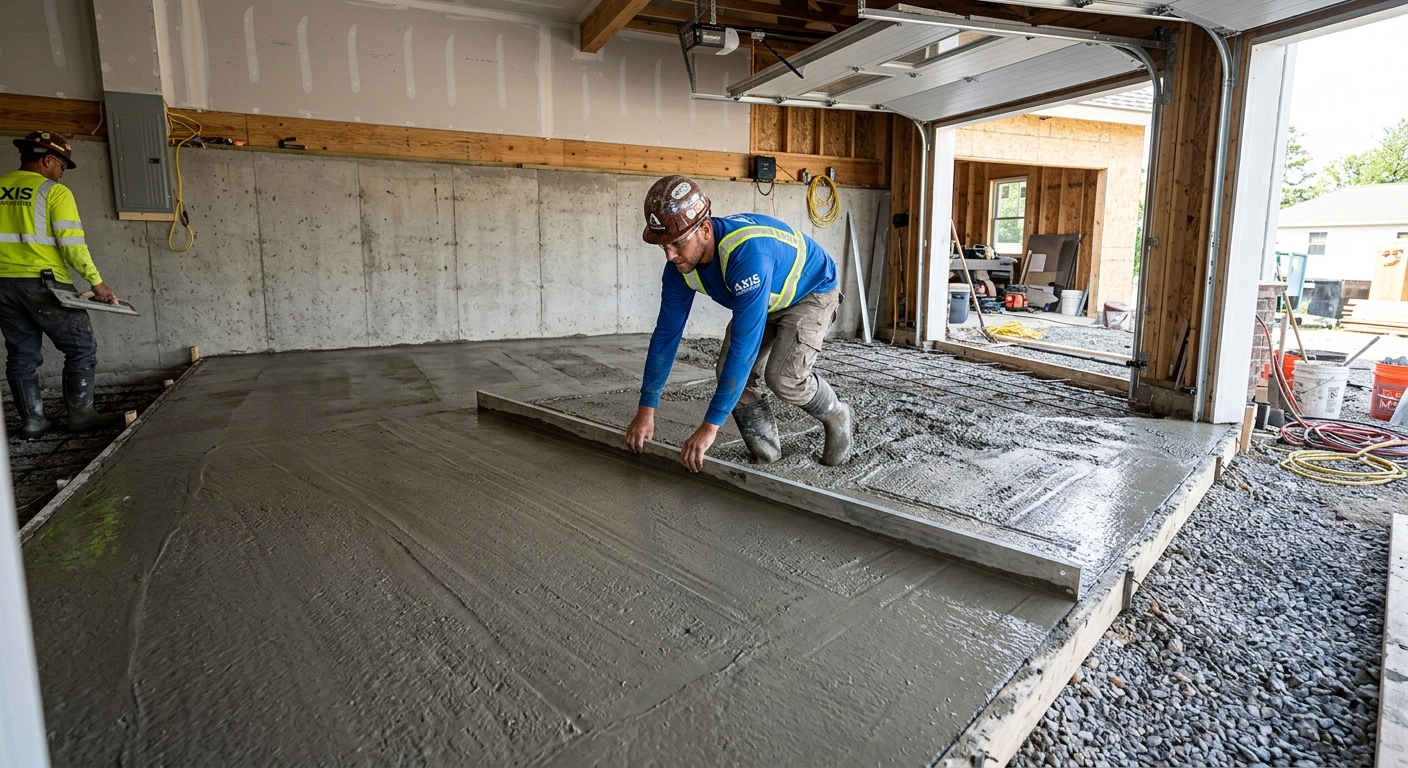
Concrete work options and costs in Gold Bar
Concrete work is a big part of home upgrades in Gold Bar, Alberta—especially for driveways, patios, walkways, and foundation repairs. While Gold Bar is a relatively small community (population of 2,837 in 2021, per Statistics Canada, 2021 Census), the surrounding Calgary area pulls demand hard for residential concrete flatwork and new-build foundations. Most projects come from homeowners and builders coordinating exterior work with landscaping and grading, and the city’s cold continental freeze–thaw cycles make “engineered basics” (base prep, air-entrained mixes, and joints) non-negotiable.
What many people don’t see in early estimates is how Calgary’s design frost depth (about 1.2 m, roughly 4 ft) drives excavation volume and footing height. In practice, that means foundation and footing scopes are more labour- and material-heavy in Alberta than in milder regions—so you’ll often see foundation work priced higher than a quick online comparison would suggest. The same climate reality also affects exterior slabs: freeze–thaw accelerates deterioration unless the concrete is air-entrained and the joints and sealing are planned from day one.
In Gold Bar, trades are especially busy around winter-ready turnarounds and infill projects where access and scheduling matter—so a well-organized crew can save you money, while a rushed pour season can add corrective costs later.
Below is a practical way to compare common options and what they typically cost in your tier before you request itemised quotes for your exact footprint and finish.
| Application |
Typical Size |
Key Spec |
Finish Option |
Price Range |
| Concrete driveway (standard broom finish) |
400–600 sq. ft. |
Air-entrained exterior mix; compacted granular base; control joints |
Broomed finish with sealant |
$12,000–$18,000 |
| Exposed aggregate driveway |
400–600 sq. ft. |
Air-entrained exterior mix; appropriate surface retarder/wash; joints |
Exposed aggregate for texture and traction |
$16,000–$22,000 |
| Stamped concrete driveway or patio |
300–600 sq. ft. |
Air-entrained mix; steel trowel timing; joints aligned to pattern |
Stamped pattern with release and colour |
$15,000–$26,000 |
| Plain concrete patio or walkway |
150–300 sq. ft. |
Air-entrained exterior mix; compacted base; saw-cut joints |
Broom finish or light trowel finish |
$5,000–$9,000 |
| Garage floor (interior slab) |
500–700 sq. ft. |
Vapour control where required; fibre or mesh; expansion where needed |
Float and steel trowel with densifier optional |
$14,000–$22,000 |
| Foundation footings (structural, below frost) |
Per house (typical) |
Engineered excavation; rebar; concrete pour below design frost depth |
Plain formed footings |
$28,000–$45,000 |
Prices are estimates only and vary by project scope, site access and material selection.
What affects the price of concrete work in Gold Bar
In and around Gold Bar, you’ll often see quotes for “the same” concrete job vary by 30–50% across Calgary and Alberta. The reason isn’t usually the concrete itself—it’s the hidden engineering and site work: excavation to frost depth, granular base thickness and compaction, reinforcement detailing, and whether the contractor can pour and cure properly in a colder, shorter exterior season. When those details are priced correctly, performance improves; when they’re skimmed, you pay later with repairs.
Frost line depth and freeze–thaw cycles dictate every major spec in this region. Footings must extend below the design frost depth (about 1.2 m in Alberta practice) to prevent frost heave and seasonal movement. Exterior slabs also need an air-entrained mix so the concrete can survive repeated cycling without spalling. Because the pour season tightens in late fall and early spring, contractors may add winter-grade admixtures, insulated blankets, and controlled curing—especially if you’re trying to set a date. De-icing salts are another cost driver; they accelerate surface wear unless the surface is sealed and the mix/joints are done right.
Two quick Gold Bar examples: a stamped patio can cost more than a plain broom-finished walkway because the contractor is spending time on base consistency, stamping operations, and extra colour/finish materials. Meanwhile, foundation scopes tend to be higher where excavation is deeper or access is tight—yet if your soil conditions are stable and you have straightforward forms, the cost can land closer to the lower end of the foundation band (for reference, foundation/footings typically fall around $28,000–$45,000). For exterior flatwork, a well-prepped broom-finished driveway can stay closer to the $12,000–$18,000 range, while exposed aggregate or heavy reinforcement can push totals upward.
| Price Factor |
Why It Matters |
Cost Impact |
| Frost line depth — determines footing depth and form height |
Deeper frost requirements mean more excavation and concrete volume |
Often the single biggest cost driver on foundations; can shift budgets significantly |
| Site preparation — excavation, grading, compacted granular base |
Bad sub-base leads to settlement and cracking even if concrete is strong |
Adds labour and hauling; scope variance can create 10–25% differences |
| Reinforcement — rebar or wire mesh requirement |
Rebar/wire controls cracking and improves performance under loads |
Materials plus labour; small footprint changes can alter the grid layout |
| Mix design — air-entrainment and compressive strength spec |
Air-entrainment is essential for freeze–thaw durability |
May increase material cost, but reduces freeze-spall failures later |
| Finish type — broom vs. stamped vs. exposed aggregate |
Complex finishes require tighter timing and more labour/consumables |
Stamped/exposed often push projects toward the upper band |
| Pour size and concrete truck access to site |
Smaller pours or difficult access increase handling time and equipment use |
Can add “crew time” and pump/placing costs |
| Cold-weather curing precautions — heating and blankets |
Proper curing prevents scaling and early-age damage |
Winter measures can noticeably raise the total if required |
| Control joint pattern and sealing cost |
Joints and sealing manage cracking and salt exposure |
Often modest line items, but skipping them raises repair risk |
Permits & regulations in Alberta
In Alberta, structural concrete work typically needs a building permit. That includes footings, foundation walls, grade beams, and other structural elements that affect the building’s load path. For these scopes, engineered drawings are often required and reviewed through the municipal permitting process. Concrete flatwork (patios, walkways, and most driveways) usually does not require a permit unless it changes lot grading, impacts impervious surface coverage limits, or affects municipal right-of-way requirements (for example, where drainage and curb/sidewalk ties are involved). Before you break ground in Gold Bar, confirm with the local authority—small grading tweaks can turn a “no-permit” slab into something that needs approval.
For contractor accountability, always verify two things before signing: liability insurance and WSIB/WCB coverage. Here’s a straightforward step-by-step check for Alberta homeowners. First, ask for a current certificate of insurance and confirm the contractor’s name matches the quote and work order. Look for general liability with adequate limits and ask whether the certificate includes your project address as “certificate holder” where applicable. Second, request proof of WSIB (or WCB clearance/coverage documentation, as provided in Alberta employment records) and don’t accept verbal assurances. Third, for structural work, confirm the contractor understands permit timelines and can coordinate with the engineer/permit package. Finally, use references on similar-scale Calgary-area jobs—especially exterior slabs exposed to freeze–thaw.
Getting concrete right in Gold Bar's freeze-thaw climate
Concrete fails in Gold Bar winters mainly when it’s not protected from freeze–thaw movement, salt exposure, and early-age curing problems. The biggest culprit we see is spalling caused by inadequate air-entrainment or poor consolidation/finishing timing, especially when crews try to “push through” cold weather. Spec the job so it’s designed for this region’s climate, not for a warmer season.
Start with base preparation: use a compacted granular sub-base sized for local soil conditions and excavate to the depth required for frost protection. For exterior flatwork, plan for a stable, well-graded base—because settlement is what turns “hairline cracks” into trip hazards. Next, require an air-entrained mix with a typical target of 5–7% air content for exterior slabs, along with a minimum 32 MPa compressive strength spec (exact mix details should be in your contract). Third, control joints: saw-cut or form joints at a spacing that limits random cracking. Fourth, curing: plan for at least 7 days of curing under proper conditions; in cold snaps, insulating blankets or temporary heat may be required so the concrete reaches strength without surface scaling. Fifth, sealing: apply a penetrating sealer after the cure window—commonly around 28 days post-pour—so de-icing salts don’t chew up the surface.
As for cost justification: upgrading from plain broom-finish to stamped can add dollars because of extra materials and labour time—sometimes pushing a patio from the simpler $5,000–$9,000 band toward the $15,000–$26,000 range for stamped/decorative work. However, skipping air-entrainment or skipping joints is where you can lose the value quickly, even if the initial price looks lower.
| Spec |
Why It Matters in Gold Bar |
What to Ask For |
Impact if Skipped |
| Compacted granular base (depth?) |
Provides frost-resistant support and prevents settlement-driven cracking |
Depth and compacted lift schedule matched to your soil conditions |
Uneven settlement, cracks, and joint failure |
| Air-entrained concrete mix (target air %?) |
Air bubbles relieve internal pressure during freeze–thaw cycles |
Target 5–7% air content for exterior flatwork |
Higher spalling risk and faster surface scaling |
| Compressive strength (MPa rating) |
Ensures durability and structural performance under loads |
Minimum 32 MPa specified for the placement |
Reduced long-term durability and premature wear |
| Control joints (spacing per ACI guidelines) |
Creates planned crack lines to limit random cracking |
Joint spacing and whether joints are saw-cut or formed |
Random cracking that’s harder to repair cleanly |
| Minimum 7-day curing period |
Proper strength gain before traffic, finishing stress, and cold exposure |
Confirm curing conditions and any blanket/heating requirements |
Scaling, weaker surface, and early-age damage |
| Penetrating sealer (when applied after cure) |
Repels de-icing salts and slows surface deterioration |
Sealer type and application timing (often around 28 days post-pour) |
Faster surface wear and more pronounced pitting |
How to choose a concrete work contractor in Gold Bar
Choosing the right concrete contractor matters more in Gold Bar than in many other areas, because freeze–thaw durability depends on the details: base prep depth, air-entrained mix confirmation, and whether the contractor can cure properly in cold conditions. Start with Alberta verification. Ask for proof of liability insurance and the contractor’s WSIB/WCB coverage (request documentation, not screenshots you provide). In practice, you’ll typically receive a certificate of insurance for general liability and coverage/clearance information for workers’ compensation. Ensure the contractor’s business name on those documents matches what’s on the quote.
Next, get 2–3 itemised written quotes. You want a breakdown that separates labour and materials (excavation/grading, granular base, reinforcement, concrete supply/mix, forms, finishing, saw-cut joints, sealing, and disposal). Avoid “lump sum only” quotes with vague scope—ask what’s included and what’s excluded. Confirm whether the permit (if required) is included for structural work, and whether disposal/hauling of removed concrete and soil is included. For warranty, ask: how long is the workmanship warranty, what does it cover, and is it transferable if you sell? Also ask for any product/manufacturer warranty terms (where applicable).
Payment scheduling should protect you: never pay more than 10–15% upfront. Use a holdback until the project is complete and you’ve confirmed key items like joints and final grading. Finally, insist on a written timeline with a start date window and realistic completion estimate—especially important if cold-weather curing precautions are needed.
- Confirm liability insurance and WSIB/WCB coverage before work starts.
- Get 2–3 itemised quotes with line-by-line scope (labour + materials).
- Ask the contractor to specify the air-entrainment target and minimum 32 MPa strength in writing.
- Require details on compacted granular base depth and compaction method.
- Confirm reinforcement plan (rebar/wire, spacing, chair supports) where required.
- Check joint plan: spacing, saw-cut timing, and sealing coordination.
- Ask about cold-weather curing: blankets/heating and who monitors temperatures.
- Verify disposal/hauling is included in the quote.
- Ask about surface sealing (penetrating sealer) timing—often around 28 days post-pour.
- Confirm warranty length and what “defect” means (cracking, spalling, joint failure).
- Use a payment schedule with a holdback until the finish and clean-up meet scope.
- Get a written start date and completion target, not just “as soon as possible.”
Concrete contractor red flags in Gold Bar include: promises to pour without addressing cold-weather curing when temperatures drop; quotes that won’t specify air-entrainment and joint spacing; “cheap” bids that omit granular base depth or reinforcement details; no clear warranty terms; and requests for large upfront payments (beyond roughly 10–15%).
Frequently asked questions — concrete work in Gold Bar
Can concrete be poured in cold weather in Gold Bar?
Yes, concrete can be poured in Gold Bar during cold weather, but it must be engineered and handled differently. The main risk in Alberta winters is early-age damage: if the concrete doesn’t cure correctly while temperatures are dropping, you can see surface scaling or reduced durability during future freeze–thaw cycles. Reputable contractors plan for cold-weather placement with winter-grade mixes, careful curing, and often insulated blankets or temporary heat to maintain temperature during the critical early period. Ask specifically how they’ll protect the slab or foundation until it reaches adequate strength (commonly at least a 7-day curing window, with temperature monitoring). If you’re pricing a driveway in the $12,000–$18,000 band, expect cold-weather precautions to be part of the scope when late-season temperatures are involved.
How do I maintain concrete in Gold Bar's freeze-thaw climate?
Maintenance in Gold Bar is mostly about controlling water and limiting salt damage. First, seal exterior flatwork once it has cured—often around 28 days post-pour—using a penetrating sealer designed for freeze–thaw environments. After that, keep drainage flowing away from the slab so water doesn’t pool at edges and joints. Use de-icing products carefully: rock salt accelerates surface wear, and excessive application can worsen pitting over time. If you notice small surface scaling, address it early with appropriate repairs rather than waiting for deeper spalling. Also, don’t seal or apply treatments immediately after finishing—curing needs to complete so moisture doesn’t get trapped. A driveway that was built with the right air-entrainment and joint spacing will generally hold up much better than one maintained without proper sealing.
What causes concrete to spall in Gold Bar winters?
Spalling in Gold Bar usually comes from freeze–thaw pressure inside the concrete combined with de-icing salt exposure. The most common technical cause is inadequate air-entrainment: without enough entrained air, water in the mix can expand during freezing, breaking the surface layers. Poor curing in cold weather can also leave the surface too weak during the first season, making scaling more likely. Another cause is weak or unstable base preparation—if the slab settles or joints are poorly spaced, micro-cracks form and let more moisture into the concrete. Sealing is a major protective step; a driveway or walkway that isn’t sealed after cure is more vulnerable to salt-driven deterioration. If you’re comparing bids and one is far cheaper, ask whether the quote includes an exterior air-entrained mix and a joint and sealing plan—those choices directly affect spalling risk.
What is rebar and when is it required in Alberta?
Rebar (reinforcing steel) is a grid or bar system placed inside concrete to help control cracking and improve strength under tension. In Alberta, rebar requirements depend on engineering design and the intended loads and exposure conditions. For structural elements like foundation footings, grade beams, and foundation walls, rebar is typically required because these components must resist bending, settlement-related movement, and load transfer. For exterior flatwork such as driveways or patios, reinforcement may be required depending on slab thickness, soil conditions, and whether the slab will carry vehicle loads (and the design approach used by the contractor/engineer). A practical way to handle this is to ask your contractor to reference the slab thickness, reinforcement type (rebar vs. welded wire mesh), and spacing in writing. If the quote discusses structural work, don’t accept “we’ll figure it out on site”—for engineered foundation scopes it should be defined before the pour.
How long does a concrete project take in Gold Bar?
Typical timelines in Gold Bar vary by scope, weather, and curing requirements. Most exterior flatwork projects are “fast” in terms of pour day, but the prep and protection work take real time: excavation and base grading, reinforcement placement (where needed), form set, pour, finishing, and curing protection. Even though the concrete pour might take a day or two, plan on several days for completion and at least a 7-day curing period before treating it as fully service-ready (more time for ongoing durability, especially if cold-weather curing measures were needed). For foundation/footings, timelines usually extend because excavation to frost depth, inspection/engineering coordination (where required), rebar installation, and then the concrete pour and cure all stack up. If you’re budgeting a driveway in the $12,000–$18,000 range, ask for a written schedule and curing/temperature plan so you’re not surprised by weather-driven delays.
What is a concrete overlay and is it suited to Gold Bar?
A concrete overlay is a new bonded layer placed over an existing slab to restore surface function without full demolition. It can be suited to Gold Bar when the existing concrete is still structurally sound—meaning it’s not significantly cracked through, not badly settled, and the surface can be prepared for proper bonding. Overlay performance depends heavily on surface preparation (often grinding/scarification, cleaning, and sometimes bonding additives) and the overlay mix design. Freeze–thaw and de-icing salts in Alberta mean overlays must be done with durable materials and good detailing so moisture doesn’t work its way under the new layer. If your existing driveway has widespread failure—spalling, active heaving, or major subsurface issues—an overlay may not be the best choice. Cost-wise, overlays are sometimes pitched as lower than replacement, but the right approach depends on condition; ask your contractor to inspect and explain whether the slab base and drainage are compatible with an overlay strategy.