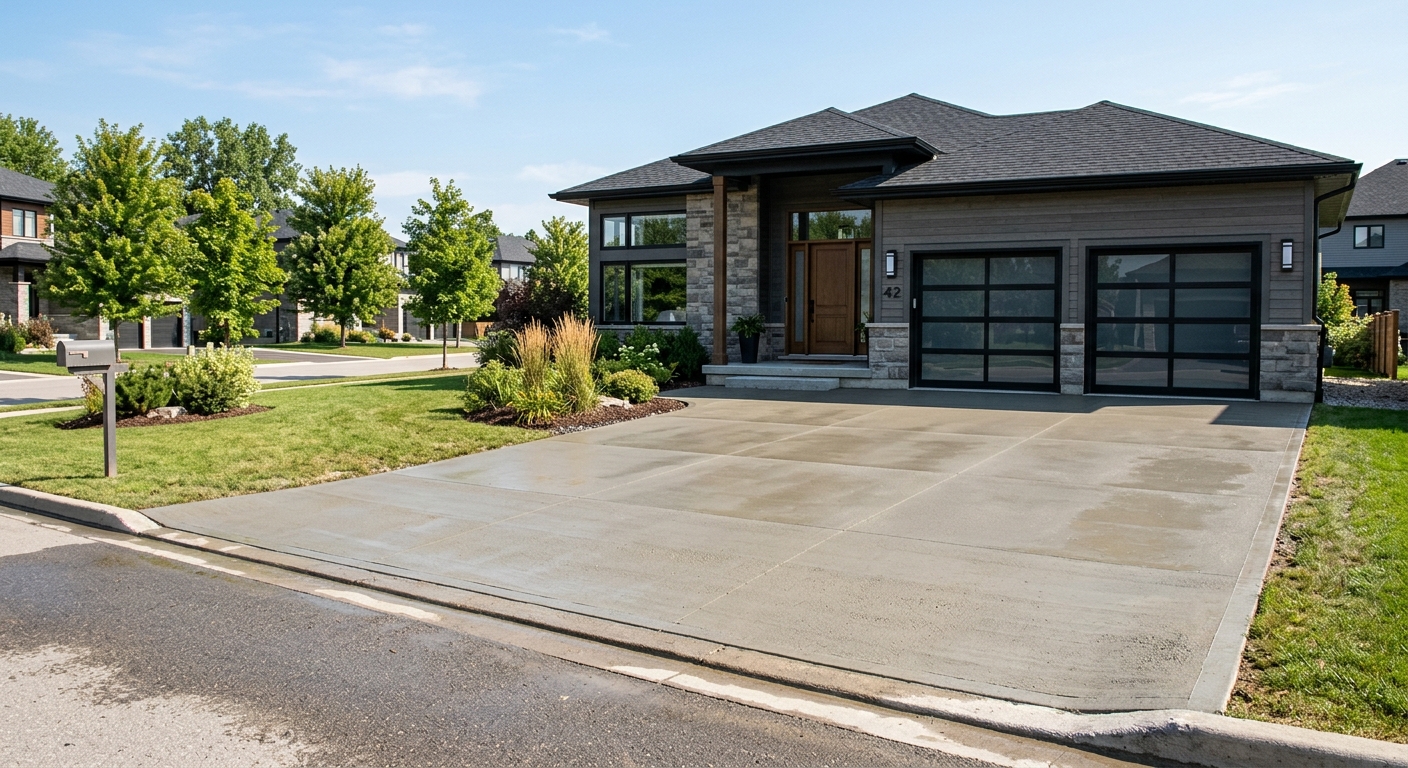
Concrete work options and costs in Oakridge
Oakridge homeowners typically invest in concrete because it holds up through Calgary-area freeze–thaw cycles better than many alternatives—especially for driveways, patios and walkway surfaces. The Oakridge community is small (population 5,620 per the Statistics Canada, 2021 Census), and that steady demand is mostly driven by established housing lots where concrete flatwork gets replaced as families modernize kitchens, garages and backyards. In a city context like Calgary, the concrete trade also runs hot because contractors have to schedule around shorter pour seasons and tighter curing requirements in cold continental winters.
In this part of Alberta, engineering assumes a design frost depth around 1.2 m (about 4 ft) for typical residential support conditions. That means foundation-related concrete and structural footings are priced differently than in warmer climates—excavation is deeper, formwork is taller, and there’s more rebar tying and inspection time. For exterior slabs, we also build for freeze–thaw: air-entrained mixes, properly compacted granular bases, and well-spaced control joints are standard to reduce cracking and spalling on driveways and patios.
In Oakridge, demand is especially strong around neighbourhood pockets like Southwood / Canyon Meadows–style residential streets (where many older garages and drive approaches are being upgraded). If you’re comparing options for flatwork versus structural concrete, the table below is a practical way to line up scope, specs and realistic budget ranges.
| Application |
Typical Size |
Key Spec |
Finish Option |
Price Range |
| Concrete driveway (standard broom finish) |
24 ft x 20 ft (480 sq. ft.) |
Air-entrained mix, compacted granular base, control joints |
Broom finish |
$12,000–$18,000 |
| Exposed aggregate driveway |
24 ft x 20 ft (480 sq. ft.) |
Air-entrained mix, sealed aggregate exposure process, joints |
Exposed aggregate |
$14,500–$22,500 |
| Stamped concrete driveway or patio |
20 ft x 16 ft (320 sq. ft.) |
Air-entrained mix, textured release, sawcut pattern |
Stamped patterns |
$15,000–$26,000 |
| Plain concrete patio or walkway |
12 ft x 12 ft (144 sq. ft.) walkway/patio |
Air-entrained mix, compacted sub-base, joints where needed |
Plain finish |
$5,000–$9,000 |
| Garage floor (interior slab) |
22 ft x 20 ft (440 sq. ft.) |
Vapour barrier, reinforced slab as required, curing plan |
Plain/steel-trowel float |
$10,000–$16,000 |
| Foundation footings (structural, below frost) |
Typical house footing system |
Engineered footing width/depth, rebar, below design frost depth |
Structural concrete only |
$28,000–$45,000 |
Prices are estimates only and vary by project scope, site access and material selection.
What affects the price of concrete work in Oakridge
In Oakridge, it’s common to see concrete quotes for the “same” job vary by 30–50% because Calgary-area pricing is driven by engineering, weather, crew availability and how much preparation your site actually needs. Two driveways can both be 24 ft wide, but one may have poor subgrade or higher frost-susceptible soil, requiring more excavation and deeper granular replacement. Another may need extra sawcut locations, thicker reinforcement, or a longer curing approach because the pour is pushed into early shoulder season.
The design frost depth and freeze–thaw cycles shape nearly every spec in this region. Even when the finishing work looks similar, footings must extend below the design frost depth (about 1.2 m for typical residential support in Calgary-area practice) to prevent frost heave and seasonal movement. For exterior slabs—driveways, patios, and walkways—air-entrained concrete is essential for survival through repeated freezing and thawing. When temperatures drop, the pour season is shorter and cold-weather curing precautions can add cost: insulated blankets, temporary heating, and tighter scheduling to keep the concrete from freezing before it gains strength.
Local de-icing habits also matter. Salt accelerates surface spalling when the mix and finishing aren’t built for durability, so sealing becomes a more cost-effective “insurance” step. In practice, a broom-finish driveway might land in the $12,000–$18,000 band, but upgrading to stamped or more labour-intensive decorative work can push you into the $15,000–$26,000 range. On foundation work, if your soil is harder to excavate or engineered footing dimensions increase, foundation / footings budgets often climb toward the $28,000–$45,000 band. Oakridge’s older housing stock and garage approaches can also mean more demolition/disposal per job, which raises total labour hours even when the new slab is the same size.
| Price Factor |
Why It Matters |
Cost Impact |
| Frost line depth — determines footing depth and form height |
Footings must bear below design frost depth to avoid movement |
Higher excavation and formwork; more labour time and steel |
| Site preparation — excavation, grading, compacted granular base |
Proper base reduces settlement and improves freeze–thaw performance |
Extra haul, granular supply and compaction equipment time |
| Reinforcement — rebar or wire mesh requirement |
Controls cracking and adds capacity under loads |
Steel + tying/labour cost; may increase slab thickness |
| Mix design — air-entrainment and compressive strength spec |
Air entrainment helps prevent scaling/spalling in Alberta winters |
Higher material cost and tighter placement/curing standards |
| Finish type — broom vs. stamped vs. exposed aggregate |
Complex finishes add steps and specialized crews |
More labour, materials and longer workflow; higher price band |
| Pour size and concrete truck access to site |
Short access routes can reduce pumping and delays |
Better access = lower pump/handling fees and fewer truck charges |
| Cold-weather curing precautions — heating and blankets |
Concrete must gain strength without freezing |
Temporary heat, insulation labour and added scheduling constraints |
| Control joint pattern and sealing cost |
Joints manage shrinkage cracks; sealing protects against de-icers |
More sawcut time and sealer product/application steps |
Permits & regulations in Alberta
For Oakridge homeowners, Alberta permits come down to whether the concrete work is structural or purely flatwork. In Alberta, structural concrete—like footings, foundation walls and grade beams—typically requires a building permit, and municipal review often depends on engineered drawings. By contrast, concrete flatwork such as driveways, patios and walkways usually does not require a permit unless it affects lot grading, drainage, impervious surface coverage or work touches municipal right-of-way conditions. Before you break ground, confirm with the local authority so you don’t lose time (or money) if grading or drainage approvals are needed.
Contractor compliance is just as important as permits. Step one: ask the contractor for a current certificate of insurance (liability) and proof of WSIB/WCB coverage. Step two: verify they carry coverage for the scope you’re hiring them for (demolition, concrete placement, and any excavation). Step three: check they can support their work with references on similar-size residential projects in Calgary-area weather conditions. For licensing verification, use the appropriate online registry tools available in Alberta to confirm the contractor’s status—then match the business name on the quote to the name on the insurance certificates.
Getting concrete right in Oakridge's freeze-thaw climate
Concrete fails in Oakridge mainly when it can’t handle repeated freeze–thaw cycles and de-icing exposure. The big technical causes are usually inadequate base preparation, insufficient air-entrainment, poor curing, and control joints that aren’t spaced to manage shrinkage cracking. In Calgary-area conditions, you want to build the slab “from the ground up”: the compacted granular sub-base must be at the correct depth for your soil and frost requirements, the concrete mix needs air entrainment to survive freeze–thaw, and the finish must be paired with the right joint pattern and curing window.
Spec the following points clearly. (1) Base prep: compacted granular sub-base sized for local frost-susceptible soil risk and the engineered footing/grade requirements. (2) Mix: air-entrainment typically 5%–7% air content for exterior flatwork and a minimum 32 MPa compressive strength—your contractor should show mix design details. (3) Control joints: spacing limits random cracking and helps the slab crack in a controlled way rather than unpredictably. (4) Curing: plan for at least 7 days of appropriate curing conditions, especially when temperatures are near freezing. (5) Sealing: apply a penetrating sealer after cure—commonly around 28 days post-pour—so it resists salt-driven surface damage.
Ask the contractor how they prevent spalling from inadequate air-entrainment. It’s not just a “finish” issue. For example, if a standard broom-finish driveway at $12,000–$18,000 is offered without documenting air content and curing steps, that discount can be false economy when surface scaling starts a few winters later. A properly spec’d driveway within the same band often costs only slightly more in labour and materials, but it buys durability in Oakridge’s winter conditions.
| Spec |
Why It Matters in Oakridge |
What to Ask For |
Impact if Skipped |
| Compacted granular base (depth?) |
Reduces settlement and supports the slab through freeze–thaw |
Engineered base depth and compaction test/verification |
Uneven settlement, cracking, and early breakdown |
| Air-entrained concrete mix (target air %?) |
Protects against scaling and spalling in repeated freezing |
Documented air content in the mix (typically 5%–7% for exterior) |
Surface deterioration and flaking under de-icers |
| Compressive strength (MPa rating) |
Strength gains affect durability and load performance |
Minimum 32 MPa specified and confirmed for placement |
Weak slab, raveling and faster wear |
| Control joints (spacing per ACI guidelines) |
Controls shrinkage cracking locations |
Joint spacing plan drawn on the layout before the pour |
Random cracking and more maintenance later |
| Minimum 7-day curing period |
Ensures proper strength development before early winter exposure |
Cooling/warming plan if temps are near freezing; curing duration confirmed |
Surface scaling, reduced long-term strength |
| Penetrating sealer (when applied after cure) |
Helps repel salts and water movement at the surface |
Sealer application around 28 days post-pour (or as specified) |
Faster staining, scaling and freeze–thaw damage |
How to choose a concrete work contractor in Oakridge
Choosing a contractor in Oakridge is about verifying capacity—not just getting a good price. First, confirm Alberta compliance. Ask for their current liability insurance certificate and proof of WSIB/WCB coverage. Then verify licensing status through Alberta’s appropriate online tools, using the exact business name on the quote and invoices. If a contractor can’t provide documents quickly, that’s a warning sign.
Next, get 2–3 itemised written quotes rather than a single lump sum. You want labour and materials breakdown so you can compare base prep, reinforcement, mix design, finishing steps and disposal. Scope clarity matters: ask whether demolition, excavation, hauling/disposal, compacted granular base supply, and any permit pull (if required) are included—or excluded. For warranty, request workmanship terms in writing (often by year) and understand whether manufacturer product warranties apply to admixtures, curing aids or sealers. Also ask whether the warranty is transferable if you sell the home.
On payment, keep it practical: never pay more than 10–15% upfront. Hold back a portion until the slab is complete, cleaned, joints are cut/sealed as agreed, and any required documentation (like mix delivery/curing notes) is provided. Finally, require a written start date and a completion estimate, because Calgary-area weather can compress schedules and impact curing.
- Provide proof of liability insurance and WSIB/WCB before signing
- Match the contractor’s business name across quote, insurance and invoices
- Ask for at least two references on similar Calgary-area winter durability projects
- Require itemised labour/materials: demo, excavation, base, reinforcement, mix, finishing, sealing
- Confirm the air-entrainment and 32 MPa minimum strength spec is included in writing
- Get a joint layout plan (spacing and locations) before the pour
- Ask about cold-weather curing: blankets/heating and how they protect curing concrete
- Confirm disposal/haul-away is included or quoted separately
- Clarify truck access plan (pumping, hoses, and site handling fees)
- Agree on sealer type and when it will be applied (commonly after cure, ~28 days)
- Use a clear warranty statement for workmanship and how claims are handled
- Set a payment schedule with meaningful holdback until final acceptance
Concrete red flags I see around Oakridge include: quotes that don’t mention air-entrainment or curing steps, “too-good-to-be-true” pricing that omits granular base prep depth, no written joint plan, pressure for full payment upfront, and crews that can’t show references from similar-sized cold-weather pours.
Frequently asked questions — concrete work in Oakridge
What is the difference between concrete and cement?
In everyday terms, homeowners in Oakridge use “cement” and “concrete” interchangeably, but they’re not the same. Cement is one ingredient—typically Portland cement—that acts like the binder. Concrete is the full mix: cement plus water, sand, gravel/crushed stone, and often admixtures (like air-entraining agents for exterior work in Alberta’s freeze–thaw climate). For driveways, patios, and walkways, the air-entrainment and curing approach are as important as the finish. If you’re comparing quotes for a broom-finish driveway in the $12,000–$18,000 band, ask what mix design they’re actually placing and whether the air content target is included. That’s where performance is won or lost in cold-weather durability.
How much does concrete work cost in Oakridge?
Pricing in Oakridge follows Calgary-area realities: deeper excavation for frost protection, stronger durability specs, and weather-driven scheduling. As a ballpark, a concrete driveway (standard broom finish) is commonly around $12,000–$18,000 depending on size, base prep, and access. A stamped driveway or patio is usually higher, often landing in the $15,000–$26,000 range because of extra labour and finishing workflow. Foundation / footings budgets frequently sit around $28,000–$45,000 since excavation and reinforcement are more involved when you must bear below the design frost depth. Always request itemised quotes; in this region, the prep and curing plan can move costs more than the surface finish.
How deep must footings be for Oakridge's frost line?
In the Calgary-area engineering approach used across Oakridge, the design frost depth is about 1.2 m (roughly 4 ft). That depth matters because footings need to bear on undisturbed soil below the frost penetration so the ground doesn’t heave and distort the foundation system over seasons. The exact footing depth and width, however, should be based on your engineered drawings and soil conditions, not a homeowner rule of thumb. During excavation, contractors typically plan for more intensive work in Alberta because frost depth is deeper than in milder provinces. If you’re budgeting foundations around the $28,000–$45,000 band, plan for the reality that excavation/formwork/rebar effort increases as footing dimensions go below the frost depth.
Why does concrete crack in Oakridge and how is it prevented?
Concrete commonly cracks in Oakridge due to shrinkage and movement—then freeze–thaw cycles can make small cracks more harmful when water and de-icers reach the surface. The main prevention strategy is controlled cracking: proper reinforcement (where specified), a well-prepared compacted base, and a planned control joint pattern with spacing designed to limit random cracking. Equally important is durable mix design for Alberta’s winters—exterior slabs should use air-entrained concrete, typically around 5%–7% air content, to reduce scaling/spalling risk. Finally, curing can’t be rushed: concrete needs adequate curing time (commonly at least 7 days under proper conditions). For driveways in the $12,000–$18,000 range, the best contractors won’t just “pour and broom”—they’ll show you the joint plan and curing protections.
Stamped vs broom-finish concrete — cost difference?
Stamped concrete costs more than broom-finish mainly because it adds workflow steps: forming and finishing textures, handling release agents, and managing labour timing so the surface accepts the stamping without compromising strength or joint control. In Oakridge, a standard broom-finish driveway often fits the $12,000–$18,000 range, while stamped driveways or patios typically land higher, often around $15,000–$26,000 depending on area and the complexity of the pattern. Exposed aggregate can also be labour-intensive for the exposure/finishing process. The key is to compare “like for like”: make sure both options include the same air-entrainment, base prep standard, reinforcement approach, and curing plan. If the stamped option looks much cheaper but skips durability specs, it may not last as intended through Calgary-area winters.
When is the best time to pour concrete in Oakridge?
The best time to pour concrete in Oakridge is when temperatures support proper curing—typically late spring through early fall—so crews can place, finish and cure without needing heavy cold-weather interventions. Calgary-area freeze–thaw risk is real, and the pour season is shorter than in warmer regions. If you must pour near freezing temperatures, Alberta projects often require cold-weather curing precautions such as insulating blankets and sometimes temporary heating to keep the slab from freezing before it gains strength. This is where quotes can vary: a late-season job may stay within the same base pricing band for a driveway, but cold-weather curing steps can push total costs upward. If you’re planning in advance, schedule earlier rather than waiting for weather delays—your slab’s long-term durability depends on getting curing right.