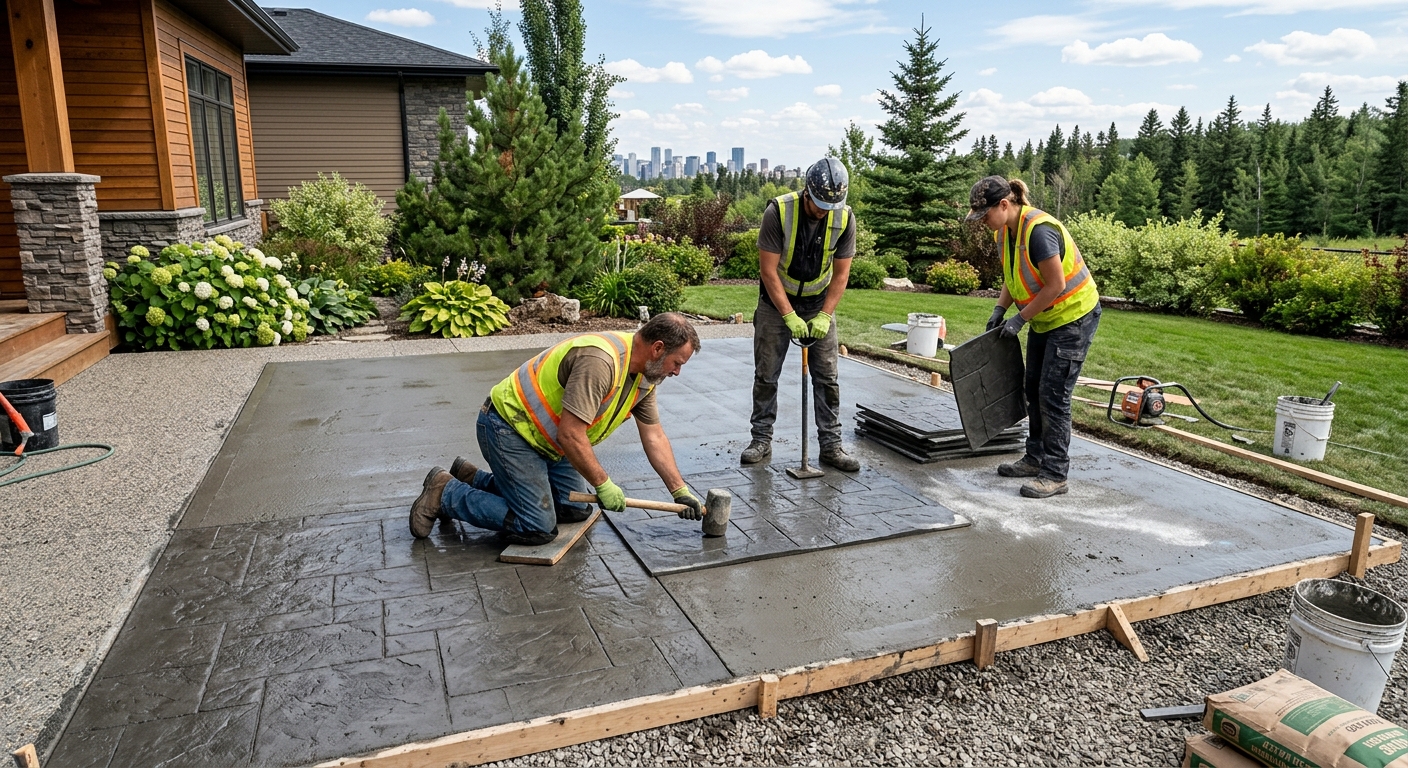
Concrete work options and costs in Ramsay Heights
In Ramsay Heights, Alberta, homeowners typically choose concrete for driveways, patios, walkways, and the flatwork that ties a property together. With a population of 3,349 (Statistics Canada, 2021 Census), the local contractor pool is small enough that scheduling matters, especially when several neighbours want work done in the same tight exterior pour window. This matters because Calgary-area concrete is engineered around deeper frost protection and frequent freeze–thaw cycles—so scope, excavation depth, and mix specs directly drive price.
In a growing neighbourhood like Ramsay Heights—where many homes are owner-occupied and flatwork is added or upgraded over time—driveway and patio projects are especially in demand around established streets with steady curb access and consistent vehicle routing. You’ll often see it in areas closer to main collector roads in Ramsay Heights where construction access is easier and homeowners want durable surfaces before winter.
What you might not notice from the “same concrete” pitch is that exterior work in Calgary can land noticeably different in cost. Because the design frost depth is about 1.2 m (roughly 4 ft) in this region, footings and any frost-protected structural elements must bear on undisturbed soil below that depth. Freeze–thaw also forces granular base prep and air-entrained concrete mixes for exterior slabs, while cold-weather placement may require insulated blankets or temporary heat to achieve proper curing. Those steps don’t just protect the concrete; they add labour, equipment time, and sometimes winter-grade materials—so quotes can vary even when your preferred finish (broom, stamped, exposed aggregate) looks similar.
Below is a practical comparison of common options you’ll see in Ramsay Heights, Calgary, and nearby communities, with realistic price ranges to help you budget before you request itemised quotes.
| Application |
Typical Size |
Key Spec |
Finish Option |
Price Range |
| Concrete driveway (standard broom finish) |
24 ft x 10 ft (240 sq ft) |
Air-entrained mix; compacted granular base; control joints |
Broom finish + sawcut joints |
$12,000–$18,000 |
| Exposed aggregate driveway |
24 ft x 10 ft (240 sq ft) |
Air-entrained mix; retarder / wash technique; sealed surface |
Exposed aggregate finish |
$15,000–$22,000 |
| Stamped concrete driveway or patio |
20 ft x 12 ft (240 sq ft) |
Air-entrained mix; proper base and colour hardeners |
Stone/brick stamp with colour integral + release |
$15,000–$26,000 |
| Plain concrete patio or walkway |
12 ft x 10 ft (120 sq ft) |
Air-entrained mix; compacted base; drainage-grade attention |
Broom or smooth trowel + light broom texture |
$5,000–$9,000 |
| Garage floor (interior slab) |
22 ft x 20 ft (440 sq ft) |
Vapour/ground prep as required; 35+ MPa mix; joints as needed |
Float and broom (or light texture) |
$8,500–$14,500 |
| Foundation footings (structural, below frost) |
Typical single-family footprint |
Excavate to undisturbed soil; engineered reinforcement; frost-depth bearing |
Structural concrete with rebar grid / ties |
$28,000–$45,000 |
Prices are estimates only and vary by project scope, site access and material selection.
What affects the price of concrete work in Ramsay Heights
In Ramsay Heights and the broader Calgary region, the same “concrete driveway” can come in 30–50% apart because the quote is really about engineering and logistics, not just the truck of concrete. Contractors may start at different footing-depth assumptions, base thicknesses, and reinforcement details. They may also price differently depending on how much excavation and hauling is needed, whether forms and steel are included, and how they handle cold-weather curing—especially during late fall or early spring when crews have to protect curing surfaces.
Here’s the core Calgary-area driver: frost and freeze–thaw cycles dictate every exterior spec. Footings and frost-protected elements must extend below the design frost depth (about 1.2 m or 4 ft in this region) to prevent frost heave. Exterior slabs also require air-entrained concrete mixes to survive repeated freezing and thawing without scaling or spalling. Add to that a shorter, tighter pour season for outdoor flatwork and the need for cold-weather precautions—insulated blankets, curing protection, and sometimes temporary heating—and you get real labour and materials differences that show up in your invoice.
Then consider Alberta winter impacts on “best finish” choices. For example, a standard broom driveway can align closely with the region’s typical concrete driveway band of $12,000–$18,000, while stamped or exposed finishes usually cost more because colour systems, release agents, and extra finishing time add labour. Conversely, a simple walkway might land nearer $5,000–$9,000 when scope is straightforward and access is easy. In Ramsay Heights specifically, tight side-yard access and more soil hauling can push excavation and base prep up quickly—while a wider, clean access lane can lower costs by reducing equipment time.
| Price Factor |
Why It Matters |
Cost Impact |
| Frost line depth |
Determines footing depth and form height below undisturbed soil |
Can significantly increase excavation and concrete volume for foundations |
| Site preparation |
Excavation, grading, and compacted granular base thickness |
Higher if soil is poor, removal is needed, or hauling/disposal is large |
| Reinforcement |
Rebar or wire mesh control cracking and support loads |
Costs rise with rebar detailing, chairs/ties, and higher steel usage |
| Mix design |
Air-entrainment and compressive strength spec for freeze–thaw durability |
Air-entrained and specified strength mixes can raise material cost; also affects finishing |
| Finish type |
Broom vs. stamped vs. exposed aggregate affects labour and materials |
Stamped/exposed can add colour, release, extra finishing time, and sealing steps |
| Pour size and concrete truck access to site |
Impacts production rate, pump needs, and crew time |
Long carry distances, pump fees, and limited access can add labour and equipment charges |
| Cold-weather curing precautions |
Heating/blankets protect strength gain and prevent surface scaling |
Adds rental equipment and labour coordination; can raise the total quote meaningfully |
| Control joint pattern and sealing cost |
Joints manage shrinkage cracking; sealing helps repel de-icing salt |
Skipping or undersizing joints/sealing increases long-term repair risk |
Permits & regulations in Alberta
In Alberta, structural concrete work—like foundation footings, foundation walls, and grade beams—generally requires a building permit and often engineered drawings that get reviewed by the municipality. For concrete flatwork (patios, walkways, and driveways), a permit typically isn’t required unless your project affects lot grading, drainage, impervious surface coverage limits, or involves work within or near the municipal right-of-way. Because Ramsay Heights driveway projects can change how water runs off during freeze–thaw season, it’s smart to verify whether any ties into municipal drainage rules apply before you break ground.
Before hiring, verify your contractor carries liability insurance and has the required workplace coverage (WSIB/WCB depending on their registration). Step-by-step, here’s how a Ramsay Heights homeowner can check:
- Check the contractor’s business licence/registration through the appropriate Alberta registry website (and confirm they’re in good standing).
- Ask for a certificate of insurance (COI) showing liability coverage and the effective dates.
- Ask for proof of WSIB/WCB coverage (or an exemption letter if they truly qualify).
- Confirm they can provide engineering/red-stamped drawings if your foundation is engineered.
- Request references from similar-scale Alberta projects and ask who pulled permits (if required) as part of the job.
When structural permits are involved, insist the quote names what drawings/inspections are included so there are no surprises later.
Getting concrete right in Ramsay Heights's freeze-thaw climate
Concrete fails in Ramsay Heights most often when it’s built for “average weather” instead of Calgary’s real freeze–thaw behaviour. The biggest enemy is moisture combined with temperature swings: weak base compaction, incorrect frost protection, inadequate air-entrainment, and poor curing can turn into surface scaling and eventually spalling. Spalling is especially common when air-entrainment is too low or the slab is exposed to de-icing salt before it’s mature.
To spec the job correctly in Ramsay Heights, focus on five items. First, base preparation: use a properly compacted granular sub-base sized for local soil conditions and frost protection (for exterior work, the goal is stable support and drainage, not just a “level” top). Second, mix design: for exterior flatwork, air-entrainment should be in the 5–7% range, and you should expect a minimum 32 MPa compressive strength specification for durability. Third, control joints: they must be cut/formed and spaced so shrinkage cracking happens in planned lines, not randomly. Fourth, curing: minimum 7 days under proper conditions—when it’s cold, curing protection (insulating blankets and sometimes heat) isn’t optional if you want the strength you’re paying for. Fifth, sealing: apply a penetrating sealer about 28 days after the pour to help repel de-icing salts.
A clear example of where price difference is justified: if you choose stamped concrete, you’ll pay extra labour and materials, but the cost can still be worthwhile if the base, mix air content, and joint plan are the same as a broom-finish slab. If a cheaper quote trims base depth or skips cold-weather curing, the savings are usually false economy—repairs and resurfacing in a freeze–thaw climate can cost more than doing it right the first time.
| Spec |
Why It Matters in Ramsay Heights |
What to Ask For |
Impact if Skipped |
| Compacted granular base (depth?) |
Stable support reduces settlement and limits water pumping under the slab |
Confirm sub-base thickness, compaction testing method, and drainage/grading details |
Early cracking, uneven surface, and accelerated freeze–thaw deterioration |
| Air-entrained concrete mix (target air %?) |
Air voids give expansion space during freeze–thaw, reducing scaling/spalling |
Request air-entrainment targets (typically 5–7% for exterior flatwork) and mix design documentation |
Surface scaling and spalling within a few winters, especially with de-icing salts |
| Compressive strength (MPa rating) |
Affects long-term performance and resistance to wear in Alberta’s conditions |
Ask for minimum 32 MPa (or higher if specified) and strength expectations |
Lower durability and higher risk of surface damage and cracking |
| Control joints (spacing per ACI guidelines) |
Controls where shrinkage cracks occur so they don’t become random failures |
Ask for joint spacing, cut timing, and whether joints align with design expansion/edge conditions |
Random cracking, water intrusion, and freeze–thaw freeze cycling along cracks |
| Minimum 7-day curing period |
Strength gain and surface integrity depend on proper curing, especially in cold weather |
Confirm curing protection plan, especially if pouring near cold snaps |
Weak surface, scaling, and reduced long-term strength |
| Penetrating sealer (when applied after cure) |
Helps repel moisture and de-icing salts that drive spalling |
Ask for sealer type and timing (commonly after 28 days) |
Faster deterioration of the top surface and higher maintenance costs |
How to choose a concrete work contractor in Ramsay Heights
Start with the basics: confirm Alberta licensing/registration (where applicable), liability insurance, and WSIB/WCB coverage. In practice, the easiest path is to ask for documents before you sign anything. A COI (certificate of insurance) should clearly show liability coverage, effective dates, and the insured party. For coverage, ask whether they have WSIB/WCB coverage or provide an exemption letter if they qualify. Then validate the company with the available online registry/verification tools and check that their listed address matches your contract paperwork.
Next, get 2–3 itemised written quotes. You want labour and materials separated—especially for excavation, base prep, reinforcement, concrete supply, finishing labour, and disposal. Avoid “lump sum only” quotes with vague scopes. Read inclusions and exclusions carefully: is permit handling included (if structural work requires it), is disposal/hauling included, and are site protection measures included? For warranties, ask for the workmanship warranty length and whether product/manufacturer warranties apply to materials like sealers or admixtures. Also ask if the warranty is transferable if you sell the home.
Payment matters: never pay more than 10–15% upfront. Hold back a portion until the job is complete and you’ve accepted final finishing and cleanup. Finally, request a written timeline with a start date and a completion estimate so you can plan around the short exterior pour season.
- Request their air-entrained mix specification for exterior work.
- Ask how they handle cold-weather pours (blankets/heating plan).
- Confirm base thickness and whether compaction is documented.
- Check whether rebar/wire mesh placement includes chairs/ties for correct cover.
- Ask about control joint timing and spacing.
- Confirm sealing is included (if you’re doing driveways/patios) and timing after cure.
- Ensure concrete truck access and pump/line requirements are described in the quote.
- Verify excavation and disposal are priced transparently.
- Confirm who pulls permits (if required) and what inspections are expected.
- Request a written warranty for workmanship and what it covers.
- Ask for references for Ramsay Heights or nearby Calgary-area projects.
- Clarify the payment schedule in writing before work begins.
Concrete red flags in Ramsay Heights include: skipping or “guessing” frost-depth/base details, promising cold-weather pours without blankets/heating, using non-air-entrained mixes for exterior slabs, refusing to provide a COI or WSIB/WCB proof, and offering only a lump-sum quote without an itemised scope or joint/sealing plan.
Frequently asked questions — concrete work in Ramsay Heights
What is air-entrained concrete and why does it matter here?
Air-entrained concrete is mixed with tiny, evenly distributed air voids that give the water in the concrete somewhere to expand during freezing. In Ramsay Heights and the Calgary area, freeze–thaw cycles and de-icing salts are tough on exterior slabs, so air content is one of the most important specs for avoiding scaling and spalling. That’s why reputable contractors build their quotes around an exterior mix with air-entrainment (commonly 5–7% for flatwork) and a durability strength requirement (often 32 MPa minimum). If someone tries to cut cost by using the wrong mix or doesn’t mention air content, it’s a major warning sign—especially if you’re budgeting for a driveway in the typical range of $12,000–$18,000 and expect it to last through multiple winters.
How do I prepare the base for a concrete slab?
Base prep is where slab durability is won or lost in Ramsay Heights. The contractor should excavate to reach stable material, then grade and compact a properly sized granular sub-base so the slab won’t settle or pump with meltwater. Because frost depth in this region is about 1.2 m (roughly 4 ft), structural elements like footings must bear below frost, and exterior slabs still need stable support and good drainage. Ask for the proposed base thickness and how compaction will be verified (not just “we compacted it”). Good base prep also reduces cracking and helps joints do their job. If your quote doesn’t clearly discuss excavation, granular thickness, and compaction, compare it against another itemised quote before you proceed—base prep is often a hidden driver of cost variation in Alberta.
How do I compare concrete quotes?
When comparing quotes in Ramsay Heights, don’t just compare totals—compare scope. Ask each contractor to itemise labour and materials: excavation and disposal, granular base depth and compaction method, reinforcement type and placement, concrete supply details (including air-entrainment and strength), finishing, sawcut/control joints, and sealing (if applicable). A cheaper quote often “saves” by reducing base prep depth, skipping reinforcement, using a different finish plan, or not including winter curing protection when temperatures drop. For example, if one contractor is quoting a driveway finish near the typical $12,000–$18,000 band while another is closer to the stamped/decorative range of $15,000–$26,000, make sure the cheaper one isn’t cutting the technical specs. The best quotes are specific, not vague.
Can concrete be poured in cold weather in Ramsay Heights?
Yes, concrete can be poured in cold weather in Ramsay Heights and still meet performance goals, but it must be placed and cured with the right precautions. Calgary’s cold snaps can slow strength gain, so contractors typically use winter-grade practices: insulated blankets, temporary heat if needed, and careful temperature management to protect curing. The key is not pouring “whenever” but executing a verified curing plan so the concrete reaches early strength and resists surface scaling. Ask the contractor what temperature range they’re planning for, what curing blankets/heating equipment they use, and how they’ll protect formwork and surfaces. If they can’t explain their cold-weather curing plan, treat that as a risk—especially for exterior slabs where freeze–thaw and de-icing salt will start testing the surface within the season.
How do I maintain concrete in Ramsay Heights's freeze-thaw climate?
Maintenance in Ramsay Heights is mostly about managing moisture and salt exposure. After the concrete has fully cured, apply a penetrating sealer (commonly around 28 days post-pour) to help repel water and de-icing salts. Use de-icing products carefully: avoid over-salting and try to maintain a lighter, regular application rather than heavy deposits. Keep surface drainage clear so meltwater doesn’t sit and refreeze along slab edges or control joints. Inspect annually for early issues—tiny spalls, joint cracking widening, or scaling—and address them promptly to prevent water intrusion. If your driveway or patio is in the $5,000–$9,000 walkway/patio range, maintenance is still worth it: sealing and basic upkeep typically cost far less than grinding and re-patching after multiple winters.
What causes concrete to spall in Ramsay Heights winters?
Spalling in Ramsay Heights usually comes from repeated freeze–thaw stress plus moisture and salt getting into the concrete and expanding. The most common root causes are inadequate air-entrainment (not enough air voids to relieve freezing pressure), weak surface curing (especially if poured in cold weather without protection), poor base drainage that traps water, and joints that aren’t spaced or sealed to control cracking. De-icing salts accelerate surface breakdown by increasing freezing damage at the surface. That’s why air-entrained mix design and proper curing are critical—cutting corners here can turn a durable driveway (often budgeted around $12,000–$18,000) into a problem child within a few winters. If you’re seeing scaling early, ask a contractor to evaluate mix spec, curing records, and joint detailing—repair strategy depends on the real cause.