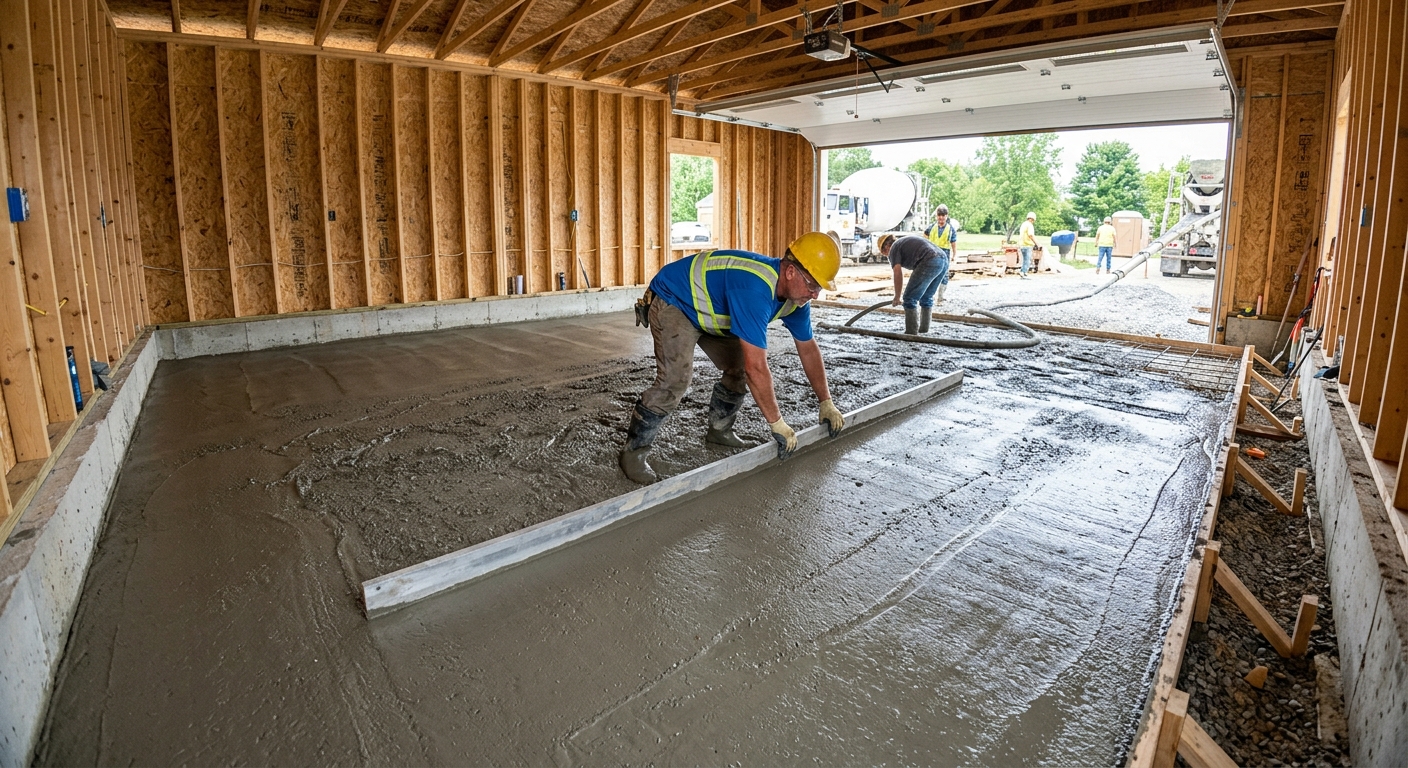
Concrete work options and costs in Heritage Pointe
Heritage Pointe, Alberta has a lot of family homes and busy driveways—so when residents call for concrete, they’re usually planning for years of daily use, not just a quick surface. With a population of 2,075 (Statistics Canada, 2021 Census) and a neighbourhood mix dominated by single-detached homes, the most common projects are driveways, patios and walkways, plus foundation footings for new builds and basement development. In Calgary’s broader market, trades are active but schedules can tighten in spring and early summer because cold weather limits exterior slab pours and proper curing.
What drives cost in this area is the climate: Calgary-region freeze–thaw cycles are hard on unprotected concrete. Footings must be set below the design frost depth (about 1.2 m in the region), and exterior flatwork typically uses air-entrained concrete and well-designed control joints to reduce cracking and surface scaling. Also, the practical pour season for outdoor slabs is shorter—so winter-grade materials and cold-weather curing precautions (insulating blankets and controlled heat when needed) can add to labour time and overhead. That’s why two contractors can quote different numbers for the “same” driveway size: one may include deeper prep and better mix specs up front, while another may assume less excavation or a lighter finish approach.
If you live near the busier connector roads and shopping area by Heritage Lake / the Heritage Pointe core, demand is especially steady—there’s less tolerance for long access downtime, and that can affect staging and crane/haul requirements. Below is a realistic side-by-side comparison to help you map your scope to today’s pricing before you request itemised quotes.
| Application |
Typical Size |
Key Spec |
Finish Option |
Price Range |
| Concrete driveway (standard broom finish) |
24 ft x 10 ft (240 sq. ft.) |
Air-entrained mix, typical 4 in. slab, reinforced where required |
Broom finish |
$12,000 – $18,000 |
| Exposed aggregate driveway |
24 ft x 10 ft (240 sq. ft.) |
Air-entrained mix, wash/expose technique |
Exposed aggregate |
$13,500 – $21,000 |
| Stamped concrete driveway or patio |
200–300 sq. ft. |
Air-entrained mix, base prep and integral colour |
Stamped patterns |
$15,000 – $26,000 |
| Plain concrete patio or walkway |
12 ft x 16 ft (192 sq. ft.) or 4 ft x 30 ft (120 sq. ft.) |
Air-entrained mix, proper base and drainage |
Plain finish (trowel or broom) |
$5,000 – $9,000 |
| Garage floor (interior slab) |
22 ft x 20 ft (440 sq. ft.) |
Vapour barrier where needed, reinforcement per design |
Broom or light trowel finish |
$7,500 – $14,000 |
| Foundation footings (structural, below frost) |
Typical new build/underpinning extent varies |
Engineered dimensions, below design frost depth, reinforced concrete |
Structural concrete |
$28,000 – $45,000 |
Prices are estimates only and vary by project scope, site access and material selection.
What affects the price of concrete work in Heritage Pointe
In Heritage Pointe, you’ll often see quotes for the “same” concrete job differ by 30–50% across Calgary and the surrounding region because contractors price the hidden work: excavation depth, base material quantity, reinforcement placement, mix design, and curing controls. A driveway might look straightforward, but in a cold continental climate the details determine whether it survives the freeze–thaw cycle without scaling or premature cracking.
First, the frost depth drives excavation and concrete volume. Local practice uses a design frost depth of about 1.2 m (roughly 4 ft). That means footings for houses, garages and retaining structures must bear on undisturbed soil below that depth to limit frost heave. In colder regions (Alberta included), the pour window is shorter and cold-weather curing precautions can be necessary—heating, insulated blankets, and scheduled placement time add real labour and equipment costs. Second, exterior slabs require air-entrained concrete to withstand repeated cycles; if air entrainment or finishing timing is compromised, the risk of spalling rises. Finally, de-icing salt usage on driveways accelerates surface deterioration—so sealing is a practical add-on many homeowners request after the concrete cures.
Two local examples: (1) If your driveway needs additional removal down to stable granular base, that can push you from the mid-range into the upper part of the concrete driveway / slab band (for example, a $12,000–$18,000 project becoming closer to $18,000 after extra excavation and haul). (2) If you choose stamped patterns for a patio, the price can jump into the $15,000–$26,000 decorative band mainly due to higher material workflow and finishing time—not because the concrete thickness changes. Even an interior garage floor can cost more when vapour barrier and reinforcement are included properly for your slab design. With Heritage Pointe’s established housing stock and ongoing infill/build schedules, crews also need to plan around access and staging, which affects labour productivity and truck trips.
| Price Factor |
Why It Matters |
Cost Impact |
| Frost line depth |
Determines footing depth and form height |
More excavation and concrete for structural jobs; increases foundation / footings pricing |
| Site preparation |
Excavation, grading, compacted granular base |
Extra haul-away, more base material, longer labour time |
| Reinforcement |
Rebar or wire mesh requirement |
Material cost plus additional labour for placement/spacing |
| Mix design |
Air-entrainment and compressive strength spec |
Winter-grade materials and correct air content can raise material costs |
| Finish type |
Broom vs. stamped vs. exposed aggregate |
Higher labour and finishing time for decorative systems |
| Pour size and concrete truck access to site |
How many placements, pumping needs, and wait time |
Pumps, smaller loads, or longer carry distances increase labour and equipment charges |
| Cold-weather curing precautions |
Heating and blankets |
Adds equipment and time; usually needed during late fall/early spring pours |
| Control joint pattern and sealing cost |
Manages shrinkage cracking and long-term surface durability |
Proper jointing reduces costly repairs; sealing adds a separate material/crew step |
Permits & regulations in Alberta
In Alberta, structural concrete work—think foundation footings, foundation walls, grade beams, and other load-bearing concrete components—generally requires a building permit and often engineered drawings that are reviewed during the permit process by the municipality. Concrete flatwork such as patios, walkways, and most standard driveways typically does not require a permit unless it changes lot grading, affects drainage in a way that impacts neighbouring/municipal requirements, or triggers impervious surface coverage and right-of-way considerations. Even when a permit isn’t usually required for flatwork, you should still confirm with the local authority before breaking ground so your scope doesn’t conflict with drainage rules or setback/right-of-way expectations.
Before hiring in Heritage Pointe, verify two things: the contractor’s licence/credentials (as applicable) and their insurance coverage. Step-by-step, ask for a Certificate of Liability Insurance that matches the project address and the concrete work scope, and confirm they have WSIB/WCB coverage for their workers. Then request written confirmation they can provide references for similar concrete scopes (driveways, stamped patios, or foundation work) and ask who pours and manages curing on-site. To verify, look for their business listing in Alberta’s online resources, check the validity dates on the insurance certificate, and ensure the coverage shows the correct business name. If they can’t produce documentation promptly, treat that as a red flag and request alternatives.
Getting concrete right in Heritage Pointe's freeze-thaw climate
Concrete failures in Heritage Pointe usually come back to one of five issues: weak base preparation, incorrect mix design, poor control joint layout, rushed curing, or skipping sealing. In a Calgary-region freeze–thaw climate, the biggest long-term risk is spalling from insufficient air-entrainment and surface protection. To spec the job correctly, start with base preparation: excavate to the proper depth for a compacted granular sub-base sized for local soil and frost conditions, then compact in lifts so the slab doesn’t settle. Next, mix design matters—exterior flatwork should use air-entrained concrete (commonly target 5–7% air content for many exterior applications) and a minimum 32 MPa compressive strength so the concrete resists cracking and durability loss.
Then control cracking: add control joints with a spacing plan that limits random shrinkage cracking. Curing is critical—plan for at least 7 days of proper curing under favourable conditions, and in colder periods use winter-grade precautions like insulated blankets and controlled heat where required. Finally, sealing: apply a penetrating sealer after the concrete has cured (often around 28 days post-pour) to repel de-icing salts and reduce moisture ingress. These specs also help your driveway or patio keep its appearance through winter sanding and melt cycles.
On price: the foundation/footings band ($28,000–$45,000) is higher here because frost-depth-driven excavation increases volume. For exterior slabs, you may pay more for exposed aggregate or stamping (up to $15,000–$26,000 for decorative projects), and in this market that premium is justified because surface durability and finishing workflow reduce early-life damage—not because we add unnecessary thickness.
| Spec |
Why It Matters in Heritage Pointe |
What to Ask For |
Impact if Skipped |
| Compacted granular base (depth?) |
Prevents settlement and supports the slab through freeze–thaw |
Granular base depth by design; compaction method and proof (where available) |
Uneven slabs, cracking, and premature failure |
| Air-entrained concrete mix (target air %?) |
Resists freeze–thaw scaling and spalling |
Air content target (commonly 5–7% for exterior flatwork) and mix schedule confirmation |
Surface scaling, spalling, and faster deterioration |
| Compressive strength (MPa rating) |
Improves structural performance and long-term durability |
Minimum 32 MPa specification for the exterior slab or as engineered |
Higher cracking risk and reduced durability |
| Control joints (spacing per ACI guidelines) |
Limits random cracking by controlling where cracks form |
Proposed joint spacing and saw-cut timing plan |
Random cracks that can open and trap water |
| Minimum 7-day curing period |
Builds strength before exposure to cold and moisture cycling |
Confirmation of curing method and protections during cold snaps |
Weak surfaces, scaling, and reduced performance |
| Penetrating sealer (when applied after cure) |
Reduces moisture and salt intrusion at the surface |
Sealer type and application timing (often after full cure, e.g., ~28 days) |
Faster staining, salt damage, and surface wear |
How to choose a concrete work contractor in Heritage Pointe
For Heritage Pointe homeowners, choosing the right contractor is about verifying coverage, getting a precise scope, and making sure the bid includes the climate-critical steps. Start with Alberta documentation: ask for a clear Certificate of Insurance (liability coverage) and proof of WSIB/WCB coverage for workers. Then verify business legitimacy using Alberta online resources for contractor/business listings. If a contractor can’t provide current certificates or the documents don’t match the legal business name on the quote, don’t proceed.
Next, get 2–3 itemised written quotes instead of one lump-sum number. You want labour and materials separated: excavation, granular base supply and compaction, reinforcement, vapour barrier (if applicable), concrete mix type, finishing, curing/blankets (if needed), saw-cut joints, and sealing (if included). Read the exclusions carefully: is permit pull included if required for foundation work? Is disposal and haul-away included? Are any saw-cut joints excluded or “allowance” items?
Warranty is also practical. Ask for the workmanship warranty length and whether the manufacturer/supply warranty for decorative finishes or sealers is separate. For payment schedule, a sensible approach is to keep upfront deposits to around 10–15% maximum and hold back the remainder until the final walk-through and curing/protection steps are done. Finally, timeline matters in cold-weather placement—insist on a start date and completion estimate in writing, including how they manage curing if temperatures drop.
- Ask for a detailed line-item quote (labour, materials, and equipment).
- Confirm air-entrained mix and minimum 32 MPa spec for exterior flatwork.
- Require written base preparation depth and compaction expectations.
- Check for current liability insurance matching the project address.
- Verify WSIB/WCB coverage for the crew performing the work.
- Ask who will pour and who oversees curing and protection on-site.
- Confirm reinforcement placement (not just “included”).
- Get the control joint plan (spacing and saw-cut timing).
- Clarify what’s included for winter/shoulder-season curing precautions.
- Ask whether disposal/haul-away is included in the price.
- Review warranty terms in writing and what they cover/exclude.
- Use a payment schedule that holds back most funds until completion.
Concrete red flags I commonly see in the Heritage Pointe area: a contractor who quotes “straight broom finish” language while you requested stamping or exposed aggregate; vague wording like “standard base” without depth/compaction details; no proof of WSIB/WCB or insurance paperwork; rushing cold-weather pours without insulated curing plans; and refusing to provide itemised allowances for reinforcement, joints, and sealing.
Frequently asked questions — concrete work in Heritage Pointe
How long does a concrete project take in Heritage Pointe?
For Heritage Pointe and the Calgary region, the schedule is usually driven by base preparation, curing conditions, and concrete access logistics. A standard exterior flatwork job like a broom-finished driveway typically takes a crew about 1–2 days of on-site work (excavation/base prep, forming, pour, and finishing), but you should plan for additional time around weather and curing protections. Even when placement is quick, curing time matters: you’ll generally want concrete to cure properly for at least 7 days before expecting full hard-use, and sealing is commonly done after full cure (often around 28 days). If you’re doing decorative work (stamped or exposed aggregate) the process takes longer due to extra steps and finishing workflow. If your pour lands in late fall or early spring, cold-weather curing precautions can extend the timeline.
What is a concrete overlay and is it suited to Heritage Pointe?
A concrete overlay is a thin concrete layer placed on top of an existing slab after prep. It can be a good option when the original concrete is structurally sound and you mainly have surface spalling or minor unevenness. In Heritage Pointe’s freeze–thaw climate, however, overlay performance depends heavily on prep quality: surface cleaning, proper bonding, and correct materials for exterior durability. If the existing slab has widespread cracking, significant settlement, or active joint failure, an overlay can trap problems and shorten service life. Cost can be attractive compared to replacing, but replacement is often the smarter long-term play if water has already penetrated deeply. If you’re looking at a driveway in the $12,000–$18,000 range for new concrete, overlay decisions should be based on a professional inspection and a clear repair/overlay spec.
How do I seal concrete to protect it in Heritage Pointe?
Sealing is one of the best defences against Alberta winters because it reduces moisture and de-icing salt intrusion. For Heritage Pointe, the common approach is a penetrating sealer applied after the concrete has cured—typically around 28 days post-pour—so the concrete is dry enough to accept the product. Before sealing, confirm the slab is clean (no dust, curing compounds, or contaminants) and let it dry after any washing. Apply the sealer at the recommended coverage rate and don’t trap water by sealing over damp surfaces. Ask contractors what sealer type they use (penetrating vs film-forming) and whether it includes guidance for reapplication. If you’re sealing a driveway or patio, plan sealing maintenance as part of your lifecycle so the surface stays more resistant to salt scaling.
What is the difference between concrete and cement?
In everyday conversation, people say “cement” when they mean “concrete,” but they’re not the same. Cement is one ingredient—usually Portland cement—that’s blended with sand, gravel (or other aggregates), and water to make concrete. Concrete is the finished material that forms the slab or footing. The mix design is what matters for performance: in Heritage Pointe’s freeze–thaw environment, exterior work typically uses air-entrainment to protect the concrete from spalling, plus appropriate compressive strength (often minimum 32 MPa for many exterior slabs). So when you compare quotes, don’t just ask what “cement” they’re using; ask about the full mix specification, air content, and curing plan. That’s the real difference between a driveway that holds up for years and one that scales early.
How much does concrete work cost in Heritage Pointe?
Concrete pricing in Heritage Pointe closely follows the Calgary regional bands because frost depth, freeze–thaw cycles, and curing requirements increase excavation and materials/controls. For a driveway or slab, homeowners commonly budget around $12,000 – $18,000 for standard broom-finished work, with decorative options like stamped concrete or exposed aggregate often landing in the higher range. A stamped driveway or patio can run $15,000 – $26,000 depending on square footage and finish complexity. Plain patios and walkways are commonly $5,000 – $9,000. Structural foundation footings are typically the most intensive, often $28,000 – $45,000, because excavation and reinforced concrete are driven by the frost depth requirement. Exact pricing depends on access, excavation, reinforcement, and whether cold-weather curing precautions are needed.
How deep must footings be for Heritage Pointe's frost line?
In the Calgary region, local engineering practice uses a design frost depth of about 1.2 m (roughly 4 ft) for estimating footing bearing below frost to reduce frost heave risk. That means footings for houses, garages, retaining structures and foundation components should typically extend to undisturbed soil below that depth, with the final depth confirmed by your engineered drawings or local requirements. In practice, the exact depth also depends on soil conditions, the structural system, and drainage/water management around the foundation. If you’re planning foundation work in Heritage Pointe, ask your contractor how the engineered foundation details specify footing dimensions and bearing level. It’s also why quotes for foundation/footings typically differ significantly—extra excavation and larger footing volumes come straight from frost and soil conditions.