Concrete work options and costs in Magrath
Magrath homeowners typically choose concrete because the town’s housing stock is dominated by single-detached homes—about 88.8% of dwellings are this type—so driveways, patios, and walkways are steady yearly needs. With 635 homeowner households (77.9% of households own), most projects are scheduled around maintenance, expansions, and curb-appeal upgrades rather than new multi-unit construction. That matters for budgeting: most crews plan around repeat clients, a similar mix of access conditions, and the same common design priorities for flatwork.
In the Lethbridge–Medicine Hat economic region, pricing is shaped by a deep frost line and hard freeze–thaw cycles. For structural work, footings need to sit below frost to reduce frost heave risk, which increases excavation and forming time. Exterior flatwork also needs air-entrained concrete to manage internal freeze pressure, and contractors often have to compress scheduling because the practical exterior pour season is shorter. On top of that, cold-weather protection—blankets, heaters, and careful curing—can add materials and labour even when the site is “dry.”
Demand is especially strong in newer residential pockets and established neighbourhoods with lots that are being regraded or expanded for garages and larger driveways—commonly around the town’s main residential streets off the highway corridor. If you’re comparing contractor quotes, use ranges as your baseline, then expect adjustments for soil conditions, drainage, and finish complexity. Below is a realistic price comparison for Magrath so you can line up scopes and ask the right questions before booking a site visit.
| Application |
Typical Size |
Key Spec |
Finish Option |
Price Range |
| Concrete driveway (standard broom finish) |
10 m x 3 m (30 m²) |
Air-entrained, compacted granular base, control joints |
Broom finish, light edging |
$4,200–$6,600 |
| Exposed aggregate driveway |
10 m x 3 m (30 m²) |
Air-entrained mix, proper curing protection |
Exposed aggregate (wash/surface reveal) |
$6,000–$9,300 |
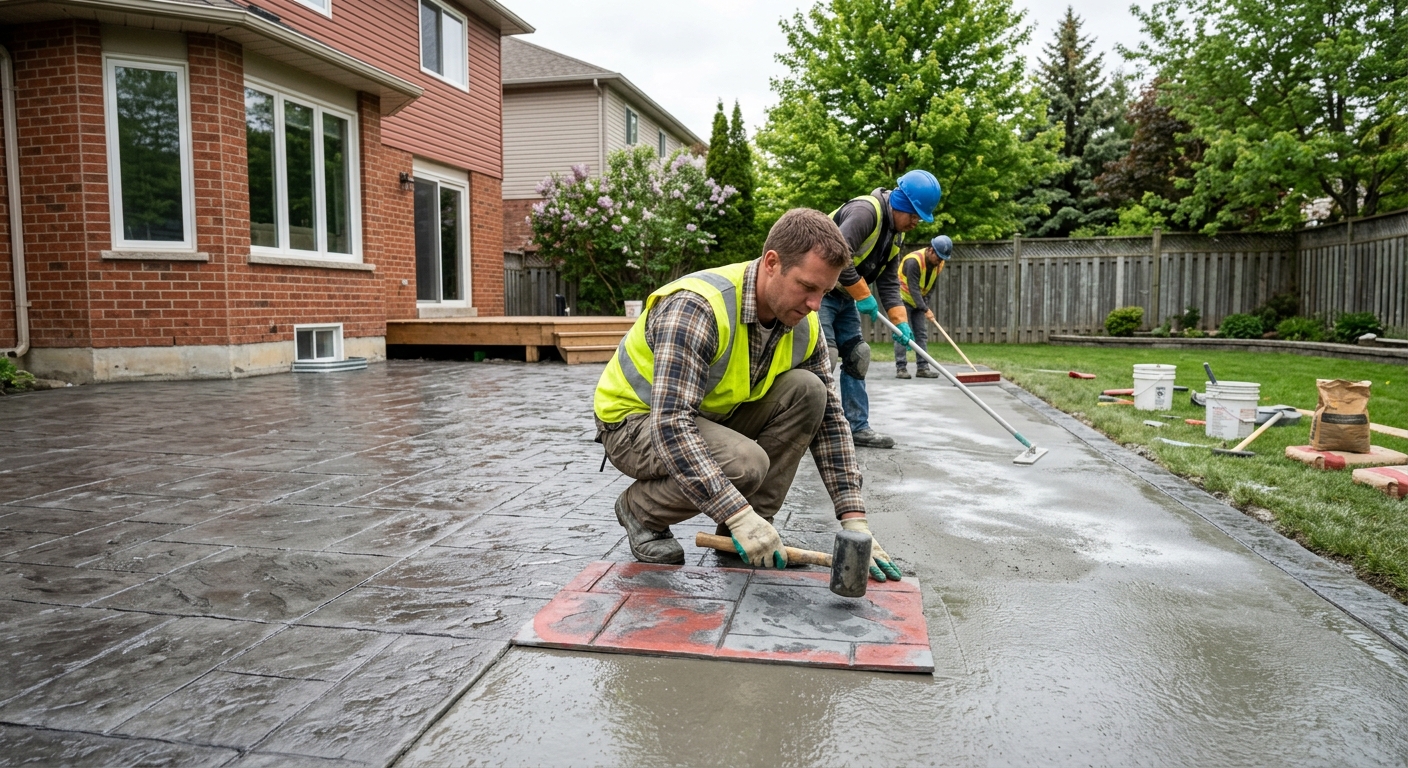
| Stamped concrete driveway or patio |
8 m x 3 m (24 m²) |
Air-entrained, base prep + densifier/curing plan |
Stamp pattern + colour hardener |
$5,000–$8,000 |
| Plain concrete patio or walkway |
6 m x 2 m (12 m²) |
Air-entrained, compacted base, joints |
Smooth or broom edge finish |
$1,400–$2,400 |
| Garage floor (interior slab) |
6 m x 6 m (36 m²) |
Vapour control/insulation as needed, reinforced slab |
Float finish, light broom or hardener |
$6,500–$10,500 |
| Foundation footings (structural, below frost) |
Typical single-detached footing package |
Below-frost excavation, rebar cages, engineered dims |
Formed concrete with ties/anchors |
$9,500–$17,000 |
Prices are estimates only and vary by project scope, site access and material selection.
What affects the price of concrete work in Magrath
In Magrath and across the Lethbridge–Medicine Hat region, it’s common to see the same concrete type come back with a 30–50% spread between quotes. The headline reason is that southern Alberta’s deep frost line and repeated freeze–thaw cycles force contractors to design for performance, not just “pour and finish.” When a quote includes the right footing depth, granular base prep, drainage, air-entrained concrete, and proper curing protection, the total rises—especially for exterior slabs and structural work. When a quote skips any of those line items, it can look cheaper upfront but typically leads to earlier maintenance or surface deterioration.
Frost depth determines how far down crews must excavate for footings, formwork heights, and hauling/disposal. For exterior slabs, freeze–thaw cycles drive a requirement for air-entrained mixes so the concrete can tolerate internal freezing pressure. Cold conditions also compress the pour season; cold-weather curing precautions (heaters/blankets and scheduling for strength gain) can add cost, even in a drier region. Then there’s de-icing salt: it accelerates surface wear and spalling, which is why sealing is often recommended after cure. Depending on your finish selection, you may also move up the spectrum from plain broom-finished concrete to stamped or exposed aggregate—those finishes carry higher labour and material overhead (and therefore often sit closer to the higher end of the $12–$22 exterior pricing bands).
In practical Magrath examples: a driveway on marginal native soil may need extra granular thickness and more base compaction time; that pushes standard broom work toward the upper end (often closer to $14–$22 per sq. ft. equivalent pricing logic for the local tier). Conversely, a patio over well-draining, easy-to-grade ground may stay near the lower band like $12–$20 for a plain finish. For foundation footings, homes built before 1981 (54.0% of housing stock) can mean retrofit or tie-in work, adding layout, obstruction management, and debris removal—costs that can’t be “averaged out” of the estimate.
| Price Factor |
Why It Matters |
Cost Impact |
| Frost line depth — determines footing depth and form height |
Footings must extend below design frost to reduce frost heave |
Higher excavation and forming; can noticeably increase foundation scope |
| Site preparation — excavation, grading, compacted granular base |
Base prep controls settlement and drainage during freeze–thaw |
Extra material hauling/compaction labour can add a large share |
| Reinforcement — rebar or wire mesh requirement |
Controls cracking and supports loads (especially garage slabs/footings) |
Material + placement labour increases cost for reinforced specs |
| Mix design — air-entrainment and compressive strength spec |
Air-entrainment improves freeze–thaw durability for exterior concrete |
Air-entrained mix and spec handling can raise per-m³ concrete cost |
| Finish type — broom vs. stamped vs. exposed aggregate |
Finish complexity changes labour time and material requirements |
Stamped/exposed typically shift closer to the upper tier pricing |
| Pour size and concrete truck access to site |
Small pours and tight access can require additional handling or visits |
More crew time and logistics can add cost even on the same area |
| Cold-weather curing precautions — heating and blankets |
Strength gain slows when temperatures drop |
Blankets/heaters and tighter sequencing add labour and materials |
| Control joint pattern and sealing cost |
Joints manage cracking; sealing helps repel de-icing salt damage |
Extra saw-cut labour and sealer material can add a measurable line item |
Permits & regulations in Alberta
In Alberta, the permitting and approval path depends on whether your concrete work is structural or purely flatwork. Structural concrete tasks—such as footings, foundation walls, and grade beams—typically require a building permit and often engineered drawings that the municipality reviews. For concrete flatwork like driveways, patios, sidewalks, and walkways, a permit is usually not required by default; however, it can be required if your project affects lot grading, drainage, or impervious surface coverage rules, or if there are any works within the municipal right-of-way. The safest approach is to confirm requirements with the City/municipal office before breaking ground.
Before you hire anyone in Magrath, verify the contractor is properly set up. Ask for proof of liability insurance and WSIB/WCB coverage, and request references on similar-size concrete projects. For licensing: if the contractor performs concrete work as part of a broader construction business, ensure they have the right standing to operate and can provide documentation upon request. You should also confirm the scope is clear—disposal, permit responsibility (if needed), and base prep depth are frequent sources of disputes.
Step-by-step homeowner checks: (1) ask for a certificate of insurance and confirm it covers the work location and effective dates; (2) request a WSIB/WCB clearance letter or account verification; (3) confirm the permit handling responsibilities in writing if structural elements are involved; (4) check references for jobs in climates similar to southern Alberta and ask how they handled cold-weather curing and drainage.
Getting concrete right in Magrath's freeze-thaw climate
Concrete failures in Magrath usually come down to four things: poor base support, the wrong mix for freeze–thaw, insufficient curing, and weak crack-control detailing. In a deep-frost, aggressive freeze–thaw environment like southern Alberta, the most common “early” failure we see is surface spalling caused by inadequate air-entrainment or air content that isn’t maintained. When water penetrates and freezes inside the concrete, it expands; the air-void system gives freezing water room to expand without destroying the paste.
To spec your job correctly, start with (1) base preparation: compacted granular sub-base to the correct depth for your soil and frost considerations, with drainage that directs water away. (2) mix design: require air-entrained concrete with a target air content appropriate for exterior flatwork and a minimum compressive strength spec (commonly 32 MPa for many flatwork designs). (3) control joints: tight, planned joint spacing so cracking happens where you want it. (4) curing: plan for at least 7 days of cure under suitable protection; when weather dips, cold-weather curing (blankets/heaters and careful scheduling) protects strength gain. (5) sealing: apply a penetrating sealer after the concrete has cured (commonly around 28 days) to help repel de-icing salts.
For questions that prevent costly rework, ask: “What is your air content target for this specific driveway/patio?” and “How do you protect curing if the temperature drops at night?” If your quote offers plain mix “because it’s dry out,” push back—freezing exposure in Alberta isn’t forgiving. As a dollar example, moving from plain patio/footings prep at the lower end of the exterior band (around $1,400–$2,400 for a typical small patio) to a sealed, properly jointed, air-entrained spec may add a few hundred dollars, but it’s money well spent compared to replacing a failing surface later.
| Spec |
Why It Matters in Magrath |
What to Ask For |
Impact if Skipped |
| Compacted granular base (depth?) |
Prevents settlement and keeps water from undermining the slab during freeze–thaw |
Base type and compacted depth for your soil + drainage plan |
Uneven cracking, rocking slabs, and faster surface deterioration |
| Air-entrained concrete mix (target air %?) |
Gives freeze–thaw durability for exterior exposure |
Air content target (commonly 5%–7% for exterior flatwork) and mix delivery control |
Higher risk of spalling and scaling from trapped freezing water |
| Compressive strength (MPa rating) |
Controls strength gain and load tolerance through cold months |
Minimum MPa spec (often 32 MPa for many flatwork designs) and strength/curing expectations |
Slower strength gain, increased early-age cracking, reduced durability |
| Control joints (spacing per ACI guidelines) |
Controls where cracking occurs during shrinkage and temperature swings |
Planned joint spacing and timing for saw-cutting in your layout |
Random cracks that can admit water and accelerate freeze damage |
| Minimum 7-day curing period |
Low temperatures in Alberta slow strength development |
How they cure if nights get cold (blankets/heaters) and schedule protections |
Reduced final strength and increased cracking risk |
| Penetrating sealer (when applied after cure) |
Helps reduce salt and moisture penetration that drives surface breakdown |
Confirm sealer type and timing (commonly around 28 days post-pour) |
More salt-related scaling and faster aesthetic/structural wear |
How to choose a concrete work contractor in Magrath
Choosing a concrete contractor in Magrath should start with verification, not just a low number. In Alberta, ensure the company can show liability insurance (certificate of insurance naming the correct job site) and WSIB/WCB coverage evidence. To check: (1) request the certificate of insurance before work starts and confirm the coverage is active for your dates; (2) ask for a WSIB/WCB clearance letter or account proof and verify it matches the legal entity doing the work; (3) if structural concrete is involved (footings/foundation walls/grade beams), confirm how permits and engineered drawings are handled in your scope.
Next, request 2–3 itemised written quotes. You want labour and materials broken out (concrete supply, granular base, reinforcement, forming, finishing, saw-cutting, disposal, and sealing). A true apples-to-apples bid will show whether the base depth is included, what reinforcement is used, and whether cold-weather protection is budgeted. Read exclusions carefully: disposal of excavated material, saw-cut timing, sealing responsibility, and whether the contractor includes any permit/municipal coordination where required.
For warranty, ask for two parts: a workmanship warranty length for finish and joints, and whether there’s a product/manufacturer warranty that covers specific materials. Ask if warranties are transferable to future owners. Payment schedule matters: never agree to more than 10–15% upfront. Use a holdback until completion and cleanup.
Finally, get timeline details in writing: a start date window, pour-day weather contingency plan, and an estimated completion date. In our climate, the schedule is part of the spec.
- Ask for proof of liability insurance and confirm coverage dates match the project.
- Request WSIB/WCB clearance or account proof before work begins.
- Get itemised quotes (no vague “materials included” wording).
- Confirm granular base type and compacted depth for your soil.
- Confirm reinforcement (mesh vs. rebar) and placement plan where required.
- Ask for the air-entrainment requirement for exterior flatwork (freeze–thaw).
- Confirm curing method and what happens if temperatures drop.
- Ask about control joint layout and saw-cut timing.
- Clarify disposal and grading restoration: what is included, what is not.
- Confirm sealing: product type and when it will be applied after cure.
- Require a written start date window and a completion estimate.
- Use a payment plan with a holdback until punch list is done.
Concrete red flags in Magrath: (1) quotes that treat exterior slabs as “plain concrete” without air-entrainment details; (2) no mention of granular base depth or drainage; (3) skipped/unspecified control joints; (4) no plan for cold-weather curing when shoulder-season temperatures are expected; (5) full payment up front or no written scope/exclusions.
Frequently asked questions — concrete work in Magrath
How long does concrete take to cure?
In Magrath and across southern Alberta, “cure time” depends on temperature and whether you’re measuring strength gain versus full dryness. For most residential flatwork pours (driveways, patios, and walkways), concrete should be protected and allowed to cure for at least 7 days before normal light use, assuming typical conditions. However, strength keeps developing beyond a week, and in cold snaps the strength gain slows, which is why reputable crews plan for blankets/heaters if needed. Full cure and best performance for sealing typically lines up around the 28-day mark. If your contractor is sealing earlier than that, ask why—especially in a freeze–thaw season where moisture and de-icing salts are hard on surfaces. (Statistics Canada, 2021 Census)
Do I need a permit for concrete work in Alberta?
In Alberta, structural concrete work such as footings, foundation walls, and grade beams typically requires a building permit and often engineered drawings that the municipality reviews. For concrete flatwork like driveways, patios, sidewalks, and walkways, a permit is usually not required as long as it doesn’t change lot drainage, grading, or violate impervious surface/right-of-way rules. In Magrath, confirm with the municipal office before you start if your project involves regrading, installing drainage, or working near the curb/municipal edge. A good contractor will also tell you what they include—permit responsibility, base prep depth, and disposal—so you’re not surprised later. If you’re unsure whether your scope triggers a permit, ask for their written approach before any excavation begins.
Concrete vs pavers for a patio in Magrath?
Concrete and pavers both work well in Alberta, but Magrath’s freeze–thaw cycles push the decision toward what’s easiest to detail for drainage and crack control. Concrete patios are usually more consistent in level, and when you use air-entrained concrete plus a proper granular base and planned control joints, they tend to handle seasonal movement well. Pavers can look great and provide easier local repairs, but they rely heavily on perfect base prep and sand bedding to stay firm during freeze cycles. If your budget is tight, a plain concrete patio is often in the lower tier—around $1,400–$2,400 for a typical small patio size—while stamped concrete can cost more due to finishing labour. If you want a decorative surface and fewer long-term edges to maintain, concrete can be the simpler long game; if you anticipate frequent landscaping changes, pavers may be a better match.
How long does a concrete driveway last?
A well-built concrete driveway in Magrath typically lasts decades, but the timeline depends on how it’s detailed for our climate. The two biggest drivers are base prep and freeze–thaw durability: compacted granular base and correct air-entrainment reduce settlement and spalling risk. Control joints manage shrinkage cracking so you don’t get random cracks that let moisture and salt in. With proper curing and, ideally, sealing after cure (commonly around 28 days), the surface often holds up much better against de-icing salts. In contrast, driveways built with insufficient base, weak joints, or non-air-entrained mix can show scaling much earlier. When comparing quotes, don’t only look at the driveway price band (often $4,200–$6,600 for a standard broom-finished driveway in our typical ranges); ask what’s included for base depth, joints, and curing protection—those decisions affect lifespan.
What is air-entrained concrete and why does it matter here?
Air-entrained concrete is a mix designed for freeze–thaw exposure. In southern Alberta, water in concrete can freeze repeatedly, and without enough engineered air voids, internal pressure can break down the paste—leading to spalling and surface scaling. By including air-entrainment, the concrete has microscopic void space where freezing water can expand safely. That’s why, for Magrath exterior concrete like driveways and patios, contractors should specify an air-entrainment requirement and control mix quality at placement. It’s also why cold-weather pours need extra attention: air-entrainment helps durability, but curing still affects strength gain. When you see a quote that doesn’t mention air-entrained requirements, treat it as incomplete—especially if you’re comparing standard broom work versus decorative finishes like stamped concrete, where consistent durability is still essential.
How do I prepare the base for a concrete slab?
Base prep is where most concrete performance is won or lost in Magrath. The contractor should excavate to the correct depth for the slab and frost considerations, then place compacted granular base (not just “fill dirt”) in lifts, compacted to spec. The goal is stable support and controlled drainage so water doesn’t pool under the slab during freeze–thaw cycles. A proper base includes grading for water run-off, eliminating soft spots, and ensuring the sub-base can carry loads without settlement. Ask your contractor to state the compacted depth and granular material type, and confirm how they handle drainage around edges. For exterior work, ensure the mix is air-entrained and that control joints are planned before and cut after the pour. If any of that is missing, your slab may crack early, even if the finish looks good on day one.