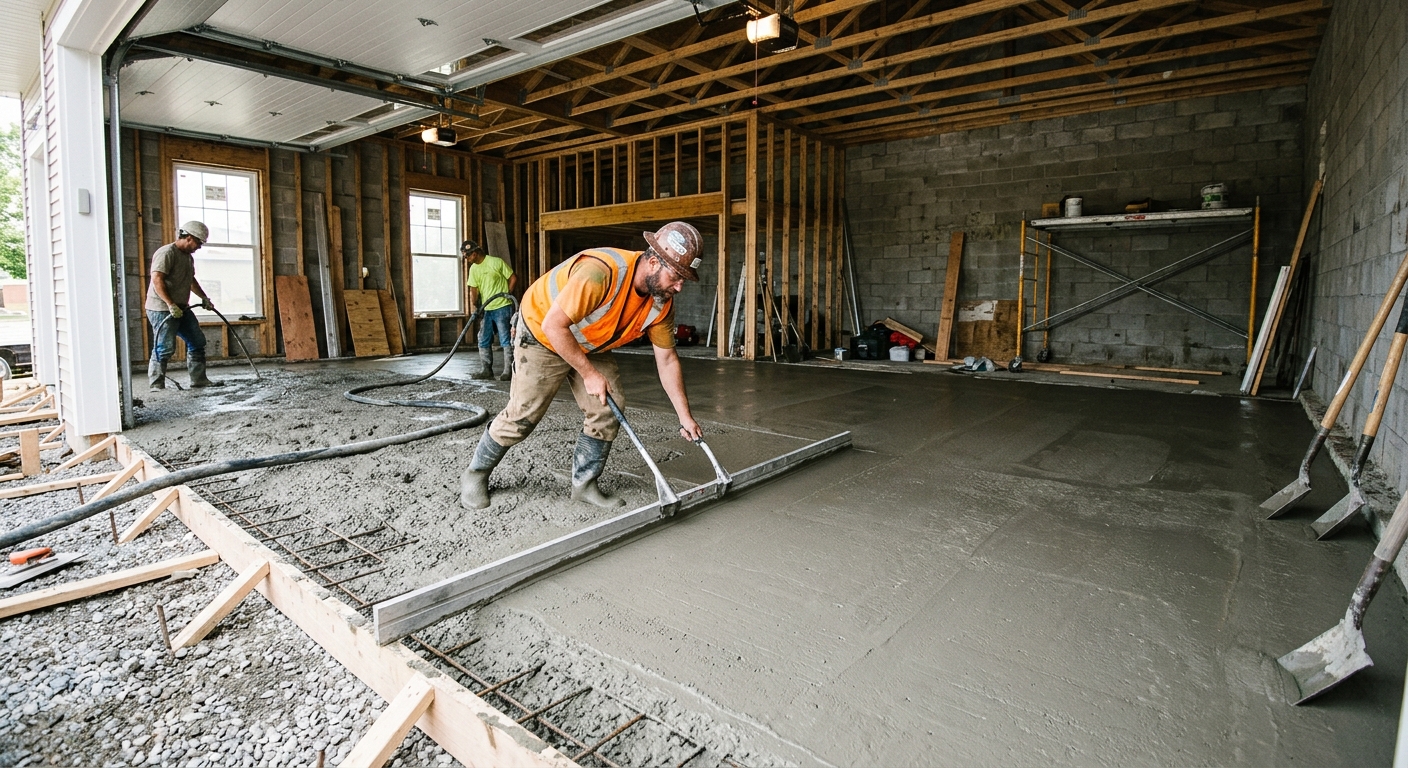
Concrete work options and costs in Martindale
Martindale is a growing community within the Calgary economic region, and that matters for homeowners planning new concrete flatwork or foundation upgrades. With a 2021 population of 14,540 (Statistics Canada, 2021 Census), there’s a steady flow of residential builds and renovations—most of which end up needing concrete driveways, patios, walkways, and footings. The local housing mix leans heavily toward single-detached and small-lot homes, the primary demand for slabs like driveway aprons, rear patio pours, and garage floors. As those projects stack up, pricing is also influenced by how quickly crews can mobilize and how much excavation volume each site requires.
In the Calgary-area cold continental climate, concrete pricing is engineered around frost and freeze–thaw. A design frost depth around 1.2 m (roughly 4 ft) means footings for houses, garages, decks, and retaining structures must bear below undisturbed soil at the right depth to prevent frost heave and seasonal movement. Exterior slabs also need air-entrained concrete, properly graded granular base prep, and control joints to reduce cracking and spalling when temperatures swing repeatedly above and below freezing. Finally, Alberta’s shorter practical pour season for exterior work often pushes scheduling into late fall/early spring, when cold-weather curing precautions (blankets, heat as required) add labour and materials. You’ll often notice this most in high-demand pockets like newer residential lanes around Martindale’s established school-area corridors, where trades get booked for driveways and walkways close together.
Below is a practical comparison of common concrete options you’ll see quoted in Martindale, including typical size assumptions and the key specs that drive cost—so you can compare apples-to-apples when you request bids.
| Application |
Typical Size |
Key Spec |
Finish Option |
Price Range |
| Concrete driveway (standard broom finish) |
400–600 sq. ft. |
Air-entrained, fibre optional; rebar or mesh based on thickness |
Broomed trowel finish |
$12,000–$18,000 |
| Exposed aggregate driveway |
400–600 sq. ft. |
Air-entrained; controlled mix + aggregate selection |
Exposed aggregate (surface retarder) |
$14,500–$22,000 |
| Stamped concrete driveway or patio |
300–600 sq. ft. |
Air-entrained; integral colour; release + stamp system |
Stamped pattern + sealer |
$15,000–$26,000 |
| Plain concrete patio or walkway |
150–350 sq. ft. |
Air-entrained exterior mix; min. thickness per design |
Smooth or broom finish |
$5,000–$9,000 |
| Garage floor (interior slab) |
350–650 sq. ft. |
Vapour barrier + reinforcement per slab design |
Trowelled finish |
$6,500–$12,500 |
| Foundation footings (structural, below frost) |
Typical 1–2 storey home footprint |
Engineered footing dimensions; excavation to design frost depth |
Structural concrete, not decorative |
$28,000–$45,000 |
Prices are estimates only and vary by project scope, site access and material selection.
What affects the price of concrete work in Martindale
In Martindale and across the Calgary area, it’s common to see quotes for what looks like the “same” concrete project vary by 30–50%. The difference usually isn’t the concrete itself—it’s the engineering reality of getting the job to survive frost and repeated freeze–thaw. In a region with deeper frost concerns (about 1.2 m design depth locally), footings must extend below the design frost depth to avoid frost heave, and that typically means more excavation, more concrete volume, and more forming height. For exterior slabs like driveways and patios, air-entrained concrete and a properly compacted granular base aren’t optional if you want long-term durability.
Freeze–thaw drives several cost items: air-entrainment in the mix, granular sub-base preparation, and a control-joint strategy to manage shrinkage cracking. Cold placement also compresses schedules—late fall or early spring work may require insulated blankets and sometimes temporary heat to achieve curing targets. When that curing window is rushed, you can get surface scaling or spalling later, and that risk often shows up as a “cheap quote” today and a rework or patch plan tomorrow. De-icing salt accelerates surface wear, which is why sealing is such a big conversation for exterior work.
In Martindale specifically, two common factors push costs up: removing clay-rich topsoil and replacing it with engineered granular base, and restricted access that forces smaller pours or extra labour for equipment positioning. Conversely, costs can come down when the excavation is straightforward (flat grade, easy truck access) and your driveway footprint is simple. For example, an engineered driveway slab in the $12,000–$18,000 range can climb quickly if you’re moving down to meet frost-depth requirements and add reinforcement for a heavier vehicle use pattern. Meanwhile, a stamped driveway/patio in the $15,000–$26,000 band can be justified by labour-heavy finishing and integral colour work—but not every site needs that added complexity if a broom-finish slab will meet your performance goals.
| Price Factor |
Why It Matters |
Cost Impact |
| Frost line depth — determines footing depth and form height |
Footings must bear below design frost depth to prevent heave |
Higher excavation + concrete volume; larger footing formwork cost |
| Site preparation — excavation, grading, compacted granular base |
Compaction quality controls settlement and slab cracking |
More truckload/hauling and labour when soil is soft or removal is required |
| Reinforcement — rebar or wire mesh requirement |
Resists shrinkage cracking and helps distribute loads |
Adds material + placement labour; increases inspection/QA time |
| Mix design — air-entrainment and compressive strength spec |
Air-entrainment and strength affect freeze–thaw and durability |
Cold-weather/air content mix may cost more; ensures long-term performance |
| Finish type — broom vs. stamped vs. exposed aggregate |
Finishing system labour and materials change dramatically |
Stamped/exposed typically adds labour and product costs |
| Pour size and concrete truck access to site |
Short access can mean extra equipment or smaller staging |
More time/mobilization cost; sometimes higher labour per cubic metre |
| Cold-weather curing precautions — heating and blankets |
Ensures proper curing despite temperature swings |
Blankets, heaters, monitoring labour; sometimes extended schedules |
| Control joint pattern and sealing cost |
Controls cracking location; sealing reduces salt-driven surface damage |
Additional cutting time and sealer product cost |
Permits & regulations in Alberta
In Alberta, the permit rules depend on what concrete work you’re doing and whether it’s considered structural. Structural concrete work—such as foundation footings, foundation walls, and grade beams—requires a building permit and often engineered drawings that are reviewed as part of the foundation and structural process. For concrete flatwork like patios, walkways, and driveways, a permit is typically not required on its own unless the work affects lot grading, changes impervious surface coverage limits, or touches the municipal right-of-way. The safe approach in Martindale is to confirm with the local authority before breaking ground, especially if you’re altering drainage patterns, moving downspouts, or changing elevations near the sidewalk.
Before you hire anyone, verify three things: (1) liability insurance, (2) WSIB/WCB coverage, and (3) references on similar-scale projects. In practice, this is how a homeowner in Martindale can check:
- Licence/registration: Use Alberta’s online business/professional search tools (and the contractor’s own number on their quotes/ads) to confirm the correct entity is registered to do the work.
- Certificate of insurance: Ask for a current COI showing general liability and correct project address; ensure it’s not expired.
- WCB/Workers’ compensation: Request proof of coverage so you’re not stuck with payroll-related exposure if someone is injured on site.
- Clearance letter (where applicable): Some contractors provide a clearance letter or WCB account status confirmation upon request.
- References: Get at least 2–3 photos and addresses of completed projects with similar frost-depth excavation and slab thickness.
Getting concrete right in Martindale's freeze-thaw climate
Concrete fails in Martindale’s freeze–thaw climate mainly when water gets into the slab/base system and can’t drain, or when the mix and curing don’t meet cold-weather requirements. The biggest long-term trigger for visible damage is inadequate air-entrainment: without the correct air system, repeated freezing can lead to scaling and spalling, especially where de-icing salt is used on driveways and garage approaches. To spec the job correctly, focus on five stages: (1) base preparation—excavate to the right depth and build a compacted granular sub-base so the slab isn’t sitting on unstable material; (2) mix design—use an air-entrained exterior mix with target air content (commonly 5–7% for exterior flatwork) and a minimum 32 MPa compressive strength where required for durability; (3) control joints—space and cut them to manage shrinkage cracking; (4) curing—plan at least 7 days of curing under proper conditions, with insulated blankets or heat as needed when temperatures drop; and (5) sealing—apply a penetrating sealer after the cure period (often after 28 days) to repel de-icing salts and reduce surface deterioration.
When you compare options, it’s also about understanding where the money is truly doing something. For instance, moving from a plain broom finish to a stamped driveway in the $15,000–$26,000 band can be justified by integral colour, stamp tools, and extra finishing labour. But if the base prep and air-entrainment are weak, the cheaper plain patio in the $5,000–$9,000 band won’t protect you from spalling either—it will just look “bad sooner.” In Calgary-area conditions, the correct specs outperform decorative upgrades every time.
| Spec |
Why It Matters in Martindale |
What to Ask For |
Impact if Skipped |
| Compacted granular base (depth?) |
Supports the slab and prevents frost-related movement |
Base depth/section detail and compaction method (and proof of thickness) |
Settlement, cracking, premature edge failure |
| Air-entrained concrete mix (target air %?) |
Protects against freeze–thaw scaling and spalling |
Exterior mix with target air content (typically 5–7%) |
Surface deterioration when temperatures cycle |
| Compressive strength (MPa rating) |
Ensures durability and long-term load performance |
Minimum 32 MPa (or project-specific rating) documented on paperwork |
Reduced resistance to wear and cracking |
| Control joints (spacing per ACI guidelines) |
Controls where shrinkage cracks form |
Joint layout plan with spacing appropriate to thickness and slab dimensions |
Random cracking across visible areas |
| Minimum 7-day curing period |
Cold weather slows strength gain; curing protects the surface |
Curing plan for your pour date (blankets/heaters if required) |
Weak early strength, increased scaling risk |
| Penetrating sealer (when applied after cure) |
Salt resistance and reduced water ingress |
Application timing (often after 28 days) and sealer type/coverage rate |
Faster surface wear and spalling around edges |
How to choose a concrete work contractor in Martindale
Choosing a concrete contractor in Martindale is mostly about verifying that they can deliver the technical parts of a freeze–thaw-ready job—not just pouring day logistics. Start with Alberta compliance checks: ask for their current liability insurance certificate, confirm Workers’ Compensation coverage (WSIB/WCB equivalent coverage status), and request a clearance letter or proof of coverage when available. Also verify the contractor’s registration/licence status through Alberta’s online directories or the appropriate public registry, and make sure the quote is issued to the correct legal company name you can match to the COI.
Next, don’t accept a “lump sum” without an itemised breakdown. Get 2–3 written quotes that separate labour and materials where possible—excavation, base material and compaction, reinforcement, concrete mix, finishing, saw cutting, sealing, and any disposal or haul requirements. Read the scope carefully: what’s excluded (topsoil removal, regrading, sump/discharge tie-ins, frost-depth excavation depth, disposal fees)? Is the permit pull included for structural work, and who handles it? For warranty, ask for workmanship warranty length, what product/manufacturer warranty applies (if any), and whether the warranty transfers to you if you sell the property.
For payment, set a clear schedule: never pay more than 10–15% upfront, and hold back a portion until the job is complete and cleaned, with curing/sealing completed where included. Ask for a written start date and completion timeline that accounts for curing and weather delays.
- Ask for photos of recent Calgary-area pours, not just brochures.
- Confirm they build to design frost depth where structural concrete is involved.
- Request air-entrainment documentation for exterior flatwork.
- Ask how they handle cold-weather curing (blankets/heat plan).
- Get joint spacing and finishing details in writing.
- Confirm base depth and compaction method (not vague “proper base prep”).
- Ensure quotes list reinforcement type (mesh vs. rebar) and thickness assumptions.
- Verify whether de-icing salt exposure is addressed via sealer inclusion.
- Clarify disposal/haul: is garbage, concrete waste, and excess material included?
- Confirm equipment access plan for your site (pumper vs. truck access).
- Require an itemised schedule and change-order process.
- Ask about cleanup and protection (covers, cut dates for joints, sealer timing).
Concrete red flags in Martindale include: skipping documentation for air-entrained exterior mix, refusing to discuss frost-depth excavation details for footings, vague scopes that don’t list base depth/compaction, cutting corners on control joints or curing, and quoting without clarifying whether sealing is included after the cure window.
Frequently asked questions — concrete work in Martindale
How long does concrete take to cure?
In Martindale and across Alberta’s cold continental climate, curing time depends on temperature and exposure, but a common rule is that concrete should cure for at least 7 days before you treat it like it’s fully ready for heavy use. Strength keeps developing beyond that, so for exterior durability—especially where de-icing salts are used—you should plan around the full cure timeline. For sealing, many systems are applied after the surface has cured adequately, often around 28 days, so the sealer can better repel water and salts. If you’re pouring in late fall or early spring, the contractor should include cold-weather precautions (insulated blankets and monitoring) to avoid weak early strength and surface scaling.
Do I need a permit for concrete work in Alberta?
In Alberta, it’s usually the structural nature of the concrete that triggers permitting, not the material itself. Foundation footings, foundation walls, and grade beams typically require a building permit and often engineered drawings reviewed as part of the structural process. Concrete flatwork like patios, walkways, and driveways often does not require a permit unless it changes lot grading, affects impervious surface limits, or involves municipal right-of-way considerations. For Martindale homeowners, the practical step is to confirm with the local authority before starting, particularly if you’re adjusting drainage routes, lowering/raising elevations near the sidewalk, or tying into existing downspouts. A reputable contractor should be able to tell you which portion is covered and what they need from you.
Concrete vs pavers for a patio in Martindale?
Concrete and pavers can both work well in Martindale, but freeze–thaw and salt exposure push many homeowners toward the right solution for the site. A plain concrete patio typically lands in the $5,000–$9,000 band, assuming a straightforward shape and correct base prep. Pavers can be more forgiving if you expect future landscaping tweaks, and they let individual units be replaced; however, they still require a well-compacted granular base and proper edge restraint to prevent shifting in wet cycles. If your patio is near a driveway where snow clearing and salt are frequent, properly sealed concrete can be a low-maintenance choice—provided it’s air-entrained and cured correctly. If you want a more decorative look, stamped concrete in the $15,000–$26,000 range may fit better than pavers for certain homeowners’ budgets and timelines.
How long does a concrete driveway last?
A well-built concrete driveway in Alberta commonly lasts decades, but the real answer depends on frost-depth performance, base compaction, air-entrained mix quality, and how joints and sealing are handled. In Martindale, freeze–thaw cycles and de-icing salts make air-entrainment and a proper joint strategy critical to prevent scaling and spalling. If the job is done with the right exterior mix and the slab is cured under suitable conditions, you can expect long service life. If the contractor cuts corners—like using an inadequate base depth, skipping air content, or skipping sealing after cure—damage can show up much sooner, often in high-traffic edges and around expansion/joint locations. When you compare bids for a driveway in the $12,000–$18,000 range, make sure the spec sheet matches the performance you’re paying for.
What is air-entrained concrete and why does it matter here?
Air-entrained concrete is designed to survive freeze–thaw by building tiny air bubbles into the mix. Those bubbles give freezing water room to expand, reducing the internal pressures that cause scaling and spalling on exterior surfaces. In Martindale and the broader Calgary region, the repeated temperature swings around freezing make air content a key spec, not a “nice to have.” For exterior flatwork, the target air content is typically around 5–7%, and the contractor should use an appropriate exterior mix design and document it. If you skip air-entrainment or use the wrong mix for cold weather, the slab may look fine at first but deteriorate as freeze–thaw continues and salt exposure accelerates surface wear.
How do I prepare the base for a concrete slab?
Base preparation is the foundation of a durable slab in Martindale’s climate—literally and performance-wise. For exterior work, excavation should reach the engineered section and, where required for structural elements, bear below the design frost depth so frost heave doesn’t move the slab. For driveways and patios, the granular base must be graded to the correct slope, then compacted to the required density before concrete placement. Homeowners should ask the contractor for the base depth, material type (and whether it’s replaced for weak soils), and compaction approach. A good contractor will also plan reinforcement and joint layout around the slab thickness so you don’t get random cracking. Even with a premium finish, skipping proper base prep can turn a driveway in the $12,000–$18,000 range into an early-repair problem.