Concrete work options and costs in Beaumaris
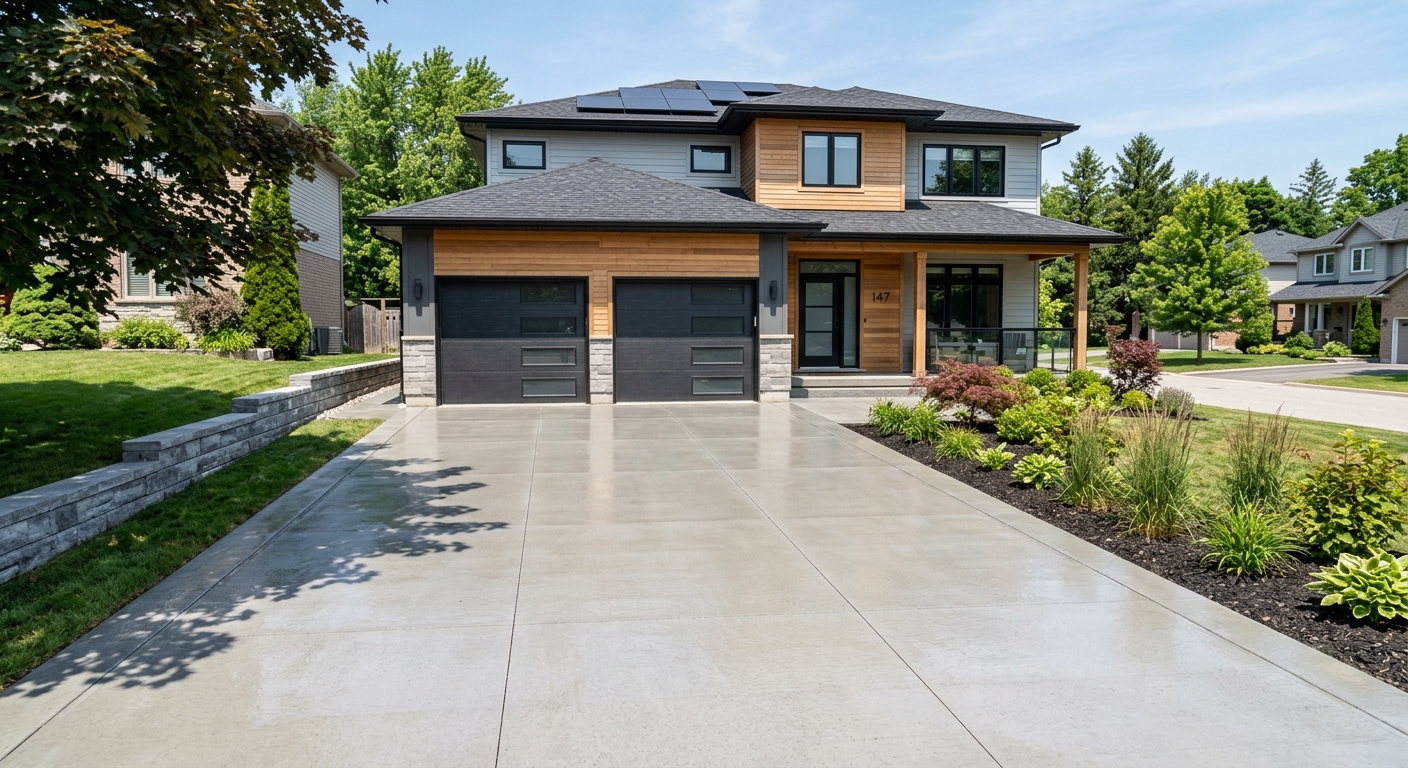
Beaumaris, Alberta is a smaller community within the Calgary economic region, with a 2021 population of 4,383 (Statistics Canada, 2021 Census). For most homeowners here, concrete flatwork is about improving curb appeal and durability for driveways, garages, patios and walkways on lots where winters are long and winters are hard on surfaces.
Calgary-area housing stock tends to favour single-detached lifestyles (Statistics Canada, 2021 Census), which means many projects start with driveways and garage slabs, then expand to patios and retention-style landscaping. The big reason pricing moves around in Beaumaris is the climate engineering: the design frost depth is roughly 1.2 m (about 4 ft), so exterior footings and structural elements must bear on undisturbed soil below that level. That increases excavation and concrete volumes compared with milder regions.
Just as important, the freeze–thaw cycling around Calgary drives specifications—air-entrained concrete, careful granular base prep, and well-spaced control joints—to reduce cracking, scaling and spalling. You also get a shorter practical exterior pour season, so winter placement requires cold-weather curing precautions (insulating blankets and sometimes temporary heat) to protect the slab during the critical early cure window.
In Beaumaris, concrete work is especially in demand in family-oriented residential streets where access is tight and driveways are often reworked alongside grading and landscaping—planning and logistics can affect labour and truck trips. Use the ranges below as a practical starting point before you compare contractor line-items in your quote.
| Application |
Typical Size |
Key Spec |
Finish Option |
Price Range |
| Concrete driveway (standard broom finish) |
400–600 sq. ft. |
Air-entrained mix, compacted base, typical rebar where required |
Broom finish + control joints |
$12,000–$18,000 |
| Exposed aggregate driveway |
400–600 sq. ft. |
Air-entrained mix, properly graded base |
Exposed aggregate with sealer |
$15,000–$21,000 |
| Stamped concrete driveway or patio |
250–450 sq. ft. |
Air-entrained mix, integral colour (where specified) |
Stamped pattern + release + seal coat |
$15,000–$26,000 |
| Plain concrete patio or walkway |
200–350 sq. ft. |
Compacted granular base, joints as required |
Broom finish or light broom |
$5,000–$9,000 |
| Garage floor (interior slab) |
400–600 sq. ft. |
Reinforcement as required, vapour barrier (if specified) |
Broom or smooth trowel (non-slip broom preferred) |
$9,500–$15,500 |
| Foundation footings (structural, below frost) |
Typical house 1,200–1,800 sq. ft. footprint |
Excavate to design frost depth, reinforced concrete footings |
Structural concrete (engineered) |
$28,000–$45,000 |
Prices are estimates only and vary by project scope, site access and material selection.
What affects the price of concrete work in Beaumaris
In Beaumaris and the wider Calgary area, it’s common to see quotes for the “same” concrete job land 30–50% apart. The difference is usually in the engineering details, not just the slab thickness. One contractor may price the concrete and finishing, while another factors in deeper excavation for frost protection, proper granular base compaction, and reinforcement that’s required for cracking resistance in freeze–thaw conditions.
Here’s the key: the frost depth is about 1.2 m (roughly 4 ft), and exterior elements must be founded below that design frost level to prevent heave and seasonal movement. That drives form height, excavation volume and truck requirements—especially for driveways, garages with exterior steps/approaches, retaining work and structural footings. On top of that, Calgary’s freeze–thaw cycles push contractors to use air-entrained mixes and plan control joints to reduce spalling and scaling. Cold-weather placement also changes the economics: achieving proper curing may require winter-grade mixes, insulated blankets and/or temporary heat, which adds labour time and equipment costs.
In practice, a few Beaumaris scenarios swing the price up or down. If your driveway ties into uneven existing grade, the base prep can increase significantly—moving from “routine” to “heavy” excavation. If your soil is more reactive or drainage is poor, contractors may recommend more granular undercut and improved drainage before pouring. Conversely, if access is wide and the pour area is straightforward, you can keep a standard broom-finish driveway closer to the $12,000–$18,000 band; if you add stamp, integral colour or exposed aggregate, the budget typically moves toward the $15,000–$26,000 stamped/decorative range because the finish workflow is more labour-intensive and weather-sensitive.
| Price Factor |
Why It Matters |
Cost Impact |
| Frost line depth |
Determines footing depth and form height |
More excavation and concrete volume can raise foundation/structural pours noticeably (often the biggest swing for below-grade work) |
| Site preparation |
Excavation, grading, compacted granular base |
Unexpected undercut, hauling, and better drainage/base work can add significant labour and equipment time |
| Reinforcement |
Rebar or wire mesh requirement |
Material cost plus placement labour; also affects how contractors finish and joint the slab |
| Mix design |
Air-entrainment and compressive strength spec |
Air-entrained/winter-grade mixes cost more and may require extra curing precautions |
| Finish type |
Broom vs. stamped vs. exposed aggregate |
Stamped and exposed finishes add labour, timing control, and often sealer/colour materials |
| Pour size and concrete truck access to site |
Logistics affect how quickly concrete must be placed and finished |
Limited access may mean more staging labour and extra trips/equipment |
| Cold-weather curing precautions |
Heating and blankets |
Shortens risk window but increases cost; skipping can lead to surface scaling |
| Control joint pattern and sealing cost |
Controls cracking and helps protect from de-icing salts |
Proper jointing and sealer are cheaper than premature repairs |
Permits & regulations in Alberta
In Alberta, structural concrete work—typically including footings, foundation walls, and grade beams—requires a building permit, and engineered drawings are often reviewed by the municipality. Concrete flatwork (patios, walkways and driveways) usually doesn’t require a permit unless it affects lot grading, impervious surface coverage limits, or the municipal right-of-way. The safest approach in Beaumaris is to confirm with the local authority before you break ground, especially if you’re changing drainage patterns, raising the grade, or adding stairs/retaining elements.
Step-by-step, here’s how a homeowner can verify a contractor in Alberta:
- Check the contractor’s licence/registration details through the appropriate Alberta registry for their trade category (request the licence number and verify it online).
- Ask for a certificate of liability insurance (make sure the policy is active and matches your project address).
- Confirm coverage for workers via WSIB/WCB documentation (request a clearance letter if they provide one for your scope).
- Request references from similar-scale concrete jobs (driveway slabs, stamped work, or footing/foundation-related work depending on your project).
- Get everything in writing: scope, concrete specs (air-entrainment/winter protection where needed), and warranty terms.
If the quote blends structural and flatwork, ask which portions are permit-requiring and whether the contractor will coordinate the paperwork—or whether you’ll need to apply separately.
Getting concrete right in Beaumaris's freeze-thaw climate
Concrete can fail in Beaumaris when freeze–thaw movement penetrates a slab’s weakest links: the base, the mix, the crack control, and the early cure protection. The first line of defence is base preparation—compact a granular sub-base to the right depth for your soil conditions and frost considerations so the slab doesn’t “pump” during thaw. Second is mix design: for exterior flatwork, you want air-entrainment (commonly targeted around 5–7% air content) and a minimum compressive strength typically specified at 32 MPa so the concrete can better resist scaling and spalling.
Third is control joints. Proper joint spacing limits random cracking so the slab can move slightly without pushing cracks into corners, edges and vulnerable transitions. Fourth is curing: aim for at least 7 days under proper conditions, and in cold snaps use winter-grade placement methods such as insulated blankets and, when necessary, temporary heating to keep the slab from curing too cold. Fifth is sealing: a penetrating sealer applied after the cure window helps repel de-icing salts that accelerate surface deterioration.
To ask the right technical questions, look for contractors who speak to air-entrainment and jointing rather than just “pour and broom.” For example, a basic broom-finish patio may fall near the $5,000–$9,000 band, but if you’re considering a stamped option closer to $15,000–$26,000, the price should be justified by colour, pattern work and proper curing/sealing workflow—not by cutting corners on base compaction or air content. In Calgary-area freeze–thaw conditions, the cheapest mix or rushed cure is often what costs the most later through surface scaling and premature spalling.
| Spec |
Why It Matters in Beaumaris |
What to Ask For |
Impact if Skipped |
| Compacted granular base (depth?) |
Prevents slab settlement and reduces frost-related movement |
Documented sub-base depth and compaction method for your soil |
Cracking, uneven surfaces, and increased spalling risk |
| Air-entrained concrete mix (target air %?) |
Survives freeze–thaw cycles by allowing safe expansion/contraction |
State air content target (typically ~5–7% for exterior flatwork) |
Surface scaling and early spalling, especially with de-icing salts |
| Compressive strength (MPa rating) |
Ensures structural durability and long-term performance |
Minimum 32 MPa specified for the application |
Reduced durability, higher risk of cracking and surface damage |
| Control joints (spacing per ACI guidelines) |
Controls crack locations under thermal and moisture movement |
Joint layout plan and spacing that matches slab size/thickness |
Random cracking and wider crack openings over time |
| Minimum 7-day curing period |
Early-age strength gain depends on temperature and protection |
How they protect curing in cold weather (blankets/heating if needed) |
Weak surface, scaling, and poor long-term wear |
| Penetrating sealer (when applied after cure) |
Repels salts and reduces water ingress during freeze–thaw |
Sealer application after cure (commonly 28 days post-pour) |
Faster deterioration from salt and moisture penetration |
How to choose a concrete work contractor in Beaumaris
When you’re hiring concrete contractors in Beaumaris, Alberta, start with verification. Ask for their Alberta licence/registration information for the trade they’re performing, and confirm it using the online registry resources associated with their category. Next, request a certificate of liability insurance that lists your project address and confirms coverage is active for the contract period. For worker protection, ask for WSIB/WCB clearance or documentation—reputable crews can provide this without hesitation.
Then compare quotes the right way. Get 2–3 itemised written quotes with a clear labour and materials breakdown, not just a lump sum. You want separate line-items for excavation and disposal, base materials, reinforcement, concrete supply (and whether it’s air-entrained and/or winter-grade), formwork, finishing, joints, and sealing. Make sure you understand what’s excluded: old slab removal, saw-cutting, regrading tie-ins, permit coordination (if any), and concrete truck access/equipment costs.
Look for warranty terms that cover workmanship—often you’ll see a limited term for cracking/spalling or “reasonable” defects, but the best ones are specific and in writing. Confirm whether any product/manufacturer warranty is included and whether it’s transferable to you.
Payment schedule matters too: avoid paying more than 10–15% upfront. Hold back a portion until forms are stripped, joints and edges are finished, and final cleanup is completed. Finally, insist on a written timeline with a start date and completion estimate, especially because freeze–thaw and curing protection can affect scheduling in Alberta.
- Licence/registration number provided and verifiable for the exact trade scope.
- Active liability insurance certificate for your project dates and address.
- WSIB/WCB documentation (or clearance letter) available before work starts.
- Itemised quote (base prep, rebar/mesh, concrete spec, joints, finish, sealing).
- Clear thickness and elevation targets for the slab and any approach ramps.
- Written frost-prep and drainage plan for exterior pours.
- Confirmation the concrete will be air-entrained for exterior work.
- Control joint spacing plan and saw-cut/formed joint timing included.
- Cold-weather curing plan (blankets/heating) when near freezing.
- Sealing included or clearly stated as a separate option with timing (28 days post-pour).
- Disposal and debris removal scope defined (hauling included or not).
- Warranty length and what defects it covers—workmanship vs product.
Red flags in Beaumaris include: (1) quotes that omit air-entrainment for exterior slabs, (2) “we’ll pour anytime” promises without a cold-weather curing plan, (3) vague jointing language (“we’ll add a few lines”) or no joint layout, (4) asking for large deposits upfront, and (5) refusing to provide proof of insurance/WSIB/WCB before starting.
Frequently asked questions — concrete work in Beaumaris
Do I need a permit for concrete work in Alberta?
In Alberta, structural concrete work such as footings, foundation walls and grade beams generally requires a building permit, often supported by engineered drawings reviewed through the municipal process. For typical flatwork—like patios, walkways and most driveways—permits are commonly not required unless you’re changing lot grading, creating or altering drainage in a way that affects compliance, or affecting municipal right-of-way/servicing conditions. In Beaumaris, I recommend confirming whether your scope touches grading or drainage before breaking ground, because that’s where permitting questions most often surface. Also make sure the contractor is properly insured and has WSIB/WCB coverage documentation, since permitting and risk responsibilities can overlap.
Concrete vs pavers for a patio in Beaumaris?
Concrete and pavers both work well in Beaumaris, but they fail differently. Concrete flatwork, if done with air-entrained mix, good base prep, and correct control joints, can handle Calgary-area freeze–thaw very efficiently—and it’s often simpler to maintain long-term. A plain concrete patio or walkway commonly lands around the $5,000–$9,000 band depending on size and site conditions. Pavers can be easier to repair if individual units shift, but the base and bedding layers must still be engineered for frost movement and drainage. In practice, if you want a monolithic surface with fewer seams to weed, concrete is usually the more predictable choice; if you expect frequent landscaping changes or utility work, pavers can be more forgiving.
How long does a concrete driveway last?
With correct specs for Beaumaris—compacted granular base, air-entrained concrete, proper joints, and appropriate curing—many concrete driveways can last decades. The Calgary climate’s freeze–thaw cycles and de-icing salts are the main stressors, so the durability hinges on details early in the job, not just thickness. A contractor who specifies winter-grade placement practices and plans for curing protection in cold snaps will usually protect the slab’s surface quality. Sealing after cure (commonly around 28 days) helps repel moisture and salts. If joints are missing or irregular, or if the base wasn’t prepped properly, you may see spalling or random cracking much sooner. When budgeting, a standard broom-finish driveway often sits in the $12,000–$18,000 range; the “cheap” option that skips engineered base prep typically costs more later.
What is air-entrained concrete and why does it matter here?
Air-entrained concrete is mixed with microscopic air bubbles that provide space for water to expand when temperatures drop and ice forms. In Beaumaris and the Calgary region, frequent freeze–thaw cycles make this critical: without proper air entrainment, water pressure damages the surface paste, leading to scaling and spalling over time. That’s why reputable contractors for exterior flatwork should specify air-entrainment and confirm target air content (often in the ~5–7% range for exterior slabs). Air-entrainment doesn’t eliminate cracking entirely—control joints still matter—but it dramatically improves freeze–thaw durability. If a contractor won’t discuss air content and curing protection, that’s a strong sign they’re pricing convenience rather than engineering for our climate conditions.
How do I prepare the base for a concrete slab?
Base preparation is the part of the job you can’t “finish your way out of” later. For concrete slabs in Beaumaris, contractors should excavate and grade to remove topsoil and soft material, then place compacted granular sub-base in layers to reach the engineered depth for your soil and local frost considerations. The goal is a stable, well-drained base that won’t settle or pump under freeze–thaw movement. A proper granular base also helps concrete achieve consistent thickness and finish quality. Ask your contractor for their planned sub-base depth, compaction method, and how they’ll handle drainage at edges and slopes. Then verify the mix is air-entrained for exterior work and that control joints will be installed/saw-cut on schedule.
How do I compare concrete quotes?
Comparing concrete quotes is less about the bottom-line number and more about the scope behind it. Start by requesting itemised quotes that break out excavation/disposal, base materials and compaction, reinforcement (rebar/mesh as required), concrete supply (including air-entrainment and compressive strength), finishing labour, jointing, and sealing. Confirm whether cold-weather curing precautions (blankets/heating) are included—Beaumaris schedules can be affected when temps drop. Make sure the quote states the finish type: standard broom versus stamped (often in the $15,000–$26,000 range depending on size and complexity) versus exposed aggregate. Watch for exclusions such as removing old slabs, hauling spoils, or permit coordination (if any permit is required for structural work). A quote that’s cheaper because it leaves out specs like air entrainment or base compaction is usually cheaper only at the moment you sign.