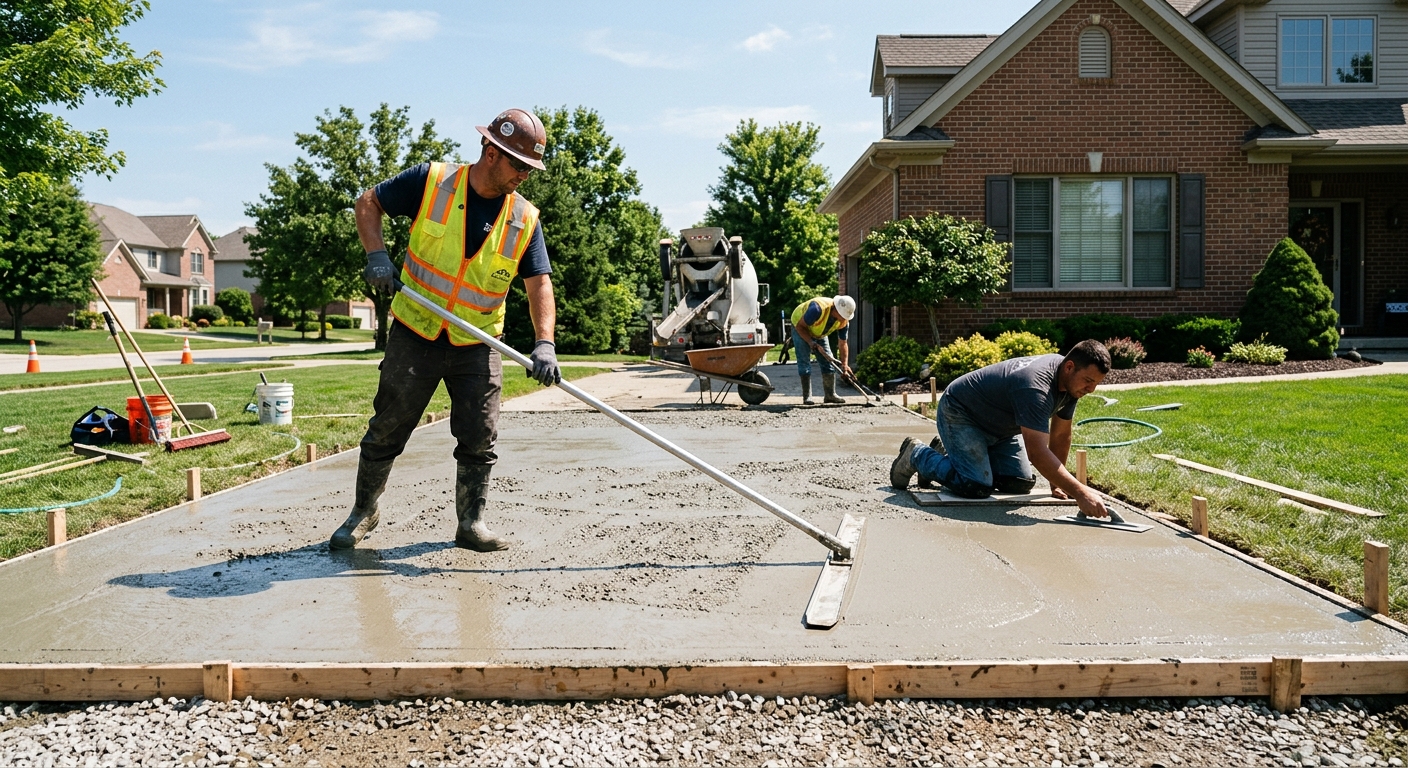
Concrete work options and costs in Tawa
Tawa, Alberta is a small community of about 1,972 residents (Statistics Canada, 2021 Census), and the homeowners here tend to prioritize durable exterior surfaces—driveways, patios, and walkways that can handle Calgary-area weather swings. In this region, concrete flatwork is especially in demand around established residential pockets such as Ranchlands Drive and the broader southeast side of town, where more properties are improving front approaches and rear yard access. When you’re comparing options, it helps to start with what you’re actually building: concrete is either a structural element (like footings) or an engineered exterior surface (like slabs) that’s designed to resist frost movement and freeze–thaw cracking.
Calgary and the surrounding area sit in a cold continental climate, so prices reflect frost depth engineering, heavier excavation, and a shorter exterior pour season. Local crews plan around a design frost depth of roughly 1.2 m (about 4 ft) so footings bear below frost to reduce heave and seasonal movement. For exterior slabs, contractors also price in air-entrained mixes, granular base prep, and cold-weather curing practices (insulated blankets and sometimes temporary heat) to protect curing. That’s why “the same size” job can land differently: the foundation and the slab specs are tailored to climate stress, not just square footage.
Below is a practical pricing comparison for common jobs in Tawa, with the specs homeowners most often choose before we talk details like access, reinforcement, and finish upgrades.
| Application |
Typical Size |
Key Spec |
Finish Option |
Price Range |
| Concrete driveway (standard broom finish) |
12 ft x 22 ft (approx. 264 sq. ft.) |
Air-entrained mix; compacted base; control joints; typical 4 in slab |
Broom finish + saw cut joints |
$12,000 – $18,000 |
| Exposed aggregate driveway |
12 ft x 22 ft (approx. 264 sq. ft.) |
Engineered base + air-entrained concrete; exposure wash process |
Exposed aggregate (durable, textured) |
$15,000 – $22,000 |
| Stamped concrete driveway or patio |
12 ft x 22 ft (driveway) or 300–400 sq. ft. (patio) |
Air-entrained mix; reinforcement as needed; integral colouring |
Stamp + colour release; sealed surface |
$15,000 – $26,000 |
| Plain concrete patio or walkway |
300 sq. ft. patio or 4 ft x 30 ft walkway |
Compacted base; air-entrained concrete; joints where required |
Float/trowel finish or light broom |
$5,000 – $9,000 |
| Garage floor (interior slab) |
22 ft x 22 ft (approx. 484 sq. ft.) |
Vapour control (as applicable); well-compacted base; fibre or mesh depending on spec |
Standard trowel + light broom edge |
$9,500 – $16,000 |
| Foundation footings (structural, below frost) |
Typical house perimeter (varies by design) |
Excavation to below design frost; rebar cage; engineered profile |
Structural concrete with formwork finish |
$28,000 – $45,000 |
Prices are estimates only and vary by project scope, site access and material selection.
What affects the price of concrete work in Tawa
If you get multiple quotes in Calgary-area communities like Tawa, it’s normal to see differences of 30–50% for what looks like “the same” concrete job on paper. That gap usually comes from how each contractor engineers the slab and foundation for our frost and freeze–thaw conditions—not just from labour or concrete supply. In this cold continental climate, footings must extend below the design frost depth (about 1.2 m here) to prevent frost heave, which means deeper excavation and larger footing volumes than homeowners expect. For exterior slabs, every quote has to account for air-entrained concrete, proper granular base prep, and a control joint pattern. In practice, the mix and curing matter: the colder pour window forces winter-grade approaches (insulated blankets and sometimes heat) to ensure the concrete reaches strength properly.
De-icing salt is another local cost driver. If a contractor skips or under-specs sealing, the surface can spall sooner in high-salt winters, leading to repairs that cost far more than doing it right up front. In Tawa, I often see cost differences from a few site realities: heavy clay or frost-susceptible soil usually requires more granular removal and replacement; narrow driveway access can slow truck placement and add labour; and wider driveway approaches increase finishing time, especially with joints and edging. A stamped driveway that lands near the $15,000–$26,000 band can be worth it when you want a higher-end look that still gets properly jointed and sealed for freeze–thaw durability. Meanwhile, a basic broom-finish driveway is commonly closer to the $12,000–$18,000 band when the base and reinforcement scope is straightforward.
| Price Factor |
Why It Matters |
Cost Impact |
| Frost line depth — determines footing depth and form height |
Footings must bear below design frost to limit frost heave and seasonal movement. |
Higher excavation and formwork often add thousands on foundations. |
| Site preparation — excavation, grading, compacted granular base |
Proper base prevents settlement and helps manage freeze–thaw stress. |
Clay/fill soils or uneven grade can increase base depth and haul costs. |
| Reinforcement — rebar or wire mesh requirement |
Reinforcement helps control cracking and supports heavier loads (driveways/garage slabs). |
Material + labour for tying/binding can meaningfully raise the budget. |
| Mix design — air-entrainment and compressive strength spec |
Air-entrainment improves freeze–thaw durability; strength spec affects total material cost. |
Specified winter/cold-weather mixes typically cost more but protect longevity. |
| Finish type — broom vs. stamped vs. exposed aggregate |
Decorative work requires additional labour, timing control, and materials. |
Stamped/exposed finishes often push the job into the upper driveway/patio ranges. |
| Pour size and concrete truck access to site |
Access affects equipment choices, pour staging, and labour time. |
Long wheelbarrow carries, crane lifts, or staged pours increase cost quickly. |
| Cold-weather curing precautions — heating and blankets |
Curing must proceed to reach required strength without surface scaling. |
Winter-grade protection can add substantial line-item labour and materials. |
| Control joint pattern and sealing cost |
Joints manage shrinkage cracks; sealing helps protect against de-icing salt damage. |
Skipping or reducing joint/seal scope can lead to earlier repairs and higher lifetime cost. |
Permits & regulations in Alberta
In Alberta, the big dividing line is whether the concrete work is part of the structural building system or simply exterior flatwork. In most cases, structural concrete work—including footings, foundation walls, grade beams, and other load-bearing structural elements—requires a building permit and typically engineered drawings for municipal review. For concrete flatwork such as patios, walkways, driveways, and garage floors, a permit often is not required, provided the work doesn’t change lot grading drainage, violate impervious surface coverage limits, or affect the municipal right-of-way. Because requirements can vary by the exact scope and how it ties into drainage, always confirm with the local authority before breaking ground.
For a homeowner in Tawa, verifying contractor compliance is straightforward if you do it in a step-by-step order. First, ask the contractor for their certificate of insurance (liability) and confirm the coverage limits and effective dates. Second, request their WCB clearance document (coverage proof) and ensure the certificate names their legal entity. Third, confirm whether the contractor is properly authorized to perform the type of work being quoted (especially if structural concrete forms part of the scope). You can verify licence/registration information and look for safety/coverage status through provincial and registry tools, then cross-check the details against the paperwork they provide. Finally, ask for references on similar-scale local projects so you can judge workmanship—not just paperwork.
Getting concrete right in Tawa's freeze-thaw climate
Concrete failures in Tawa almost always trace back to one of five things: (1) poor base preparation, (2) the wrong concrete mix, (3) control joints that aren’t placed to manage shrinkage, (4) curing that was rushed (especially when it’s cold), or (5) surface protection that doesn’t account for de-icing salt. In a freeze–thaw cycle, water expands as temperatures drop, and if the slab can’t “move safely” or if water gets trapped near the surface, you can see scaling, spalling, and random cracking.
To spec the job correctly for Calgary-area winters, start with base prep: compacted granular sub-base at the right thickness and depth for local soil and frost considerations. Next, require an air-entrained mix (commonly 5–7% air for exterior flatwork) plus a minimum 32 MPa compressive strength spec. Then lock in your joint plan—joints are placed to limit random cracking, not to be an afterthought. Curing should be at least 7 days under proper conditions; in cold weather, contractors may use insulated blankets or heat to keep the concrete on track. Finally, seal properly: a penetrating sealer is typically applied after full curing (often around 28 days) to reduce salt-driven surface deterioration.
Here’s a practical dollar example: if you’re choosing between a plain broom-finish patio and a stamped option, the stamped finish may add roughly $4,000–$7,000 depending on size and colour. That price makes sense when decorative work is paired with correct air-entrainment, joints, and sealing—otherwise you’re paying extra for appearance without the durability layer that keeps it looking good.
| Spec |
Why It Matters in Tawa |
What to Ask For |
Impact if Skipped |
| Compacted granular base (depth?) |
Supports the slab and reduces frost-related movement under freeze–thaw. |
State base depth and material; confirm compaction testing/verification method. |
Settlement and cracking; faster edge deterioration. |
| Air-entrained concrete mix (target air %?) |
Air-entrainment improves freeze–thaw durability in Calgary-area winters. |
Target air content (commonly 5–7% for exterior flatwork) and document mix design. |
Scaling/spalling risks increase significantly with salt exposure. |
| Compressive strength (MPa rating) |
Strength gain affects long-term performance under freeze–thaw and loading. |
Minimum 32 MPa (or project-specific spec) for exterior slabs/structural elements. |
Premature surface wear and higher chance of structural/repair issues. |
| Control joints (spacing per ACI guidelines) |
Joints manage shrinkage cracks when temperature changes occur. |
Joint spacing plan (and whether saw cutting timing is scheduled) for your slab size. |
Random cracking and water intrusion at unplanned cracks. |
| Minimum 7-day curing period |
Proper curing helps concrete reach adequate strength before harsh conditions hit. |
How they protect curing in cold weather (blankets/heat) and curing timeline. |
Surface scaling and reduced durability. |
| Penetrating sealer (when applied after cure) |
Reduces salt-driven surface damage during winter traffic and de-icing. |
Penetrating sealer and application timing (commonly after full cure, around 28 days). |
Faster spalling/roughening and more expensive resurfacing sooner. |
How to choose a concrete work contractor in Tawa
Choosing the right concrete contractor in Tawa comes down to proof of coverage, clarity of scope, and a realistic understanding of our freeze–thaw reality. First, verify Alberta compliance the practical way: request liability insurance (with a certificate of insurance that shows the insured contractor name and dates), and ask for WCB clearance (proof they’re covered to employ workers properly). If the contractor doesn’t want to provide those documents up front, that’s a red flag.
Next, get 2–3 itemised written quotes—ideally broken into labour and materials, with line items for excavation/base prep, reinforcement, concrete supply/mix, finishing, saw cuts, curing protection (if cold), and sealing (if included). A lump-sum quote without details is harder to compare and easier to dispute. Read the exclusions carefully: is permit pulling included if structural elements are part of the scope, is disposal (hauling spoils) included, and what’s the plan for drainage/grade adjustments around the slab?
Warranty matters too. Ask for the workmanship warranty length, the product/manufacturer warranty for any systems they’re using, and whether warranties are transferable to a future buyer. Payment should be controlled: avoid paying more than about 10–15% upfront, and hold back a portion until the work is complete and any curing/sealing items are finished. Finally, insist on a start date and estimated completion timeline in writing so weather contingencies don’t become surprises.
- Provide itemised quotes (labour + materials) instead of only a total price.
- Confirm the concrete mix plan includes air-entrainment for exterior work.
- Ask for base depth, compaction method, and whether compaction is verified.
- Require a clear rebar/mesh and tie-in detail for driveways and garage slabs.
- Ask who saw-cuts joints and when (timing affects crack control).
- Clarify curing protection for cold weather (blankets/heat) when temps drop.
- Confirm sealing is included or excluded and who supplies it.
- Ask about disposal/haul-away for removed soil and forms.
- Check liability insurance and WCB clearance with the exact contractor name/entity.
- Review references for similar Tawa-area cold-climate flatwork.
- Ensure the contract lists start date, completion estimate, and weather contingency language.
- Keep payments conservative—don’t allow large upfront deposits.
Common concrete contractor red flags in Tawa include: refusing to share WCB clearance or insurance certificates, quoting “same thickness” without explaining base depth and compacted granular prep, skipping air-entrainment claims for exterior slabs, not scheduling cold-weather curing precautions when temperatures drop, and providing vague scope language like “concrete as needed” with no joint/sealer details.
Frequently asked questions — concrete work in Tawa
Stamped vs broom-finish concrete — cost difference?
In Tawa (Calgary economic region), the difference is usually labour and timing. A standard broom-finish driveway/approach is typically priced in the $12,000–$18,000 band, while stamped concrete commonly lands higher because of colour, stamp mats, release agents, careful finishing, and sealing. For stamped driveway or patio projects, many quotes land in the $15,000–$26,000 range, depending on size, pattern complexity, and whether there’s reinforcement and decorative borders. The key point is that stamped concrete should still be engineered for frost and freeze–thaw: correct air-entrainment, proper control joints, and curing. If a contractor tries to “save money” by cutting those durability steps, the stamp won’t protect the slab—failure shows up as early cracking, scaling, or spalling.
When is the best time to pour concrete in Tawa?
The best time to pour exterior concrete in Tawa is late spring through early fall, when temperatures stay within a workable range for curing without excessive heating. In our freeze–thaw climate, crews need a reliable curing window; rushing it in late fall or early spring increases risk of surface scaling and longer-term durability issues. If a project is scheduled when nights are getting cold, reputable contractors plan for winter-grade mix and protective curing (insulated blankets and sometimes temporary heat) and they’ll document the plan in the contract. For homeowners, that means asking the contractor what the curing protection method is for the specific pour date, not just “we’ll manage it.”
How long does concrete take to cure?
Concrete curing happens on two timelines: initial set/strength gain and long-term strength development. In Alberta, a common practical benchmark is keeping the slab under proper conditions for at least 7 days before expecting normal handling, especially for exterior flatwork. Full curing and seal timing typically align around 28 days for many products, which is why penetrating sealer is usually applied after adequate cure to better repel water and de-icing salt. If you want your patio or driveway to last through multiple freeze–thaw seasons, don’t let scheduling shortcuts replace curing precautions. Ask your contractor when they will start curing protection, how they maintain temperature, and what weather triggers would pause the work.
Do I need a permit for concrete work in Alberta?
In Alberta, structural concrete work like footings, foundation walls, and grade beams typically requires a building permit and often engineered drawings reviewed by the municipality. For many concrete flatwork jobs—patios, walkways, and driveways—a permit is often not required, provided you’re not changing lot grading/drainage, violating impervious surface coverage rules, or affecting municipal right-of-way concerns. Because scope details matter, confirm with the local authority before work starts. For homeowners in Tawa, a good practical step is to ask the contractor whether permits are needed for your exact design, and who is responsible for pulling them. Make sure they can clearly explain the scope and show you any permit reference number if one applies.
Concrete vs pavers for a patio in Tawa?
For patios in Tawa, both concrete and pavers can perform well, but they fail differently. Concrete patio pricing commonly sits around $5,000–$9,000 for typical sizes, while stamped/decorative concrete goes higher. Concrete is usually faster to install and can provide a seamless surface—when built with proper base prep, air-entrainment, control joints, and adequate curing. Pavers can be an advantage if you anticipate re-grading or utility adjustments, since individual units can be lifted and reset. However, pavers still need proper excavation and base compaction, and weeds/settlement can become a maintenance issue if the base isn’t built correctly. If your goal is low ongoing maintenance and durability through salt and freeze–thaw, well-built concrete often makes the most sense.
How long does a concrete driveway last?
A concrete driveway in Alberta can last for decades, but longevity depends heavily on the details that handle freeze–thaw: air-entrained concrete, correctly sized/compacted granular base, reinforcement where needed, a good joint pattern, and sealing for de-icing salt protection. If these are done right, many homeowners see long service lives before major repairs. If they’re not, you can get early cracking, spalling, and scaling within a few winters. In Tawa’s climate, sealing timing matters—commonly after full cure around 28 days—and concrete poured late in the season needs cold-weather curing precautions. Ask your contractor what mix spec and curing method they’ll use for your pour date; that answer is often a better predictor than the “price per square foot.”