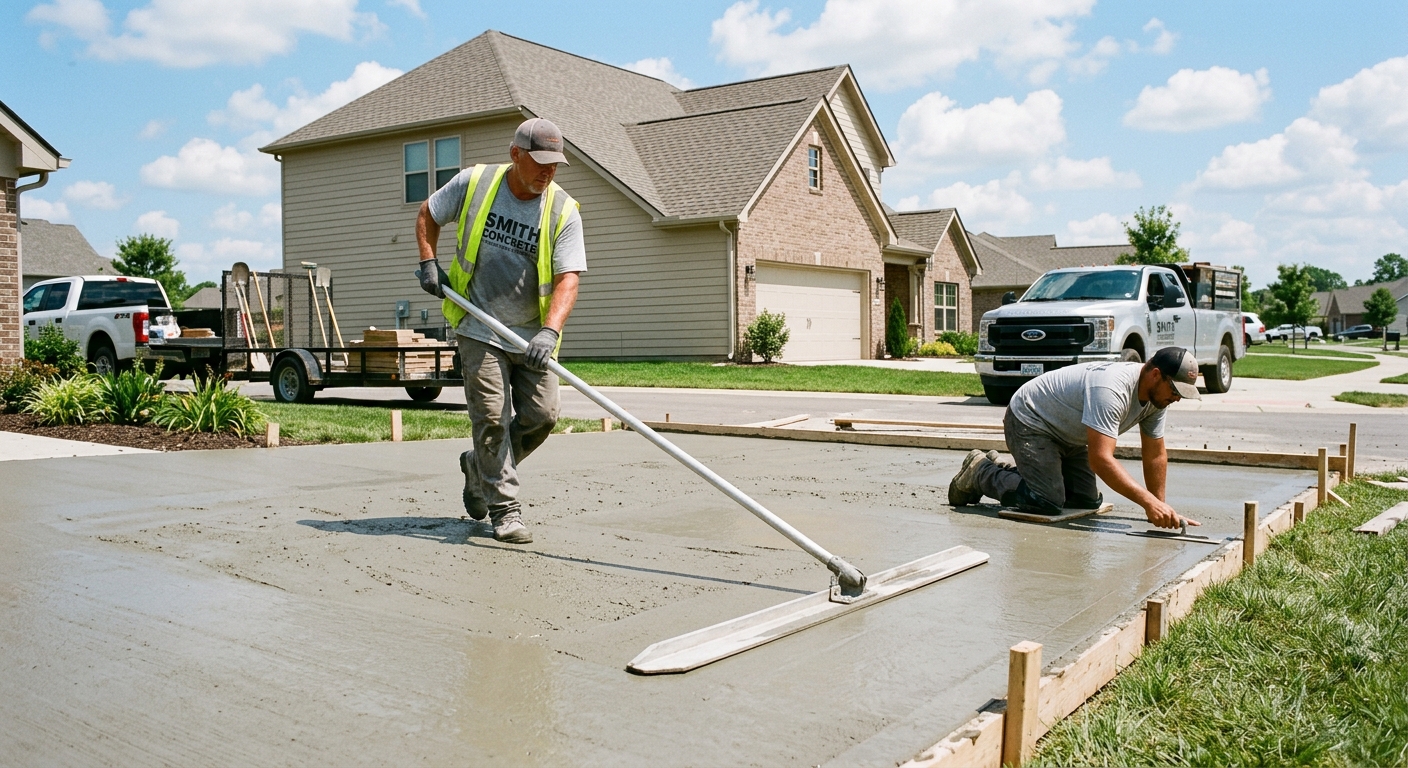
Concrete work options and costs in Dunmore
Dunmore homeowners typically consider concrete because it lasts through Alberta winters without the constant patching you see with asphalt. With a small population of 1,088 people (Statistics Canada, 2021 Census), local contractors can be selective on scheduling, so timing matters when you want exterior work done before temperatures swing. In practice, the most common concrete flatwork demand comes from the broader housing mix of single-detached homes—these owners often upgrade driveways, patios and walkways as part of exterior renovations and resale preparation. In Dunmore, the Calgary-area cold continental climate drives the cost: frequent freeze–thaw cycles force stronger specs (air-entrained mixes), deeper engineering for footings, and more granular base prep. The region also follows a design frost depth of about 1.2 m (roughly 4 ft), which is why excavation and footing volumes are higher than many milder provinces. Finally, the pour season for exterior slabs is shorter, so cold-weather placement may require insulated blankets, temporary heat, and tighter curing supervision—each of which adds labour and material overhead. If you’re in the thicker infill pocket near the core services area, or you’re upgrading access off local roads where truck access is limited, you’ll often see pricing adjust due to staging time and equipment needs.
Below are practical budget ranges so you can compare like-for-like when you request quotes for Dunmore projects.
| Application |
Typical Size |
Key Spec |
Finish Option |
Price Range |
| Concrete driveway (standard broom finish) |
400–600 sq. ft. |
Air-entrained, compacted base, control joints |
Broom finish |
$12,000–$18,000 |
| Exposed aggregate driveway |
400–600 sq. ft. |
Air-entrained mix, surface retarder/aggregate exposure plan |
Exposed aggregate finish |
$14,000–$21,000 |
| Stamped concrete driveway or patio |
300–600 sq. ft. |
Air-entrained mix, integral colour, release agent system |
Stamped & textured pattern |
$15,000–$26,000 |
| Plain concrete patio or walkway |
200–400 sq. ft. |
Compacted base, air-entrained concrete, jointing |
Float/finish with light broom or trowel |
$5,000–$9,000 |
| Garage floor (interior slab) |
500–650 sq. ft. |
Vapour barrier, base prep, welded wire mesh or rebar as specified |
Standard smooth/fine finish |
$10,500–$16,000 |
| Foundation footings (structural, below frost) |
Typical house perimeter |
Engineered reinforcement; bearing below design frost depth |
Structural concrete/inspections |
$28,000–$45,000 |
Prices are estimates only and vary by project scope, site access and material selection.
What affects the price of concrete work in Dunmore
In Calgary and the surrounding region, it’s common to see quotes for the “same” concrete job land 30–50% apart. The difference usually comes down to engineering choices made to survive Alberta’s freeze–thaw cycles, plus how complicated your site is to prepare and access. Calgary’s cold continental climate has a design frost depth of about 1.2 m (roughly 4 ft), so footings for houses, garages, retaining structures and any structural grade change must be built below that depth to reduce frost heave and seasonal movement. On exterior slabs—driveways, patios and walkways—contractors typically specify air-entrained concrete and a realistic curing plan, because cold snaps and thawing cycles increase the risk of surface scaling and long-term cracking if the concrete isn’t protected and cured properly. When the pour season tightens late in the year, some crews add cold-weather packages like insulated blankets and controlled heat to achieve proper strength gain; that adds cost but it’s often cheaper than premature repairs. De-icing salt in winter also accelerates spalling on poorly finished surfaces, so sealing and proper jointing are part of the “real” scope, not an afterthought.
In Dunmore, a few local examples show how pricing shifts. If your driveway ties into an older slab and requires partial saw-cut removal and regrading, the labour ramps up; that’s why a standard driveway budget near $12,000–$18,000 can stretch when excavation and tie-ins get involved. If you choose stamped work from the $15,000–$26,000 band, the added cost reflects colour systems, stamping labour, and careful finishing—those steps can’t be rushed without muddy edges and early surface issues. Finally, older housing lots with mature trees and constrained truck access often cost more because formwork, staging and disposal take longer.
| Price Factor |
Why It Matters |
Cost Impact |
| Frost line depth — determines footing depth and form height |
Footings must bear below the design frost depth to prevent heave |
Higher excavation volume and concrete tonnage increase costs |
| Site preparation — excavation, grading, compacted granular base |
Weak or wet subgrade leads to settlement and cracking |
More haul-off/compaction time pushes the price up |
| Reinforcement — rebar or wire mesh requirement |
Controls cracking and improves slab durability under loading |
Material plus labour for tying/spacing impacts totals |
| Mix design — air-entrainment and compressive strength spec |
Cold exposure and freeze–thaw require durable concrete |
Higher-spec mix and curing supervision add cost |
| Finish type — broom vs. stamped vs. exposed aggregate |
Finish systems affect labour time and surface performance |
Decorative finishes typically cost more |
| Pour size and concrete truck access to site |
Longer carry distances and extra staging slow production |
Access constraints increase labour and equipment time |
| Cold-weather curing precautions — heating and blankets |
Proper curing protects strength gain in early/late pours |
Added materials and labour can materially raise bids |
| Control joint pattern and sealing cost |
Jointing manages cracking; sealing helps resist salt scaling |
Better detailing and sealing usually increases value |
Permits & regulations in Alberta
In Alberta, structural concrete work generally needs a building permit and often engineered drawings reviewed through the municipality process. That includes items like foundation footings, foundation walls, grade beams, and any structural concrete supporting the house, garage or a retaining structure. For concrete flatwork—patios, walkways, and driveways—the work often does not require a permit by default, but it can trigger permit review if it affects lot grading, drainage direction, or impervious surface coverage rules, or if it involves municipal right-of-way considerations. Because Dunmore is in the Calgary region, crews commonly run into “small” drainage grading questions when a driveway elevation changes runoff patterns.
Step-by-step, here’s how a homeowner in Dunmore can verify the contractor properly before breaking ground. First, ask for their liability insurance certificate showing the policy term and limits, and confirm the certificate lists your project address or the correct insured parties. Second, request proof of WSIB coverage (Workers’ Compensation Board coverage) and make sure it’s current for the dates of work. Third, verify the contractor’s applicable Alberta registrations/licensing through the appropriate online registry tools for their trade category (your contractor’s proposal should state what licence they hold and for which scope). Finally, insist on references from similar-sized concrete jobs (driveways/sidewalks or footings depending on your scope) so you can compare finishing quality and durability in freeze–thaw conditions.
Getting concrete right in Dunmore's freeze-thaw climate
Concrete doesn’t fail in Dunmore because “concrete is fragile”—it fails because water and freeze–thaw cycles find weak points. The most common issues are spalling (surface scaling) from inadequate air-entrainment, cracking from poor base support, and long-term movement from insufficient frost-depth bearing on structural work. The way to spec the job correctly is to treat the slab like a system: base, mix, jointing, curing and surface protection must align with Calgary-area climate realities. Start with base preparation: a compacted granular sub-base should be placed to the depth required for local soil conditions and frost protection so the slab doesn’t flex. Next, require an air-entrained mix—typically designed for 5–7% air content for exterior flatwork—and a minimum compressive strength around 32 MPa so strength gain supports durability. Third, add control joints at a spacing that limits random shrinkage cracking; then cure properly—minimum 7 days under suitable conditions—because rushing curing in cold weather raises scaling risk and weak surface bond. Finally, sealing helps: apply a penetrating sealer after cure (commonly around 28 days post-pour) to repel melt water and de-icing salts.
If you’re deciding between options, the cost premium should match the durability goal. For example, upgrading a driveway near the $12,000–$18,000 standard broom range to a stamped system in the $15,000–$26,000 band is often justified when you’ll maintain proper jointing, use the specified integral colour/release system, and still install durable base and proper air-entrainment. A decorative finish won’t “save” a slab with weak base prep—those specs still drive the long-term outcome.
| Spec |
Why It Matters in Dunmore |
What to Ask For |
Impact if Skipped |
| Compacted granular base (depth?) |
Reduces settlement and helps the slab resist frost movement |
Confirm required base thickness for your soil and frost requirements |
Cracks, uneven surface, and early edge failure |
| Air-entrained concrete mix (target air %?) |
Helps concrete survive freeze–thaw cycles without scaling |
Target 5–7% air for exterior flatwork; request mix design details |
Spalling and surface breakdown during winter |
| Compressive strength (MPa rating) |
Ensures strength gain for durability in cold exposure |
Minimum 32 MPa (or engineered spec for structural elements) |
Lower durability and higher risk of surface damage |
| Control joints (spacing per ACI guidelines) |
Controls where cracks happen and limits random cracking |
Ask for joint spacing plan and how/when they will be cut or tooled |
Wider random cracks and accelerated water intrusion |
| Minimum 7-day curing period |
Proper curing is critical when temperatures drop |
Confirm cure method and cold-weather measures if needed |
Scaling, weak surface, and reduced long-term performance |
| Penetrating sealer (when applied after cure) |
Helps repel melt water and de-icing salt from freeze–thaw exposure |
Apply after cure (often at ~28 days post-pour) with the specified product |
Faster spalling and staining from salts and water |
How to choose a concrete work contractor in Dunmore
Choosing the right contractor in Dunmore is mostly about verifying documentation and matching the quote to the climate-driven specs that prevent failure. Start by confirming Alberta coverage and legitimacy: request the certificate of liability insurance (valid dates, limits, and project scope) and verify they carry current WSIB/WCB coverage for the crew. If they’re working in categories that require specific registration, ask which licence applies to your scope (structural footings vs. flatwork) and have them list it on the proposal. A reputable outfit in the Calgary region should also be willing to show references for projects with similar freeze–thaw exposure and finishing requirements.
Next, get 2–3 itemised written quotes rather than a single lump-sum number. Separate labour from materials and list what’s included: excavation, disposal/hauling, granular base depth, reinforcement type, mix design/air content, curing methods, jointing plan, and whether sealing is included or priced as a post-cure option. Confirm whether any permits are included (structural concrete typically requires permits/engineering review) and what happens if soil conditions differ during excavation. On warranty, ask for workmanship warranty length and whether any manufacturer/product warranties are included, and whether they’re transferable to a future owner. For payment, avoid large upfront deposits—commonly keep initial payment around 10–15%—and hold back payment until you see complete work, clean-up, and finishing quality. Get a start date and completion estimate in writing, plus how weather impacts the schedule.
- Confirm liability insurance and WSIB/WCB coverage dates match the project timeline
- Ask which Alberta registrations/licences apply to your scope (footings vs. flatwork)
- Require itemised pricing: base, concrete volume, reinforcement, finishing, curing, sealing
- Insist on a granular base thickness and compaction method suitable for frost exposure
- Request the mix spec (air-entrainment and target strength) for exterior slabs
- Check that control joints are included with a clear spacing plan
- Ask how they handle cold-weather placement (blankets/heating) when temperatures drop
- Clarify disposal/hauling of excavated material and unused concrete
- Confirm truck access plan and whether they include saw-cutting tie-ins if needed
- Get a written curing plan including minimum curing duration
- Verify warranty terms: workmanship vs. products, and what’s excluded
- Use a payment schedule with a holdback until final inspection and clean-up
Red flags in Dunmore: vague “materials included” language with no mix/joint details, quotes that ignore air-entrainment for exterior work, crews promising a late-fall pour without cold-weather curing measures, no written scope for excavation/disposal, and warranties that only cover concrete supply but not workmanship.
Frequently asked questions — concrete work in Dunmore
What causes concrete to spall in Dunmore winters?
In Dunmore and across Alberta, spalling usually comes from freeze–thaw damage concentrated at the surface. When snowmelt and melt water soak into concrete micro-pores, repeated freezing expands water and weakens the surface. The biggest avoidable cause is inadequate air-entrainment for exterior slabs, because the small air bubbles provide space for freeze expansion. Spalling can also worsen if the base is poorly compacted (allowing flex), if control joints aren’t detailed (cracks open paths for water), or if the concrete isn’t cured correctly during cold snaps. If the surface isn’t sealed after cure, de-icing salts can accelerate surface breakdown. For homeowners budgeting, this is why paying for the right exterior specification matters—moving from a basic $12,000–$18,000 broom driveway plan to a higher-spec approach isn’t “extras,” it’s durability insurance in our climate.
What is rebar and when is it required in Alberta?
Rebar (reinforcing steel bars) is used to strengthen concrete by controlling cracking and adding tensile capacity, especially where slabs or beams carry structural loads. In Alberta, when reinforcement is required depends on the engineering design and the structural system. For structural concrete like foundation footings, foundation walls and grade beams, reinforcement is typically specified by an engineer and inspected through the permit process. For flatwork such as garage floors, reinforcement may be recommended based on slab thickness, soil conditions, and anticipated loads (for example, heavier vehicles). Some driveways and patios use wire mesh or fibre reinforcement instead of traditional rebar, but the key is that the quote should name the reinforcement type and spacing—not “just concrete.” In all cases, reinforcement isn’t the only factor: proper granular base prep and correct air-entrainment are still critical for freeze–thaw survival in Dunmore.
How long does a concrete project take in Dunmore?
Project duration depends on size, site access, weather, and curing requirements. For typical Dunmore flatwork, the actual pour day is often just one part of the timeline—delivery, grading, forms, and finishing can take the better portion of a day, then you manage curing and protection afterward. With standard conditions, homeowners often see 1–3 days of active work for driveways or patios, but the “usable” timeline depends on when curing conditions are met. Exterior concrete also requires enough curing time before exposing it to heavy loads or freeze conditions. In cold weather, crews may add insulated blankets and temporary heat, which can extend the protective period. Foundation work is different: excavation, inspection points, reinforcement, formwork, pour and cure can easily stretch across multiple days or weeks when permits and engineering reviews are involved. If your quote aligns with Alberta scheduling realities, you should get a written start date and completion estimate that accounts for curing, not just the pour day.
What is a concrete overlay and is it suited to Dunmore?
A concrete overlay is a new layer of concrete placed over an existing slab or surface—either to restore appearance or to address minor surface wear. In Dunmore’s freeze–thaw climate, overlays can be suited to the right situations, but they’re not a blanket solution. Overlays depend heavily on the condition of the existing concrete: if the original slab has major cracking, settlement, or ongoing moisture issues, water can travel through and undermine the bond, leading to early failure or reflective cracking. Proper surface preparation (often grinding/scarifying) and bonding method are essential, along with drainage planning and joint strategy so freeze–thaw doesn’t keep forcing movement. If you’re trying to control budget, it can be less than full replacement in some cases, but the savings only hold when the existing slab is sound. If the existing surface is already spalling from poor exterior spec, a full rebuild may be closer to the more durable price range you’d expect for driveways.
How do I seal concrete to protect it in Dunmore?
Sealing is one of the best practical steps to reduce damage from melt water and de-icing salts in Dunmore winters, but timing and product choice matter. In most exterior flatwork cases, penetrating sealer is applied after the concrete has cured sufficiently—commonly around 28 days post-pour—so the sealer can form a protective barrier without trapping unhydrated moisture. Before sealing, the surface should be clean and dry, with any contaminants removed (dirt, oil, curing compounds). Your contractor should tell you which sealer they’re using and whether it’s suitable for freeze–thaw exposure. Sealing doesn’t replace proper air-entrainment or jointing; it’s a protective layer on top of the engineered design. When comparing quotes, ask whether sealing is included, when it’s scheduled, and whether they recommend maintenance frequency based on local salt usage and your driveway/patio exposure.
What is the difference between concrete and cement?
Concrete and cement aren’t the same thing. Cement is one ingredient—an essential binder—while concrete is the final composite material. Concrete typically includes cement, water, sand, and aggregates (like gravel), and for Alberta exterior work, it also often includes air-entrainment admixtures to help survive freeze–thaw cycles. So when you see a quote that references “air-entrained concrete,” it’s describing the concrete mix design as a whole, not just cement. Cement-only products can’t provide the structural and durability performance on their own. In Dunmore, the freeze–thaw environment makes mix design and curing as important as the materials themselves. That’s why two contractors quoting the same application can differ significantly: one may specify the right concrete air content and strength target for exterior slabs, while another might give a generic cement/concrete description. For homeowners, using the project spec language in your quote is the simplest way to protect your budget—whether you’re in the $12,000–$18,000 driveway range or the $5,000–$9,000 patio range.