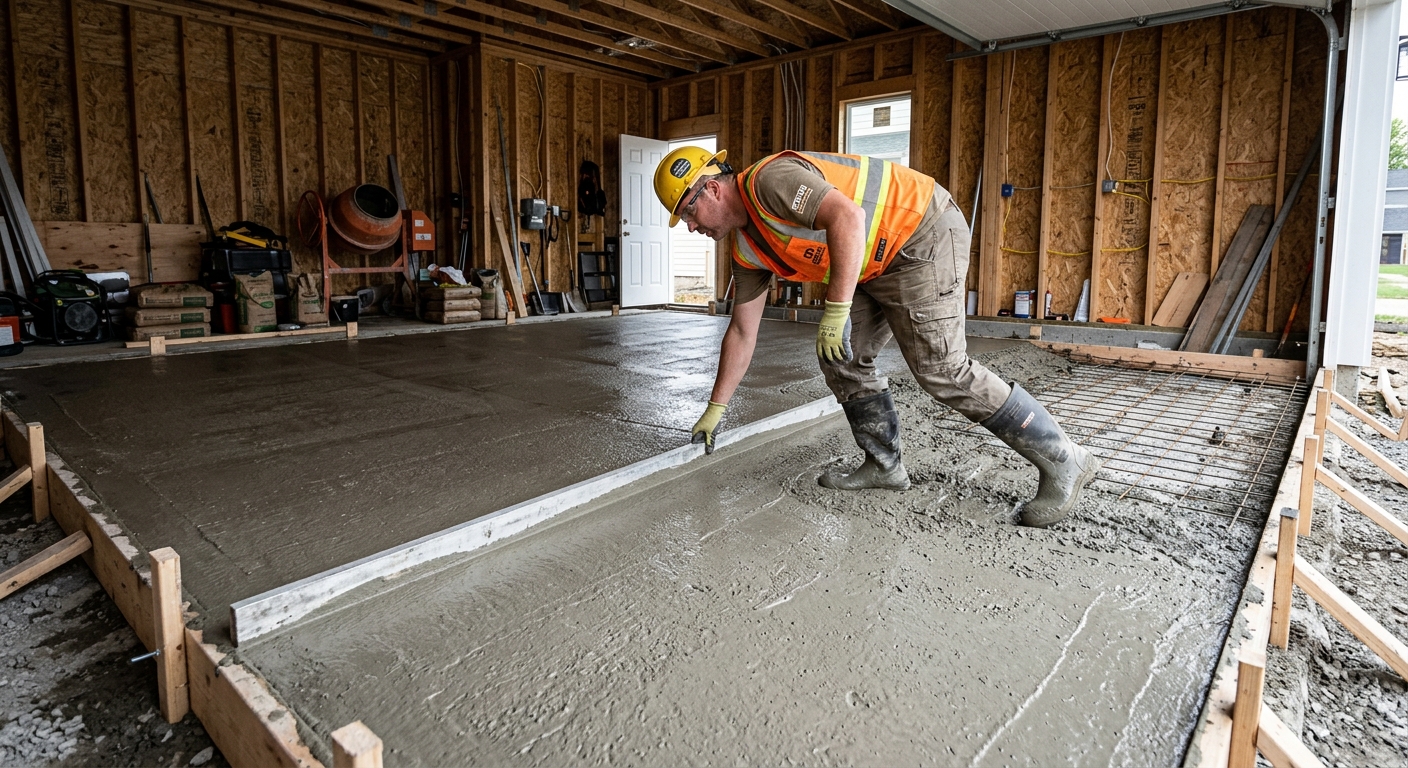
Concrete work options and costs in Arbour Lake
In Arbour Lake, Alberta, homeowners typically choose between standard flatwork (driveways, patios, walkways) and more engineered work like stamped concrete or foundation footings. With 10,335 people in the community (Statistics Canada, 2021 Census), there’s a steady mix of new builds and renovations, which keeps concrete demand consistent year-round. That matters because concrete flatwork contractors are scheduling around the practical exterior pour window in the Calgary region, where freeze–thaw cycles are frequent and the frost depth is deep enough to demand careful foundation design.
Calgary’s cold continental climate engineering doesn’t just affect foundations—it also drives the spec for exterior slabs. In Arbour Lake, driveways and patios are built to resist frost heave and surface scaling by using air-entrained concrete, granular base preparation, and control joints. Because Calgary’s design frost depth is about 1.2 m (roughly 4 ft), footings for garages, decks, and retaining structures need to be excavated deeper to bear on undisturbed soil below that depth, which increases foundation volumes and labour.
Local demand is especially strong around family-oriented pockets like the Arbour Lake/Okotoks-side commuting corridor where many homes have aging driveways and back patios. You’ll also see pricing differences between “quick pours” and properly engineered work: air-entrainment, curing blankets, and proper jointing add cost up front, but they reduce costly repairs later. Use the table below to compare typical scopes and finishes, and then we can fine-tune the price based on your exact dimensions and site access.
| Application |
Typical Size |
Key Spec |
Finish Option |
Price Range |
| Concrete driveway (standard broom finish) |
400–600 sq. ft. |
Air-entrained, compacted granular base, control joints |
Broomed, standard edging |
$12,000–$18,000 |
| Exposed aggregate driveway |
400–600 sq. ft. |
Air-entrained mix, properly timed wash/exposure |
Exposed stone aggregate texture |
$14,500–$22,500 |
| Stamped concrete driveway or patio |
300–650 sq. ft. |
Air-entrained, colour hardener/sealer system, jointing plan |
Stamp pattern with integral or surface colour |
$15,000–$26,000 |
| Plain concrete patio or walkway |
200–450 sq. ft. |
Air-entrained, thickened edges where needed |
Float & broom/steel trowel for walkways |
$5,000–$9,000 |
| Garage floor (interior slab) |
480–650 sq. ft. |
Vapour barrier, compacted base, typical fibre or rebar (engineered) |
Steel-trowel finish |
$10,500–$16,500 |
| Foundation footings (structural, below frost) |
Per engineered take-off (typ. 1,000–2,000 sq. ft. of footprint) |
Below design frost depth, reinforced footings per engineer |
Structural concrete, no decorative finish |
$28,000–$45,000 |
Prices are estimates only and vary by project scope, site access and material selection.
What affects the price of concrete work in Arbour Lake
In Calgary and the surrounding region, it’s normal to see quotes for the “same” concrete project swing by about 30–50%. The difference is usually not the concrete itself—it’s the engineering and prep that protects it through Arbour Lake winters. For example, two driveways with similar square footage can price far apart if one contractor builds to frost-depth bearing with a properly graded, compacted granular base and the other doesn’t. In a cold continental climate, “close enough” becomes a problem after freeze–thaw cycles start expanding and contracting moisture in the slab and subgrade.
Cost drivers start with frost depth and freeze–thaw performance. Footings must extend below the design frost depth (about 1.2 m in Alberta practice) to reduce frost heave risk and seasonal movement. Exterior slabs also need air-entrained concrete to survive repeated freeze–thaw cycles, plus well-spaced control joints to manage cracking. If the job lands near the edges of the exterior pour season, cold-weather placement may require winter-grade concrete, insulated blankets, and sometimes temporary heat to achieve proper curing—those precautions add labour and materials. Finally, de-icing salt accelerates surface spalling if the mix and curing aren’t right, so sealing is often recommended.
Here are a few Arbour Lake examples that move the needle: replacing a narrow, hard-access driveway apron often costs more due to limited truck access and hand work; a stamped driveway can cost closer to the $15,000–$26,000 band because of layout, stamping time, and a multi-step colour/sealer system; and a well-prepped patio can land toward the $5,000–$9,000 range when the base and drainage are straightforward. Newer neighbourhood lots can be cleaner to excavate, while older lots sometimes need extra removal of old aggregate and unsuitable soils.
| Price Factor |
Why It Matters |
Cost Impact |
| Frost line depth — determines footing depth and form height |
Footings must bear below frost to prevent heave and movement |
Higher excavation and formwork can add significant cost |
| Site preparation — excavation, grading, compacted granular base |
Subgrade condition controls settlement and slab longevity |
Poor soils or extra hauling can push prices up |
| Reinforcement — rebar or wire mesh requirement |
Controls cracking under load and thermal movement |
Material + labour for tying/wrapping can add cost |
| Mix design — air-entrainment and compressive strength spec |
Improves freeze–thaw resistance and structural performance |
Higher-spec mixes raise material costs |
| Finish type — broom vs. stamped vs. exposed aggregate |
Complex finishes take more time and materials |
Stamped/exposed work typically adds labour and product |
| Pour size and concrete truck access to site |
Truck placement affects labour time and feasibility |
Limited access increases wheelbarrow/line-pumping time |
| Cold-weather curing precautions — heating and blankets |
Proper curing prevents scaling and strength loss |
Winter measures can add day-of and after-pour costs |
| Control joint pattern and sealing cost |
Joints manage cracking; sealer reduces salt-related spalling |
More joints and a sealing system add cost but protect surfaces |
Permits & regulations in Alberta
In Alberta, structural concrete work—especially anything that carries loads or affects the building’s structural system—generally needs a building permit. This includes foundation elements such as footings, foundation walls, and grade beams. In many cases, engineered drawings are also required and reviewed through the permitting process. For concrete flatwork like patios, walkways, and driveways, a permit often is not required on its own, unless the work changes lot grading/drainage, touches impervious surface coverage limits, or involves impacts to municipal right-of-way conditions.
For Arbour Lake homeowners, the safest approach is to verify with your local authority before breaking ground—especially if you’re changing drainage patterns, removing existing curb/sidewalk sections, or building a new retaining structure. Also confirm your contractor is properly insured: ask for a certificate of liability insurance and proof they carry WSIB/WCB coverage where applicable. Get references from similar projects (same type of slab and similar winter exposure).
Step-by-step verification you can do:
- Licence/registration: check the contractor’s business listing and credentials via provincial/industry directories they provide (ask them for the exact company name for searches).
- Certificate of Insurance: request the COI and verify it lists you/your address if required by the agreement, with active dates.
- WSIB/WCB: request a clearance letter or equivalent proof of coverage status.
- Ask what permits they pull: confirm whether they handle permits for structural work and whether any fees are included in your quote.
- Confirm engineering involvement: for footings/grade beams, ask who provides the stamped design and what the inspection plan is.
Getting concrete right in Arbour Lake's freeze-thaw climate
Concrete failures in Arbour Lake typically come down to moisture movement and thermal cycling. Freeze–thaw cycles can open up tiny cracks, push water into the slab edges, and—if the mix isn’t right—lead to spalling and surface scaling. The right approach is to spec the whole system: base, mix, joints, curing, and protection.
Start with (1) base preparation: compacted granular sub-base to the correct depth for your soil and frost considerations, not just “to grade.” Poor drainage or uncompacted fill increases settlement and creates stress concentrations. Next, (2) mix design: for exterior flatwork, you want air-entrainment (commonly around 5–7% air content for proper freeze–thaw durability) and a minimum 32 MPa compressive strength spec, with proper water-cement control. Then (3) control joints: space and layout should limit random cracking patterns, especially on long driveway runs. (4) curing: aim for at least 7 days of proper curing conditions; if you’re pouring cold weather, contractors may need insulated blankets and controlled heat to keep strength development on track. Finally, (5) sealing: apply a penetrating sealer after the concrete cures (often around 28 days) to help repel de-icing salts.
To avoid the most common failure—spalling from inadequate air-entrainment—ask direct questions: “What air content are you targeting?” and “How do you maintain curing temperatures when it’s cold?” A concrete example: if one contractor offers the driveway closer to the lower end of the $12,000–$18,000 range but won’t commit to winter-grade curing and air-entrainment verification, you may save money today and pay for patching later. In contrast, a stamped driveway around the $15,000–$26,000 band can be worth it when the prep is solid and the sealer system is included, because the labour-intensive finish still needs the same structural durability.
| Spec |
Why It Matters in Arbour Lake |
What to Ask For |
Impact if Skipped |
| Compacted granular base (depth?) |
Proper sub-base reduces settlement and frost-related movement |
Compaction method, granular type, and confirmed depth to frost-safe bearing |
Cracking, unevenness, and early edge failure |
| Air-entrained concrete mix (target air %?) |
Improves freeze–thaw resistance in Arbour Lake winters |
Target air content (commonly 5–7% for exterior flatwork) and mix documentation |
Spalling and surface scaling during freeze–thaw cycles |
| Compressive strength (MPa rating) |
Strength development supports durability under snowplow and traffic loads |
Minimum 32 MPa specified at placement/control time |
Reduced long-term performance and accelerated wear |
| Control joints (spacing per ACI guidelines) |
Controls where cracks occur when temperature changes |
Joint spacing plan and whether joints align with slab geometry |
Random cracking and harder-to-repair damage |
| Minimum 7-day curing period |
Curing affects strength gain and surface durability in cold conditions |
Curing method and schedule; winter protection plan if temperatures drop |
Surface scaling, weak near-surface concrete |
| Penetrating sealer (when applied after cure) |
Helps repel salt intrusion and reduces moisture damage |
Sealer type and application timing after cure (commonly around 28 days) |
Faster salt-related deterioration and more frequent patching |
How to choose a concrete work contractor in Arbour Lake
Choosing the right concrete contractor in Arbour Lake is mostly about verification and clarity. In Alberta, structural concrete work ties into permits and inspections, so you want a contractor who can document the job—not just promise results. Start by confirming licensing/registration as applicable for the business, then verify insurance: request a certificate of liability insurance and ask for WSIB/WCB clearance or proof of coverage status. If anything seems vague, that’s a red flag—concrete delays and rework are expensive in a freeze–thaw climate.
Next, get 2–3 written itemised quotes instead of one lump-sum number. Ask for a labour-and-materials breakdown (excavation/granular base, reinforcement, concrete supply, finishing, joints, curing blankets if needed, and sealing). Read the scope carefully: what’s excluded (removal/disposal of old concrete, sawcutting, hauling, permits if required, drainage adjustments)? If the quote says “concrete only,” ask who is responsible for formwork, reinforcement, and base prep.
Warranty matters too. Ask for the workmanship warranty length and whether manufacturer product warranties apply to admixtures/sealers, and if those warranties are transferable. For payment schedule, avoid paying large deposits—sticking to about 10–15% upfront is reasonable, with a holdback until the job is complete and final cleanup is done.
Finally, timelines should be in writing: a start date, pour date conditions (temperature/cure protection), and an estimated completion window. In Calgary-area winters, the “start date” without weather/curing planning often becomes a cancellation risk.
- Ask for the exact mix spec (air-entrainment and minimum strength) for your project type.
- Confirm base prep depth and compaction method—not just “excavate to grade.”
- Request a joint/control plan and finishing sequence (especially for stamped/exposed work).
- Verify whether winter-grade curing is included if temperatures drop.
- Check liability insurance dates and coverage limits on the certificate.
- Provide WSIB/WCB proof or clearance letter before scheduling.
- Insist on an itemised quote (disposal, hauling, reinforcement, sealing).
- Ask who pulls permits for foundation/structural concrete.
- Confirm inspection points and whether engineer sign-offs apply.
- Review the warranty in writing: workmanship + product-related terms.
- Keep a holdback until final curing steps (like sealing timing) are completed.
- Get a written schedule that includes curing protection days.
Common red flags I see around Arbour Lake: contractors who won’t state the air-entrainment target for exterior work, quotes that lump base/compaction as an afterthought, no winter-curing plan for cold-weather pours, “we’ll seal later” without timing/specs, and pressure to accept a high deposit or pay the full amount before the final cure/cleanup.
Frequently asked questions — concrete work in Arbour Lake
Can concrete be poured in cold weather in Arbour Lake?
Yes, but it needs the right setup in Alberta’s cold continental winters. In Arbour Lake, the risk isn’t only the day-of temperature—it’s whether the concrete achieves proper strength gain while staying workable and protected. Contractors may use winter-grade mix design, insulated blankets, and sometimes temporary heat to protect the slab during the critical early curing window. The goal is to meet curing requirements so you don’t get early scaling or weak near-surface concrete that can show up as spalling later after freeze–thaw cycles. For pricing, cold-weather precautions can push a driveway or walkway toward the higher end of the typical bands (for example, the $12,000–$18,000 range), but it’s usually cheaper than repairs.
How do I maintain concrete in Arbour Lake's freeze-thaw climate?
Maintenance in Arbour Lake is mainly about managing moisture and de-icing salt. First, use a penetrating sealer applied after the concrete has cured (often around 28 days) to reduce salt intrusion and help repel water. Second, keep edges and joints clean: debris in joints holds water, which feeds freeze–thaw damage. Third, avoid aggressive shovelling methods—impact from metal blades can chip corners and accelerate spalling. For cracks, address them early with appropriate joint repair products so water doesn’t keep migrating under the slab. If you’re within the exterior $5,000–$9,000 band for a patio or walkway, the sealer step is one of the best “value” upgrades because it directly targets salt-driven deterioration in our winters.
What causes concrete to spall in Arbour Lake winters?
Spalling is usually caused by moisture entering the concrete and then expanding during freeze–thaw cycles, combined with a mix that isn’t properly designed for cold weather exposure. The big culprit is inadequate air-entrainment: without the right air-void system, the concrete can’t handle internal ice formation, and the surface flakes or breaks off. Other contributors include rushing curing in cold weather, poor base preparation that allows movement, or weak sealing/jointing that lets de-icing salts and water penetrate. In Arbour Lake, where freeze–thaw cycles are frequent and de-icing salts are common, it’s especially important that exterior slabs use an air-entrained mix and a curing plan. A slightly higher initial cost is often justified compared to patching later.
What is rebar and when is it required in Alberta?
Rebar is steel reinforcement used to strengthen concrete and control cracking under loads and temperature movement. Whether you need it depends on the concrete application and how the slab or foundation is engineered. For foundation footings and many structural elements in Alberta, reinforcement is commonly required because those members carry building loads and must be designed for frost, soil pressures, and movement. For driveways, sidewalks, and some interior slabs, some projects use wire mesh or fibre reinforcement, but rebar may be specified for thicker slabs, heavy loads, or where engineering calls for it. The key is to follow the engineered drawings for structural work and use reinforcement practices consistent with the slab thickness and soil conditions in Arbour Lake.
How long does a concrete project take in Arbour Lake?
Time depends on scope, access, and weather. A typical stamped concrete patio or walkway (often within the $5,000–$9,000 band for simpler flatwork or up to higher costs for stamped work) may take a few days on-site: excavation/base prep one day, forming and reinforcement setup another day, then the pour and finishing. Curing requirements matter: even when crews are “done” after finishing, the concrete needs protected curing time. Most homeowners can expect at least a week before regular traffic, but full durability develops over longer curing periods. In cold weather, added time is sometimes required for blankets/heating, which extends the effective schedule. For foundations/footings, timeline often extends due to excavation depth and engineering/inspection sequencing in Alberta.
What is a concrete overlay and is it suited to Arbour Lake?
A concrete overlay is a new layer of concrete placed on top of an existing slab—often to improve appearance or recover a surface without full demolition. It can be suited to Arbour Lake when the existing concrete is still structurally sound, the surface can be prepared properly (cleaned, profiled, and bonded), and drainage isn’t causing ongoing moisture issues. Overlays aren’t ideal if the original slab is badly heaved, badly cracked, or actively failing at joints—because the overlay can bond to surface issues and eventually reflect the problem. In Arbour Lake’s freeze–thaw climate with de-icing salt use, overlays succeed best when they include the right mix design, bond preparation, and joint planning. If you’re considering a solution instead of a new slab in the $12,000–$18,000 driveway band, it’s worth evaluating the existing slab conditions first so you don’t pay twice.