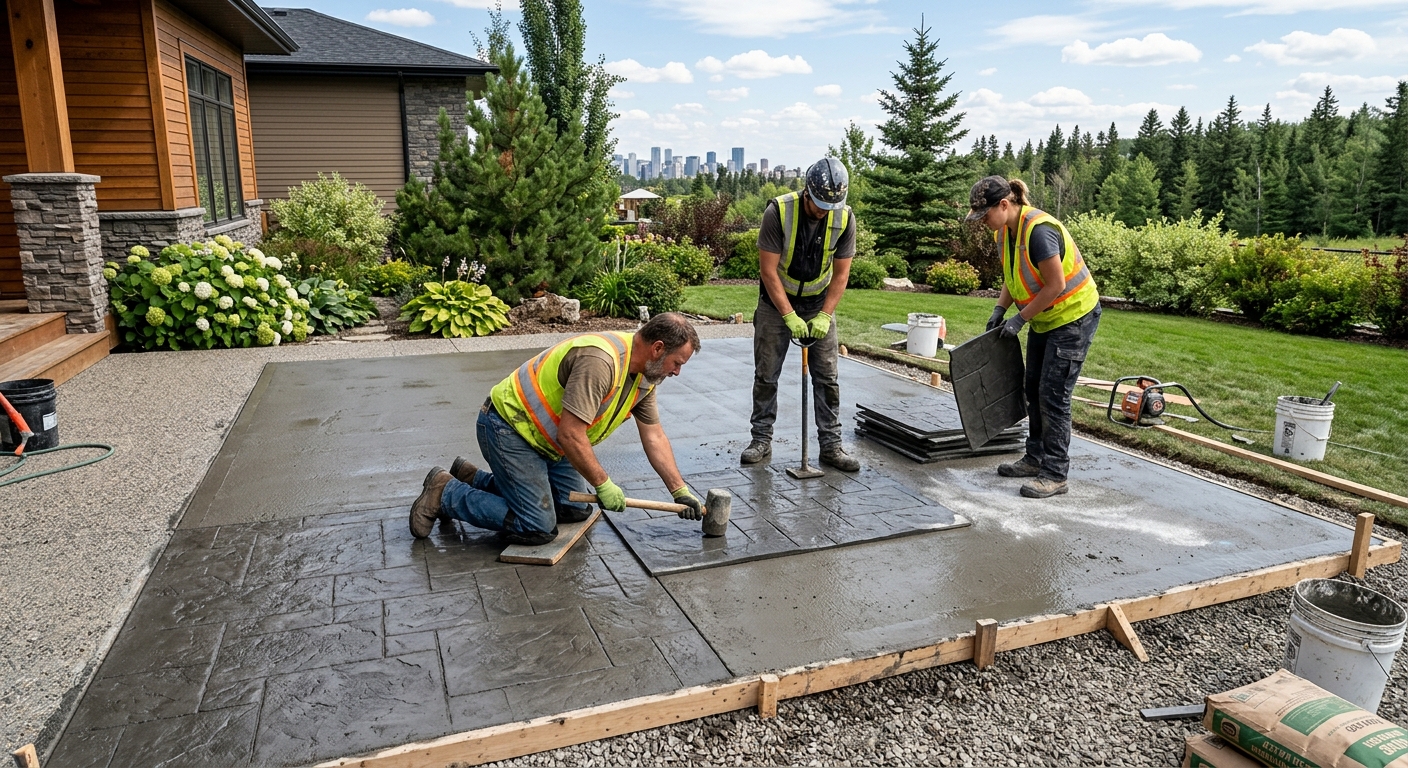
Concrete work options and costs in Elmwood
Elmwood, Alberta may be a small community, but the concrete demand is real—especially for homes with driveways, patios and walkways. With a population of 2,611 (Statistics Canada, 2021 Census), most concrete flatwork is tied to individual property upgrades and replacement cycles rather than large-scale commercial work. In the Calgary economic region, concrete contractors stay busy year-round, because freeze–thaw cycles punish surfaces that aren’t built to handle winter conditions.
In practical terms, Calgary-area pricing comes from engineered foundation depth and exterior slab specs. Local code and engineering practice for this climate are built around a design frost depth of about 1.2 m (roughly 4 ft). That means footings for houses, garages, decks and retaining structures often require deeper excavation and more concrete than homeowners expect. For exterior slabs—driveways and patios—contractors also plan for air-entrained mixes, granular base prep, and a joint layout that reduces random cracking and spalling. The pour season can feel “short” when late fall freezes or early spring soft ground limits excavation and finishing, so some customers see higher bids in colder months due to winter-grade mix requirements, insulated curing blankets, and sometimes temporary heat.
In Elmwood, trade demand is particularly noticeable around older established residential blocks where driveways and small patios are commonly replaced to improve drainage and curb appeal—often in the same yards where foundation walls have been previously updated. From there, the best way to compare options is by finish and structure type, which is what the table below is designed to show.
| Application |
Typical Size |
Key Spec |
Finish Option |
Price Range |
| Concrete driveway (standard broom finish) |
24 ft x 24 ft (approx. 576 sq. ft.) |
Air-entrained exterior mix, compacted base, control joints |
Broom-finished, light seal (optional) |
$12,000 – $18,000 |
| Exposed aggregate driveway |
24 ft x 24 ft (approx. 576 sq. ft.) |
Air-entrained exterior mix, proper base and jointing |
Exposed aggregate with sealer |
$14,500 – $20,500 |
| Stamped concrete driveway or patio |
300–650 sq. ft. |
Air-entrained exterior mix, integral colour/texture prep |
Stamp mats + release agent (coloured or natural) |
$15,000 – $26,000 |
| Plain concrete patio or walkway |
200–450 sq. ft. |
Compacted granular base, slope away from house, joints |
Plain broom/float finish |
$5,000 – $9,000 |
| Garage floor (interior slab) |
22 ft x 24 ft (approx. 528 sq. ft.) |
Vapour barrier (if required), wire mesh or rebar, proper curing |
Float finish; trowel/steel finish option |
$11,000 – $17,500 |
| Foundation footings (structural, below frost) |
Typical single-family house footprint varies |
Engineered footing size; extends below design frost depth |
Structural concrete (no decorative finish) |
$28,000 – $45,000 |
Prices are estimates only and vary by project scope, site access and material selection.
What affects the price of concrete work in Elmwood
In Elmwood and across the Calgary region, quotes for “the same” concrete job can vary by 30–50% because the driver isn’t just the concrete—it’s the engineering and preparation that protect the slab or foundation through winter. Two crews can pour identical-looking driveway areas, but if one bid includes deeper excavation, better compaction, proper air-entrained mix specs, and a robust joint/sealing plan, the outcome is very different. Labour availability also tightens around peak construction windows, and cold-weather placement adds handling and curing precautions that aren’t needed in milder climates.
Frost depth and freeze–thaw cycles dictate every major spec here. Footings must extend below the design frost depth—about 1.2 m in this region—so seasonal ground movement doesn’t heave and crack the foundation. Exterior slabs also need air-entrained concrete (plus well-spaced control joints) to survive repeated freezing cycles. When the season gets cold, contractors may need winter-grade mixes, insulated blankets, and sometimes temporary heat to achieve proper curing; rushing curing increases the risk of surface scaling and long-term deterioration. De-icing salt is another local reality: it accelerates surface breakdown, so sealing becomes a practical “maintenance cost” that helps protect your investment.
In Elmwood, a driveway with tight access down a narrow side yard can push costs up because more labour and equipment time is needed to place and consolidate concrete correctly. Conversely, a straightforward backyard patio on already-stable, well-draining soil can come in closer to the lower end of the $5,000–$9,000 band. Similarly, foundations tied to engineered footing dimensions (and deeper frost-bearing excavation) often land nearer the $28,000–$45,000 range, while decorative upgrades—like stamped work—commonly shift budgets into the $15,000–$26,000 band when colour, stamp mats, and extra finishing labour are included.
| Price Factor |
Why It Matters |
Cost Impact |
| Frost line depth — determines footing depth and form height |
Footings must bear below the design frost depth to prevent heave |
Often the single biggest driver on foundation quotes (can add significant excavation and concrete volume) |
| Site preparation — excavation, grading, compacted granular base |
Bad grading or weak base leads to settlement and cracking |
Can swing pricing widely depending on soil conditions and disposal/haul needs |
| Reinforcement — rebar or wire mesh requirement |
Controls cracking and supports loads (especially in driveways/garage slabs) |
Material and labour add cost, but skipping it increases repair risk |
| Mix design — air-entrainment and compressive strength spec |
Exterior durability depends on air-entrainment through freeze–thaw |
Higher-performance mixes cost more, but they reduce surface scaling and spalling |
| Finish type — broom vs. stamped vs. exposed aggregate |
Decorative finishes require additional labour steps and curing/handling |
Stamped/exposed work typically moves projects from “standard flatwork” into the higher price band |
| Pour size and concrete truck access to site |
Smaller pours and difficult access can require extra labour and pumping/extra equipment |
Trucking and placement time can add labour charges |
| Cold-weather curing precautions — heating and blankets |
Proper curing prevents scaling and strength shortfalls |
Winter protection can materially raise labour/material costs during shoulder seasons |
| Control joint pattern and sealing cost |
Joints manage cracking; sealer helps repel salt and moisture |
Proper detailing adds small up-front cost that can prevent expensive replacement later |
Permits & regulations in Alberta
In Alberta, how a concrete project is regulated depends on whether it’s structural or purely flatwork. Structural concrete work—such as footings, foundation walls, grade beams and other elements that support the building—typically requires a building permit, and it’s often supported by engineered drawings reviewed through the municipal process. For homeowners in Elmwood, that means if you’re doing a foundation-related scope (even partial), assume permits and inspections will be part of the plan.
Concrete flatwork like patios, walkways, and standard driveways usually does not require a permit. However, it can trigger approvals if it affects lot grading, stormwater drainage, impervious surface coverage limits, or anything that ties into municipal right-of-way requirements. Before you break ground, it’s smart to confirm with the local authority—especially if you’re adding drainage changes, raising the slab significantly, or modifying approaches near the street.
Step-by-step contractor verification in Alberta is straightforward. First, confirm licensing/registration details through Alberta’s online business/contractor information sources (or the registry the contractor provides). Second, request a current certificate of liability insurance that names you as an additional insured for the project period. Third, verify clearance/coverage for workers via WSIB/WCB documentation (ask for the current clearance letter and expiry date). Finally, ask for references on similar foundation or flatwork jobs completed recently, and speak with at least one homeowner about timing, site prep, and winter curing practices.
Getting concrete right in Elmwood's freeze-thaw climate
Concrete failure in Elmwood is usually less about “bad concrete” and more about how the job is specified and protected through Calgary-area freeze–thaw. The most common problems are spalling (surface flaking), scaling after winter, random cracking from restrained movement, and settlement from a weak or improperly compacted base. In this climate, the solution is to spec the slab as a system: base, mix, joints, curing and sealing—done in the correct order and for enough time.
Start with base preparation: excavate to the proper depth for your soil and frost exposure, then place and compact granular sub-base to grade with the right slope. Next, mix design matters: for exterior flatwork, use air-entrainment typically around 5–7% air content, with a minimum 32 MPa compressive strength so the concrete can tolerate freeze–thaw stress. Then plan control joints: spacing should be set to limit random cracking to predictable lines. Curing is non-negotiable—minimum 7 days under proper conditions, and in cold weather you may need insulated blankets or heat so concrete actually gains strength before it freezes. Finally, sealing should be applied after curing (commonly 28 days post-pour) using a penetrating sealer to repel de-icing salts.
Asking the right questions helps you avoid the biggest costly mistake: inadequate air-entrainment. For example, if you choose a “lowest bid” driveway that saves money on mix spec, you might come in near the lower end of the $12,000–$18,000 driveway range, but the risk of early scaling often leads to costly repairs or resurfacing later. Spending a bit more up front to protect the slab is usually justified in this part of Alberta, where winter exposure is constant.
| Spec |
Why It Matters in Elmwood |
What to Ask For |
Impact if Skipped |
| Compacted granular base (depth?) |
Provides stability so frost movement doesn’t translate into settlement and cracking |
“What depth of granular sub-base and how will you confirm compaction?” |
Settlement, pumping, uneven cracking and early failure |
| Air-entrained concrete mix (target air %?) |
Air voids help concrete survive freeze–thaw cycles common in Calgary-area winters |
“What air content will the mix be, and is it confirmed by the supplier’s ticket?” |
Scaling, spalling and accelerated deterioration |
| Compressive strength (MPa rating) |
Strength affects durability and long-term performance under loads and impacts |
“What minimum MPa rating is specified for exterior durability?” |
Reduced performance, cracking and surface wear |
| Control joints (spacing per ACI guidelines) |
Controls where cracks form when concrete shrinks as it cures |
“What joint spacing and timing (saw-cut vs. formed) will you follow?” |
Random cracking through the slab |
| Minimum 7-day curing period |
Strength gain depends on curing conditions, especially in cold weather |
“How will you protect the pour if temperatures drop?” |
Surface scaling and strength shortfalls |
| Penetrating sealer (when applied after cure) |
Helps reduce moisture/salt penetration that triggers surface breakdown |
“Will you seal after 28 days (or as recommended for the product) and which sealer?” |
Faster spalling from salt and moisture exposure |
How to choose a concrete work contractor in Elmwood
Choosing a concrete contractor in Elmwood should start with proof—because concrete work in the Calgary region is won or lost on base prep and winter curing, not just finish appearance. In Alberta, structural work (like footings and foundation walls) typically involves permits and engineered requirements, so you want a crew that understands the sequencing and inspection expectations.
Verify licensing/registration first using the contractor’s Alberta business information, then request their certificate of liability insurance for the project period. For workers’ coverage, ask for WSIB/WCB clearance documentation and check the clearance letter dates—don’t rely on “it’s handled” without paperwork. Next, insist on 2–3 written, itemised quotes (not just lump sums). A good quote breaks out labour, concrete supply, excavation/base materials, reinforcement, formwork, finishing, sealing and any winter protection.
Read the scope carefully: what’s excluded for example—subgrade stabilization, disposal/hauling of excess soil, regrading, dowels for tie-ins, or permit handling if applicable? Also confirm warranty terms: workmanship warranty length, any manufacturer/product warranty details, and whether it transfers if you sell the property. For payments, keep it reasonable—never pay more than 10–15% upfront; use a holdback until completion and final cure/cleanup items are done. Finally, get a start date and completion estimate in writing, including what conditions would delay the pour (frost, weather, curing protection availability).
- Confirm liability insurance is current and valid for the project dates.
- Verify WSIB/WCB coverage with the clearance letter and expiry date.
- Request project examples in Calgary-area freeze–thaw conditions, not only warm-season work.
- Ask for an itemised quote showing labour + materials + equipment + disposal.
- Clarify whether excavation includes hauling and whether topsoil/overburden is included.
- Confirm base design: granular depth, slope, and compaction expectations.
- Make sure the quote specifies air-entrained mix and exterior minimum compressive strength.
- Ask about reinforcement: wire mesh vs. rebar and why it applies to your slab.
- Verify the joint plan: spacing, saw-cut timing, and joint sealing (if included).
- Ask what winter plan exists for curing if nights drop below target temperatures.
- Confirm finishing details: broom vs. stamp vs. exposed aggregate steps and timing.
- Review warranty terms in writing and understand what maintenance is required (like sealing).
Concrete red flags I see around Elmwood include: quotes that don’t specify mix design details (especially air-entrainment), vague scope language like “standard base prep” without depth/compaction, contractors asking for large upfront payments, no written curing plan for cold weather, and “cheap” stamped work with missing curing/colour steps. If you hear any of those, slow down and get the specs in writing before you sign.
Frequently asked questions — concrete work in Elmwood
How deep must footings be for Elmwood's frost line?
For Elmwood and the broader Calgary region, concrete footings are engineered around a design frost depth of about 1.2 m (roughly 4 ft). That depth matters because footings must bear on undisturbed soil below the frost zone to prevent frost heave and seasonal movement. The exact footing size and embedment are still determined by your house design, soil conditions and structural engineer requirements, so don’t treat “1.2 m” as a universal one-size number. If you’re getting a foundation quote, ask whether the bid includes excavation to the frost-bearing depth and whether the scope accounts for deeper excavation if soils are unstable or waterlogged. On typical single-family foundation scopes, homeowners often see structural footing work fall within the $28,000–$45,000 band depending on engineered specs and excavation conditions. (Statistics Canada, 2021 Census)
Why does concrete crack in Elmwood and how is it prevented?
Concrete cracks in Elmwood mainly because concrete naturally shrinks as it cures, and winter ground movement can amplify stress if the base isn’t stable. In freeze–thaw climates, poor base prep and moisture issues can also cause settlement, which then turns shrinkage into visible cracking. The prevention plan is a combination: compacted granular base, air-entrained exterior mix, and a control joint layout that’s designed to “tell” the slab where cracks should occur. Joint timing matters too—saw-cut or formed joints should be installed at the right time so they relieve stress before random cracking starts. If de-icing salt and moisture get into cracks and pores, spalling can follow over time. For exterior projects, a proper joint plan plus sealing (often applied around 28 days after pour) helps extend the service life. In short, cracking prevention is mostly specification and scheduling, not just surface finishing.
Stamped vs broom-finish concrete — cost difference?
Stamped concrete and broom-finished concrete differ mostly in labour and finishing complexity, which is why stamped options usually cost more in Elmwood. A broom finish is straightforward: grade, base prep, pour, strike, and broom for slip resistance—typically landing in the standard driveway range of about $12,000–$18,000 depending on size and access. Stamped concrete adds more steps: integral colour or colour hardener (if used), stamp mats/release agent work, additional finishing attention, and careful curing/handling to preserve the pattern and reduce early surface issues. Because Calgary-area freeze–thaw is hard on exterior surfaces, the same durability specs (air-entrainment, jointing, curing) still apply—so you’re not “buying decoration only,” you’re paying for both look and process. That’s why stamped driveways and patios commonly fall into the $15,000–$26,000 band. If you want the best value, compare like-for-like: same slab thickness, same joint plan, same mix spec, and sealing included.
When is the best time to pour concrete in Elmwood?
The best time to pour concrete in Elmwood is when the weather supports predictable curing—typically late spring through summer and into early fall, before sustained cold nights arrive. In Calgary-area freeze–thaw conditions, your contractor has to consider both the placement temperature and the overnight temperatures for curing. If you pour too late in the season, contractors may need insulating blankets and sometimes temporary heat to keep the slab curing properly and to reach adequate strength before the concrete is exposed to freeze conditions. That winter protection increases cost and coordination, and it can tighten scheduling for homeowners. For exterior slabs like driveways and patios, it’s also important to avoid rainy or soft periods that can compromise grading and base compaction. If your project schedule is flexible, ask contractors to outline a “weather decision point” in the estimate (for example, what happens if nights drop below a threshold). This is one area where getting a clear plan in writing can protect your budget and reduce the risk of surface scaling.
How long does concrete take to cure?
Concrete needs time to develop strength, and in Elmwood’s cold continental climate you should plan around both curing time and curing conditions. A good rule for typical exterior work is a minimum of 7 days of proper curing conditions before treating the slab as substantially safe to handle—especially if temperatures stay in a workable range. However, if you’re pouring near colder weather, curing may require blankets or heat so the concrete continues to hydrate. Full strength and durability development generally extend beyond 7 days, and many durability steps—like proper sealing—are scheduled after full cure time. For example, penetrating sealers are often applied 28 days after the pour (or as recommended by the sealer manufacturer) to help repel de-icing salts and reduce moisture penetration. If a contractor promises “walk on it tomorrow” and won’t discuss protection or cure conditions, that’s a major concern. Ask how they handle curing during shoulder-season weather and whether they’ll confirm temperature protection for the first critical days.
Do I need a permit for concrete work in Alberta?
In Alberta, permits depend on what concrete is being installed. Structural concrete work—such as footings, foundation walls and grade beams—typically requires a building permit and often engineered drawings reviewed through the municipal process. Concrete flatwork like patios, walkways and standard driveways usually does not require a permit unless it affects lot grading, stormwater management, impervious surface coverage limits, or municipal right-of-way considerations. In Elmwood, the easiest way to avoid mistakes is to confirm with the local authority before you break ground, particularly if your work involves raising the slab height near drainage paths or changing how water flows off the property. Also verify your contractor is insured and properly covered for workers (WSIB/WCB) before work starts. For many homeowners, the permit question is less about the finish and more about whether you’re touching structural elements or drainage/grade decisions. If your quote includes permit coordination, it should be clearly stated in the scope.