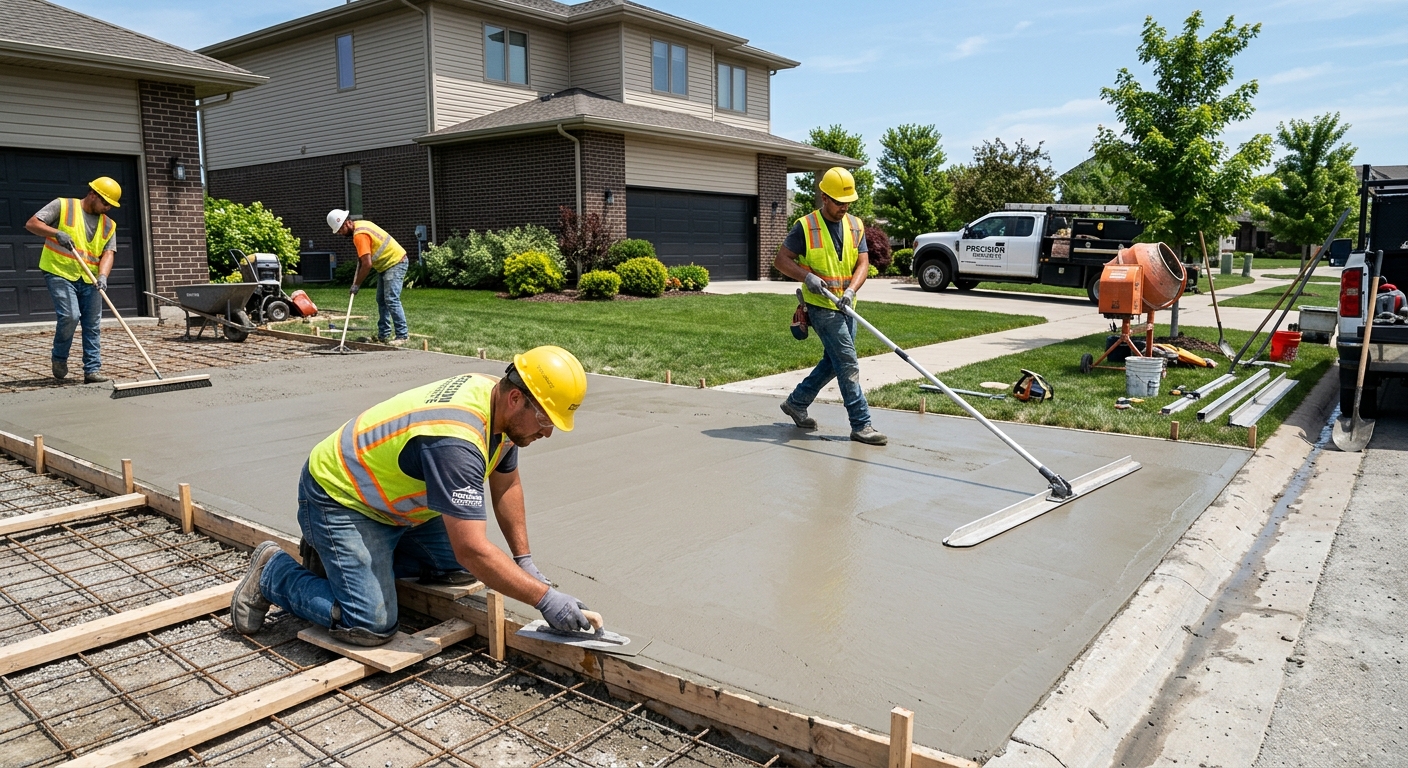
Concrete work options and costs in Potter Greens
Potter Greens, Alberta is a smaller community (population 1,520 per Statistics Canada, 2021 Census), so concrete contractors who serve Calgary’s east-side growth tend to get booked quickly when exterior work seasons line up. The most common projects homeowners ask for are driveways, patios and walkways—especially in the type of single-detached neighbourhood build-out that creates steady demand for durable flatwork. In the Calgary economic region, pricing is largely driven by how engineered the cold-weather spec must be: Calgary’s freeze–thaw cycles and frost depth require excavation and base prep that are deeper and more intensive than in milder parts of Canada.
Locally, trade demand is often strongest in the newer pocket areas of Potter Greens where lots are being finalized and landscaping grade is being set—driveway and walkway pours get scheduled right after final grading so the finished elevations match the driveway apron and entry steps. Because the design frost depth in Alberta is engineered to about 1.2 m (roughly 4 ft), foundation work and exterior supports frequently require more concrete volume and deeper footing excavations. Exterior slabs also require air-entrained mixes and tighter curing control, particularly around late fall and early spring.
To make comparisons easier, here’s a practical set of ranges by application. Use these as budgeting anchors, then refine with a site visit for soil conditions, access, and finish selection.
| Application |
Typical Size |
Key Spec |
Finish Option |
Price Range |
| Concrete driveway (standard broom finish) |
400–480 sq ft |
Air-entrained exterior mix, compacted base, control joints |
Broom finish |
$12,000–$18,000 |
| Exposed aggregate driveway |
400–480 sq ft |
Air-entrained exterior mix, proper curing for wash timing |
Exposed aggregate (wash) |
$14,000–$20,500 |
| Stamped concrete driveway or patio |
300–500 sq ft |
Air-entrained exterior mix, release agent, colour hardener |
Stamped pattern |
$15,000–$26,000 |
| Plain concrete patio or walkway |
180–300 sq ft |
Air-entrained exterior mix, edge forms, light broom finish |
Plain with control joints |
$5,000–$9,000 |
| Garage floor (interior slab) |
520–600 sq ft |
Interior mix, vapour considerations, thickened edges as needed |
Steel trowel or light broom |
$10,000–$16,000 |
| Foundation footings (structural, below frost) |
Typical detached house plan |
Reinforced concrete footings to bear below design frost |
Structural steel + concrete finish as required |
$28,000–$45,000 |
Prices are estimates only and vary by project scope, site access and material selection.
What affects the price of concrete work in Potter Greens
In Potter Greens and the wider Calgary region, quotes for what looks like “the same” concrete job can differ by 30–50% because each price depends on engineering and execution details that are hard to see from the street. In cold continental conditions, the contractor isn’t just pouring concrete—they’re building the frost protection system: excavation depth, granular base thickness, reinforcement, air-entrainment, and a curing plan. If the base is too thin, if air content isn’t right, or if curing is rushed, the slab may scale and spall later, which drives rework risk and warranty costs—so reputable crews price for the full spec.
Frost line depth is the big lever: exterior supports and slabs must be engineered to bear on undisturbed soil below the design frost depth (about 1.2 m, roughly 4 ft). That means more excavation and more concrete volume, which pushes foundation / footings toward the $28,000–$45,000 band more often than homeowners expect. Freeze–thaw cycles also force air-entrained mixes for driveways, patios and walkways, plus properly spaced control joints to manage shrinkage cracking.
Timing matters too. The exterior pour season is shorter, and late-season pours may require insulated blankets or temporary heat to achieve proper curing. Additions like sealing for de-icing salt exposure are also common; salt accelerates surface damage if the top layer isn’t protected.
Concrete examples in Potter Greens: (1) a standard broom-finish driveway typically aligns with the $12,000–$18,000 band because it uses fewer labour-intensive steps; (2) switching to stamped or exposed aggregate usually costs more because of colour hardeners, extra labour, and tighter wash/release timing—often pushing budgets toward $15,000–$26,000 depending on size.
Finally, local housing-stock realities affect logistics—older lots with established grades may require more rework to achieve correct elevations, while newly developed lots may have easier access but more trenching for services, both of which change labour hours and disposal needs.
| Price Factor |
Why It Matters |
Cost Impact |
| Frost line depth — determines footing depth and form height |
Footings must bear below the design frost depth to prevent frost heave. |
Can add significant excavation and concrete volume; major driver for foundation jobs. |
| Site preparation — excavation, grading, compacted granular base |
Proper base prevents voids and reduces settlement and cracking. |
More labour and granular material when soil is wet, variable, or poorly graded. |
| Reinforcement — rebar or wire mesh requirement |
Reinforcement controls cracking and provides structural capacity. |
Material + placement labour; can rise when thickness or spans increase. |
| Mix design — air-entrainment and compressive strength spec |
Air-entrained concrete improves freeze–thaw durability. |
Higher-performance mix and strict testing can add cost but reduces future spalling risk. |
| Finish type — broom vs. stamped vs. exposed aggregate |
Complex finishes require additional materials and careful timing. |
Stamped/exposed typically add labour and product; often the biggest “upgrade” premium. |
| Pour size and concrete truck access to site |
Concrete must be placed efficiently; access impacts labour time. |
Long carries, limited access, or multiple truck visits increase labour and equipment costs. |
| Cold-weather curing precautions — heating and blankets |
Cold slows hydration; curing must be protected to reach strength safely. |
Insulated blankets/heaters can increase costs, especially in early spring or late fall. |
| Control joint pattern and sealing cost |
Joints control cracking and sealing helps resist de-icing salt damage. |
More cutting/layout time and sealer product; usually worthwhile for driveways. |
Permits & regulations in Alberta
In Alberta, most homeowners focus on the flatwork, but permits usually hinge on what the concrete is doing. Structural concrete work such as foundation footings, foundation walls, and grade beams typically needs a building permit, and engineered drawings are commonly reviewed through the municipal process. Concrete flatwork—like patios, walkways and standard driveways—often does not require a permit by itself, unless the work affects lot grading, impervious surface coverage limits, or municipal right-of-way requirements (for example, changes close to a road approach).
In practical Potter Greens terms, your best approach is to confirm scope before excavation. Step-by-step, here’s how a homeowner should verify a contractor in Alberta:
- Ask for the contractor’s certificate of liability insurance and confirm the coverage limits are active for the job.
- Request proof of WSIB/WCB coverage (clearance can be provided; don’t rely on verbal assurances).
- Confirm the contractor’s business details and standing through the appropriate online registries (search the company name and principal contact).
- For structural jobs: ask whether engineering drawings are provided or stamped as required, and whether the permit will be pulled by the right party.
- Get the permit status and inspection plan in writing so you know what happens before forms go up and after curing.
Before breaking ground, also confirm access and excavation rules—especially where drainage and grading may influence how water sheds after freeze–thaw cycles.
Getting concrete right in Potter Greens's freeze-thaw climate
Potter Greens concrete fails in a very predictable way in Alberta’s freeze–thaw climate: moisture gets into the slab surface or near-surface paste, then repeated freezing expands it, leading to scaling and spalling. The most common root cause is inadequate air-entrainment or shortcuts in base prep and curing. Specs must be built around durability: (1) base preparation with a compacted granular sub-base to the correct depth for local soil and frost; (2) a mix design with air-entrainment and a minimum compressive strength rating; (3) a control joint pattern that limits random cracking; (4) curing that continues long enough under protection in cold weather; and (5) sealing applied after the slab has properly cured to repel de-icing salts.
For exterior flatwork, a typical target is 5–7% air content with a minimum 32 MPa compressive strength. Control joints should be laid out to control shrinkage cracking rather than hoping the slab “behaves.” Curing should be at least 7 days under proper conditions—if a crew pours and immediately exposes cold winds or temperature swings, the top surface may not gain strength evenly, which raises long-term scaling risk.
Sealing is where homeowner spending often feels optional, but in Calgary-area winters it’s usually smart. Salt accelerates surface deterioration; a properly applied penetrating sealer after curing helps keep the top layer more resistant.
Dollar example: if you’re budgeting $12,000–$18,000 for a standard broom-finish driveway, adding the right air-entrained mix, correct base depth, and proper curing precautions is part of that price. Switching to stamped concrete often pushes toward $15,000–$26,000, but you’re paying for visual complexity and additional labour/material timing—not for “stronger concrete.” If a quote claims “the same structure, just nicer stamps,” ask for the mix and air content spec to ensure the durability hasn’t been traded away.
| Spec |
Why It Matters in Potter Greens |
What to Ask For |
Impact if Skipped |
| Compacted granular base (depth?) |
Improves support and limits frost-related movement in Alberta soils. |
Granular base thickness and compaction requirements by engineer/contractor. |
Settlement, uneven cracking, and increased freeze–thaw damage. |
| Air-entrained concrete mix (target air %?) |
Durability against freeze–thaw cycling and moisture movement. |
Confirm target air content (typically 5–7% for exterior flatwork). |
Higher risk of spalling and surface scaling within seasons. |
| Compressive strength (MPa rating) |
Strength gain supports long-term performance under traffic and weather. |
Minimum 32 MPa (or higher if engineered for the application). |
Reduced strength development; potential cracking and surface deterioration. |
| Control joints (spacing per ACI guidelines) |
Controls random cracking patterns from shrinkage and temperature changes. |
Joint spacing/layout plan specific to your slab size and shape. |
Random cracks, which can become pathways for water and salt. |
| Minimum 7-day curing period |
Cold snaps slow hydration; consistent curing is critical in Calgary winters. |
Protection plan for cold weather (blankets/heating if needed). |
Surface weakness, scaling, and loss of durability. |
| Penetrating sealer (when applied after cure) |
Helps repel de-icing salts and reduces moisture ingress. |
Application timeline—typically 28 days post-pour after cure. |
Faster salt-driven surface damage and more frequent maintenance. |
How to choose a concrete work contractor in Potter Greens
Start with verification. In Alberta, reputable concrete contractors should be able to show active general liability insurance and WSIB/WCB coverage (or a current clearance letter). Your job is to ask for the documents before signing, not after work starts. Check the insurance certificate for the policy dates and the named insured; for WSIB/WCB, confirm the coverage applies to the trades that will be on-site.
Next, collect 2–3 written quotes that are itemised—not just a single lump sum. You want a labour + materials breakdown so you can compare base prep depth, reinforcement type, mix design details (especially air-entrainment for exterior work), concrete thickness, joint cutting, and whether disposal and regrading are included. Confirm whether permits are included (when required) and who is pulling them.
Warranty matters in concrete, because most issues show up over time. Ask for a workmanship warranty length, product/manufacturer warranty details (and whether it covers freeze–thaw durability outcomes), and whether warranties are transferable if you sell your home.
Payment schedule: never agree to more than about 10–15% upfront. A reasonable approach is to hold back a portion until the forms are removed, the final finish and joint layout are verified, and the site is cleaned and left properly graded.
Finally, get timeline commitments in writing: the start date window and an estimated completion date. In Potter Greens, weather can shift the pour and curing plan—good contractors plan around it rather than rushing through it.
- Ask what frost-bearing strategy they use for footings (below design frost depth) and who engineers it.
- Confirm mix spec for exterior work: air-entrainment target and minimum strength (e.g., 32 MPa).
- Require base preparation details: granular base thickness and compaction method.
- Check whether they supply control joint layout drawings or measurements.
- Verify cold-weather curing plan (blankets/heating) when temps drop.
- Ensure sealing is addressed: penetrating sealer timing after cure (typically 28 days).
- Request a disposal plan for excavated soil and excess materials.
- Ask about truck access and whether they include saw-cutting/clean-up.
- Get the finish method stated: broom, exposed aggregate wash, or stamped sequence.
- Confirm reinforcement type and placement (wire mesh vs rebar) and how it is supported.
- Review warranty terms in plain language—what’s covered and what triggers service.
- Make sure everything excluded is listed (repairs to existing grades, minor lowering/raising, drainage touches).
Concrete red flags in Potter Greens: (1) no mention of air-entrainment for exterior slabs; (2) vague curing timelines or “we’ll pour if we have to” without blankets/heating options; (3) quotes that skip base depth/compaction details; (4) contractors who want a large deposit (well above 10–15%); and (5) no proof of liability insurance or WSIB/WCB coverage.
Frequently asked questions — concrete work in Potter Greens
What is the difference between concrete and cement?
Concrete is the final building material you see and walk on—it’s made from cement, water, and aggregates (sand and gravel), plus sometimes admixtures for freeze–thaw durability. Cement is one ingredient in the mix; by itself, it’s a binder that reacts with water and helps “glue” the aggregates together. In Alberta, the freeze–thaw environment makes the overall concrete mix design critical—especially for exterior driveways, patios, and walkways in Potter Greens. You’ll hear contractors talk about air-entrainment and target compressive strength (often a minimum 32 MPa for exterior work) because those specs are what determine whether the slab resists scaling and spalling over winter cycles (Statistics Canada, 2021 Census; local population 1,520). Always ask for the mix spec, not just the “cement brand.”
How much does concrete work cost in Potter Greens?
Pricing in Potter Greens typically follows the same Calgary market bands: a concrete driveway is often budgeted at $12,000–$18,000 for standard broom-finish work, while stamped options commonly land around $15,000–$26,000 depending on size and colour/texture complexity. Patios and walkways usually sit around $5,000–$9,000 for plain concrete. Foundation footings are a different category—structural, below-frost work often ranges from $28,000–$45,000. Your final number depends on excavation depth tied to frost protection, granular base requirements, reinforcement, truck access, and whether cold-weather curing precautions are needed during your pour window. Because Potter Greens is smaller (population 1,520 per Statistics Canada, 2021 Census), scheduling can also affect labour rates when crews are booked tight.
How deep must footings be for Potter Greens's frost line?
For Potter Greens and the broader Calgary region, footings are engineered to bear below the design frost depth to prevent frost heave. The commonly used design frost depth is about 1.2 m (roughly 4 ft). In practice, a foundation engineer or the engineered drawings for your house will specify the exact footing depth based on the site soil conditions and structural requirements, but the key takeaway is that the excavation can’t stop “near the surface” the way it sometimes does in milder climates. If you’re comparing quotes, ask what depth they’re excavating to and how they confirm undisturbed soil. This is especially important because Alberta’s freeze–thaw cycles and deeper frost penetration drive more intensive excavation and larger footing volumes, which is why foundation/footings typically fall in the $28,000–$45,000 band.
Why does concrete crack in Potter Greens and how is it prevented?
Concrete in Potter Greens cracks mostly because of shrinkage and temperature movement—those stresses are normal—but freeze–thaw makes proper detailing non-negotiable. If control joints aren’t cut with the right layout and timing, cracking can occur randomly. If base preparation isn’t compacted and layered correctly, settlement can also cause cracking patterns that won’t “heal.” The other major failure mode is freeze–thaw surface damage: inadequate air-entrainment can lead to spalling and scaling, and cracks become pathways for moisture and de-icing salts. Prevention is a combination of correct mix design (often 5–7% air for exterior flatwork), correct compaction/base depth, reinforcement where required, a deliberate control joint spacing plan, and proper curing (minimum 7 days) with protection if cold weather threatens. Sealing after cure helps further reduce salt-driven deterioration.
Stamped vs broom-finish concrete — cost difference?
Stamped concrete costs more than broom-finish because you’re paying for additional materials and labour: colour hardeners or stains, release agents, forming and stamping, and often extra finishing steps to manage timing. In the Calgary region and Potter Greens, stamped work usually moves you toward the $15,000–$26,000 band for driveways and patios depending on size. By contrast, standard broom-finish driveways typically align with $12,000–$18,000. It’s important to compare durability specs when you upgrade the finish. A higher price doesn’t automatically mean a stronger slab—if air-entrainment, curing, and base preparation aren’t done to spec, stamped and broom slabs will both fail prematurely in freeze–thaw. Ask every contractor to state the mix spec, air content target, reinforcement approach, and curing protection plan.
When is the best time to pour concrete in Potter Greens?
In Potter Greens, the best pour timing is when air temperature and ground conditions support proper curing without excessive protection. While exact dates depend on your schedule and the weather forecast, most exterior flatwork is easiest to place and finish during the warmer part of the season. Late fall and early spring can work, but only if the contractor has cold-weather curing precautions—insulated blankets and sometimes temporary heat—to keep the slab hydrated long enough. The curing window is critical in this region: rushing curing increases the risk of surface scaling and longer-term freeze–thaw damage, and that’s exactly what homeowners notice after a couple of winters. If you’re planning a driveway budget around $12,000–$18,000 or a patio around $5,000–$9,000, ask the contractor how they protect curing when temperatures drop. Planning around cold snaps is often the difference between a slab that looks good for years and one that needs early repairs.