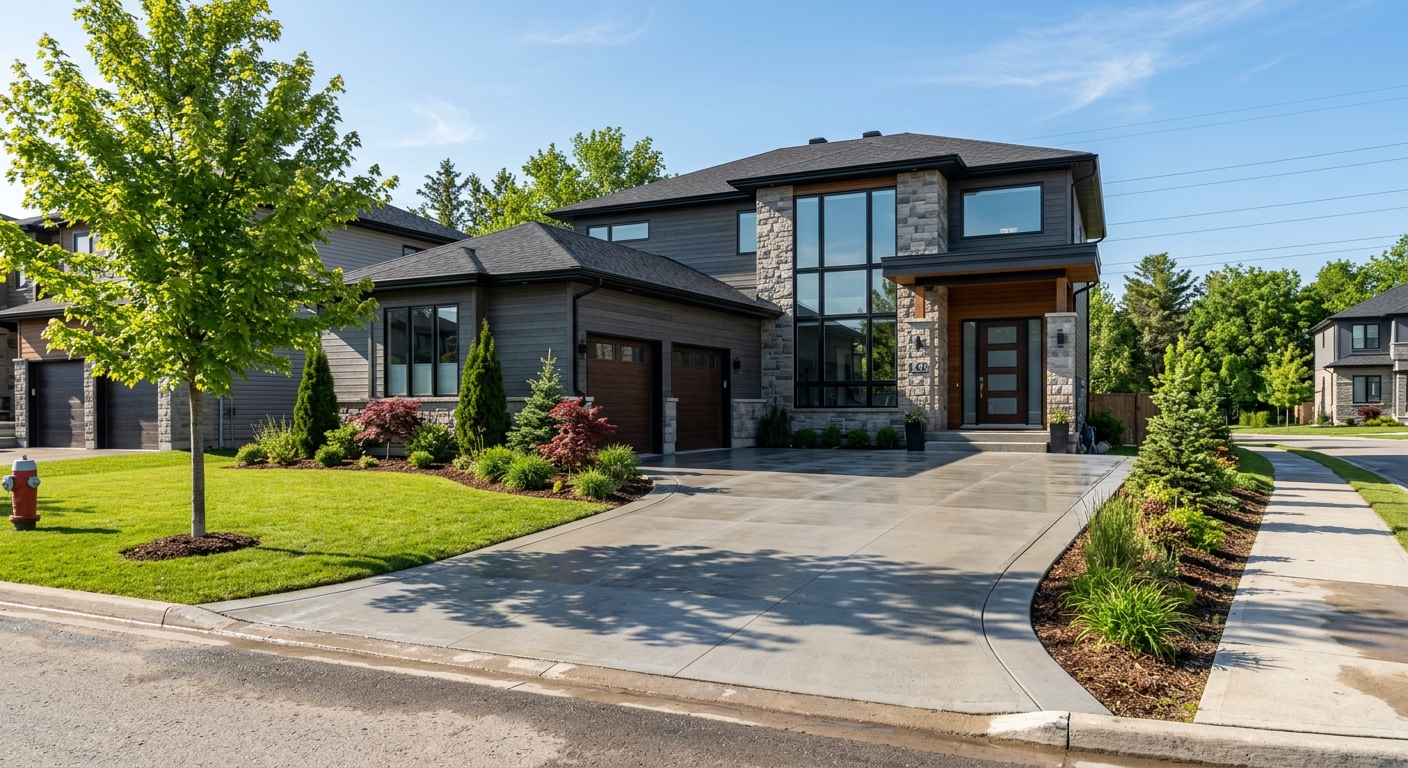
Concrete work options and costs in Bulyea Heights
Concrete work in Bulyea Heights is a year-round need for homeowners, but the pricing and engineering depends heavily on Calgary’s freeze–thaw reality. With a population of about 3,600 people (Statistics Canada, 2021 Census), the local demand tends to cluster around practical upgrades for typical residential lots—especially for single-detached homes that commonly need new driveways, patios, and functional exterior flatwork. In this part of the Calgary region, contractors are often busiest around neighbourhoods with growing infill and active renovations, and trade work is especially in demand around SE Calgary and the surrounding new-build corridors that serve Bulyea Heights area projects.
Unlike milder provinces, Calgary-area concrete is engineered around frost. A design frost depth of about 1.2 m (roughly 4 ft) is a major driver: footings for houses, garages, decks, and retaining structures must bear on undisturbed soil below that depth to reduce frost heave. Frequent freeze–thaw cycles also require air-entrained mixes for exterior slabs and careful control-joint planning to limit cracking and surface scaling. Finally, Alberta’s shorter pour season for exterior work means cold-weather protection—blankets, controlled curing, and sometimes temporary heat—can add cost if your schedule falls late fall or early spring.
Below are realistic price ranges you can use as a starting point, then fine-tune with an itemised quote once your measurements and site access are confirmed.
| Application |
Typical Size |
Key Spec |
Finish Option |
Price Range |
| Concrete driveway (standard broom finish) |
400–600 sq. ft. |
Air-entrained mix, compacted granular base, control joints |
Broom finish, simple edges |
$12,000–$18,000 |
| Exposed aggregate driveway |
400–600 sq. ft. |
Air-entrained mix, correct base compaction for freeze–thaw |
Exposed aggregate with standard sealer |
$15,500–$22,500 |
| Stamped concrete driveway or patio |
300–500 sq. ft. |
Air-entrained mix, joint pattern planned for shrinkage |
Stamp + colour hardener, release powder, seal coat |
$15,000–$26,000 |
| Plain concrete patio or walkway |
200–400 sq. ft. |
Air-entrained mix, proper slope/drainage, joints |
Float/brush trowel or broom light texture |
$5,000–$9,000 |
| Garage floor (interior slab) |
400–700 sq. ft. |
Vapour barrier, reinforcement (mesh/rebar as required), fibre optional |
Steel-trowel smooth or light broom |
$12,500–$20,000 |
| Foundation footings (structural, below frost) |
Typical footing perimeter 1,000–1,600 lin. ft. (project dependent) |
Excavate below design frost depth; reinforced structural concrete |
Structural concrete finish only |
$28,000–$45,000 |
Prices are estimates only and vary by project scope, site access and material selection.
What affects the price of concrete work in Bulyea Heights
In Bulyea Heights and the wider Calgary market, quotes for “the same” concrete job can swing by 30–50% because the critical hidden work is what changes: excavation depth, base preparation, frost-safe footing requirements, reinforcement, mix design, and curing protection. A homeowner might compare two driveway bids and see a big gap—yet one contractor is budgeting for deeper granular removal, air-entrained concrete sized for exterior exposure, and the right control-joint layout for freeze–thaw. In this climate, those choices are not cosmetic; they’re structural durability.
Frost line depth is the first cost lever. Footings must extend below the design frost depth (about 1.2 m here) to reduce frost heave, which means more digging and more structural concrete than warmer regions. Second, Calgary’s frequent freeze–thaw cycles dictate air-entrained mixes for exterior slabs, plus well-spaced control joints to reduce random cracking and later spalling. Third, the practical pour season is shorter—cold-weather curing precautions (insulating blankets and, when needed, temporary heat) can increase labour and material costs. Lastly, de-icing salt is common; without sealing, you can see surface scaling and pitting over time.
In Bulyea Heights specifically, two common scope examples show why pricing shifts: (1) a driveway with poor drainage at the entrance often requires additional grading and base depth to avoid washboarding and premature cracking; and (2) stamped upgrades with complex patterns may jump from the standard driveway range of roughly $12,000–$18,000 into the $15,000–$26,000 band because of extra finishing time, hardener/release material, and seal timing. If you’re building near the typical age pattern of many older infill and renovation homes in the Calgary region, expect some sites to need more demolition and disposal—often a direct driver of the difference you feel between bids, sometimes by hundreds of dollars per truckload.
| Price Factor |
Why It Matters |
Cost Impact |
| Frost line depth — determines footing depth and form height |
Footings must bear below the design frost depth to prevent frost heave. |
Can be the largest swing factor on foundation-related concrete; deeper excavation increases labour and volume. |
| Site preparation — excavation, grading, compacted granular base |
Bad base compaction leads to settlement, cracking, and edge failure. |
Added removal/grading can move a driveway bid substantially even if slab thickness stays similar. |
| Reinforcement — rebar or wire mesh requirement |
Rebar/mesh supports shrinkage cracking control and improves slab durability. |
Material + labour to place correctly; often required for garage slabs and some exterior uses. |
| Mix design — air-entrainment and compressive strength spec |
Exterior durability in freeze–thaw depends on air-entrainment and strength. |
Higher-spec mix and verification can add cost but reduces spalling risk. |
| Finish type — broom vs. stamped vs. exposed aggregate |
Complex finishes require more labour steps and tighter timing. |
Stamped/exposed typically pushes you into the higher flatwork bands. |
| Pour size and concrete truck access to site |
Long carries, crane/pump needs, or limited access increase labour and risk. |
Truck count, pumping/placing tools, and manpower can add several thousand dollars. |
| Cold-weather curing precautions — heating and blankets |
Proper curing in cold snaps reduces surface scaling and strength loss. |
Extra rentals and supervision; most noticeable on late-season exterior pours. |
| Control joint pattern and sealing cost |
Joints control cracking locations; sealing helps resist de-icing salt damage. |
Joint saw cuts and seal product/application add line-item cost but protect your investment. |
Permits & regulations in Alberta
In Alberta, the key idea is that structural concrete typically needs a building permit and often engineered documentation. For Bulyea Heights homeowners, this usually means work such as foundation footings, foundation walls, grade beams, and other load-bearing concrete elements will require permits and municipal review depending on your project scope. Concrete flatwork—like driveways, patios, and walkways—often does not require a permit on its own, unless it affects lot grading/drainage, impacts impervious-surface coverage rules, or touches municipal right-of-way considerations. Because policies can vary with the specific site plan and how you connect to existing grades, confirm with the local authority before excavation.
Regardless of permits, do the homeowner due diligence every time. Step one: confirm the contractor carries liability insurance and WSIB/WCB coverage (as applicable). Step two: request certificates of insurance—your contractor should provide a current COI that names you or confirms coverage is in place for the project period. Step three: ask for a clearance letter/status document if the contractor uses a third-party system for worker coverage verification.
To verify licensing: Alberta’s trades licensing is typically handled through the province’s business/trade registration requirements for the contractor’s legal entity. You can cross-check company details through online business registries, then confirm with the contractor’s certificate paperwork you’re given. Finally, ask for references from similar-scale foundation or flatwork projects in the Calgary region—durability in freeze–thaw is best proven by finished work from this market.
Getting concrete right in Bulyea Heights's freeze-thaw climate
Concrete failure in Bulyea Heights usually traces back to five things: unstable sub-grade, inadequate air-entrainment, poor joint planning, rushed curing, and skipping sealer. In Calgary’s freeze–thaw climate, water enters tiny surface pores or micro-cracks and then expands as temperatures drop. That’s why the job has to be spec’d for durability, not just appearance. Start with (1) base preparation: compacted granular sub-base at the right depth for local soil and frost conditions, so the slab doesn’t flex and crack. Next (2) mix design: exterior flatwork should be air-entrained (commonly 5–7% air) and meet at least 32 MPa compressive strength requirements. (3) control joints should be spaced to limit random cracking patterns. (4) curing should be a minimum of 7 days under proper conditions; late-season pours may need blankets or heat management to keep curing temperatures stable. (5) sealing matters: apply a penetrating sealer after cure—typically around 28 days post-pour—so de-icing salts don’t aggressively attack the surface.
Here’s where price differences are justified: a standard broom-finished driveway may land in the $12,000–$18,000 band, while stamped work is often $15,000–$26,000. The extra cost isn’t only the stamp—it's the timing, hardener/release systems, and tighter joint/sealer coordination so the surface doesn’t prematurely dull or spall from freeze–thaw exposure. If a contractor can’t clearly explain how they’ll prevent spalling—especially through correct air-entrainment—you should treat it as a red flag.
When you’re interviewing contractors in Bulyea Heights, ask: What exact air content are you targeting? How thick is the slab and base? Where are control joints cut and how soon? What’s your curing plan if we pour near the cold-weather shoulder season?
| Spec |
Why It Matters in Bulyea Heights |
What to Ask For |
Impact if Skipped |
| Compacted granular base (depth?) |
Stabilizes the slab and reduces frost-related movement and settlement. |
“What granular base depth and compaction method are you using for my site?” |
More cracking and uneven edges after winter cycles. |
| Air-entrained concrete mix (target air %?) |
Provides freeze–thaw durability by allowing safe expansion of freezing water. |
“What air content are you targeting (typically 5–7% for exterior flatwork)?” |
Higher risk of spalling and surface scaling within a few seasons. |
| Compressive strength (MPa rating) |
Strength supports durability and reduces surface breakdown under freeze conditions. |
“Confirm the mix meets at least 32 MPa for exterior flatwork—what’s the spec?” |
Weak surfaces wear faster and can crack earlier. |
| Control joints (spacing per ACI guidelines) |
Controls where shrinkage cracks form to keep cracking predictable. |
“Where will you place joints and what spacing will you follow for this slab size?” |
Random cracking, widened cracks, and faster water intrusion. |
| Minimum 7-day curing period |
Proper curing builds strength and reduces early-age surface damage. |
“What curing method will you use, especially if temperatures drop?” |
Scaling, reduced durability, and potential strength loss. |
| Penetrating sealer (when applied after cure) |
Helps resist de-icing salts and reduces moisture uptake at the surface. |
“When will sealer be applied (typically ~28 days after pour) and which product?” |
More pitting and dulling from salt exposure. |
How to choose a concrete work contractor in Bulyea Heights
Choosing a concrete contractor in Bulyea Heights comes down to proof: proof of coverage, proof of spec discipline, and proof they’ve built in Calgary-area weather before. Start with Alberta verification. Ask for their liability insurance certificate (COI) showing active coverage for the job dates and project location. Next, confirm WSIB/WCB coverage so you’re not exposed if a worker is injured on your site. Then check how they handle licence/registration for their company—use online business registries to confirm the legal business name matches the invoice and paperwork, and request any trade registration/clearance documents they use to operate legally in Alberta.
For quotes, don’t accept a single lump sum without line items. Get 2–3 itemised written quotes that break out labour and materials (excavation/grading, granular base, reinforcement, concrete supply, forming, finishing, saw-cutting, sealing, and disposal). Read the scope carefully: what’s excluded (demo, hauling, tree root removal), is a permit included if required for the foundation scope, and is excess soil disposal included in the price?
Warranty matters too. Ask for a workmanship warranty length, whether product warranties apply to the concrete system or just materials, and whether the warranty is transferable if you sell your home. Finally, protect your cash flow: avoid paying more than 10–15% upfront. Use a holdback until the final finish and sealing steps are complete, and get the start date and completion estimate in writing so cold-weather timing is clear.
- Ask for the exact mix design (air content target and strength spec) for exterior work.
- Confirm the slab thickness and granular base depth match the design and frost considerations.
- Require reinforcement plan details (mesh/rebar type, spacing, and cover).
- Get control-joint spacing and saw-cut timing in writing.
- Verify curing plan for cold weather (blankets, heat management if needed).
- Ask whether they will seal and when (typically after proper cure, around 28 days).
- Ensure demolition and haul-away are explicitly included or excluded.
- Confirm approach to drainage: slopes, tie-ins, and how they prevent water ponding.
- Review accessibility: truck routes, any pumping/placing equipment, and labour assumptions.
- Ask about finish crew experience with broom vs. stamped vs. exposed aggregate patterns.
- Request insurance COI and WSIB/WCB clearance documentation before work begins.
- Make payment milestones match inspections (base prep, rebar placement, pour day, finishing/cure, seal).
In Bulyea Heights, common concrete contractor red flags include: promising “universal” mix specs without air-entrainment discussion, skipping detailed base prep depth/compaction methods, offering only lump-sum pricing with no joint/sealing scope, pushing for large upfront payments, and avoiding written curing and temperature protection plans near cold-weather periods.
Frequently asked questions — concrete work in Bulyea Heights
What is a concrete overlay and is it suited to Bulyea Heights?
A concrete overlay is a topping placed over an existing slab—often to renew appearance or address minor surface wear without full removal. In Bulyea Heights and the broader Calgary area, it can be suited when the original concrete is still structurally sound: no major settlement, no deep joint failure, and good base support underneath. The freeze–thaw climate makes prep critical—any moisture pathways or weak bonding can lead to debonding and rapid deterioration. You’ll typically want the contractor to grind/clean properly, repair spalled areas, and install the correct bonding system. As a budget reference, a new broom-finished driveway often lands around $12,000–$18,000, while overlays can cost less only if the substrate is good—otherwise full replacement is often the more durable long-term solution.
How do I seal concrete to protect it in Bulyea Heights?
Sealing in Alberta is about keeping salts and water from getting into the surface. For typical exterior flatwork in Bulyea Heights, use a penetrating sealer after the concrete has fully cured—commonly around 28 days post-pour. Make sure the surface is clean and dry before application; any trapped moisture can interfere with penetration. Apply according to product coverage rates and avoid heavy over-application that can leave hazing or uneven absorption. Re-apply on a schedule recommended by the sealer manufacturer, since winter de-icing use accelerates wear compared with less-salted regions. If you’re doing a stamped or coloured finish, sealing timing also helps protect the appearance from freeze–thaw cycling. Get the exact sealer type from your contractor and ask what they use for snow-melt conditions in Calgary.
What is the difference between concrete and cement?
Cement is one ingredient, while concrete is the full mix. Cement is the binding powder; concrete includes cement plus water and aggregate (sand and gravel/crushed stone), and often admixtures like air-entrainment for exterior freeze–thaw durability. In Bulyea Heights, the practical difference matters because your contractor should spec the full concrete system—especially the air content for exterior slabs—to prevent spalling and scaling during Alberta’s cold winters. If someone says they “use good cement,” ask what the full air-entrained mix spec is and what compressive strength they meet (commonly at least 32 MPa for exterior flatwork). The cement brand alone doesn’t guarantee durability; the finished concrete performance, placement, curing, and correct joints do.
How much does concrete work cost in Bulyea Heights?
Concrete pricing in Bulyea Heights is driven by scope, frost-safe construction requirements, and finish complexity, and it typically aligns with Calgary-area price bands. As a quick guide: a concrete driveway (standard broom finish) often falls around $12,000–$18,000. A plain concrete patio or walkway commonly comes in around $5,000–$9,000, while stamped concrete driveway or patio work frequently ranges about $15,000–$26,000 depending on size and pattern complexity. For structural work, foundation footings (below frost) are often in the $28,000–$45,000 band, depending on excavation, reinforcement, and project dimensions. Always request an itemised quote so you can see what’s included—base depth, reinforcement, saw-cut joints, curing protection, and disposal.
How deep must footings be for Bulyea Heights's frost line?
In the Calgary region, engineering practice uses a design frost depth of about 1.2 m (roughly 4 ft). For Bulyea Heights, that means foundation footings generally must extend below this depth to bear on undisturbed soil and reduce frost heave risk. The exact required depth on your site can vary with soil conditions, drainage, and engineering requirements, so your foundation designer/engineer should set the final spec. When a contractor proposes a shallower footing without a documented rationale, that’s a serious durability risk in Alberta’s freeze–thaw climate. Ask how they’ll excavate to the required depth, how they’ll handle over-excavation, and what concrete and reinforcement plan they’ll use for structural integrity below the frost line.
Why does concrete crack in Bulyea Heights and how is it prevented?
Concrete cracks mainly due to shrinkage, temperature changes, and movement from freeze–thaw cycling—especially when the base isn’t stable or joints aren’t planned. In Bulyea Heights, frequent cold cycles and de-icing salt also increase the consequences of small cracks because water can enter and expand as it freezes. Prevention starts with the basics: properly compacted granular base, air-entrained concrete for exterior exposure, and a control joint pattern placed to guide where cracking occurs. A minimum curing period of 7 days under suitable conditions helps reduce early-age shrinkage issues. Sealing after cure can reduce moisture/salt ingress. If you’re seeing random cracking early, ask your contractor what their joint spacing plan is and whether the mix is air-entrained with the right target air content for freeze–thaw durability.