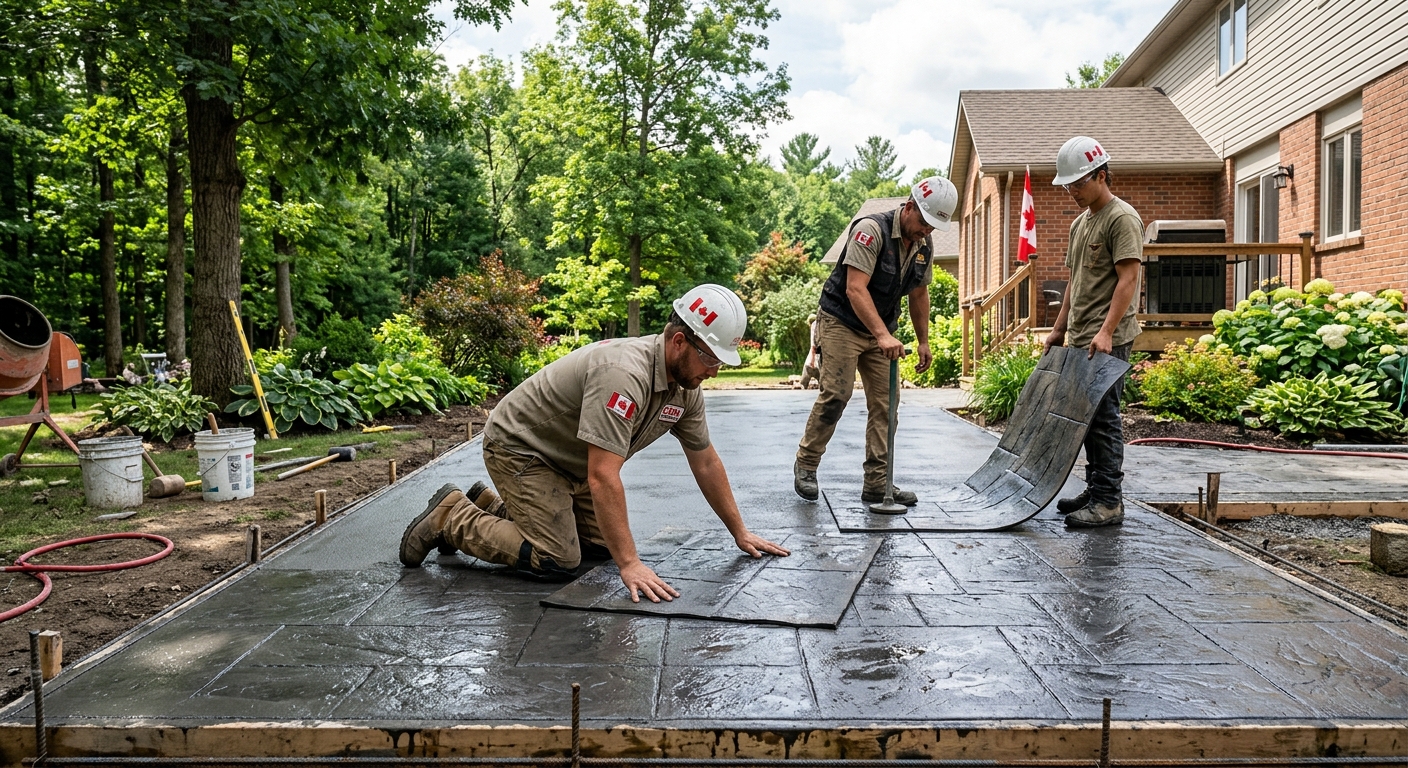
Concrete work options and costs in Canyon Meadows
Canyon Meadows is a growing residential pocket in Calgary where homeowners typically invest in long-lived exterior concrete flatwork—especially driveways, patios and walkways—because winter conditions demand durability. With a population of 7,435 (Statistics Canada, 2021 Census), the neighbourhood’s workload is steady, and demand is driven largely by family-style housing stock; Calgary’s built form includes many single-detached homes, which is exactly where we see repeat driveway and patio projects.
In this part of Alberta, pricing is shaped by a cold continental climate and a design frost depth of about 1.2 m (roughly 4 ft). That means deeper excavation and larger footing volumes than you’d see in milder regions. On top of that, freeze–thaw cycles across the Calgary area push engineers and contractors to use air-entrained mixes, properly graded granular bases, and well-spaced control joints to reduce cracking and surface scaling. The shorter practical pour season for exterior slabs also affects availability—late fall or early spring can require insulated blankets and sometimes temporary heat so curing stays on track.
We often see especially high demand in and around the Canyon Meadows Drive and 52 Street corridor, where lots are close to roads and truck access is tight, so accurate site planning becomes part of the cost. Below is a practical side-by-side of common options you’ll see in Canyon Meadows, including typical sizes and spec choices to help you compare like-for-like when quotes come in.
| Application |
Typical Size |
Key Spec |
Finish Option |
Price Range |
| Concrete driveway (standard broom finish) |
24 ft x 10 ft (240 sq. ft.) |
6 in (150 mm) slab, air-entrained, fibre or joints as required |
Broom finish, edges + control joints |
$12,000–$18,000 |
| Exposed aggregate driveway |
24 ft x 10 ft (240 sq. ft.) |
6 in (150 mm) slab, air-entrained, proper curing + surface prep |
Exposed aggregate (light wash/acid-free finishing options) |
$15,500–$22,500 |
| Stamped concrete driveway or patio |
20 ft x 12 ft (240 sq. ft.) driveway/patio |
6 in slab, air-entrained, integral colour (typical) |
Stamped pattern + release + seal coat (as specified) |
$15,000–$26,000 |
| Plain concrete patio or walkway |
10 ft x 16 ft (160 sq. ft.) |
4 in (100 mm) slab, air-entrained, compacted base |
Float and light broom, minimal form lines |
$5,000–$9,000 |
| Garage floor (interior slab) |
22 ft x 20 ft (440 sq. ft.) |
4–5 in (100–125 mm), vapour considerations as applicable |
Light broom finish, saw-cut joints |
$11,500–$19,500 |
| Foundation footings (structural, below frost) |
Typical house/extension footprint; varies by design |
Engineered footing elevations and rebar placement below frost |
Structural finish (not decorative) |
$28,000–$45,000 |
Prices are estimates only and vary by project scope, site access and material selection.
What affects the price of concrete work in Canyon Meadows
In Canyon Meadows, the same “driveway” can produce quotes that differ by 30–50% because contractors price the details—excavation, base prep, reinforcement, cold-weather curing, and finishing—rather than just the cubic yards. Two crews can pour a similar slab area, but one may build to the deeper frost-driven footing practice and include a properly graded granular base, while another value-engineers those items. In a cold continental climate with freeze–thaw cycles, those differences show up later as scaling, cracking, or uneven settlement.
Frost depth and freeze–thaw cycles drive specification decisions. Footings and any structural concrete elements must bear on undisturbed soil below the design frost depth (about 1.2 m in this region) to limit frost heave and seasonal movement. Exterior slabs and exposed surfaces also need air-entrained concrete mixes to survive repeated expansion and contraction. Calgary’s shorter pour season means cold-weather placement may require winter-grade mixes, insulated blankets, and sometimes temporary heat, all of which add direct labour and equipment costs. Finally, de-icing salt accelerates surface wear, so sealing and good surface workmanship matter—especially on broom-finished vs decorative surfaces.
Local site conditions also swing cost. If your driveway ties into existing curb/sidewalk grades, added forming and more complex drainage grading can push you toward the higher end of the $12,000–$18,000 driveway band. Conversely, a straightforward patio on a flat grade with easy truck access may land near the lower $5,000–$9,000 patio range. For older Canyon Meadows homes where basements and backfill exist, we sometimes see extra excavation and disposal, which can add hundreds to thousands even before concrete is placed.
| Price Factor |
Why It Matters |
Cost Impact |
| Frost line depth |
Determines footing depth and required form height below frost |
Higher footing excavation elevates structural concrete budgets |
| Site preparation |
Excavation, grading, and compacted granular base control settlement |
Poor access or deeper topsoil removal raises labour and disposal |
| Reinforcement |
Rebar or mesh controls cracking from load and thermal movement |
More steel and tying time increases cost, especially on driveways |
| Mix design |
Air-entrainment and compressive strength spec for freeze–thaw survival |
Wrong mix risks spalling; correct mix can cost more upfront |
| Finish type |
Broom vs stamped vs exposed aggregate requires different labour and curing care |
Decorative work typically pushes projects into higher bands |
| Pour size and concrete truck access to site |
Large pours need scheduling; access affects pumping or placement time |
Tight sites can require pump/extended labour windows |
| Cold-weather curing precautions |
Heating/blankets protect strength gain during freezes |
Can add equipment and labour if placed late in the season |
| Control joint pattern and sealing cost |
Joints manage shrinkage; sealing protects from de-icing salts and moisture |
Better joint layout and sealer increase durability and material scope |
Permits & regulations in Alberta
In Alberta, the key line is structural work versus simple cosmetic flatwork. Structural concrete work—such as footings, foundation walls, and grade beams—generally requires a building permit and, in most cases, engineered drawings that the municipality reviews as part of the permit process. If you’re adding or altering a foundation, building an engineered retaining element, or changing load paths, assume you will need a permit before any concrete is placed.
Concrete flatwork—patios, walkways, and most driveways—typically does not require a permit unless it affects lot grading, drainage, impervious surface coverage limits, or the municipal right-of-way (for example, work near sidewalks or curb tie-ins). Because rules can hinge on how the project interacts with drainage and adjacent areas, confirm with the local authority before breaking ground.
For contractor verification in Canyon Meadows, ask for three things and check them step-by-step:
- Licence/registration: search the Alberta online public listings for the exact legal business name on the quote.
- Liability insurance: request a certificate of insurance (COI) matching your contractor’s business name and effective dates; confirm it covers concrete operations.
- WSIB/WCB coverage: verify coverage status and request proof that workers are covered for the scope being performed.
- Clearance letter (where applicable): ask for the latest clearance documentation if the contractor is in a category that provides it.
Also request references on similar-scale projects within the Calgary area so you can confirm they’ve handled freeze–thaw specs, not just the pouring day.
Getting concrete right in Canyon Meadows's freeze-thaw climate
Concrete fails in Canyon Meadows most often for predictable reasons: water gets into the slab or base, then freeze–thaw cycles expand it; or shrinkage and movement aren’t controlled, leading to random cracking; or air-entrainment and curing aren’t right for the cold-season timeline. To spec the job correctly, build the system from the ground up.
(1) Base preparation: use a compacted granular sub-base to the right depth for your soil and frost requirements. We’re not guessing—good contractors verify elevations, slope, and compaction so the slab doesn’t settle.
(2) Mix design: for exterior flatwork, air-entrained concrete with a typical 5–7% air content (depending on the exact mix and exposure) is a core requirement in this climate. Pair that with a minimum 32 MPa compressive strength specification so the concrete gains strength reliably.
(3) Control joints: install and locate joints to limit random cracking. In practice, this means a planned joint pattern, not “whatever looks right.”
(4) Curing: target minimum 7-day curing under proper conditions. In late fall/early spring, curing needs help—insulating blankets or heat—so the surface doesn’t scale.
(5) Sealing: apply a penetrating sealer after full cure—commonly 28 days post-pour—to repel de-icing salts.
Ask how they prevent spalling from inadequate air-entrainment. A common example: choosing a decorative stamped driveway might add roughly $3,000–$6,000 versus a broom-finished driveway because of labour and material for stamping and integral colour. That premium is justified when the contractor also uses the right air-entrained mix, proper curing, and sealing; it’s not justified if they cut on base prep or joint layout.
| Spec |
Why It Matters in Canyon Meadows |
What to Ask For |
Impact if Skipped |
| Compacted granular base (depth?) |
Controls settlement and helps resist moisture pumping during freeze–thaw |
Base depth, compaction method, and slope/drainage plan |
Uneven slab, cracking, and accelerated deterioration |
| Air-entrained concrete mix (target air %?) |
Protects concrete from freeze–thaw damage in Calgary-area winters |
Confirm air content target (commonly 5–7% for exterior flatwork) |
Spalling/scaling, surface flaking and loss of durability |
| Compressive strength (MPa rating) |
Ensures strength gain for the service conditions of exterior use |
Minimum 32 MPa specification for the intended application |
Higher risk of early cracking and surface wear |
| Control joints (spacing per ACI guidelines) |
Limits shrinkage cracking in the freeze–thaw moisture environment |
Planned joint spacing and layout drawings before pour |
Random cracks, water ingress, and faster freeze damage |
| Minimum 7-day curing period |
Cold-weather curing failures can permanently weaken the surface |
How curing is handled when temps drop (blankets/heating) |
Scaling, dusting, reduced durability |
| Penetrating sealer (when applied after cure) |
Repels meltwater and de-icing salt from Canyon Meadows driveways |
Application timing (commonly after 28 days) and sealer type |
Salt-driven surface deterioration and patchy staining |
How to choose a concrete work contractor in Canyon Meadows
Choosing the right concrete contractor in Canyon Meadows is less about a low per-square-foot number and more about proof: correct specs, proper insurance, and a clear scope. In Alberta, verify their ability to legally operate and cover workers. Start by checking Alberta registration/licensing information using the exact business name on the quote. Next, request a certificate of insurance (liability) and ensure it’s current and covers concrete operations for your project type. Finally, confirm WSIB/WCB coverage for the work crew so you’re not taking on risk if someone is injured.
Then get 2–3 itemised written quotes. Don’t accept a lump sum only—ask for labour and materials breakdown, including excavation/base prep, reinforcement (if any), concrete mix spec, finishing, joints, curing method, disposal, and sealing. Read exclusions carefully: is permit support included (when required)? Is sidewalk/curb saw-cutting and restoration included if the driveway ties in? Is concrete waste hauling/disposal included, or is that a surprise later?
Warranty matters too. Ask for a workmanship warranty length and what it covers, plus any product/manufacturer warranty for admixtures or sealers—and whether it’s transferable to you as the homeowner. For payment, never pay more than 10–15% upfront; keep a holdback until the job is complete and surfaces are sealed where specified. Finally, insist on a written start date and a realistic completion estimate, especially if your pour window could be affected by Calgary temperatures.
- They describe the base depth and compaction, not just the slab thickness.
- They specify air-entrained mix and the strength requirement for your exposure.
- They provide a joint plan (layout and intent), not “we’ll add a few cuts.”
- They show how they handle cold-weather curing when temperatures drop.
- They include disposal and hauling in the quote or clearly exclude it.
- They confirm truck access and whether pumping/extras are needed.
- They outline sealing timing (often after cure) and which product is used.
- They list reinforcement (mesh/rebar) and where it’s placed.
- They provide insurance COI and WCB/WSIB proof with your name/job listed.
- They include prep for drainage so water doesn’t pond near foundations.
- They state a clear schedule and weather contingency plan.
- They give a written scope that matches your measurements and drawings.
Concrete red flags in Canyon Meadows: they won’t discuss frost depth realities; they promise “no cracks” without a joint and curing plan; they refuse to provide air-entrainment details; they ask for large upfront payments (well above 15%); and their quote omits base prep, reinforcement, or sealing entirely—then tries to upsell after the pour.
Frequently asked questions — concrete work in Canyon Meadows
How long does concrete take to cure?
Concrete cure time depends on temperature, mix design, and whether it’s exposed to wind and freeze–thaw risk. In Canyon Meadows, the practical rule is that contractors should plan for at least 7 days of curing before you expect meaningful strength in typical exterior flatwork conditions. However, “cured enough to walk on” isn’t the same as “ready for full service.” For sealing, many good crews schedule penetrating sealer after 28 days so the slab has time to release moisture properly—important when de-icing salts and meltwater are frequent in Calgary winters. If you’re pouring in late fall or early spring, ask how they’ll protect curing with blankets or heat when temperatures dip.
Do I need a permit for concrete work in Alberta?
In Alberta, structural concrete work typically needs a building permit—think footings, foundation walls, and grade beams. For exterior concrete flatwork like driveways, patios, and walkways, permits are usually not required unless the work affects grading/drainage, impervious surface coverage rules, or the municipal right-of-way (for example, certain sidewalk/curb tie-ins). In Canyon Meadows, the safest approach is to ask your contractor to confirm whether your specific tie-in or drainage modification triggers a permit. Before ground breaks, also verify the contractor’s insurance and WCB/WSIB coverage so you’re protected if something goes wrong during excavation, forming, or concrete placement.
Concrete vs pavers for a patio in Canyon Meadows?
For a patio in Canyon Meadows, concrete usually wins on longevity and predictable maintenance when it’s built with proper base preparation and joints. Concrete patios can be budget-friendlier for similar sizes: a plain concrete patio or walkway commonly sits around $5,000–$9,000 depending on size, thickness, and access. Pavers can look great and allow easier repairs to individual units, but they rely on excellent base drainage and polymeric joint sand management—freeze–thaw can lift or shift pavers if the base isn’t compacted correctly. If you want a uniform, monolithic look that handles salt exposure, discuss concrete air-entrainment, joint pattern, and sealer timing with your contractor. If you’re after lots of colour variation, pavers may justify the extra care—but the base spec is still everything.
How long does a concrete driveway last?
A well-built concrete driveway in Calgary-area freeze–thaw conditions often lasts 20–30 years, sometimes longer. The lifespan depends less on “brand of concrete” and more on the system: correct excavation and compacted granular base, air-entrained mix for exterior exposure, a planned joint pattern, and proper curing. Driveways in this region are exposed to de-icing salts, which is why sealing after cure (commonly after 28 days) helps reduce surface deterioration. If you compare options in Canyon Meadows, the budget band for a standard broom-finished driveway often lands around $12,000–$18,000. Paying for correct base prep and joints within that range typically beats paying less up front and relying on thicker concrete alone.
What is air-entrained concrete and why does it matter here?
Air-entrained concrete has tiny, evenly distributed air bubbles intentionally included in the mix. In Alberta’s winter climate—where freeze–thaw cycles repeat—those bubbles provide space for water expansion, reducing damage to the cement paste. That directly impacts spalling and scaling risk on exterior slabs and driveways in Canyon Meadows. If air-entrainment is missing or not on-spec, water that enters the surface or base can expand as it freezes, breaking the concrete’s outer layer over time. A good exterior spec commonly targets about 5–7% air for air-entrained exterior flatwork, along with a minimum compressive strength (often 32 MPa). Ask your contractor to state the air content target and to describe cold-weather curing precautions if placement happens near freezing.
How do I prepare the base for a concrete slab?
Base prep is where quality is either made or lost. For Canyon Meadows, you should expect excavation to remove topsoil and bring the subgrade to the proper elevation, followed by placement of a compacted granular sub-base to the right depth for your soil and frost considerations. Then the contractor should grade the base for correct slope and drainage so meltwater doesn’t pond. The base must be compacted in lifts with appropriate equipment, not “loosely backfilled,” because settlement and moisture movement are what lead to cracking and premature failure. Before the pour, ask what compaction method they use, how they confirm thickness, and whether reinforcement (mesh or rebar) is needed for your specific application. A well-prepped base is a major reason properly built projects land in the realistic pricing bands (for example, patios around $5,000–$9,000 and driveways around $12,000–$18,000).