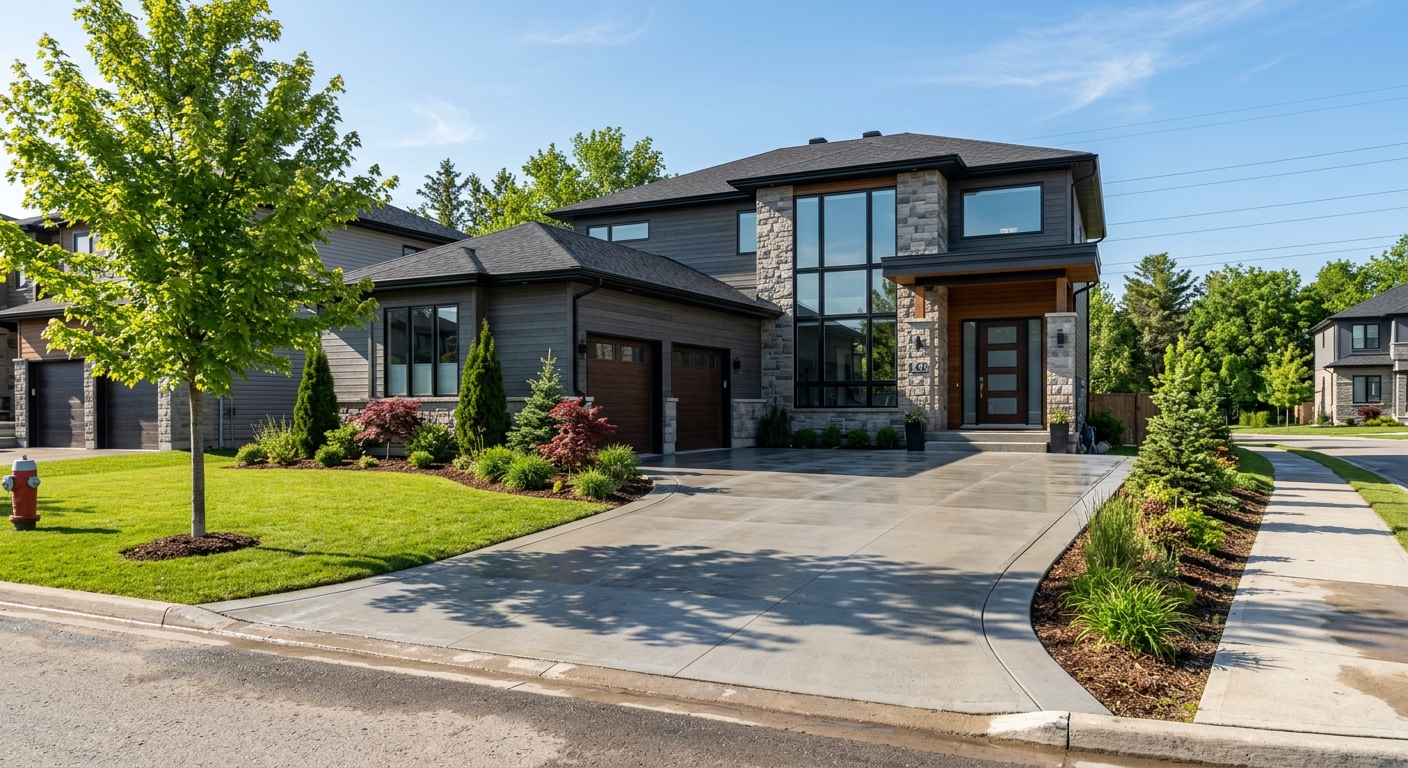
Concrete work options and costs in Downtown
In Downtown, Alberta, homeowners usually choose between driveways, patios/walkways, garage floors and foundation work—all concrete flatwork that has to perform through Calgary’s deep frost and frequent freeze–thaw cycles. According to the Statistics Canada 2021 Census, Downtown’s population is 12,423, and the area has a steady mix of household types, including a large share of single-detached homes that drive demand for driveways and backyard concrete. When concrete is specified for exterior use here, it’s not “just pour and finish”: it’s engineered with proper sub-base depth, air-entrained mixes, and control joints so the surface doesn’t scale or spall later.
Pricing can also swing because Calgary’s trade availability tightens during the short practical pour season for exterior slabs. Pouring too late in the fall or too early in spring can push contractors into winter-grade materials, insulation blankets, and sometimes on-site heating—costs that rarely show up on a basic quote. In neighbourhood pockets such as Erlton and the Mission area, driveways and backyard pads are especially in demand due to frequent renovations on older properties, where excavation is often more complicated.
Below is a practical comparison of typical sizes, specs, finishes and budget ranges for Downtown projects, so you can line up apples-to-apples before you request quotes.
| Application |
Typical Size |
Key Spec |
Finish Option |
Price Range |
| Concrete driveway (standard broom finish) |
20 ft x 10 ft (200 sq. ft.) |
4 in slab, reinforced where required, air-entrained for exterior exposure |
Broom finish + control joints |
$12,000–$18,000 |
| Exposed aggregate driveway |
20 ft x 10 ft (200 sq. ft.) |
Higher material quality + appropriate surface retarder/technique |
Exposed aggregate finish + sealed |
$15,000–$22,000 |
| Stamped concrete driveway or patio |
300 sq. ft. |
Reinforcement and base prep sized for freeze–thaw durability |
Stamp pattern + integral colour + sealer |
$15,000–$26,000 |
| Plain concrete patio or walkway |
12 ft x 20 ft (240 sq. ft.) |
4 in slab (or project-specific thickness), air-entrained mix |
Float/straight-edged + light broom |
$5,000–$9,000 |
| Garage floor (interior slab) |
22 ft x 24 ft (528 sq. ft.) |
Interior mix design, vapour considerations, and proper sub-base |
Steel-trowel or light broom, edges sealed |
$10,000–$17,000 |
| Foundation footings (structural, below frost) |
Typical detached home footing perimeter (varies) |
Engineered footings sized below design frost depth; rebar cage as required |
Structural concrete (no decorative finish) |
$28,000–$45,000 |
Prices are estimates only and vary by project scope, site access and material selection.
What affects the price of concrete work in Downtown
In Downtown, Alberta, two quotes for the “same” concrete job can differ by 30–50% because the big cost drivers are hidden below the surface: excavation depth, granular base, reinforcement detailing, mix design, and the amount of cold-weather protection needed to cure properly. Calgary’s climate is a cold continental setup, with a design frost depth engineered around roughly 1.2 m (about 4 ft). That means footings, retaining elements and some slab details must bear on undisturbed soil below frost line to reduce heave and seasonal movement. On exterior flatwork—driveways, patios and walkways—engineered air-entrained concrete and well-planned control joints are standard, not optional, to survive freeze–thaw.
Cost also changes with the project season. When exterior pours fall near late fall or early spring, contractors may need winter-grade mixes, insulated blankets, and sometimes heated enclosures to maintain curing conditions. That can push an exterior slab closer to the upper end of the $12,000–$18,000 driveway range or the $5,000–$9,000 patio/walkway range, even if the finished size looks identical. De-icing salt further increases the importance of sealing; if sealing is skipped or delayed, spalling risk rises, and you can end up paying again for repairs.
Here are a few Downtown examples of local conditions that raise or lower cost: (1) a steep driveway approach or poor truck access increases labour time and formwork; (2) clayey or frost-susceptible soils require deeper, more engineered excavation and base replacement; (3) an older neighbourhood lot with mature landscaping can increase demo and disposal scope—while a newer, flatter site with straightforward access keeps costs closer to the lower band.
| Price Factor |
Why It Matters |
Cost Impact |
| Frost line depth — determines footing depth and form height |
Footings must extend below design frost to prevent heave and seasonal movement |
Often adds thousands if excavation/form height increases |
| Site preparation — excavation, grading, compacted granular base |
Base quality controls settlement, drainage and long-term cracking |
Can swing costs significantly on rocky/clay sites |
| Reinforcement — rebar or wire mesh requirement |
Rebar detailing improves resistance to shrinkage and freeze–thaw stress |
Higher labour and steel cost for correct reinforcement |
| Mix design — air-entrainment and compressive strength spec |
Air entrainment helps resist freeze–thaw scaling and spalling |
Small material delta, but big performance payoff |
| Finish type — broom vs. stamped vs. exposed aggregate |
Complex finishing increases labour, curing timing and materials |
Stamped/exposed typically lifts price toward upper bands |
| Pour size and concrete truck access to site |
Longer pours and limited access increase staging and labour |
May require pumps or additional delivery strategy |
| Cold-weather curing precautions — heating and blankets |
Maintains adequate early strength gain and reduces surface scaling |
Winter protection can add major overhead in shoulder seasons |
| Control joint pattern and sealing cost |
Joints limit random cracking; sealing repels de-icing salts |
Usually a moderate add-on that prevents expensive failures |
Permits & regulations in Alberta
In Alberta, concrete work falls into two buckets: structural work that typically requires a building permit and documentation, and flatwork that usually doesn’t—unless it changes grading, drainage, or lot coverage. Structural concrete such as foundation footings, foundation walls, and grade beams generally requires a building permit and often engineered drawings reviewed through the municipality’s process. Concrete flatwork—like driveways, patios and walkways—usually does not require a permit when it’s simply replacing existing slab-on-grade work. However, you should still confirm if the project affects lot grading, drainage, impervious surface coverage rules, or any municipal right-of-way portion of the work.
To protect yourself in Downtown, verify three things before signing: (1) the contractor’s insurance and (2) their work coverage for workers, and (3) the job’s permitting responsibilities. Step-by-step: ask for a certificate of liability insurance and ensure it lists the correct legal name and policy dates. For worker coverage, request proof of WSIB/WCB coverage (or the equivalent clearance/coverage documentation they provide). Then check licensing online through Alberta’s contractor/licensing resources (many contractors will also provide their business number and proof of standing). Finally, require the quote to state whether permits and engineered documentation are included (for structural scopes) and who will pull them.
Getting concrete right in Downtown's freeze-thaw climate
Concrete fails in Downtown when the system is weak in one of four places: base preparation, mix durability, crack control, or curing/sealing. Calgary’s freeze–thaw cycles attack poorly drained bases and any concrete that isn’t air-entrained for exterior exposure. To spec the job correctly, start with base prep: use a compacted granular sub-base sized for local soil conditions and excavation depth to support the slab below the impacts of frost. Second, require an air-entrained exterior mix; for outdoor flatwork, target about 5–7% air content, and specify a minimum 32 MPa compressive strength so the slab achieves adequate early and long-term performance. Third, control joints must be planned and spaced so cracks form where intended, not randomly. Fourth, curing matters: aim for a minimum 7-day curing period under proper conditions, and in cold weather plan for insulation blankets or heating to prevent early freeze. Finally, add sealing: apply a penetrating sealer after the cure window (commonly around 28 days) to repel de-icing salts.
On price, homeowners sometimes think they can shave cost by reducing reinforcement or skipping sealing. Here’s where it usually isn’t justified: a basic broom-finish driveway might land near the mid range of the $12,000–$18,000 band, while a stamped patio can push toward the $15,000–$26,000 range when detailing and materials increase. But spending a small amount on correct air-entrainment, joint layout, and sealing protects the larger ticket item you already paid for.
| Spec |
Why It Matters in Downtown |
What to Ask For |
Impact if Skipped |
| Compacted granular base (depth?) |
Supports slab and controls frost-related movement during freeze–thaw |
Ask for base depth and compaction method (and whether soil is replaced) |
Settlement and cracking; faster deterioration and edge spalling |
| Air-entrained concrete mix (target air %?) |
Resists freeze–thaw scaling and surface damage in Calgary winters |
Target 5–7% air for exterior flatwork; confirm mix is air-entrained |
Higher risk of spalling, scaling, and premature surface failure |
| Compressive strength (MPa rating) |
Ensures durability and adequate strength gain through cold seasons |
Minimum 32 MPa specification |
Weaker slab surface, increased cracking and reduced service life |
| Control joints (spacing per ACI guidelines) |
Directs cracking and prevents random fractures |
Joint spacing plan based on slab dimensions and reinforcement layout |
Random cracking and water intrusion along edges |
| Minimum 7-day curing period |
Early strength gain prevents surface damage from early freezing |
How they protect curing in shoulder seasons; curing protection method |
Scaling and micro-cracking that shows up later |
| Penetrating sealer (when applied after cure) |
Reduces salt and moisture ingress that accelerates spalling |
Confirm sealer type and that it’s applied after cure (often ~28 days) |
More salt damage and surface breakdown over multiple winters |
How to choose a concrete work contractor in Downtown
Choosing a concrete contractor in Downtown, Alberta starts with verification: licensing/standing (where applicable), liability insurance, and worker coverage (WSIB/WCB). Step one is to request a certificate of liability insurance and verify the policy is active, the coverage amount is reasonable, and the legal entity matches the contract. Step two is to obtain proof of WSIB/WCB coverage for workers—ask for a clearance document or current coverage letter. Step three is to check their business standing and contractor status through Alberta’s available online resources; if they hesitate or provide incomplete paperwork, that’s a serious warning.
Next, get 2–3 written, itemised quotes—not a single lump-sum that hides trade-offs. Ask for a breakdown that includes excavation/disposal, granular base, reinforcement, concrete mix details (including air-entrainment), finishing method, joints, curing protection, and sealing (if included). Read exclusions carefully: is debris removal and grading adjustment included? Is permit pulling included for structural work? Clarify whether the contractor supplies engineered drawings when required and whether subcontractors are insured.
Warranty should be in writing. Ask for the workmanship warranty length, whether it covers labour only or labour plus materials, and whether it’s transferable to future owners. For payment, avoid paying more than 10–15% upfront; hold back a portion until completion and walk-through. Finally, require the schedule in writing: start date, pour date window, and estimated completion time for curing, finishing and any sealer application.
- Confirm insurance certificate dates match the project timeline.
- Verify WSIB/WCB clearance/coverage for the workers who will pour and finish.
- Ask who is the stamped/engineered responsible party (if structural scope).
- Demand itemised pricing for demo/excavation, base, concrete, reinforcement, finishing, and sealing.
- Ensure the quote states air-entrained mix for exterior slabs.
- Get the joint plan: spacing, layout, and how joints will be cut or formed.
- Ask about cold-weather curing: blankets, heating, or schedule adjustments.
- Confirm how drainage will be handled at the edges of the slab.
- Ask whether rebar/wire mesh is included and where it’s placed (not just “for reinforcement”).
- Verify disposal and hauling are included if excavation is required.
- Request a clear warranty in writing, including coverage boundaries.
- Keep payment tied to milestones; hold back until final grade, finish, and cleanup are accepted.
Concrete red flags in Downtown: (1) “No need for air-entrainment” or vague mix descriptions for exterior work, (2) skipping control joints or cutting them too late, (3) no plan for cold-weather curing protection, (4) quotes that lump disposal and base prep together without details, and (5) contractors who won’t provide insurance/WSIB documentation before mobilizing.
Frequently asked questions — concrete work in Downtown
How do I compare concrete quotes?
Start by comparing quotes line-by-line, not by total price alone. For Downtown, ask each contractor to itemise excavation and disposal, granular base depth/compaction, reinforcement (if included), the concrete mix (confirm air-entrainment for any exterior driveway/patio/walkway), finishing method, joint plan, curing approach, and whether sealing is included. If two bids differ by 30–50%, it’s usually because one includes better sub-base prep or winter-grade curing precautions. A broom-finish driveway commonly sits in the $12,000–$18,000 band, while stamped work often moves higher toward $15,000–$26,000 depending on detailing. Also confirm timeline: short seasonal windows in Calgary can require insulating blankets or heat, which affects cost. (Statistics Canada, 2021 Census)
Can concrete be poured in cold weather in Downtown?
Yes, concrete can be poured in cold weather in Downtown, Alberta, but it must be handled differently. In Calgary’s freeze–thaw climate, the goal is to maintain proper early strength gain so the concrete doesn’t freeze at the wrong time, which can lead to surface scaling or long-term weakness. Contractors typically use winter-grade mixes, insulated blankets, and sometimes temporary heating depending on temperatures, wind, and slab thickness. You should ask what specific cold-weather curing method they’ll use and how long the concrete must be protected. Avoid contractors who promise “we pour no matter what” without a curing plan. Proper curing is especially important because the design frost depth in Alberta is engineered deeper (around 1.2 m), and poorly cured concrete may not survive repeated winter cycles.
How do I maintain concrete in Downtown's freeze-thaw climate?
Maintenance is mostly about keeping moisture and salt away from the surface and controlling stress. If your slab is exterior, make sure it’s sealed after it cures (commonly around 28 days) with a penetrating sealer meant for salt exposure. Sweep debris regularly and use appropriate de-icers—some products are harsher than others and can accelerate surface breakdown. During freeze–thaw seasons, avoid leaving pooled water near slab edges and monitor for small cracks that allow water intrusion. If you have a driveway or walkway in Downtown, routine inspections each spring and fall help catch issues early. Preventive steps protect the investment more effectively than waiting for spalling patches, because repairs after salt exposure tend to be more disruptive and expensive.
What causes concrete to spall in Downtown winters?
Spalling in Downtown winters is usually caused by freeze–thaw damage combined with moisture and de-icing salt. The biggest technical causes are insufficient air-entrainment in the exterior mix, poor base drainage, or curing that didn’t achieve proper early strength before cold exposure. If the slab is sealed too late—or not sealed at all—saltwater migrates into pores and expands when it freezes, breaking down the surface. Another common contributor is inadequate control joint planning, which leads to random cracking and water pathways. In exterior flatwork, contractors should use air-entrained concrete (target about 5–7% air content) and include joint and sealing procedures. If any of these were skipped to hit a low budget, the spalling risk climbs.
What is rebar and when is it required in Alberta?
Rebar is steel reinforcement placed inside concrete to improve tensile strength and control cracking under load, shrinkage, and temperature movement. In Alberta, whether rebar is required depends on the design and slab/foundation type, plus engineering requirements. For structural work like foundation footings and grade beams, reinforcement is typically engineered and mandatory. For exterior slabs like driveways and patios, rebar or wire mesh may be specified based on thickness, soil support, and expected loads (and the engineer/contractor may also rely on proper joint spacing and base prep to manage cracking). In your Downtown project, ask the contractor to specify where reinforcement goes (bottom third vs. fully supported) and whether it’s included in the quote. A thorough quote should also confirm the mix design is air-entrained for exterior freeze–thaw durability.
How long does a concrete project take in Downtown?
Timelines vary by scope and curing conditions, but in Downtown, you’re usually managing the cold-weather curing schedule as much as construction labour. A typical interior garage floor may take a few days from prep to completion, with curing time considered for finishing and acceptance. Exterior work is faster to place but can take longer to become fully serviceable: after placement and finishing, concrete needs protection during curing, and sealing is commonly applied after the cure window (often around 28 days). If the pour is scheduled near colder temperatures, contractors may add time for insulated blankets/heating and for meeting minimum curing conditions. For exterior slabs, plan on weather-dependent timing during Calgary’s shorter practical pour season. As a reference, driveways that fall into the $12,000–$18,000 band may still take longer if cold-weather precautions are required, even when the square footage is straightforward.