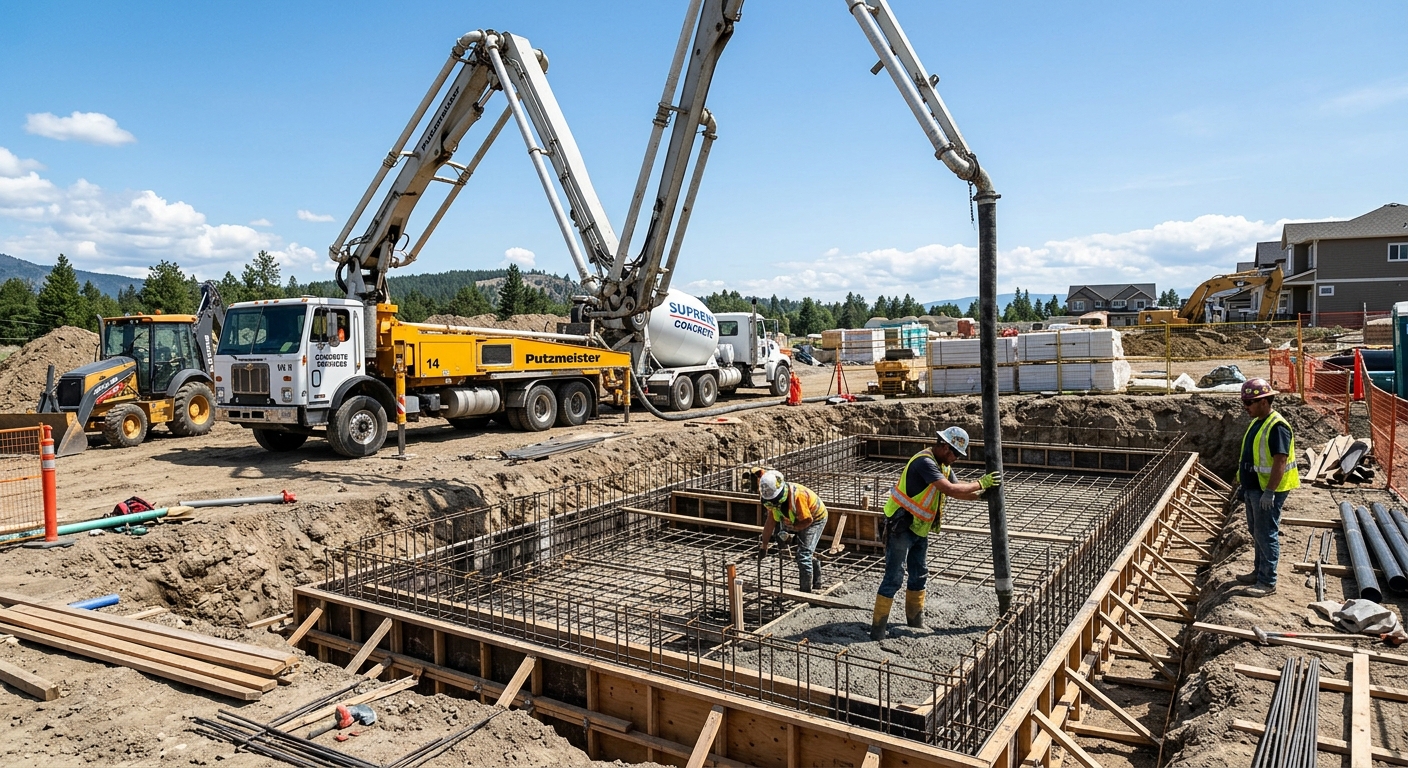
Concrete work options and costs in Leduc
Leduc is a growing community in the Edmonton region, and that shows up in steady demand for driveways, patios and walkways—especially with the housing stock you see around town. In Leduc, single-detached homes make up 63.2% of dwellings (Statistics Canada, 2021 Census), which is why most concrete flatwork projects we price are for homeowners who need a durable entrance from garage to curb. Homeownership is also strong, with 73.2% of households owning (Statistics Canada, 2021 Census), so residents typically reinvest in long-term surfaces rather than short-term repairs.
Concrete pricing here is strongly shaped by Edmonton’s cold continental climate. Frost depths are commonly designed around 1.5 m or more, so footings and any frost-susceptible layers need to be placed and compacted below design frost to reduce heaving. Freeze–thaw cycles across late fall, winter and spring mean exterior slabs need air-entrained mixes, good drainage, and a correct control joint layout to limit cracking and spalling. Also, the practical pour season for flatwork is shorter, so scheduling can tighten in late spring to early fall—often pushing labour premiums on busy weeks.
In Leduc, demand is especially noticeable around family-oriented residential pockets like Southfork, where new builds and remodels keep crews booked for driveways and stamped patios. With those realities in mind, the table below gives realistic starting points for common options—so you can compare quotes like-for-like before you ask for adjustments.
| Application |
Typical Size |
Key Spec |
Finish Option |
Price Range |
| Concrete driveway (standard broom finish) |
400–600 sq ft |
4"–5" slab, compacted base, joints, air-entrained mix |
Broom finish, saw-cut joints |
$9,000–$18,000 |
| Exposed aggregate driveway |
400–600 sq ft |
4"–5" slab, compacted base, edging/forming detail |
Exposed aggregate with seal-ready surface |
$12,000–$21,000 |
| Stamped concrete driveway or patio |
300–600 sq ft |
Air-entrained mix, base compaction, release + densifier workflow |
Stamped pattern + integrated texture |
$12,000–$26,000 |
| Plain concrete patio or walkway |
150–400 sq ft |
4" slab typical, slope to drainage, joints as required |
Float + broom or light trowel, minimal texture |
$3,500–$9,000 |
| Garage floor (interior slab) |
400–650 sq ft |
Vapour barrier (as applicable), mesh/wire depending on design |
Float finish, optional decorative hardener |
$6,500–$14,500 |
| Foundation footings (structural, below frost) |
Varies by plan |
Below frost depth, engineered reinforcement and formwork |
Typical structural concrete finish |
$25,000–$60,000 |
Prices are estimates only and vary by project scope, site access and material selection.
What affects the price of concrete work in Leduc
In Leduc and the wider Edmonton region, you can see the same basic concrete project swing by 30–50% between quotes—and it usually comes down to how each contractor deals with frost protection, base prep, and cold-weather curing. A driveway “price per square foot” sounds simple, but if one quote assumes the same base thickness and joint layout as another, the difference should narrow. When it doesn’t, it’s often because one contractor is building a slab to survive the local freeze–thaw conditions, while another is trying to keep costs down in excavation, reinforcement, or finishing.
First, frost line depth dictates footing depth and form height. In Alberta, footings must typically extend below the local design frost depth to prevent frost heave—meaning more excavation, more forming, and more backfill than in milder climates. Second, exterior slabs need air-entrained concrete to survive repeated freeze–thaw cycles; without the correct mix design, you get surface spalling and scaling sooner. Third, the pour season is realistically tighter here. If a crew has to add heating or insulating blankets to protect curing concrete during shoulder-season temperatures, that can add measurable cost. Finally, de-icing salt in winter accelerates surface wear; properly sealing the slab after curing helps extend service life.
To make that real: if one driveway quote comes in at roughly $9,000–$18,000 for standard broom finish, another may land higher—say closer to the upper end—because it includes deeper base, more robust reinforcement around edges, and better drainage grading. For stamped work, the jump into the $12,000–$26,000 band is justified when the scope includes correct preparation, release/colour system, and joint placement that won’t telegraph cracks through the pattern.
| Price Factor |
Why It Matters |
Cost Impact |
| Frost line depth — determines footing depth and form height |
Heave risk rises if concrete or footings sit too shallow |
Higher excavation + deeper formwork; often increases cost significantly |
| Site preparation — excavation, grading, compacted granular base |
Weak sub-base leads to settlement and premature cracking |
Can swing labour and material charges by tens of percent |
| Reinforcement — rebar or wire mesh requirement |
Controls cracking and supports load paths |
Adds material and placement time (and inspection/fit-up effort) |
| Mix design — air-entrainment and compressive strength spec |
Air-entrainment improves freeze–thaw durability |
Usually modest per m³, but must be spec’d correctly to avoid failure |
| Finish type — broom vs. stamped vs. exposed aggregate |
Decorative systems add labour, tools and controlled timing |
Stamped/exposed typically costs more than standard broom |
| Pour size and concrete truck access to site |
Long carries, tight sites and extra pump/handling increase costs |
Access constraints can add setup charges and labour hours |
| Cold-weather curing precautions — heating and blankets |
Ensures proper strength gain in freezing or near-freezing conditions |
Adds material, fuel and monitoring time |
| Control joint pattern and sealing cost |
Joints guide cracking and sealing reduces salt/moisture damage |
Correct jointing prevents costly early patching; sealing is an added line item |
Permits & regulations in Alberta
In Alberta, whether you need a permit for concrete depends on what you’re building. Structural concrete work—such as new or modified footings, foundation walls, and grade beams—typically requires a building permit, and it is often tied to engineered drawings reviewed through the municipal process. Concrete flatwork (driveways, patios, and walkways) usually does not require a permit by itself, unless it changes lot grading, impacts impervious surface coverage limits, or affects municipal right-of-way conditions (for example, altering a frontage approach or drainage path). Because rules can vary based on scope and exact location, confirm before breaking ground with Leduc’s municipal office or the development/building intake channel.
Before you hire anyone in Leduc, don’t just ask if they are “licensed”—verify key paperwork step-by-step:
- Licence/credentials: request their Alberta business contact details and check the applicable online registry listing (business name and contractor profile).
- Liability insurance: ask for an up-to-date Certificate of Insurance showing the proper limits and project coverage.
- WSIB/WCB coverage: confirm they carry worker protection coverage for their crews; ask for the clearance letter or proof they are in good standing.
- References: ask for 2–3 similar jobs (exterior flatwork in cold climates is not the same as small interior pours).
- Engineering/permit support (if structural): ensure they understand who provides the engineered drawings and how inspections are handled.
If a contractor won’t provide documentation, or says “permits aren’t needed” without reviewing your exact scope, that’s a red flag.
Getting concrete right in Leduc's freeze-thaw climate
Concrete failures in Leduc almost always trace back to one or two missed steps in the recipe: the base, the mix design, the joints, or curing. Edmonton-area frost design commonly targets frost depths around 1.5 m or more, so any structural element (like footings) must be placed below design frost. For flatwork—driveways, patios and walkways—the biggest failure mode is freeze–thaw damage that leads to scaling or spalling, typically from inadequate air-entrainment, poor drainage, or weak base compaction.
To spec the job correctly, start with the base: use a properly graded and compacted granular sub-base to the right depth for your soil conditions and slab thickness. Next is mix design: for exterior flatwork, air-entrainment is typically in the 5–7% air range, and the concrete should meet at least a 32 MPa compressive strength spec (as required by the engineer/contract spec). Third, control joints should be planned so cracking happens where it’s acceptable—not randomly across the slab. Fourth, curing matters: allow a minimum 7-day curing period under good conditions, and if temperatures dip, ask how they’ll protect the pour with insulated blankets or heating to maintain curing temperatures. Finally, sealing: apply a penetrating sealer after the slab has cured (commonly around 28 days post-pour) to help repel de-icing salts and reduce surface deterioration.
When you’re comparing options, understand what’s worth paying for. For example, a broom-finish driveway might land in the $9,000–$18,000 range. If an “upgrade” pushes toward the upper end, it’s often justified by better base preparation, stronger jointing, and correct air-entrained mix—things that prevent expensive early repairs.
| Spec |
Why It Matters in Leduc |
What to Ask For |
Impact if Skipped |
| Compacted granular base (depth?) |
Controls settlement and reduces water-related frost movement |
State base depth, granular type, and compaction method |
Uneven settling, cracking, premature surface failure |
| Air-entrained concrete mix (target air %?) |
Improves freeze–thaw durability in exterior slabs |
Confirm air content target (typically 5–7% for exterior flatwork) |
Spalling/scaling, surface deterioration after winters |
| Compressive strength (MPa rating) |
Supports strength gain for load and long-term performance |
Ask for minimum 32 MPa spec (as appropriate to project requirements) |
Lower durability and higher risk of cracking under load |
| Control joints (spacing per ACI guidelines) |
Governs crack locations during shrinkage |
Request joint spacing plan and sealant approach |
Random cracking and wider joint deterioration |
| Minimum 7-day curing period |
Ensures concrete reaches strength before exposure |
Ask how they protect and monitor curing in cold weather |
Weak surface, reduced performance and durability |
| Penetrating sealer (when applied after cure) |
Reduces moisture and de-icer salt impact |
Apply around 28 days after pour (or per sealer instructions) |
Faster spalling and staining; more frequent patching |
How to choose a concrete work contractor in Leduc
Choosing the right concrete contractor in Leduc is mostly about verification and clarity. In Alberta, before you sign, confirm they carry liability insurance and WSIB/WCB coverage for their workers. Practically, you should ask for: (1) a current Certificate of Insurance (COI) showing project coverage and correct limits, and (2) proof of WSIB/WCB in good standing (often a clearance letter or equivalent certificate). If they can’t provide it quickly, that’s a major concern—especially for exterior work where crews work around excavators, rebar and concrete trucks.
Then request 2–3 itemised written quotes, not just a lump sum. You want line items for excavation/haul, granular base, vapour barrier (if interior), reinforcement, concrete supply, forming, finishing, joints, sealing (if included), and disposal/site cleanup. Make sure the quote clearly notes exclusions: permit pulls (if structural), removal of existing slabs, curb/ramp modifications, and any required engineering.
Finally, look at warranty and the payment schedule. A workmanship warranty should be in writing (and you should know the length). Product warranties for decorative systems can differ—confirm whether they’re transferable. On payment timing, never pay more than 10–15% upfront; hold back the balance until the job is complete and any deficiencies are corrected. Get a start date and completion estimate in writing, because cold-weather protection and curing protections can shift schedules.
- Ask for proof of liability insurance and confirm coverage is active for the project period.
- Request WSIB/WCB clearance proof for all crews working on your site.
- Verify the company can provide references for similar Edmonton-area freeze–thaw exterior flatwork.
- Get quotes in writing with itemised scope (base, reinforcement, concrete, finishing, joints, sealing).
- Confirm whether excavation includes hauling off excess material or if disposal is extra.
- Ask who performs the final grading and drainage check before the pour.
- Confirm mix design specifics: air-entrainment for exterior slabs and minimum strength spec.
- Require joint spacing and details (saw-cut timing and sealant plan if applicable).
- Ask how curing will be handled if temperatures fall—blankets/heating and how long.
- Check whether decorative finishes include densifier/release processes and what surfaces are prepared.
- Agree on a warranty in writing and understand what “covered” means for cracking/spalling.
- Set payment terms: keep upfront to 10–15% and retain holdback until final acceptance.
Concrete contractor red flags in Leduc include: refusing to provide COI or WSIB/WCB proof, quoting decorative concrete without specifying air-entrained mix and joint placement, skipping or downplaying base depth/compaction, using “thin slab” pricing without explaining frost-safe base design, and pushing for large upfront deposits without a signed scope and schedule.
Frequently asked questions — concrete work in Leduc
Do I need a permit for concrete work in Alberta?
In Alberta, it depends on the scope of concrete. Structural items—like new or modified footings, foundation walls, and grade beams—typically require a building permit and often engineered drawings reviewed through the municipal process. For flatwork such as driveways, patios and walkways, permits are usually not required by default, but they may be triggered if the work changes lot grading, touches impervious surface limits, or affects drainage and any right-of-way requirements near the frontage. Since Leduc projects can vary by lot layout and drainage, confirm the specific requirement with the local authority before you pour. Also, make sure your contractor can show liability insurance and WSIB/WCB coverage before work starts.
Concrete vs pavers for a patio in Leduc?
In Leduc’s freeze–thaw climate, both concrete and pavers can perform well, but they fail differently. Concrete patios rely on proper base preparation, air-entrained mix, and control joints; when installed right, they’re low-maintenance. Pavers can offer easy spot repairs if a section shifts, but they still need correct base depth and compaction, and they often require joint sand maintenance. Cost-wise, a plain concrete patio often sits in the $3,500–$9,000 band, depending on size and finish. Stamped concrete moves higher (commonly into the $12,000–$26,000 range), while pavers are usually priced by material and labour intensity. If you want a cleaner, monolithic look and fewer joint lines than pavers, concrete is a strong fit—provided air-entrainment and joints are done properly.
How long does a concrete driveway last?
On well-prepared, properly specified exterior concrete in Leduc, a driveway can last 20 to 30 years or more. The key is surviving freeze–thaw cycling and de-icer exposure. When the base is compacted to the right depth, the mix is air-entrained, drainage is correct, and control joints are spaced and executed so cracking stays managed, the concrete holds up well. If a contractor cuts corners—thin base, weak mix, missing air content, or poor joint layout—you may see scaling or spalling within a few winters. A standard broom-finish driveway typically lands in the $9,000–$18,000 range; paying closer to the realistic upper end can be worthwhile if it includes better base prep and correct mix design. Sealing after the slab cures can also help extend performance against salt.
What is air-entrained concrete and why does it matter here?
Air-entrained concrete is mixed with controlled microscopic air bubbles that give freezing water space to expand without breaking the cement paste. In Leduc and the Edmonton region, freeze–thaw cycles are frequent across late fall, winter and spring, so exterior concrete without adequate air entrainment is much more likely to scale, spall, and deteriorate at the surface. That’s why credible concrete quotes for exterior flatwork should specify air-entrainment and typically target about 5–7% air content for slabs. It’s not just a “material add-on”—it’s a durability requirement for cold climates. Pair that with proper curing and well-compacted granular base, and you dramatically reduce the risk of early failure. If a quote doesn’t mention air content or mix specs, ask directly before you sign.
How do I prepare the base for a concrete slab?
Base prep is where most driveway and patio problems begin. For Leduc’s frost and wet–dry swings, you need a compacted granular sub-base to the depth the slab design requires, with proper grading and drainage so water doesn’t sit under or beside the concrete. The process typically includes excavation to the correct elevation, removing topsoil/organic material, placing granular in lifts, compacting each lift, and verifying grade and slope before the pour. For exterior slabs, the thickness and base depth matter as much as the finish. When discussing your quote, ask for the base depth and compaction approach. A “low” quote can look attractive until you realize it assumed less excavation or a thinner base, which is exactly how you get settlement cracks and water-driven frost movement over time.
How do I compare concrete quotes?
Start by comparing quotes line-by-line, not by a single total. Ask for itemised scope: excavation and hauling/disposal, granular base depth and compaction, reinforcement (wire mesh or rebar where required), concrete strength and air-entrainment, forming, finishing, control joints (spacing and timing), and whether sealing is included. Confirm how the contractor handles cold-weather curing—heating or insulated blankets—because curing protection can change labour and material costs. Compare access constraints too: truck access, concrete pumping needs, and any extra labour for forming around edges. Use realistic expectations from the local price bands: for example, a standard broom driveway commonly falls around $9,000–$18,000, and stamped work often lands in $12,000–$26,000. Finally, check that each contractor carries liability insurance and WSIB/WCB coverage in Alberta, and that payment terms are sensible (minimal upfront, holdback until completion).