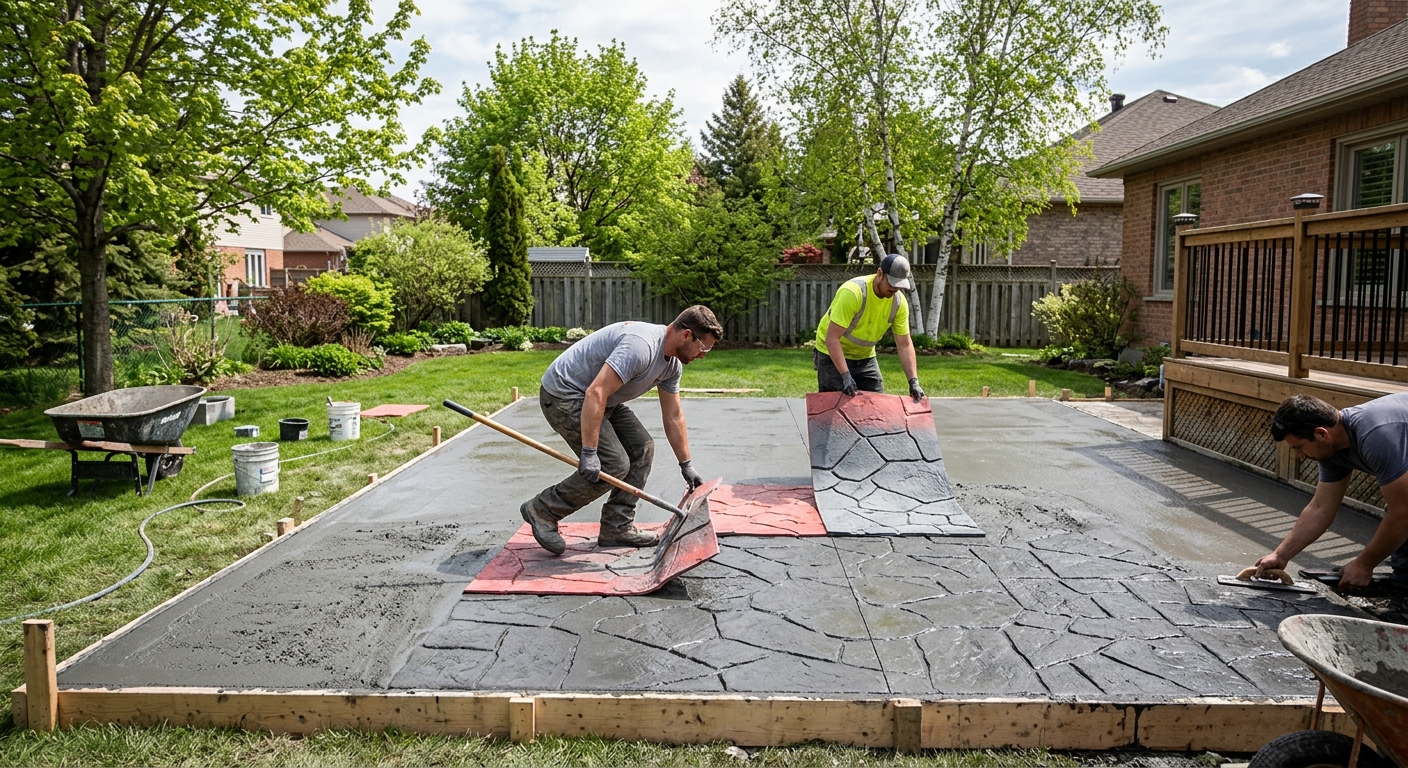
Concrete work options and costs in Prince Rupert
Prince Rupert is a smaller community (population 1,319, Statistics Canada, 2021 Census), but homeowners still need reliable concrete for the basics—driveways, patios, walkways and foundation work that can handle Alberta’s cold continental swings. In many nearby Calgary-area homes, concrete flatwork is especially common because it’s durable, low maintenance and easy to keep safe in winter. The frost-and-freeze reality here affects nearly every dollar of your quote: Calgary’s practical pour season is shorter, and specs are engineered around a design frost depth of about 1.2 m (roughly 4 ft), meaning exterior footings and structural bearing must sit below that zone.
On top of that, freeze–thaw cycles drive requirements like air-entrained concrete for exterior slabs and walkways, granular base prep, and well-spaced control joints to reduce random cracking and spalling. Contractors also plan logistics around weather—if a pour window is tight, cold-weather curing blankets, insulated tents, or temporary heat can be added to protect strength gain. In Prince Rupert, demand is often strongest in established residential pockets such as the downtown/near-downtown area, where homeowners are most likely to upgrade older entries and flatwork. That’s why prices in this region can differ meaningfully even for “similar” jobs.
Use the ranges below as a comparison starting point, then match the right option to your site conditions, desired finish and whether the scope includes excavation, reinforcement, and sealing.
| Application |
Typical Size |
Key Spec |
Finish Option |
Price Range |
| Concrete driveway (standard broom finish) |
24 ft × 10 ft (240 sq. ft.) |
Air-entrained mix; compacted granular base; control joints |
Broom finish, light saw-cut joints |
$12,000–$18,000 |
| Exposed aggregate driveway |
24 ft × 10 ft (240 sq. ft.) |
Air-entrained mix; exposed stone; base + reinforcement as needed |
Exposed aggregate with sealer |
$15,000–$21,000 |
| Stamped concrete driveway or patio |
20 ft × 12 ft (240 sq. ft.) |
Air-entrained mix; integral color; joints planned for shrinkage |
Stamped pattern (e.g., slate/stone look) |
$15,000–$26,000 |
| Plain concrete patio or walkway |
12 ft × 10 ft (120 sq. ft.) |
Air-entrained mix; compacted sub-base; minimal slope away from house |
Smooth float or light broom |
$5,000–$9,000 |
| Garage floor (interior slab) |
20 ft × 22 ft (440 sq. ft.) |
Vapour barrier (as specified), fibre or mesh, proper sub-base |
Smooth trowel; optional broom edge |
$10,500–$16,500 |
| Foundation footings (structural, below frost) |
Typical house layout (varies) |
Engineered rebar cage; designed depth below frost; concrete placement plan |
Structural finish; formwork as required |
$28,000–$45,000 |
Prices are estimates only and vary by project scope, site access and material selection.
What affects the price of concrete work in Prince Rupert
In Prince Rupert and across the Calgary region, the same basic “concrete driveway” can land 30–50% apart depending on soil, excavation volume, reinforcement needs, and how the contractor protects the pour in cold weather. A lot of that comes down to Alberta’s frost depth and freeze–thaw behaviour. In practice, footings and bearing must extend below the design frost depth (about 1.2 m / 4 ft) to prevent frost heave and seasonal movement. That requirement increases excavation and footing volume versus milder areas. For exterior slabs and flatwork, air-entrained concrete is essential so the concrete survives repeated freeze–thaw cycles without spalling. Calgary’s colder placement window also means contractors may need winter-grade materials, insulated blankets, or temporary heat—especially for late-fall or early-spring pours—so you get proper strength gain instead of surface scaling or long-term weakness.
Local site conditions in and around Prince Rupert can also push costs up or down. For example, a driveway replacement on heavy clay or poor drainage often requires deeper granular base and more grading to achieve a stable, compacted sub-base. Conversely, a flatter site with good access for the concrete truck and a shorter haul distance can reduce labour and equipment time. If you’re choosing between a standard broom-finish driveway (commonly aligned with the $12,000–$18,000 band) and a decorative stamped or exposed aggregate finish (often near the $15,000–$26,000 band), the price difference is usually justified by extra materials, specialized finishing labour and curing/sealing care to keep the surface looking right in winter.
| Price Factor |
Why It Matters |
Cost Impact |
| Frost line depth — determines footing depth and form height |
Footings must bear below design frost to limit frost heave and seasonal movement |
Higher excavation depth increases concrete and forming costs |
| Site preparation — excavation, grading, compacted granular base |
Proper sub-base reduces settlement and protects the slab from shifting |
More removal/hauling and base material can add major labour and trucking |
| Reinforcement — rebar or wire mesh requirement |
Controls cracking and supports load transfer where needed |
Material + labour for placement, chairs, and overlaps increases cost |
| Mix design — air-entrainment and compressive strength spec |
Air entrainment helps concrete survive freeze–thaw; strength supports durability |
Premium mix and stricter batching/testing typically raise unit costs |
| Finish type — broom vs. stamped vs. exposed aggregate |
Decorative finishes require timing, tooling, and extra steps |
Stamped/exposed work usually costs more than broom-finished flatwork |
| Pour size and concrete truck access to site |
Smaller pours may need more mobilizations; difficult access can slow placement |
Extra equipment or hand work can increase labour |
| Cold-weather curing precautions — heating and blankets |
Ensures adequate strength gain and reduces scaling/spalling risk |
Can add significant line-item cost during short weather windows |
| Control joint pattern and sealing cost |
Joints manage shrinkage; sealing helps with de-icing salt exposure |
Sealing and proper saw-cut planning add time and materials |
Permits & regulations in Alberta
In Alberta, structural concrete work—typically footings, foundation walls, and grade beams—generally requires a building permit and often involves engineered drawings that the municipality reviews as part of permitting. Concrete flatwork such as patios, walkways and driveways usually does not require a separate permit by default, unless it affects lot grading, drainage, impervious surface coverage limits, or works near a municipal right-of-way. Because requirements can vary by project scope (especially if you’re changing drainage routes or increasing impervious area), confirm with your local authority before the first excavation.
For contractor compliance, don’t rely on verbal assurances. For a homeowner in Prince Rupert, the practical verification steps are: (1) confirm the contractor is properly registered/licensed in Alberta through the relevant provincial registry/online listings; (2) ask for a current Certificate of Insurance and confirm you’re added as the appropriate certificate holder or that liability limits are sufficient for the scope; (3) request proof of WSIB/WCB coverage (or the contractor’s applicable exemption documentation, if truly applicable) so you’re not exposed if a worker is injured on site; and (4) check references for similar concrete scopes—especially projects that had exterior freeze–thaw exposure and required air-entrained mixes and cold-weather curing precautions.
Want it to go smoothly? Have the permit responsibility listed clearly in the contract, including who pulls it and what drawings/specs are required.
Getting concrete right in Prince Rupert's freeze-thaw climate
Concrete fails in Prince Rupert primarily when the slab or foundation can’t handle freeze–thaw expansion, moisture intrusion, or differential settlement. The most common issues homeowners see are surface scaling and spalling from inadequate air-entrainment, cracking from poor base compaction or missing control joint strategy, and long-term durability problems when curing is rushed during cold snaps. The fix starts with specs that match the Calgary-region climate engineering approach: base preparation, mix design, joints, curing and sealing.
(1) Base preparation: Use a compacted granular sub-base to the correct depth for your local soil conditions so the slab bears on stable material below the frost-affected zone. If the base is too thin or poorly compacted, the slab can settle and crack even if the finish looks good.
(2) Mix design: For exterior flatwork, require air-entrained concrete. Many contractors target about 5–7% air content to manage freeze–thaw durability, along with a minimum 32 MPa compressive strength spec for exterior durability.
(3) Control joints: Ask for a joint layout that limits random cracking and includes saw-cut timing coordinated with bleed water and initial set.
(4) Curing: Plan for at least 7 days of curing under proper conditions. In cold-weather periods, winter-grade placement, insulated blankets and/or temporary heat may be needed to reach strength safely.
(5) Sealing: A penetrating sealer applied after the concrete has cured (often 28 days post-pour for exterior protection) helps repel moisture and de-icing salt impacts.
How this ties to price: if you’re deciding between a plain broom-finish patio/walkway (often within the $5,000–$9,000 band) and a decorative stamped option (commonly $15,000–$26,000), the premium is real—but it’s only worth it when the foundation of the job is correct. For example, adding cold-weather curing blankets to protect a $7,500 walkway can cost far less than replacing a scaled surface later.
| Spec |
Why It Matters in Prince Rupert |
What to Ask For |
Impact if Skipped |
| Compacted granular base (depth?) |
Stable base reduces settlement and helps the slab resist frost movement |
State sub-base depth, soil conditions, and compaction testing/requirements |
Cracking, unevenness, and premature failure |
| Air-entrained concrete mix (target air %?) |
Air voids protect concrete during freeze–thaw cycles |
Target air content (commonly 5–7% for exterior flatwork) and confirm it on the mix ticket |
Spalling and scaling, especially with de-icing salts |
| Compressive strength (MPa rating) |
Strength gain supports long-term durability in cold exposure |
Minimum 32 MPa and strength control plan |
Surface weakness, durability loss, increased cracking risk |
| Control joints (spacing per ACI guidelines) |
Manages shrinkage cracking to predictable locations |
Requested joint spacing and saw-cut timing; confirm joint pattern drawing |
Random cracks and joint-edge spalling |
| Minimum 7-day curing period |
Cold weather can slow strength development |
How curing will be protected when temperatures are low; curing blanket/heat plan if needed |
Reduced strength, scaling, and long-term performance issues |
| Penetrating sealer (when applied after cure) |
Helps repel moisture and reduces de-icing salt damage |
When it’s applied (commonly around 28 days) and which sealer type is used |
Faster deterioration, staining, and increased surface wear |
How to choose a concrete work contractor in Prince Rupert
Choosing the right concrete contractor in Prince Rupert starts with proof, not promises. For Alberta work, verify licensing/registration where applicable through the province’s online registry, then request a current Certificate of Insurance showing liability coverage for the concrete scope. Next, confirm WSIB/WCB coverage—ask for documentation that covers the employees who will be on your site. If a contractor won’t provide paperwork up front, treat that as a major red flag. Also ask for references on similar Calgary-region concrete projects that involved exterior freeze–thaw exposure and cold-weather curing precautions.
Get 2–3 itemised written quotes rather than a single lump sum. Itemised quotes should separate labour, concrete supply, excavation/site prep, base materials, reinforcement, finishing, curing measures, and sealing (if included). Read the exclusions line-by-line: does the quote include permit handling (if structural), disposal of excavated material, saw-cutting, reinforcement placement, and surface drainage/grading changes? For warranty, confirm workmanship warranty length and whether it covers cracking/spalling under normal use. Ask if product/manufacturer warranties apply to admixtures/sealers and whether those are transferable to you.
On payment schedule, avoid paying more than about 10–15% upfront. Hold back a portion until the finished work is inspected and cleaned up. Finally, get a start date and completion estimate in writing so cold-weather delays don’t become “extra charges” later.
- Provides mix design details (air-entrainment and strength) and confirms it matches the spec.
- States frost-depth strategy and footing/bearing requirements for any structural scope.
- Shows how the granular base will be built and compacted (including depth).
- Includes reinforcement plan (mesh vs rebar, chairs, overlaps) if required.
- Documents cold-weather curing plan (blankets/heat) when temperatures drop.
- Explains control joint spacing and saw-cut timing.
- Lists sealing scope (product, timing after cure, and coverage expectations).
- Includes disposal/hauling for excavation in the quote or lists it as an add-on.
- Clarifies access requirements and whether concrete pump/extra handling is needed.
- Offers a written warranty and identifies what’s covered and for how long.
- Uses an inspection walk-through before final payment.
- Provides itemised pricing so you can compare like-for-like.
Concrete red flags in Prince Rupert include: “too cheap” driveway pricing that omits air-entrainment, quotes that don’t mention curing protection in cold weather, no clear joint layout, vague base prep descriptions (no depth/compaction plan), and contractors who won’t provide insurance/WSIB/WCB documentation before starting.
Frequently asked questions — concrete work in Prince Rupert
Why does concrete crack in Prince Rupert and how is it prevented?
Concrete cracks in Prince Rupert mainly due to shrinkage as it cures, settlement from inadequate base prep, and thermal movement caused by freeze–thaw cycles. The prevention strategy in Alberta is practical: build the correct compacted granular base, use air-entrained concrete for exterior durability, and plan control joints so cracks happen in predictable locations instead of randomly. Joints should be saw-cut or formed on a schedule coordinated with the slab’s set and bleed water. Curing matters too—during cold spells, curing blankets or temporary heat can be needed so the slab gains strength properly. If de-icing salt is used heavily, sealing after the concrete cures (commonly around 28 days) helps reduce surface damage that can worsen cracking.
Stamped vs broom-finish concrete — cost difference?
Stamped concrete costs more than broom-finish because it uses integral color (or stains), specialized stamping tools, extra finishing steps and a tighter schedule to get the imprint before the surface sets. In the Calgary-area pricing bands that guide local estimates, plain broom-finish driveways often land around $12,000–$18,000, while stamped concrete driveways or patios commonly align with $15,000–$26,000. The key is that the extra cost isn’t just “decoration”—it’s labour-intensive finishing and timing. If you want stamped work to last through Alberta winters, ensure the contractor still specifies air-entrained concrete, proper joints, and curing protection; otherwise the decorative surface may spall or scale just like a plain slab.
When is the best time to pour concrete in Prince Rupert?
In Alberta, the best time to pour concrete is when temperatures stay in a workable range for proper placement and curing. In the Prince Rupert area tied to the Calgary market, contractors typically prefer spring through early fall because cold-weather curing becomes more complicated and more expensive when temperatures drop. If you must pour in late fall or early spring, ask for a winter-grade plan: insulated blankets and/or temporary heat to protect strength gain. A rushed curing window increases the risk of surface scaling and long-term durability problems from freeze–thaw. Your contractor should also protect the slab from wind chill, keep the site closed briefly after finishing, and coordinate saw-cut timing for control joints. If a contractor promises “we can pour anytime” without cold-weather measures, that’s a warning sign.
How long does concrete take to cure?
Concrete curing happens in stages. You’ll see initial set within hours, but full durability development takes longer. For everyday planning in Alberta, treat curing as a minimum of 7 days under proper conditions, especially for exterior flatwork exposed to freeze–thaw cycles. Strength keeps building beyond that, which is why sealing is typically timed after cure—commonly around 28 days post-pour for exterior protection against moisture and de-icing salt. If you pour during cold weather in Prince Rupert, curing may need active protection (blankets or heat) so the concrete actually reaches the required strength. The contractor should specify curing methods in the scope, including what they’ll do if temperatures drop overnight.
Do I need a permit for concrete work in Alberta?
In Alberta, structural concrete work like footings, foundation walls and grade beams typically requires a building permit and often engineered drawings reviewed through the municipal process. Concrete flatwork—such as driveways, patios and walkways—usually does not require a permit by default, unless your project affects drainage, lot grading, impervious surface coverage rules, or a municipal right-of-way. For Prince Rupert homeowners, the safest approach is to confirm the requirement before excavation starts and ensure the contract clearly states who is pulling permits (if any). Also verify the contractor’s compliance documentation—liability insurance and WSIB/WCB coverage—so you’re protected if something goes wrong on site.
Concrete vs pavers for a patio in Prince Rupert?
Concrete and pavers both work well for patios, but the decision usually comes down to maintenance, cracking expectations and schedule. A plain concrete patio often fits the $5,000–$9,000 band for typical residential sizes, and it’s poured as one monolithic slab with proper joints and air-entrained mix to handle freeze–thaw. Pavers can look great and allow easier spot repairs if a section settles, but they still depend on good base prep and correct drainage; if the base is poor, you’ll get shifting and weed growth. In Prince Rupert’s Alberta climate, ask both contractors how they handle compaction, jointing/drainage, and winter durability. If you’re adding de-icing salt exposure, sealing concrete after cure can improve surface longevity.