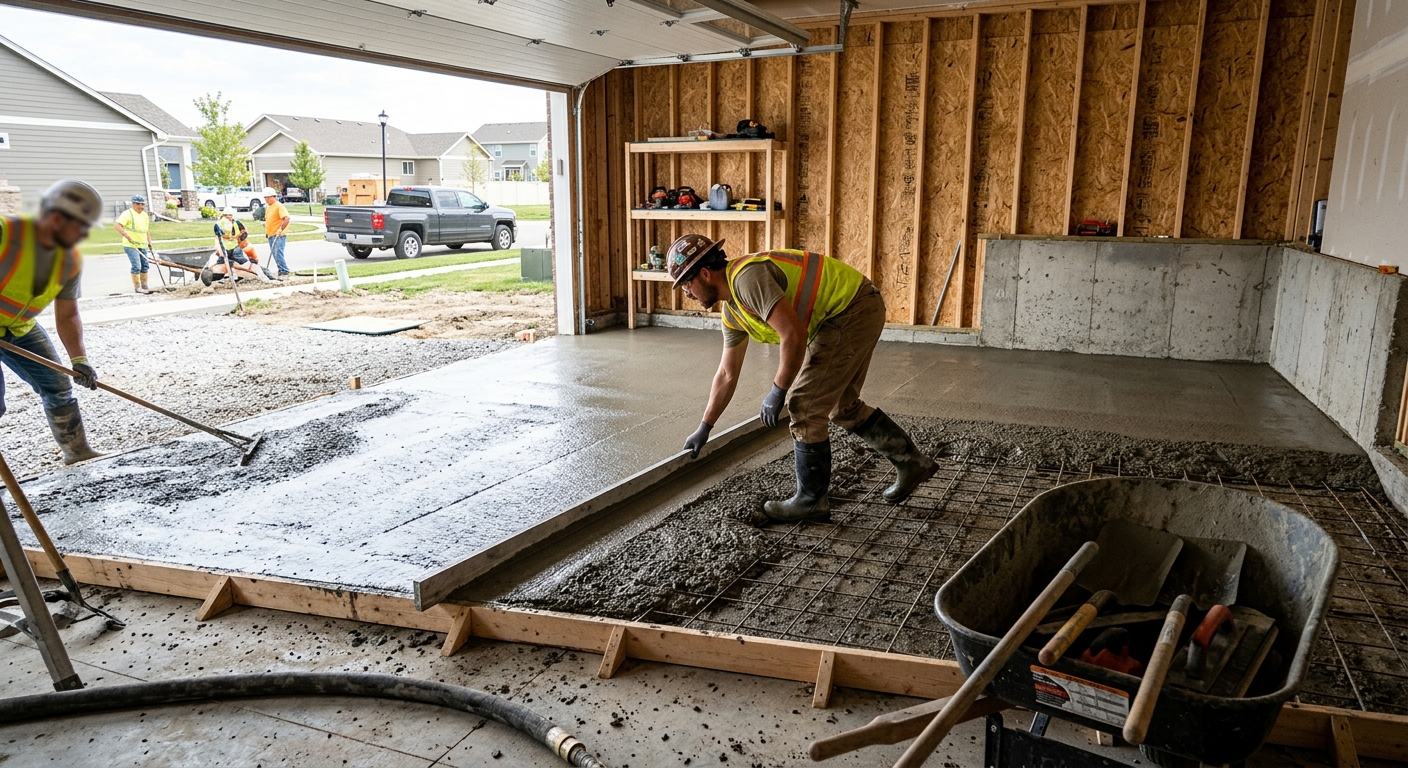
Concrete work options and costs in Evanston
Evanston is a growing community in the Calgary economic region, and concrete flatwork is one of the first upgrades many new and established homeowners tackle. With the majority of local housing being single-detached homes (Statistics Canada, 2021 Census), the demand is steady for driveways, patios, walkways and interior garage slabs—plus the foundation work that makes it all possible. If your property is in the older-built pockets near the residential core, or you’re updating access and outdoor living spaces in the newer phases, you’ll typically find concrete contractors booked around the seasons that work best for placement and curing.
In Calgary-area conditions, pricing isn’t just about square footage. The cold continental climate drives deeper frost protection requirements and more engineered excavation. In practice, Calgary’s design frost depth is about 1.2 m, so footing excavation and volumes are higher than in warmer regions. Freeze–thaw cycles also push specs toward air-entrained mixes for exterior slabs, and you’ll often see tighter control-joint layouts to reduce random cracking and spalling. On top of that, the pour season for outdoor slabs is shorter, and late-season work may require winter-grade materials, insulated blankets, and sometimes temporary heat to get adequate curing—those steps cost more but protect the slab long-term.
To help you compare apples to apples, here are typical cost ranges for common concrete projects in Evanston, before we talk about what drives your specific quote.
| Application |
Typical Size |
Key Spec |
Finish Option |
Price Range |
| Concrete driveway (standard broom finish) |
24 ft x 10 ft (240 sq ft) |
Air-entrained exterior mix, compacted base, jointing |
Broom finish, control joints |
$12,000–$18,000 |
| Exposed aggregate driveway |
24 ft x 10 ft (240 sq ft) |
Air-entrained mix, wash/expose timing, sealed for salts |
Exposed aggregate (light reveal) |
$15,000–$22,000 |
| Stamped concrete driveway or patio |
24 ft x 10 ft (240 sq ft) or 15 ft x 12 ft (180 sq ft) |
Air-entrained exterior mix, colour hardener/antiquing |
Stamped pattern with release and seal |
$15,000–$26,000 |
| Plain concrete patio or walkway |
12 ft x 16 ft (192 sq ft) or 4 ft x 20 ft (80 sq ft) |
Compacted granular base, air-entrained mix, control joints |
Float/smooth with light broom |
$5,000–$9,000 |
| Garage floor (interior slab) |
22 ft x 20 ft (440 sq ft) |
Vapour barrier, reinforcement where specified |
Standard float finish |
$7,000–$12,500 |
| Foundation footings (structural, below frost) |
Per project (varies by perimeter length) |
Excavate below design frost depth, structural rebar |
Formed/placed structural concrete |
$28,000–$45,000 |
Prices are estimates only and vary by project scope, site access and material selection.
What affects the price of concrete work in Evanston
In Evanston, you can easily see 30–50% differences between two quotes for what looks like the same concrete project because Calgary-area pricing is driven by frost engineering, labour scheduling, and how thoroughly the contractor prepares the base. A standard-size driveway might land near the $12,000–$18,000 band when excavation is straightforward and truck access is easy. The same driveway can rise quickly if the site needs deeper removal, more granular base, or enhanced winter curing measures. Stamped work also jumps because more labour is involved in colour work, timing, and finishing; it’s commonly closer to the $15,000–$26,000 band depending on pattern complexity and quantity.
The frost line depth and freeze–thaw cycles are the biggest cost drivers. Exterior footings and foundation elements need to extend below the design frost depth (about 1.2 m in this region) to prevent frost heave and seasonal movement. Because Calgary experiences frequent freeze–thaw cycles, exterior slabs also require air-entrained concrete mixes and properly spaced control joints to reduce cracking and spalling. Cold-weather placement shortens the practical pour season and adds curing precautions—insulated blankets, winter-grade mix adjustments, and sometimes temporary heat—so contractors often charge more in late fall or early spring. Finally, de-icing salt accelerates surface wear, so sealing and durable finishing matter; skipping them doesn’t change the price much today, but it can cost more later.
In Evanston, two real-world examples that raise cost are (1) clay-leaning or frost-susceptible soils requiring additional granular excavation and (2) replacing slabs where older concrete had to be removed deeper than expected because of poor past drainage. Cost can come down when you have direct truck access and stable grade, and when your chosen finish is a broom-finish rather than stamped or exposed aggregate.
| Price Factor |
Why It Matters |
Cost Impact |
| Frost line depth — determines footing depth and form height |
Footings must bear on undisturbed soil below frost to prevent heave |
Higher excavation and concrete volume typically add thousands |
| Site preparation — excavation, grading, compacted granular base |
Proper base prevents settlement and controls drainage |
More removal and hauling increases labour and equipment time |
| Reinforcement — rebar or wire mesh requirement |
Controls cracking and improves load performance |
Material and labour add cost, especially on driveways |
| Mix design — air-entrainment and compressive strength spec |
Air entrainment protects against freeze–thaw damage and scaling |
Upgraded mix can add to material cost but improves durability |
| Finish type — broom vs. stamped vs. exposed aggregate |
Finish affects labour time, materials, and timing controls |
Stamped/exposed finishes often add significant labour and supplies |
| Pour size and concrete truck access to site |
Smaller pours or difficult access can require additional staging |
More truck time, batching coordination, and labour elevate price |
| Cold-weather curing precautions — heating and blankets |
Ensures concrete reaches adequate strength before freezing |
Winter curing can add direct materials and extra labour days |
| Control joint pattern and sealing cost |
Joints manage shrinkage; sealing reduces salt-driven surface wear |
Proper joint layout and sealer add cost but reduce callbacks |
Permits & regulations in Alberta
In Alberta, the rule of thumb is that structural concrete work needs more oversight than typical flatwork. For Evanston homeowners, concrete flatwork like driveways, patios, and walkways usually does not require a permit by itself unless it changes lot grading, affects impervious surface coverage rules, or impacts the municipal right-of-way. The work that typically DOES require a permit includes structural and foundation components such as footings, foundation walls, grade beams, and engineered foundation elements—because they tie directly into building structure and frost-related performance.
To verify compliance and protect yourself, check contractor credentials in a clear sequence. First, request the job details in writing: what’s being built, whether any engineering drawings are included, and whether the contractor is pulling the permit (if needed). Second, confirm liability insurance: ask for a current Certificate of Insurance showing the contractor’s liability coverage and the project address (where possible). Third, confirm WSIB/WCB coverage (workplace injury coverage) by requesting proof of active coverage. If you’re asked to sign something, ensure it matches the coverage dates and the legal name on the certificate.
Next, verify licensing/registration where applicable for the trade and the specific scope. Then ask for references on similar-scale foundation or flatwork jobs around the Calgary region. A legitimate contractor should be comfortable walking you through paperwork without pressure.
Getting concrete right in Evanston's freeze-thaw climate
Evanston’s freeze–thaw cycles are tough on concrete because water expands when it freezes, stressing the surface and any unprotected pores. The most common failures I see around Calgary-area homes are surface scaling and spalling, which often trace back to inadequate air-entrainment, rushed curing, or poor base preparation. To prevent this, you want specs that match the region’s design frost depth (about 1.2 m) and its repeated temperature swings—especially for driveways, patios, and walkways that sit exposed to de-icing salts.
Start with base preparation: compacted granular sub-base to the correct depth and crossfall so water can’t pool. Next, mix design: exterior flatwork should be air-entrained (targeting about 5–7% air content) with a minimum 32 MPa compressive strength. Then lock in a control joint pattern that limits random shrinkage cracking—joints aren’t “cosmetic” in Calgary; they’re how you steer cracking. Curing matters: aim for at least 7 days of curing under proper conditions, and if temperatures drop, winter curing measures (insulated blankets and/or heating) are often needed. Finally, sealing is your salt insurance—use a penetrating sealer applied after cure (commonly around 28 days) to repel de-icing salts and reduce surface deterioration.
When it comes to cost, it’s usually not worth chasing the lowest bid on mix quality. For example, a driveway option that lands in the $12,000–$18,000 band may include the correct air entrainment and base compaction. A “cheaper” bid that trims those items can look good upfront, but the likelihood of early spalling increases—turning a manageable project into a premature replacement.
| Spec |
Why It Matters in Evanston |
What to Ask For |
Impact if Skipped |
| Compacted granular base (depth?) |
Controls settlement and reduces freeze-related movement |
Confirm base depth, compaction method, and drainage grade |
Premature cracking, uneven surface, pumping/voids |
| Air-entrained concrete mix (target air %?) |
Air bubbles give room for freeze expansion and reduce scaling |
Request target air content (typically 5–7% for exterior flatwork) |
High risk of spalling and surface deterioration in freeze–thaw |
| Compressive strength (MPa rating) |
Supports load performance and long-term durability |
Confirm minimum 32 MPa and mix design documentation |
Lower strength, faster wear, potential structural concerns |
| Control joints (spacing per ACI guidelines) |
Manages shrinkage cracking during Calgary temperature swings |
Ask for planned joint layout and spacing |
Random cracking that’s harder to repair and cosmetically worse |
| Minimum 7-day curing period |
Ensures strength development before freeze conditions hit |
Confirm curing plan; winter work includes blankets/heating if needed |
Surface scaling, weak top slab, reduced durability |
| Penetrating sealer (when applied after cure) |
Repels de-icing salt intrusion on exposed slabs |
Confirm sealer type and timing (commonly after full cure period) |
Faster salt damage, need for earlier resealing or replacement |
How to choose a concrete work contractor in Evanston
Picking the right contractor in Evanston is mostly about verification and clarity. Start by confirming Alberta requirements are covered for your scope. Ask for proof of current liability insurance (with the certificate dated), and request evidence of WSIB/WCB coverage for the contractor and any sub-trades they use. Don’t rely on verbal assurances—ask to see documents before the job starts. If you’re doing foundation footings or foundation walls, require engineered details and permit handling where applicable, because structural work is where paperwork mistakes become expensive.
Next, get 2–3 itemised written quotes—not just a lump sum. A good quote separates labour, excavation/site prep, concrete materials, reinforcement, forming, finish work, jointing/sealing, and any hauling/disposal. Confirm what’s excluded (for example: hauling beyond a certain distance, replacing trees/shrubs, snow removal, or removing old concrete). Ask whether permits and inspections are included if they’re needed.
Warranty should be specific: workmanship warranty length, what it covers (cracks under certain conditions, spalling, re-sealing), and whether it’s transferable if you sell. Payment schedules should be conservative—never pay more than about 10–15% upfront, and hold back payment until the final cleanup and inspection are complete. Finally, get a written start date and completion estimate, and make sure the contractor’s schedule aligns with weather curing realities in Calgary-area winters.
- Verify liability insurance certificate is current and matches the legal entity quoting
- Confirm WSIB/WCB coverage and that it applies to the crews on your site
- Use itemised quotes: labour vs materials vs reinforcement vs finish vs disposal
- Ask who pulls permits (if required) for foundation/footings structural work
- Confirm frost-related excavation depth approach and how undisturbed soil is verified
- Require air-entrained mix specs and minimum compressive strength for exterior slabs
- Ask for control joint layout and sealing plan (when and what product)
- Get curing method details for cold weather: blankets/heating if temperatures drop
- Review how they protect surrounding landscaping and manage water run-off
- Confirm reinforcement details: wire mesh vs rebar, and where it’s used
- Set payment schedule with a small deposit and a holdback until final acceptance
- Request a written workmanship warranty and clarify repair process and timelines
Concrete contractor red flags in Evanston: vague quotes that don’t list mix specs or reinforcement, refusal to provide insurance/WSIB/WCB proof, cutting corners on base prep or joint spacing, promises to “pour anytime” without winter curing planning, and warranties that are limited to “surface cosmetics” rather than structural workmanship.
Frequently asked questions — concrete work in Evanston
Why does concrete crack in Evanston and how is it prevented?
Concrete in Evanston (Calgary region) most often cracks due to shrinkage and temperature movement, then worsens if freeze–thaw and de-icing salt get to the surface. Even a well-finished driveway will form shrinkage cracks if it isn’t given a planned joint pattern. The prevention approach is technical: proper compacted granular base to reduce settlement, air-entrained exterior mix to resist freeze scaling, and control joints placed at appropriate spacing to “steer” where the cracks occur. Curing is also critical—if the slab freezes too early, the top layer can weaken and crack more readily. If your project is on the typical driveway band (about $12,000–$18,000 for many standard sizes), choose contractors who specify jointing, air content, and curing rather than only talking about colour or finish.
Stamped vs broom-finish concrete — cost difference?
Stamped concrete usually costs more because it adds labour and materials for pattern mats, release agents, colour hardeners or colouring, and extra finishing time. In Evanston, the pricing gap is also affected by the fact that exterior slabs must still be air-entrained and properly jointed—so the “extra” is mainly the decorative workflow, not a shortcut on durability. As a baseline comparison, a broom-finished driveway often lands in the $12,000–$18,000 range for common sizes, while stamped driveway or patio work commonly falls near the $15,000–$26,000 band depending on pattern complexity and total square footage. If you’re choosing stamped concrete, confirm the contractor includes sealing after cure and uses a joint layout that matches Calgary’s freeze–thaw behaviour, not just the aesthetic.
When is the best time to pour concrete in Evanston?
For best results in Evanston, schedule exterior slabs for the warmer part of the year when temperatures are stable enough to support proper curing. In the Calgary area, the challenge is that the pour season is shorter and late fall/early spring can bring cold nights that slow hydration. The best-time answer is practical: aim for daytime temperatures that allow the contractor to achieve adequate strength gain before freezing conditions. If you must pour in colder weather, reputable contractors plan for winter-grade mixes and curing precautions such as insulated blankets and/or temporary heat—those steps typically increase cost but protect the slab. A contractor who pressures you to “just pour and hope” is taking a gamble with long-term spalling risk on driveways and patios, especially where de-icing salts are used.
How long does concrete take to cure?
Concrete curing has two timelines: strength gain and surface readiness. As a homeowner-friendly rule, many exterior flatwork projects require at least 7 days of curing under proper conditions for the slab to develop adequate early strength, and contractors should manage protection if temperatures drop. Full long-term performance continues beyond that; practically, many specifications align sealing with a cure milestone—commonly around 28 days after the pour—so penetrating sealer can better repel de-icing salts. In Alberta winters, the curing window can be the difference between a durable driveway and one that scales early. Ask your contractor what curing method they’ll use and how they’ll monitor conditions during those first critical days.
Do I need a permit for concrete work in Alberta?
In Alberta, it depends on what you’re building. Structural concrete work—such as footings, foundation walls, and grade beams—typically requires a building permit and often needs engineered drawings reviewed by the municipality. Concrete flatwork like patios, walkways, and driveways usually does not require a permit by itself unless it affects lot grading, impervious surface coverage limits, or the municipal right-of-way. For Evanston homeowners, the best approach is to confirm with the local authority before digging, especially if you’re changing drainage patterns or modifying elevations. Also, insist your contractor clarifies permit responsibility in writing. A contractor who can’t explain whether your scope triggers permitting is a warning sign.
Concrete vs pavers for a patio in Evanston?
Concrete and pavers both work well in Evanston, but they fail differently in freeze–thaw climates. Concrete patios are typically more straightforward to maintain because there are no individual units to shift; with the right air-entrainment, base prep, control joints, and curing, concrete can perform for decades. Pavers can be excellent too, especially if you want easy visual repair—damaged units can be lifted and reset. The trade is that pavers depend heavily on edge restraints, base stability, and joint sand management; if drainage isn’t right, weeds and shifting can show up over time. Cost-wise, plain patios and walkways commonly fall in the $5,000–$9,000 band for typical sizes, while upgrades in concrete finishes (stamped work) move higher. If salt and winter loads are a concern, ask each contractor how they’ll address base preparation and drainage first.