Concrete work options and costs in Silverado
In Silverado, concrete projects are a daily reality for homeowners because flatwork and foundations have to perform through Calgary’s cold continental winters, not just look good for a season. According to the 2021 Census, Silverado’s population is 7,975 (Statistics Canada, 2021 Census), and most local homes are single-detached properties—the primary market for driveways, patios and walkways. That matters because these areas are constantly exposed to freeze–thaw cycles, snowmelt, and de-icing salt, so the engineering and materials specs are where the real value lives.
Calgary-area concrete pricing is higher than many people expect because the design frost depth is about 1.2 m (roughly 4 ft), and foundation-related excavations often need to reach undisturbed soil below that depth. Exterior slabs also rely on air-entrained mixes, correct granular base prep, and well-planned control joints. Add in a shorter exterior pour season and cold-weather curing requirements (insulating blankets and sometimes temporary heat), and you can see why costs shift faster here than in milder parts of Alberta.
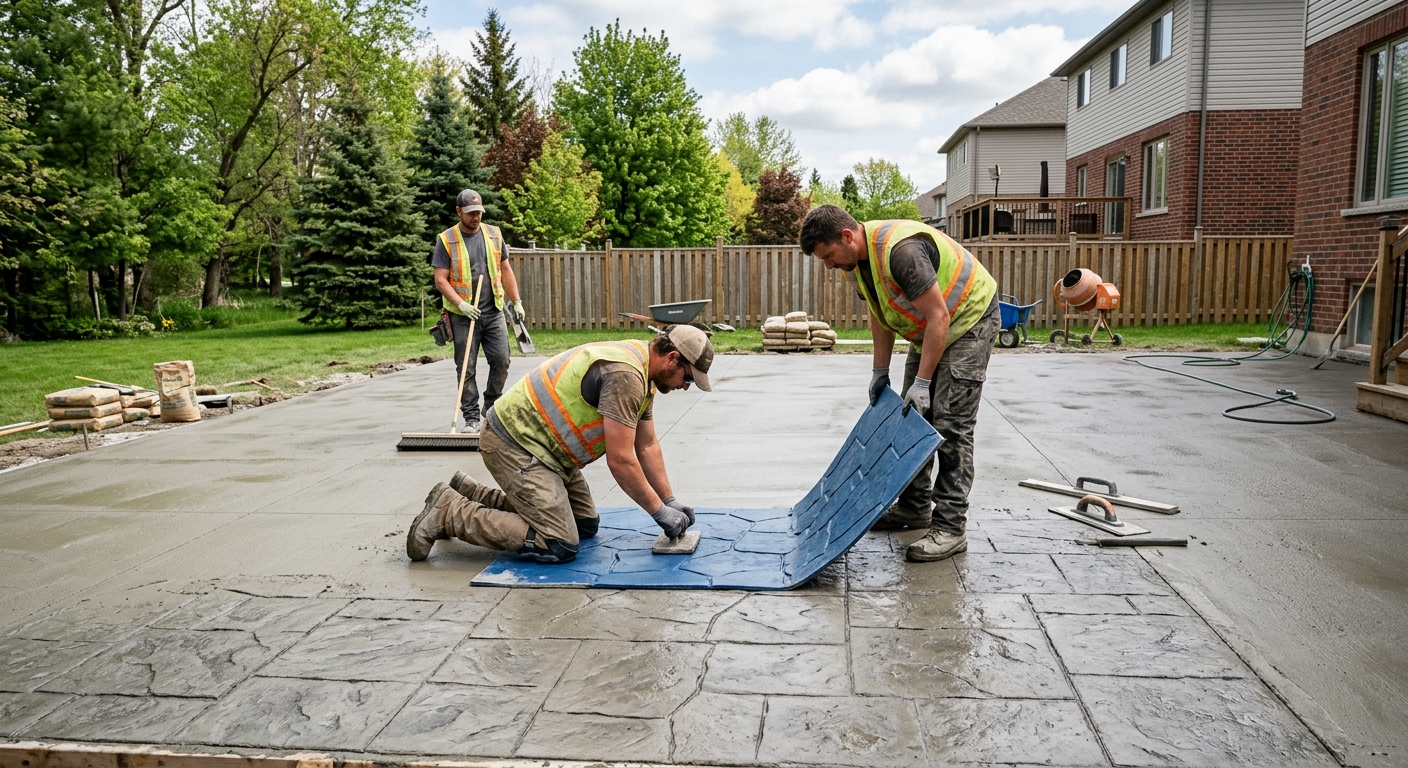
Contractor availability can also tighten in peak months, especially for decorative work like stamping and exposed aggregate, which are more labour-intensive and require extra forming, finishing time, and curing management. In Silverado, demand tends to be especially strong around established residential pockets where driveways and backyard patios are frequently upgraded—often alongside garage floor refinishing and small landscaping tie-ins. With that in mind, here’s a practical comparison of common concrete options and what you should budget before you call for quotes.
| Application |
Typical Size |
Key Spec |
Finish Option |
Price Range |
| Concrete driveway (standard broom finish) |
400–500 sq. ft. |
Air-entrained exterior mix; proper granular base |
Broom finish + control joints |
$12,000–$18,000 |
| Exposed aggregate driveway |
400–500 sq. ft. |
Air-entrained mix; approved base compaction |
Exposed aggregate with sealer |
$15,000–$22,000 |
| Stamped concrete driveway or patio |
300–450 sq. ft. |
Air-entrained mix; colour hardener where specified |
Stamped pattern + release + seal coat |
$15,000–$26,000 |
| Plain concrete patio or walkway |
150–300 sq. ft. |
Exterior slab thickness; joints and slope |
Plain trowel/brush finish |
$5,000–$9,000 |
| Garage floor (interior slab) |
400–600 sq. ft. |
Vapour barrier + reinforcement plan |
Broom finish or light trowel |
$14,000–$24,000 |
| Foundation footings (structural, below frost) |
Approx. 1,000–1,800 sq. ft. of footing footprint coverage |
Excavate to undisturbed soil below design frost depth; engineer/spec concrete |
Reinforced footings; forms and curing control |
$28,000–$45,000 |
Prices are estimates only and vary by project scope, site access and material selection.
What affects the price of concrete work in Silverado
In Silverado and the wider Calgary region, two quotes for the “same” concrete job can differ by 30–50% because the real cost drivers are the invisible ones: how deep you must excavate for frost protection, what the contractor has included in base preparation, and how the mix and curing are managed for Calgary’s freeze–thaw swings. Even when the finished surface looks identical, the specs underneath can be very different—especially in a climate engineered around frost.
Here, frost depth is a big deal. Footings and structural elements need to bear on undisturbed soil below the design frost depth (commonly about 1.2 m in this area). That typically means more excavation, more granular and formwork height, and larger concrete volumes than in warm regions. Exterior slabs and flatwork also require air-entrained concrete mixes to survive freeze–thaw cycling, and in colder months the pour season tightens—so contractors may use winter-grade mixes, insulated blankets, and sometimes heat to protect curing. On top of that, de-icing salt accelerates surface wear; sealing is often the difference between “looks fine after a season” and “scales and spalls early.”
Local examples that move costs up or down in Silverado: (1) replacing an existing driveway often costs more if you need deeper underpinning for transitions or remove unsuitable base; (2) a stamped driveway may cost noticeably more than a standard broom finish because it requires additional materials, timing, and careful curing control—often pushing you toward the higher side of the $15,000–$26,000 stamped/decorative band; and (3) access constraints (tight side yards, street restrictions, or long hose/bucket handling) can add labour and equipment costs, nudging projects from the $12,000–$18,000 driveway range toward the top end. As the housing stock ages and yards get more compacted over time, base remediation becomes more common—so budgets should account for site prep, not just concrete.
| Price Factor |
Why It Matters |
Cost Impact |
| Frost line depth |
Determines footing depth and form height |
More excavation and concrete can add major cost; can swing projects by tens of thousands for foundations |
| Site preparation |
Excavation, grading, compacted granular base |
Unstable soil or poor drainage increases labour and granular supply; often 15–30% of total for flatwork |
| Reinforcement |
Rebar or wire mesh requirement |
Reinforcement and chairing add material and labour; omission can reduce cost but increases cracking risk |
| Mix design |
Air-entrainment and compressive strength spec |
Higher-spec mixes cost more and may require winter curing measures |
| Finish type |
Broom vs. stamped vs. exposed aggregate |
Decorative finishes are labour- and material-intensive, often moving you into $15,000–$26,000 territory |
| Pour size and concrete truck access to site |
Scheduling and placement logistics |
Tight access or small sections can add equipment/labour; affects the $12,000–$18,000 driveway band |
| Cold-weather curing precautions |
Heating and blankets |
Winter-grade protection can add cost and manpower; essential for structural integrity |
| Control joint pattern and sealing cost |
Reduces random cracking and limits salt scaling |
Proper joints and sealers add line items, but skipping them often causes early surface deterioration |
Permits & regulations in Alberta
In Alberta, many concrete projects involve standard construction administration rather than “just pour a pad.” Structural concrete work—specifically concrete footings, foundation walls, and grade beams—typically requires a building permit and often engineered drawings that the municipality reviews as part of your project. Concrete flatwork like patios, walkways and driveways typically does not require a permit unless it affects lot grading, impervious surface coverage limits, or municipal right-of-way considerations. Even when a permit isn’t usually triggered, it’s still smart to confirm with the local authority before excavation, because drainage and property servicing requirements can change the acceptable approach.
From a homeowner standpoint in Silverado, verify three things before work begins. First, confirm the contractor carries liability insurance; ask for a current Certificate of Insurance showing the coverage level and your name/project referenced where possible. Second, ask for proof of WSIB/WCB coverage (or the correct Alberta coverage arrangement for the company/roles on the project). Third, check for Alberta licensing/registration information through the appropriate online resources, then request references for similar-scale concrete jobs done recently in comparable cold-climate conditions.
Step-by-step: (1) Get the quote in writing and ensure the scope matches drawings/engineer notes if you’re doing footings or foundation walls; (2) request COI and WSIB/WCB proof before signing; (3) verify the contractor’s status using online registry listings; (4) ask for a clearance letter (where applicable) or confirmation of current standing; and (5) keep copies of all documents with your contract package.
Getting concrete right in Silverado's freeze-thaw climate
Concrete failure in Silverado usually isn’t a mystery—it’s a process outcome from freeze–thaw exposure. The biggest causes are poor base preparation, incorrect mix design (especially not enough air entrainment), inadequate reinforcement planning, and rushed curing. In Calgary’s cold continental climate, water in the concrete and at the surface expands when temperatures swing below freezing. If the mix doesn’t have the right air system to accommodate that expansion, you get scaling and spalling, then progressive surface breakdown.
To spec the job correctly, start with base preparation: a compacted granular sub-base to the required depth for local soil and drainage conditions. Next, require an air-entrained exterior mix with a target air content typically around 5–7% for exterior flatwork and a minimum compressive strength spec (commonly 32 MPa for typical exterior structural applications, as required by your project requirements). Third, insist on a control joint plan. Joints must be spaced to limit random cracking, then made cleanly so water can’t migrate into uncontrolled cracks.
Curing is where many “cheap” pours go wrong. You should plan for at least 7 days of proper curing conditions, and in colder weather the contractor may need insulating blankets or temporary heat to protect early strength development. Finally, plan for sealing: a penetrating sealer applied after the concrete has fully cured—often at about 28 days—helps repel de-icing salts and slows surface deterioration.
Price-wise, decorative options cost more, but not always in a “pay extra for nothing” way. For example, moving from a standard driveway in the $12,000–$18,000 band to a stamped driveway in the $15,000–$26,000 band is usually justified because decorative work demands extra labour, materials and careful finishing/curing control to achieve crisp impressions without premature surface damage. Asking about air entrainment and curing first will prevent the most expensive failure later.
| Spec |
Why It Matters in Silverado |
What to Ask For |
Impact if Skipped |
| Compacted granular base (depth?) |
Prevents pumping and frost-related movement during freeze–thaw |
Base depth and compaction test method; confirm drainage slope |
Settling, uneven cracking, and premature slab deterioration |
| Air-entrained concrete mix (target air %?) |
Allows freeze–thaw expansion without damaging the paste |
Air content target typically 5–7% for exterior flatwork |
Surface scaling and spalling within a few winters |
| Compressive strength (MPa rating) |
Ensures early and long-term durability in a cold climate |
Minimum spec of 32 MPa (or engineer-specified rating) |
Reduced strength development and increased cracking risk |
| Control joints (spacing per ACI guidelines) |
Directs shrinkage cracking where you want it |
Joint spacing plan and sawcut timing |
Random cracks, water infiltration, and more freeze–thaw damage |
| Minimum 7-day curing period |
Protects strength gain and surface integrity in cold conditions |
Confirm curing method; blankets/heat when needed |
Weak surface, scaling, and long-term durability problems |
| Penetrating sealer (when applied after cure) |
Repels de-icing salts used during Alberta winters |
Schedule typically around 28 days post-pour (per product requirements) |
Faster spalling and colour/texture loss |
How to choose a concrete work contractor in Silverado
Choosing the right concrete contractor in Silverado starts with verifying the basics—because in freeze–thaw climates, workmanship and compliance are inseparable. First, confirm Alberta licensing/registration for the contractor and review their liability insurance certificate (ask for the COI details and policy effective dates). Second, verify WSIB/WCB coverage: request proof before work starts so you’re not exposed if there’s an incident on site.
Next, get 2–3 itemised written quotes. You want a breakdown that separates labour and materials where possible (base prep, forms, reinforcement, concrete supply, finishing, joints, sealing, winter-cure measures). Avoid “one number only” proposals for structural concrete. For driveways and patios, ask whether demolition, disposal, and haul-off are included, and whether permit pulls (where applicable) are included or excluded.
Warranty matters too. Ask for the workmanship warranty length and what it covers (cracking due to shrinkage vs. structural failures), plus any manufacturer warranty for products like sealers or admixtures. Clarify whether warranties are transferable to future owners.
Payment schedule should be conservative. Never pay more than about 10–15% upfront. The best practice is to hold back a portion until completion and final walkthrough. Finally, lock in the timeline in writing: start date, concrete pour date, curing window assumptions, and completion estimate. In Calgary-area weather, “we’ll pour when it warms up” is not a schedule—ask for the plan and backup precautions if temperatures dip.
- Confirm contractor insurance (COI) and WSIB/WCB coverage before the first day on site.
- Ask for Alberta licensing/registration details and verify them using available online resources.
- Require itemised quotes: base prep, excavation, reinforcement, concrete supply, finishing, joints, and sealing.
- Ask what’s excluded (dewatering, rock removal, disposal, tree root removal, or landscaping restoration).
- For driveways/patios, confirm they’ll use air-entrained exterior concrete and specify the target air content.
- Ask how they handle frost protection and minimum base depth for your soil condition.
- Request a joint plan: spacing, sawcut timing, and whether joint sealant is included.
- Confirm curing method and cold-weather measures (blankets/heating) when temps drop.
- Ask about concrete thickness and whether reinforcement is included for your use case (garage vs walkway).
- Get a realistic timeline for curing and sealing (sealing usually after the full cure period).
- Use a payment schedule with a holdback until final completion and cleanup.
- Insist on a written start date, pour date (or range), and completion estimate.
Concrete red flags in Silverado include: (1) quotes that omit base excavation/compaction details; (2) “we pour anytime” without winter curing blankets or heat plan; (3) no clear discussion of air entrainment for exterior flatwork; (4) refusal to provide insurance/WSIB/WCB proof; and (5) no written scope for joints, sealing, and disposal.
Frequently asked questions — concrete work in Silverado
What is air-entrained concrete and why does it matter here?
Air-entrained concrete is designed with tiny air bubbles in the mix so that, when water inside freezes, there’s room for expansion without cracking the concrete paste. In Silverado, Alberta winters follow frequent freeze–thaw cycles, and de-icing salts accelerate surface damage if the concrete isn’t properly specified. That’s why exterior slabs and driveways should use air-entrained mixes; it’s one of the biggest differences between a durable job and one that scales and spalls early. When you compare quotes, look for the mix spec rather than just the colour or finish. If you’re budgeting a driveway in the $12,000–$18,000 range, ask whether the quote includes air entrainment and appropriate curing—not just the surface finishing.
How do I prepare the base for a concrete slab?
Base preparation is where long-term performance is decided. For Silverado and the Calgary region, you need proper excavation, grading, and a compacted granular sub-base so the slab doesn’t settle or pump when the soil freezes and thaws. Ask your contractor to confirm the base depth and compaction process for your soil and drainage condition, plus how they’ll handle any unsuitable material and groundwater. The goal is stable support and correct slope to move water away from the slab. Many failures come from “thin base” shortcuts or poor compaction, which can push the project into redo territory. A well-prepped base supports both plain patios/walkways and heavier uses like garage floors, helping keep you from paying twice.
How do I compare concrete quotes?
To compare quotes in Silverado, line them up on scope—not just total price. Ensure each quote includes: excavation depth, granular base type and compaction, thickness, reinforcement plan (if any), concrete mix requirements (including air entrainment for exterior), joint pattern, finishing method, and curing measures. Also check what’s included for disposal/haul-off and site restoration (especially if there’s demolition). In cold-weather situations, ask whether the contractor includes blankets/heating and what curing timeline is assumed. Quotes that land in different parts of the price band (for example, a driveway quoted near $12,000–$18,000 vs. another near the top end) should be justified with the spec differences—often base prep, access logistics, or winter curing precautions. Request written clarification before signing.
Can concrete be poured in cold weather in Silverado?
Yes, concrete can be poured in cold weather in Silverado, but it must be engineered for curing conditions. As temperatures drop, early concrete can lose strength development too quickly, increasing the risk of surface scaling and long-term durability issues. A reliable contractor will plan winter-grade mix requirements and protect the pour with insulated blankets and/or temporary heat, while monitoring conditions until the concrete reaches safe strength. The short practical pour season in the Calgary region means scheduling matters; rushing a cold pour without proper protection is where failures start. Ask for the contractor’s cold-weather plan in writing—what protection they’ll use, how long it will run, and what temperatures trigger changes.
How do I maintain concrete in Silverado's freeze-thaw climate?
Maintenance is simple, but it has to be done with Alberta winters in mind. Start with sealing: a penetrating sealer applied after full curing (often around 28 days) helps repel de-icing salts and slows surface breakdown. For day-to-day care, avoid overusing harsh de-icers; use recommended products and apply sparingly. Keep joints free of debris so water doesn’t pool, and inspect for early signs of spalling or widening cracks so you can address them promptly. If you have a driveway or walkway with control joints, sealing and occasional joint maintenance can reduce freeze–thaw intrusion. Even when the original project is a solid build, good maintenance protects your investment in the $12,000–$18,000 driveway range or the higher-cost decorative options.
What causes concrete to spall in Silverado winters?
Spalling in Silverado usually comes from water getting into the surface and freezing, then breaking off small layers of concrete. The most common technical cause is inadequate air entrainment, which prevents the concrete from handling freeze–thaw expansion. It can also be triggered by insufficient curing, poor surface finishing, or a weak/poorly prepared base that allows movement. De-icing salts then accelerate scaling because they concentrate at the surface as water freezes and melts. Improper joint spacing or missing/incorrect sealing can also let water migrate where it shouldn’t. When you’re reviewing quotes, ask explicitly how they address exterior air entrainment, curing time (including cold-weather blankets/heating if needed), and whether sealing is included after cure—these are the spec choices that prevent spalling over multiple winters.