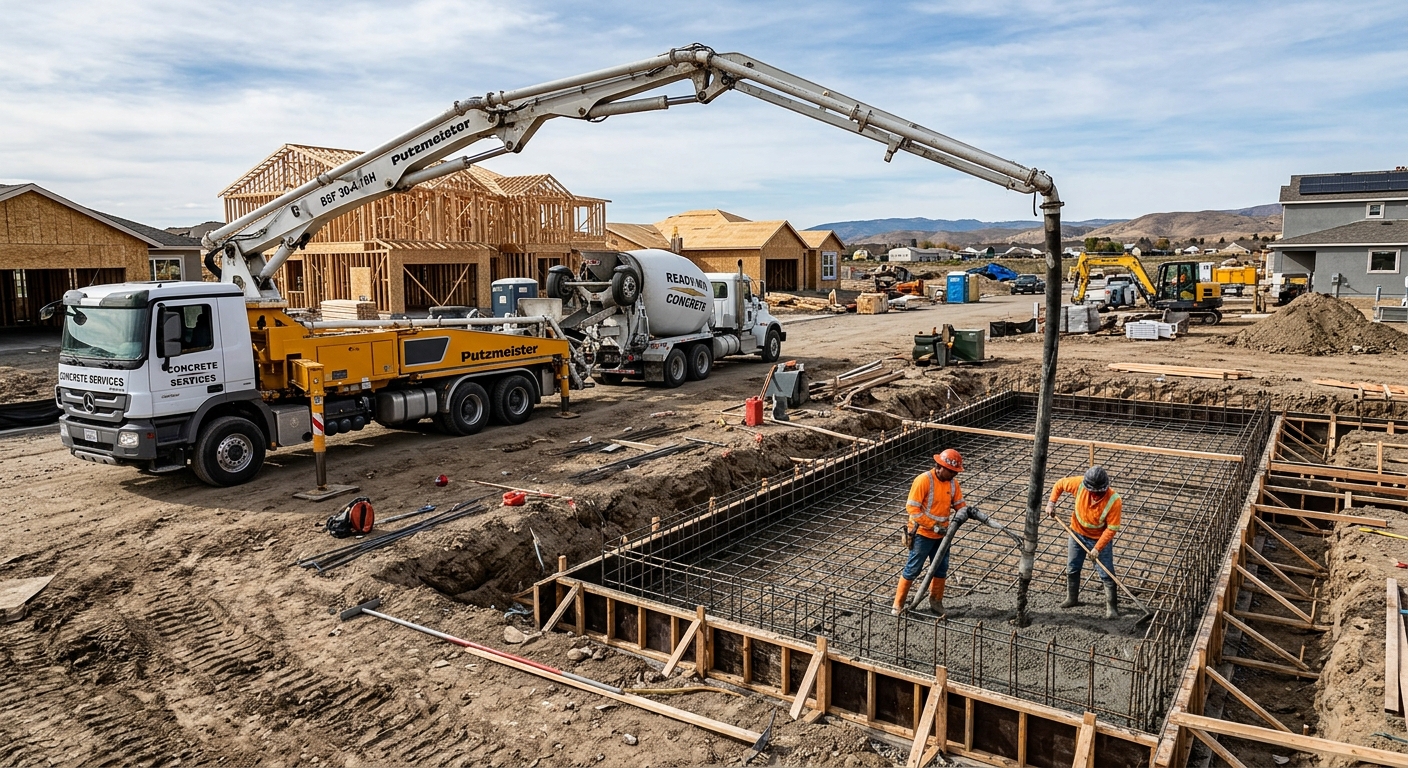
Concrete work options and costs in Glastonbury
Concrete work in Glastonbury, Alberta is shaped by the same reality Calgary-area homeowners face every year: cold, wet winters and freeze–thaw cycles that punish poorly prepared bases and rushed curing. With a population of 5,991 (Statistics Canada, 2021 Census), Glastonbury is a smaller market than central Calgary, so well-qualified crews can be booked quickly—especially around the short exterior pour window. Flatwork demand is also consistent because the majority of homes are built around family-sized lots where driveways, patios and walkways are more than a nice-to-have. In this region, those projects are engineered around a deeper design frost depth (engineered around roughly 1.2 m/4 ft) and proper drainage, which increases excavation and footing volume compared with milder areas.
Costs also vary because concrete here is specified for durability, not just appearance. Exterior slabs typically require air-entrained mixes, and late-season pours often need insulated blankets and sometimes temporary heat to keep curing on track. If you’re in the habit of using de-icing salt, sealing becomes a real line item, not an afterthought—surface scaling and spalling are usually where homeowners feel the difference between a bargain mix and a correctly engineered one.
In Glastonbury, trade activity is often steady in residential pockets like the newer subdivision areas near local road connections, where homeowners are setting up driveways, garages, and backyard landscaping. Below is a practical comparison of common options and typical pricing to help you budget for your scope.
| Application |
Typical Size |
Key Spec |
Finish Option |
Price Range |
| Concrete driveway (standard broom finish) |
400–500 sq ft |
Air-entrained exterior mix; compacted granular base; control joints |
Broom finish |
$12,000–$18,000 |
| Exposed aggregate driveway |
400–500 sq ft |
Air-entrained exterior mix; base prep; shaker/washed aggregate |
Exposed aggregate |
$15,000–$22,000 |
| Stamped concrete driveway or patio |
300–450 sq ft |
Air-entrained exterior mix; integral color; stamp pattern system |
Stamp + release + optional border |
$15,000–$26,000 |
| Plain concrete patio or walkway |
200–300 sq ft |
Air-entrained mix; compacted base; joints where needed |
Float + light broom |
$5,000–$9,000 |
| Garage floor (interior slab) |
400–600 sq ft |
Vapour barrier (where required); reinforced slab as specified |
Standard power trowel / broom option |
$10,000–$16,000 |
| Foundation footings (structural, below frost) |
House/garage footing perimeter varies |
Engineered excavation; rebar cage; concrete placement below design frost depth |
Structural concrete (not decorative) |
$28,000–$45,000 |
Prices are estimates only and vary by project scope, site access and material selection.
What affects the price of concrete work in Glastonbury
In Glastonbury and the Calgary region, you can easily see 30–50% differences between quotes for the “same” concrete job. The spread usually isn’t about labour being wildly different—it’s about how contractors engineer for Alberta’s winter: frost depth requirements, freeze–thaw durability specs, base preparation, and curing controls. Alberta’s deeper frost penetration compared to milder provinces (and the way Calgary cycles through freeze and thaw repeatedly) means footings must be built below design frost depth—commonly engineered up to about 2.4 m in parts of Alberta. For exterior flatwork, concrete also needs air-entrainment to resist scaling and spalling.
Cold weather is the other cost driver. The local pour season for exterior slabs is shorter, and when projects land in late fall or early spring, teams may need winter-grade concrete mixes, insulated blankets, and sometimes temporary heat to reach proper strength gain. That curing window matters: rushing it can lead to surface scaling, and later repairs are far more expensive than doing the prep correctly now. De-icing salt use in sidewalks and drive lanes also accelerates deterioration without sealing, so sealing and surface protection can add cost but typically reduce long-term failures.
Concrete example impacts you’ll notice locally: a 400–500 sq ft driveway can land near the $12,000–$18,000 band if excavation and grading are straightforward, but it can climb toward the higher end if you need deeper sub-base, extra reinforcement, or extended truck access time. A plain patio in the $5,000–$9,000 band stays closer to budget when the area is level; it jumps if regrading, drainage adjustments, or additional control joints are needed.
Even housing age plays a role. Older lots may have unknown fill conditions, requiring extra excavation and granular replacement—often one of the reasons foundation and exterior slab scopes swing by thousands of dollars.
| Price Factor |
Why It Matters |
Cost Impact |
| Frost line depth — determines footing depth and form height |
Footings must bear below design frost depth to prevent frost heave |
More excavation and concrete volume can add major cost, especially for basements and garages |
| Site preparation — excavation, grading, compacted granular base |
Frozen soil and poor drainage amplify settlement and cracking |
Heavier hauling, regrading, and compaction testing increases labour and equipment time |
| Reinforcement — rebar or wire mesh requirement |
Controls cracking and improves slab performance under loads and thermal movement |
Additional materials and labour for tying/spacing can raise the quote |
| Mix design — air-entrainment and compressive strength spec |
Exterior freeze–thaw durability depends on air-entrained concrete and strength gain |
Winter-rated and engineered mixes cost more than “standard” batches |
| Finish type — broom vs. stamped vs. exposed aggregate |
Finishes require different labour time, materials and curing sequencing |
Stamped and exposed aggregate are typically highest due to colour/stamp systems |
| Pour size and concrete truck access to site |
More volume and tighter access increase time, pumping needs, and labour hours |
Truck/pump fees and extra labour for placement can move the price up quickly |
| Cold-weather curing precautions — heating and blankets |
Proper curing prevents scaling and premature surface damage |
Insulated blankets/heaters add both materials and setup labour in shoulder seasons |
| Control joint pattern and sealing cost |
Joints manage cracking; sealing protects against de-icing salt-related scaling |
More jointing labour and a 28-day sealer step increase total project cost |
Permits & regulations in Alberta
In Alberta, the general rule is that structural concrete work is treated more strictly than typical flatwork. Work like foundation footings, foundation walls, and grade beams usually requires a building permit, and many projects rely on engineered drawings reviewed by the municipality. Concrete flatwork such as driveways, patios, and walkways often does not require a permit by itself, but it can require municipal approval if it affects lot grading, changes stormwater drainage, increases impervious surface coverage beyond what’s allowed, or ties into municipal right-of-way conditions. Always confirm with the local authority before breaking ground—especially if your project changes drainage patterns.
For your contractor, don’t assume they’re covered. Ask for proof of liability insurance and Workers’ Compensation coverage (WCB/WSIB equivalent in Alberta) before any excavation. The easiest way for a homeowner in Glastonbury to verify credentials is step-by-step: (1) check the contractor’s licensing/registration through the appropriate Alberta online registry tools listed in their paperwork or on their website; (2) request a certificate of insurance showing you as an interested party (or at minimum confirming current coverage limits) and match the company name to the quote; and (3) obtain a clearance letter or WCB account confirmation showing active coverage for the term of the work.
Then ask for references on similar-scale jobs—driveways, garage slabs, or footing scopes—so you can see how they handle Calgary-area base prep and cold-weather curing.
Getting concrete right in Glastonbury's freeze-thaw climate
Concrete failures in Glastonbury are usually predictable: water gets into the slab or edges, freezes, expands, and gradually breaks down weak surfaces. In a cold continental climate like Calgary’s, the job is won or lost before the truck arrives—through base preparation, a durable mix, correct jointing, and curing that actually completes. When contractors shortcut any of those steps, you tend to see spalling, scaling, and early cracking on driveways, walkways and patios, even when the concrete initially looks fine.
To spec correctly for this region, start with base preparation: use a compacted granular sub-base to the engineered depth for your soil and frost considerations, and ensure drainage routes water away from slab edges. Next, require an air-entrained exterior mix. For exterior flatwork, the target air content is typically in the 5–7% air range, and the concrete should meet a minimum 32 MPa compressive strength with a placement plan for cold days. Control joints are critical—space them to limit random cracking and plan for where you want the slab to crack. Also require proper curing: minimum 7 days under proper conditions, and if the temperature drops, blankets or heat to maintain curing conditions. Finish with sealing: apply a penetrating sealer after the slab has cured (commonly around 28 days) to repel de-icing salts.
A practical example: choosing stamped concrete instead of plain can add cost—often moving you toward the $15,000–$26,000 band versus the $5,000–$9,000 band for a basic patio. That price difference is justified when the prep, air-entrainment, joint plan, and curing are done to match the finish’s added sensitivity; otherwise, the more expensive surface fails faster and becomes a repair problem.
| Spec |
Why It Matters in Glastonbury |
What to Ask For |
Impact if Skipped |
| Compacted granular base (depth?) |
Creates stable support and manages frost-related movement in a cold Alberta climate |
Engineered granular thickness and compaction method; proof of base prep depth |
Settlement, edge cracking, and accelerated deterioration |
| Air-entrained concrete mix (target air %?) |
Improves freeze–thaw durability and reduces spalling in exterior slabs |
5–7% air target for exterior flatwork and confirmation on delivery tickets |
Scaling and spalling after winter exposure and de-icing salt |
| Compressive strength (MPa rating) |
Strength gain supports structural integrity and resistance to early damage |
Minimum 32 MPa spec and cold-weather placement plan |
Premature surface breakdown and cracking |
| Control joints (spacing per ACI guidelines) |
Controls where cracks form as the slab contracts and expands |
Planned joint spacing for your slab dimensions; joint saw-cut timing |
Random cracking patterns and wider, uneven distress |
| Minimum 7-day curing period |
Ensures proper strength development in Alberta’s temperature swings |
Curing method, blankets/heaters where needed, and who monitors conditions |
Surface weakness, scaling risk, and reduced long-term performance |
| Penetrating sealer (when applied after cure) |
Helps repel moisture and salt solutions during winter cycles |
Application after cure (commonly around 28 days) and compatible product choice |
Faster salt-driven spalling and staining |
How to choose a concrete work contractor in Glastonbury
When you’re hiring concrete contractors in Glastonbury, focus on verification first, not just the lowest number. In Alberta, ask the contractor for three core documents: (1) proof of appropriate registration/licensing for the scope (structural concrete and permit-related work typically involves more formal oversight than flatwork), (2) a current certificate of liability insurance with coverage limits that make sense for your project, and (3) proof of WCB coverage for the crew working on your site. Then check consistency: make sure the company name on the quote matches the insurance certificate and the WCB coverage details, and that dates cover your planned work window.
Next, get 2–3 itemised written quotes. You want a breakdown showing labour, concrete supply, base prep (excavation and granular), reinforcement (rebar/wire mesh), forming, finishing, joints, and any curing/blanket provisions for cold weather. Avoid lump-sum quotes that don’t list what’s included. Confirm whether permits (when required for footings/foundation walls/grade beams) are pulled by the contractor or by you, and whether disposal/hauling of excess material is included. In Glastonbury, where site access can affect truck time, those “hidden” inclusions matter.
Warranty should be clear: workmanship warranty length, whether it covers cracking/spalling caused by materials and installation, and whether manufacturer coverage is separate. Be cautious with payment schedules—never pay more than 10–15% upfront. Hold back a portion until forms are struck, finishing is complete, and you’ve got final documentation. Finally, insist on a written timeline with start date and completion estimate, including contingency if temperatures drop.
- Request the exact concrete mix description and target air-entrainment for exterior work
- Confirm compaction method and granular base thickness in writing
- Ask whether reinforcement is included and show rebar/wire mesh specifications
- Require a control joint plan (spacing and timing of saw cutting)
- Check whether cold-weather curing (blankets/heating) is included if needed
- Verify concrete truck access plan (pumping/extra labour if access is tight)
- Get disposal/hauling included or confirmed as extra cost
- Ensure sealing is specified separately (if included) and confirm the timing after cure
- Confirm warranty terms in plain language (what’s covered and for how long)
- Ask for previous Glastonbury-area references with photos of winter performance
- Confirm who pulls permits if your scope involves structural concrete
- Use a payment schedule that ties to milestones, not large upfront transfers
Concrete red flags I’ve seen in Glastonbury: contractors who won’t show delivery tickets or mix specs, “one-size-fits-all” pricing with no base prep depth detail, crews starting exterior pours late without discussing curing blankets/heating, ignoring joint spacing, and offering vague warranties that don’t address workmanship or winter-related performance.
Frequently asked questions — concrete work in Glastonbury
How do I maintain concrete in Glastonbury's freeze-thaw climate?
Maintenance in Glastonbury is mostly about controlling water and salt exposure. First, keep drainage working: don’t let soil piles or mulch sit against slab edges, and ensure downspouts route water away from patios and driveways. Second, use de-icers carefully—calcium chloride is common, but any salt will still drive deterioration over time if the surface isn’t protected. A good rule is to plan sealing after the slab has cured (often around 28 days after a new pour), then re-evaluate the sealer every few winters depending on traffic and winter use. For hairline issues like minor surface scaling, address them early rather than waiting for freeze-thaw to widen defects. Finally, inspect after major thaw/freeze cycles; small problems tend to stay repairable when caught early. (Statistics Canada, 2021 Census)
What causes concrete to spall in Glastonbury winters?
Spalling in Glastonbury is typically a freeze–thaw and moisture problem combined with inadequate durability specs. The most common cause is insufficient air-entrainment in the mix. Without proper air void structure, water in the paste freezes, expands, and breaks the surface layer—then de-icing salts accelerate that breakdown. Poor base prep and drainage can also contribute by trapping water under or at slab edges, and inadequate curing makes the surface more vulnerable. If a patio or driveway was poured in late fall without winter-grade measures or curing blankets, early surface weakness can show up as scaling and later spalling after the first hard season. The fix is usually not just patching—make sure the next pour includes the correct air-entrainment, joint plan, and sealing. Budget-wise, plain patios often start around $5,000–$9,000, while higher-durability approaches for exterior slabs may push projects toward the upper end of similar scopes.
What is rebar and when is it required in Alberta?
Rebar is steel reinforcement placed inside concrete to help control cracking and improve slab performance under loads and temperature movement. In Alberta, whether rebar is “required” depends on the engineering and the slab’s purpose: thickened edges, garages, driveways carrying vehicle loads, and foundation elements often call for reinforcement, while smaller thin slabs may use wire mesh or fibre reinforcement depending on design. For structural concrete like foundation footings and grade beams, reinforcement is a standard engineered requirement because those members must withstand structural loads and frost-related movement below the design frost depth. For exterior flatwork, many contractors include reinforcement when the slab is larger, slopes are challenging, or soil conditions are variable. If you’re comparing quotes, ask whether reinforcement is included and request the bar spacing/size or mesh type in writing, not just “reinforced.” For planning, footing scopes commonly fall in the $28,000–$45,000 range because engineered excavation and rebar cages add both material and labour.
How long does a concrete project take in Glastonbury?
The timeline in Glastonbury depends on the scope and—importantly—weather and curing needs. Typical small flatwork projects (like a patio or walkway) often take about 1–3 days on site for excavation, formwork, placement, finishing and initial curing measures, but your usable time extends longer because concrete needs a proper cure period. Even though finishing happens quickly, the concrete should sit for at least 7 days before you assume full strength for normal traffic; stronger access requirements may be longer depending on mix and conditions. Driveways can take 2–5 days depending on base preparation, reinforcement, edges/approach cuts, and truck access. Foundations and footings are staged with excavation and inspection steps, so they take longer—often about 1–2 weeks for the concrete phase across crews, depending on the design and municipal process. Late-season pours can add time if blankets or temporary heat are needed to maintain curing temperatures. Always ask for a written start date and completion estimate tied to the local forecast.
What is a concrete overlay and is it suited to Glastonbury?
A concrete overlay is an additional layer poured over an existing concrete surface after preparation—typically by removing unsound concrete, cleaning, and sometimes grinding and patching before bonding the new layer. It can be suitable in Glastonbury if the existing slab is structurally sound and the underlying base isn’t failing. If there’s significant settlement, deep cracking, or recurring spalling from freeze–thaw and water ingress, an overlay can sometimes cover the problem temporarily but it won’t correct the cause. Overlay durability also depends on bonding, thickness, and mix suitability for freeze–thaw conditions, plus sealing afterward. In colder winters, overlays need air-entrained mixes and a solid surface protection plan, especially if de-icing salt is used regularly. If your existing surface is just worn but well-supported, an overlay may be a cost-effective approach compared to full replacement. For budget context, new patios often land around $5,000–$9,000, while stamped work is typically higher at $15,000–$26,000; overlays sit in between depending on preparation and thickness.
How do I seal concrete to protect it in Glastonbury?
Sealing concrete in Glastonbury is one of the best defenses against de-icing salt and winter moisture. After a fresh pour, let the concrete cure fully before sealing—commonly about 28 days—because trapping moisture too early can reduce sealer performance. Choose a penetrating sealer designed to repel water and salt solutions rather than just forming a surface film. The contractor should clean the slab first (sweep and remove dust; address stains or efflorescence appropriately) and apply the sealer when the surface is dry and temperatures are suitable for cure/adhesion. For high-traffic areas like driveways, plan on more frequent monitoring—sealers don’t last forever, especially with daily salt exposure and tire abrasion. If you’re receiving an exterior quote, confirm whether sealing is included, what product type is used, and whether application is scheduled after the cure period. Skipping sealing can accelerate surface scaling during freeze–thaw cycles, especially on broom-finished or lightly finished slabs.