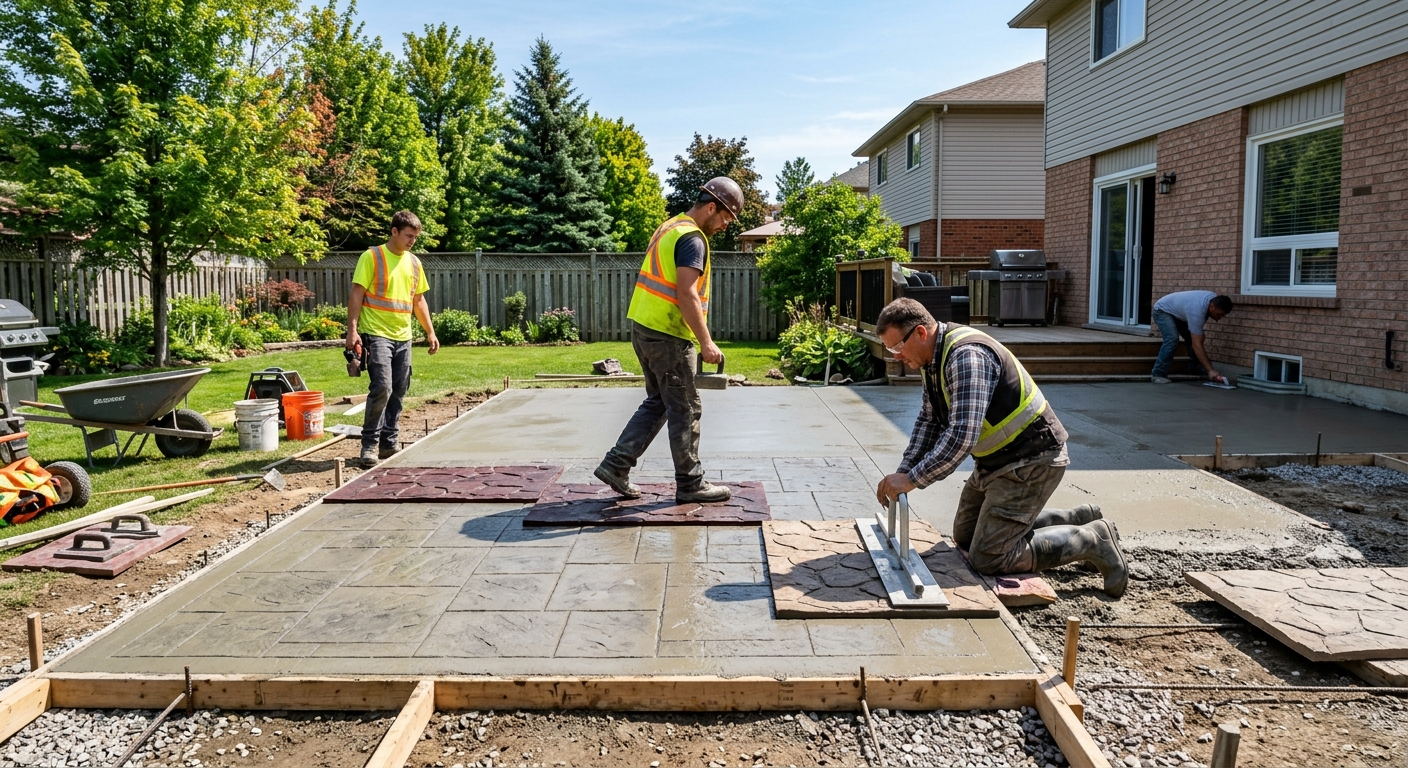
Concrete work options and costs in Delton
Delton, Alberta is a small community (population 2,009 per the Statistics Canada, 2021 Census), but it sits inside the Calgary market where concrete demand stays steady because homeowners keep updating driveways, patios, walkways and even portions of their foundations. Many houses in the area rely on concrete flatwork as part of day-to-day convenience, especially around the neighbourhoods closer to the industrial and residential mix near Langdon-style growth corridors and commuter routes into Calgary, where truck access and seasonal weather exposure matter. In Delton, concrete pricing is shaped by the cold continental climate: Calgary’s design frost depth is about 1.2 m (roughly 4 ft), so footings for garages, decks, retaining features and foundation work must bear on undisturbed soil below that depth to reduce frost heave. On top of that, frequent freeze–thaw cycles drive air-entrainment requirements, granular base preparation, and a tight control-joint plan to limit cracking and spalling—especially when people use de-icing salt in winter. The practical pour window is also shorter, and cold-weather curing precautions can add labour and materials cost when work pushes into late fall or early spring.
Because of these climate-driven engineering and scheduling realities, two quotes for “the same” driveway can differ—sometimes by thousands—depending on excavation depth, reinforcement scope, truck access, and whether the finish option is plain broom versus exposed aggregate or stamped detailing. Use the table below to compare typical options you’ll see in the Delton area, then follow up for a site-specific breakdown.
| Application |
Typical Size |
Key Spec |
Finish Option |
Price Range |
| Concrete driveway (standard broom finish) |
10 m x 3 m (about 30 m²) |
Air-entrained mix, compacted granular base, control joints |
Broomed surface for traction |
$12,000–$18,000 |
| Exposed aggregate driveway |
10 m x 3 m (about 30 m²) |
Air-entrained mix, base prep sized to frost requirements, coordinated joint layout |
Exposed aggregate (brought to surface) |
$15,000–$22,000 |
| Stamped concrete driveway or patio |
Driveway 10 m x 3 m (about 30 m²) or Patio 8 m x 4 m (about 32 m²) |
Air-entrained mix, integral colour, edge restraints, seal system |
Stamped pattern + colour |
$15,000–$26,000 |
| Plain concrete patio or walkway |
8 m x 4 m (about 32 m²) or Walkway 1 m x 10 m (about 10 m²) |
Compacted base, control joints, slip-resistant finish |
Broom or light trowel + saw cuts |
$5,000–$9,000 |
| Garage floor (interior slab) |
6 m x 7 m (about 42 m²) |
Vapour control as needed, reinforced slab, proper thickness for loads |
Plain trowel or broom depending on use |
$12,000–$19,000 |
| Foundation footings (structural, below frost) |
Typical house perimeter/isolated points (varies by design) |
Excavate to undisturbed soil below design frost depth, engineered reinforcement |
Structural concrete (no decorative finish) |
$28,000–$45,000 |
Prices are estimates only and vary by project scope, site access and material selection.
What affects the price of concrete work in Delton
In and around Delton, you can see the same driveway or patio quoted at very different numbers—often 30–50%—because Calgary-area concrete projects aren’t “cookie-cutter.” The climate forces specific engineering choices: Alberta’s frost penetration means footings must extend below the design frost depth (up to about 2.4 m in Alberta, depending on geotechnical and local conditions) to prevent frost heave and seasonal movement. Meanwhile, freeze–thaw cycles require air-entrained concrete for exterior slabs, plus a base that drains and compacts properly. When crews pour in winter conditions (or just shoulder-season cold snaps), cold-weather curing precautions can become a cost driver: insulated blankets, temporary heat, and tighter scheduling to protect curing concrete. Finally, de-icing salt is harsh on surfaces; without the right sealer and mix durability, homeowners often see premature scaling, and that future repair cost gets “paid” later.
Concrete pricing shifts up or down in real-world ways. For example, a driveway near heavier snow storage areas often needs extra sub-base grading and improved drainage—raising costs within the typical $12,000–$18,000 driveway band. A stamped patio can land on the higher end (closer to the $15,000–$26,000 range) when the contractor includes thicker slab build-up, colour packs, and a proper seal plan—not just the stamps. Conversely, a simple broom-finished walkway usually stays closer to the $5,000–$9,000 band when excavation is straightforward and truck access is easy.
In Delton, housing stock and land conditions also matter. Older lots may have inconsistent fill or weaker native soil, which increases excavation volume. New builds still face the same freeze-thaw engineering, but the difference is that equipment access and compaction testing may be clearer. Either way, the “hidden” differences show up in the quote line-by-line.
| Price Factor |
Why It Matters |
Cost Impact |
| Frost line depth — determines footing depth and form height |
Footings must bear below design frost depth to reduce heave and movement. |
Major cost driver through excavation and formwork height. |
| Site preparation — excavation, grading, compacted granular base |
Proper base reduces settlement and helps drainage through freeze–thaw cycles. |
Can add thousands if soil is removed and replaced. |
| Reinforcement — rebar or wire mesh requirement |
Controls cracking and supports slab performance under loads and temperature cycling. |
Moderate to major depending on slab thickness and load class. |
| Mix design — air-entrainment and compressive strength spec |
Air entrainment improves freeze–thaw durability for exterior flatwork. |
Usually moderate; skipping spec increases long-term failure risk. |
| Finish type — broom vs. stamped vs. exposed aggregate |
Decorative finishes require extra labour, materials, and timing. |
Often the difference between mid- and high-end driveway/patio pricing. |
| Pour size and concrete truck access to site |
Smaller job access issues can increase labour time and pumping/placing complexity. |
Higher access difficulty can bump cost significantly. |
| Cold-weather curing precautions — heating and blankets |
Winter-grade practices protect curing concrete and reduce scaling/spalling. |
Can meaningfully increase labour and equipment costs. |
| Control joint pattern and sealing cost |
Proper jointing reduces random cracking; sealing helps resist salt scaling. |
Relatively small line item that protects the larger concrete investment. |
Permits & regulations in Alberta
In Alberta, structural concrete work—such as foundation footings, foundation walls, and grade beams—typically needs a building permit, and many homes require engineered drawings that get reviewed as part of the permit process. Concrete flatwork (driveways, patios and walkways) often does not need a permit by itself, but you can be required to obtain approval if the work impacts lot grading, drainage, or municipal right-of-way considerations (for example, altering runoff patterns toward a property line or sidewalk area). Because rules can vary by municipality, confirm with the local authority before excavation starts.
Before you hire anyone for concrete in Delton, verify the contractor is properly set up. Step-by-step: (1) confirm their Alberta licensing/registration status using the applicable online resources and the contractor’s business details; (2) request a current certificate of liability insurance naming you as an additional insured if available; and (3) verify WSIB/WCB coverage through their clearance documentation or proof of coverage they provide to clients. Then ask for references on similar-scale work in cold climates—driveways with correct jointing and patios that survived winter for multiple years are the best proof.
Also, get your permit responsibility in writing: if the contractor says they handle permitting, the scope should clearly state who pulls it, what fees are included, and whether drawings/engineering are part of their package.
Getting concrete right in Delton's freeze-thaw climate
Concrete failures in Delton are usually not “mysteries”—they’re predictable outcomes of base issues, the wrong mix, poor curing, or skipped finishing steps that matter in Calgary’s freeze–thaw conditions. First, base preparation: we excavate to the correct depth and install a compacted granular sub-base sized for local soil behaviour and frost requirements. This isn’t just about thickness; it’s about compaction and drainage pathways so water doesn’t sit under the slab and expand during freezes. Second, mix design: exterior flatwork should use air-entrainment (commonly in the 5–7% air range) and a minimum 32 MPa compressive strength so the concrete survives repeated freezing and thawing cycles. Third, control joints: saw cuts and joint spacing need to limit random cracking, especially where driveways experience thermal movement and vehicle loads.
Fourth, curing: in our climate, you need at least 7 days of proper curing conditions. If you pour when temperatures drop, you may need insulated blankets or temporary heat to keep the slab from curing too cold. Fifth, sealing: apply a penetrating sealer after the concrete has cured (commonly after about 28 days) so de-icing salts don’t attack the surface and accelerate spalling. If the contractor skips sealing, it’s not a small “cosmetic” miss—over time, scaling can start at the top layer.
Here’s a dollar example from the real world: adding a proper air-entrained mix and including sealing can add a few hundred to about a thousand dollars to a driveway or patio job, but it helps keep the work within the standard $12,000–$18,000 driveway band from turning into early replacement. If someone offers a price that’s dramatically lower, ask what they changed—base depth, air content, curing plan, or jointing.
| Spec |
Why It Matters in Delton |
What to Ask For |
Impact if Skipped |
| Compacted granular base (depth?) |
Correct base thickness and compaction reduce settlement and frost-driven movement during freeze–thaw cycles. |
Confirm excavation depth, base material type, and compaction requirements. |
Uneven settling, cracking, and faster degradation around edges and joints. |
| Air-entrained concrete mix (target air %?) |
Air voids help concrete resist freeze–thaw damage in Alberta winters and de-icing environments. |
Ask for the target air content range (typically 5–7% for exterior flatwork) and mix documentation. |
Higher risk of spalling and surface scaling after winters. |
| Compressive strength (MPa rating) |
Adequate strength supports durability under traffic, thermal stress, and moisture movement. |
Confirm minimum 32 MPa compressive strength for the specified application. |
Reduced lifespan and increased cracking under loads. |
| Control joints (spacing per ACI guidelines) |
Jointing controls where cracks occur as the slab expands/contracts in cold weather. |
Request joint spacing and joint execution method (saw-cut timing plan). |
Random cracking that can widen and allow water intrusion. |
| Minimum 7-day curing period |
Proper curing in Delton’s cold snaps is critical to strength gain and surface integrity. |
Ask how they protect curing concrete (blankets/heat if needed) and the curing timeline. |
Scaling, weaker surface, and potential premature deterioration. |
| Penetrating sealer (when applied after cure) |
Sealers help repel de-icing salts that can accelerate surface breakdown. |
Confirm product type and sealing timing after cure (commonly ~28 days). |
Salt attack and faster spalling, especially on driveways. |
How to choose a concrete work contractor in Delton
Start by verifying credentials. In Alberta, confirm the contractor’s business licensing/registration status and then request proof of liability insurance. Next, verify WSIB/WCB coverage: ask for a current clearance document or acceptable proof and double-check dates so it’s not expired. A reputable concrete crew won’t hesitate to provide these items before quoting.
For pricing, don’t accept a “lump sum” without structure. Ask for 2–3 itemised written quotes that separate labour and materials (concrete supply, rebar/wire mesh, base material and compaction, formwork, saw cutting, sealing, and disposal/excavation haul). Read the scope line-by-line for what’s excluded: permit handling, disposal of excess soil, saw-cutting existing edges, height adjustments, and any patching of adjacent surfaces. Also confirm if the contractor includes control joints and sealing as part of the base scope, because those are not optional in a freeze–thaw climate if you want long-term performance.
Warranty matters too. Ask for a workmanship warranty length and whether it covers cracking that results from poor jointing or base prep. Separate that from manufacturer/product warranties (concrete supply and sealing products) and ask if anything is transferable to future owners.
For payment schedule, never pay more than 10–15% upfront. Hold back remaining funds until forms are stripped, jointing is complete, the surface is accepted, and cleanup is done. Finally, get a start date and completion estimate in writing, especially because late-season cold can compress curing time and affect scheduling.
- Request proof of liability insurance and confirm coverage limits match the job size.
- Verify WSIB/WCB clearance documentation is current (no expired paper).
- Get 2–3 itemised quotes with labour and materials breakdown.
- Ask who is responsible for permits (if required) and confirm whether contractor includes permit fees.
- Confirm excavation scope: depth to undisturbed soil and granular base spec.
- Ask about reinforcement details (where rebar/wire mesh is used and at what spacing).
- Confirm mix requirements: air entrainment target and minimum 32 MPa strength.
- Ask joint layout and saw-cut timing plan.
- Confirm winter plan for curing if temperatures drop (blankets/heat).
- Ask whether disposal/haul-away of excess material is included.
- Request a written workmanship warranty and what “failure” is covered.
- Set payment milestones and keep a holdback until you accept the finished surfaces.
Concrete contractor red flags in Delton include: quotes that don’t mention frost-depth excavation and base compaction, “no need for air-entrained mix” statements, skipping or vague jointing/saw-cut timing, refusing to provide insurance/WSIB/WCB proof, and offering rock-bottom pricing without clarifying sealing and cold-weather curing precautions.
Frequently asked questions — concrete work in Delton
What is rebar and when is it required in Alberta?
Rebar (reinforcing steel) is added to concrete to help it handle tension and reduce cracking under load and temperature movement. In Alberta, the need for rebar depends on the structure and the engineered design—not just the homeowner’s preference. For example, foundation footings and many foundation elements are typically reinforced as part of engineered drawings, especially because Calgary-area freeze–thaw movement and frost-bearing requirements put real stress on structural concrete. For exterior flatwork like driveways, reinforcement may be required based on slab thickness, soil conditions, and expected loads (and it’s common to see mesh or rebar in thicker driveway pours). When reviewing a quote in Delton, ask what reinforcement is included, where it’s placed (bottom/middle), and whether it matches the slab thickness and intended use.
How long does a concrete project take in Delton?
In Delton, timelines depend heavily on site prep, weather, and curing conditions. For a typical plain concrete patio or walkway, you can often expect about 1–3 days of active work (excavation, base compaction, forms, pour, finishing, and saw cutting), with curing continuing afterward. A driveway can take longer due to base thickness work, joint layout, and coordination around access—so practical timelines are commonly longer than patios even when the footprint is similar. The concrete itself “sets” within hours, but curing is the real schedule: many exterior pours need proper protection so they can reach adequate strength, and colder weather may require insulated blankets or heat. If you’re planning a pour late fall or early spring, factor extra time because cure protection affects both schedule and cost within the normal concrete bands (for instance, driveway projects often land around $12,000–$18,000, but winter precautions can shift the end of that range).
What is a concrete overlay and is it suited to Delton?
A concrete overlay is a new concrete layer placed over an existing slab to improve appearance or correct minor surface issues without full removal. In Delton and the Calgary region, overlays can be suitable only when the existing slab is structurally sound—no widespread settlement, major delamination, or severe cracking that indicates movement. Freeze–thaw cycling and water intrusion are the main enemies: if the original slab is allowing moisture in, an overlay may still crack or spall over time. Overlays are also sensitive to surface prep—mechanical profiling, cleaning, and bond integrity. If your driveway is only cosmetically tired, an overlay can sometimes avoid the higher cost of full replacement, but if joints or base drainage are failing, removal and rebuild often performs better. When getting quotes, ask how they test the existing slab condition and what preparation and bonding system they plan to use.
How do I seal concrete to protect it in Delton?
Sealing in Delton is about resisting de-icing salts and limiting moisture penetration through the concrete surface during freeze–thaw cycles. The key is timing: apply a penetrating sealer after the concrete has fully cured (commonly around 28 days for typical placements) and the surface is clean and dry. Many homeowners expect sealing immediately after pour, but rushing it can trap moisture or reduce bond to the surface, which undermines performance. For exterior flatwork like driveways, sealing is usually discussed alongside jointing and mix durability, because cracks and joints are where water can travel. To protect your investment, ask your contractor for the sealer type, who supplies it, the coverage rate, and whether they will prepare the surface according to the product instructions. Skipping sealing may not show problems in the first season, but scaling can start after multiple winters.
What is the difference between concrete and cement?
Cement is the binder in concrete; concrete is the full mixture of cement, water, and aggregates (sand and gravel), plus air-entraining agents or other admixtures as specified. Homeowners sometimes hear “cement” used casually when they mean the finished slab, but the engineering and durability requirements are tied to the full concrete mix design. In Calgary-area conditions (including Delton), the big durability factors are air entrainment and curing practices for freeze–thaw resilience, not just the brand of cement. For example, your quote should specify air content targets and compressive strength (often a minimum 32 MPa for typical exterior applications) as part of the concrete performance requirements. That’s why two quotes with similar “cement” talk can still differ substantially—admixtures, air content control, and curing protection are where the long-term cost shows up.
How much does concrete work cost in Delton?
Costs in Delton typically track the Calgary regional pricing reality and the cold-weather specs required for freeze–thaw durability. For a concrete driveway (standard broom finish), homeowners commonly budget roughly $12,000–$18,000, while plain patio or walkway projects often fall around $5,000–$9,000 depending on size, excavation, and drainage needs. Decorative options like stamped concrete are usually higher, often aligning with a $15,000–$26,000 range for typical driveway or patio footprints. For structural foundation footings below frost depth, costs often land around $28,000–$45,000 depending on engineered design, excavation volume, and reinforcement scope. If you’re seeing a price far outside these bands, ask what spec was changed—base depth, air-entrainment, reinforcement, curing plan, or sealing—because those are the items that determine whether the slab performs through Alberta winters.